Teaming up with Jo Nova to answer The Team down under: “Professor Sherwood is inverting the scientific method”
Guest post by Alec Rawls
My leak of the draft IPCC report emphasized the chapter 7 admission of strong evidence for solar forcing beyond the very slight variance in solar irradiance, even if we don’t know the mechanism:
The forcing from changes in total solar irradiance alone does not seem to account for these observations, implying the existence of an amplifying mechanism such as the hypothesized GCR-cloud link.
One of the fifteen lead authors of chapter 7 responded that the evidence for one of the proposed mechanisms of solar amplification, GCR-cloud, indicates a weak effect, and proceeded as if this obviated the IPCC’s admission that some such mechanism must be having a substantial effect:
[Professor Steven Sherwood] says the idea that the chapter he authored confirms a greater role for solar and other cosmic rays in global warming is “ridiculous”.
“I’m sure you could go and read those paragraphs yourself and the summary of it and see that we conclude exactly the opposite – that this cosmic ray effect that the paragraph is discussing appears to be negligible,” he told PM.
Sherwood uses theory—his dissatisfaction with one theory of how solar amplification might work—to ignore the (admitted) evidence for some mechanism of solar amplification. Putting theory over evidence is not science. It is the exact definitional opposite of science (see Feynman snippet above).
Since Sherwood is Australian, it seemed a visit Down Under was due, so Jo Nova and I teamed up to issue a reply on her website.
Jo knows Sherwood
Here is Jo Nova’s take on Sherwood’s shenanigans:
The IPCC are now adding citations of critics (so they can’t be accused of ignoring them completely), but they bury the importance of those studies under glorious graphic art, ponderous bureacrat-speak, and contradictory conclusions.
When skeptics point out that the IPCC admit (in a hidden draft) that the solar magnetic effect could change the climate on Earth, the so-called Professors of Science hit back — but not with evidence from the atmosphere, but with evidence from other paragraphs in a committee report. It’s argument from authority, it’s a logical fallacy that no Professor of Science should ever make. Just because other parts of a biased committee report continue to deny the evidence does not neutralize the real evidence.
Alec Rawls pulls him up. Sherwood calls us deniers, but the IPCC still denies solar-magnetic effects that have been known for 200 years. This anti-science response is no surprise from Sherwood, who once changed the colour of “zero” to red to make it match the color the models were supposed to find. (Since when was red the color of no-warming? Sure you can do it, but it is deceptive.) That effort still remains one of the most egregious peer reviewed distortions of science I have ever seen. — Jo
Earlier this week Nova posted about Sherwood’s glowing support for recent claims that the IPCC’s predictions of global warming have been accurate. Obviously Sherwood needs to take a closer look at the Second Order Draft which, in particular the following graph (SOD figure 1.4 on page 1-39, with a hat tip to Anthony):

Absolutely NOT falsified says Sherwood, but guess what he thinks IS falsified?
Steve Sherwood, Co-Director, Climate Change Research Centre at the University of New South Wales said the paper showed “that if you take natural year-to-year variability into account in any reasonable way, the predictions are as close as one could reasonably expect.”
“Those who have been claiming ad nauseum that the climate models have been proved wrong, should read this paper, even though for most of us it is not very surprising,” said Dr Sherwood, who was not involved in the Nature Climate Change paper.
“Though there is no contrarian analogue to the IPCC, individual contrarians have made predictions over a similar time frame that the warming would stop or reverse. The data since then have probably falsified many of those predictions (which the deniers continue to make today).”
Predictions that warming would stop have been falsified? By what? By the fact that, according to HadCRUT4, there has been no statistically significant warming for 16 years? Falsification in Steve Sherwood’s dictionary: “whatever preserves Steve Sherwood’s presumptions.” Just what we’d expect from a definitional anti-scientist.
My own response to Sherwood gets into the back-story on the Second Order Draft. Readers might be interested to know that the SOD admission of substantial evidence for solar amplification seems to be in response to my submitted comments on the FOD. I had charged them with, you guessed it, inverting the scientific method. That’s why Sherwood, in pretending that the new admission never happened, is also inverting the scientific method. He’s reverting to the FOD position. Well, some of his co-authors are apparently not willing to go there any more, and hopefully they will speak out.
My guest post at Jo Nova’s:
Professor Steven Sherwood inverts the scientific method: he is an exact definitional anti-scientist
My submitted comments on the First Order Draft of AR5 accused the IPCC of committing what in statistics is called “omitted variable fraud.” As I titled my post on the subject: “Vast evidence for solar climate driver rates one oblique sentence in AR5.”
How vast is the evidence? Dozens of studies have found between a .4 and .7 degree of correlation between solar activity and various climate indices going back many thousands of years, meaning that solar activity “explains” in the statistical sense something like half of all past temperature change (citations at the link above).
Solar activity was at “grand maximum” levels from 1920 to 2000 (Usoskin 2007). Might this explain a substantial part of the unexceptional warming of the 20th century? Note also that, with the sun having since dropped into a state of profound quiescence, the solar-warming theory can also explain the lack of 21st century warming while the CO2-warming theory cannot.
Now take a look the radiative forcing table from any one of the IPCC reports, where the explanatory variables that get included in the IPCC computer models are laid out. You will see that the only solar forcing effect listed is “solar irradiance.” In AR5 this table is on page 8-39:
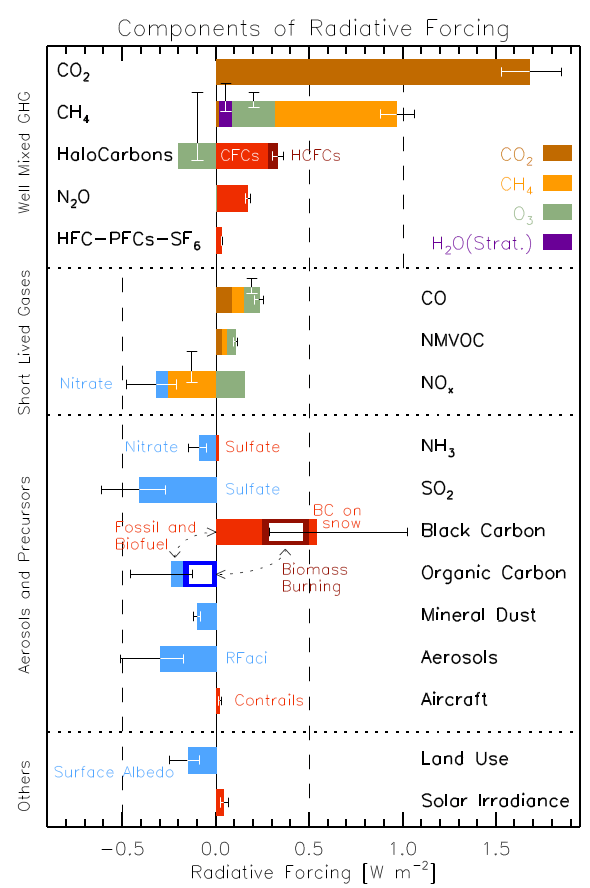
Why is the solar irradiance effect so tiny? Note that Total Solar Irradiance, or TSI, is also known as “the solar constant.” When solar activity ramps up and down from throwing wild solar flares to sleeping like a baby, TSI hardly varies a whit. That’s where the name comes from. While solar activity varies tremendously, solar irradiance remains almost constant.
This slight change in the solar radiation that shines on our planet is known to be too small an energy variation to explain any substantial change in temperature. In particular, it can’t begin to account for anything near to half of all past temperature change. It can’t begin to account for the large solar effect on climate that is evidenced in the geologic record.
Implication: some other solar effect besides TSI must also be at work. One of the solar variables that does vary when solar activity ramps up and down, like solar wind pressure, must be having some effect on climate, and this is certainly plausible. We in-effect live inside of the sun’s extended corona. When the solar wind is going full blast the earth’s immediate external environment is rather different than when the solar wind is down, and even if we don’t know the mechanism, we have powerful evidence that some solar effect other than the slight variation in TSI is driving global temperature.
This is what the IPCC admits in the Second Order Draft of AR5, which now includes the sentence in bold below (page 7-43, lines 1-4, emphasis added):
Many empirical relationships have been reported between GCR or cosmogenic isotope archives and some aspects of the climate system (e.g., Bond et al., 2001; Dengel et al., 2009; Ram and Stolz, 1999). The forcing from changes in total solar irradiance alone does not seem to account for these observations, implying the existence of an amplifying mechanism such as the hypothesized GCR-cloud link. We focus here on observed relationships between GCR and aerosol and cloud properties.
Sherwood’s response is to consider only one possible mechanism of solar amplification. He looks at the evidence for Henrik Svensmark’s proposed GCR-cloud mechanism and judges that the forcing effect from this particular mechanism would be small, then concludes that a greater role for the sun in global warming is “ridiculous.”
Hey Sherwood, read the added sentence again. It says that the evidence implies the existence of “an amplifying mechanism.” Presenting an argument against a particular possible mechanism does not in any way counter the report’s new admission that some such mechanism must be at work. (Guess he didn’t author that sentence eh? Since he doesn’t even know what it says.)
Sherwood is trying to use theory—his dissatisfaction with a particular theory of how solar amplification might work—to dismiss the evidence that some mechanism of solar amplification must be at work. The bad professor is inverting the scientific method, which requires that evidence always trump theory. If evidence gives way to theory it is not science. It is anti-science. It is the exact opposite of science.
The new sentence was added specifically to avoid the criticism that the authors were inverting the scientific method
My submitted comments on the First Order Draft ripped the authors up and down for inverting the scientific method. They were all doing what Sherwood is doing now. Here is the same passage from the FOD. It lacks the added sentence, but otherwise is almost identical (FOD page 7-50, lines 50-53):
“Many empirical relationships or correlations have been reported between GCR or cosmogenic isotope archives and some aspects of the climate system, such as SSTs in the Pacific Ocean (Meehl et al., 2009), some reconstruction of past climate (Kirkby, 2007) or tree rings (Dengel et al., 2009). We focus here on observed relationships between GCR and aerosol- and cloud-properties.”
The first sentence here, citing unspecified “empirical relationships” between cosmogenic isotopes (a proxy for solar activity) and “some aspects of the climate system” is the only reference in the entire report to the massive evidence for a solar driver of climate. Not a word about the magnitude of the correlations found, nothing about how these correlations are much too strong to possibly be explained by the slight variance in solar irradiance alone, and almost nothing (“many”) about the sheer volume of studies that have found these correlations. And that’s it: one oblique sentence, then the report jumps immediately to looking at the evidence for one proposed mechanism by which solar amplification might be occurring.
The evidence for that particular mechanism is judged (very prematurely) to indicate a weak effect, and this becomes the implicit rationale for the failure of the IPCC’s computer models to include any solar variable but TSI. Readers of the FOD have no idea about the mountain of evidence for some solar driver of climate that is stronger than TSI because the report never mentions it. A couple of the citations that were included mention it (in particular, Kirkby 2007, which is a survey paper), but the report itself never mentions it, and the report then goes on to ignore this evidence entirely. The enhanced solar forcing effect for which there is so much evidence is completely left out of all subsequent analyses.
In other words, the inversion of the scientific method is total. In the FOD, the authors used their dissatisfaction with the GCR-cloud theory as an excuse for completely excluding the vast evidence that some mechanism of enhanced solar forcing is at work. Theory was allowed to completely obliterate and remove a whole mountain of evidence. “Pure definitional anti-science,” I charged.
At least one of the co-authors seems to have decided that this was a bridge too far and added the sentence acknowledging the evidence that some mechanism of solar amplification must be at work. The added sentence declares in-effect, “no, we are not inverting the scientific method.” They are no longer using their dissatisfaction with a particular theory of how enhanced solar forcing might work as a ruse to pretend that the evidence for some such mechanism does not exist.
So good for them. In the sea of IPCC dishonesty there is a glimmer of honesty, but it doesn’t go very far. TSI is still the only solar effect that is included in the “consensus” computer models and the IPCC still uses this garbage-in claim to arrive at their garbage-out conclusion that observed warming must be almost entirely due to the human release of CO2.
One of the reason I decided to release the SOD was because I knew that once the Steven Sherwoods at the IPCC realized how the added sentence undercut the whole report they would yank it back out, and my submitted comments insured that they would indeed realize how the added sentence undercut the whole report. Now sure enough, as soon as I make the added sentence public Steven Sherwood publicly reverts to the FOD position, trying to pretend that his argument against one proposed mechanism of solar amplification means that we can safely ignore the overwhelming evidence that some such mechanism is at work.
We’ll find out in a year or so whether his co-authors are willing to go along with this definitional anti-science. Evidently there is at least some division. With Sherwood speaking up for the FOD position, any co-authors who prefer the new position should feel free to speak up as well. Come on real scientists, throw this blowhard under the bus!
In any case, it is good to have all of them stuck between a rock and a hard place. They can invert the scientific method and be exact definitional anti-scientists like Steven Sherwood, or they can admit that no one can have any confidence in the results of computer models where the only solar forcing is TSI, not after they have admitted strong evidence for some mechanism of solar forcing beyond TSI. That admission is a game changer, however much Sherwood wants to deny it.
He piles on with more of the same at the ridiculous “DeSmog Blog” (as if CO2 is “smog”), and is quoted front and center by the even more ridiculous Andrew Sullivan. Sherwood has become the go-to guy for the anti-science left.
The two dozen references documenting strong correlations between solar activity and various climate indicies
Jo wanted to include references so I sent along the list of citations that I had included in my FOD comment. Worth seeing again I think:
Bond et al. 2001, “Persistent Solar Influence on North Atlantic Climate During the Holocene,” Science.
Excerpt from Bond: “Over the last 12,000 years virtually every centennial time scale increase in drift ice documented in our North Atlantic records was tied to a distinct interval of variable and, overall, reduced solar output.”
Neff et al. 2001, “Strong coherence between solar variability and the monsoon in Oman between 9 and 6 kyr ago,” Nature.
Finding from Neff: Correlation coefficients of .55 and .60.
Usoskin et. al. 2005, “Solar Activity Over the Last 1150 years: does it Correlate with Climate?” Proc. 13th Cool Stars Workshop.
Excerpt from Usoskin: “The long term trends in solar data and in northern hemisphere temperatures have a correlation coefficient of about 0.7 — .8 at a 94% — 98% confidence level.”
Shaviv and Veizer, 2003, “Celestial driver of Phanerozoic climate?” GSA Today.
Excerpt from Shaviv: “We find that at least 66% of the variance in the paleotemperature trend could be attributed to CRF [Cosmic Ray Flux] variations likely due to solar system passages through the spiral arms of the galaxy.” [Not strictly due to solar activity, but implicating the GCR, or CRF, that solar activity modulates.]
Plenty of anti-CO2 alarmists know about this stuff. Mike Lockwood and Claus Fröhlich, for instance, in their 2007 paper: “Recent oppositely directed trends in solar climate forcings and the global mean surface air temperature” (Proc. R. Soc. A), began by documenting how “[a] number of studies have indicated that solar variations had an effect on preindustrial climate throughout the Holocene.” In support, they cited 17 papers, the Bond and Neff articles from above, plus:
Davis & Shafer 1992; Jirikowic et al. 1993; Davis 1994; vanGeel et al. 1998; Yu&Ito 1999; Hu et al. 2003; Sarnthein et al. 2003; Christla et al. 2004; Prasad et al. 2004; Wei & Wang 2004; Maasch et al. 2005; Mayewski et al. 2005; Wang et al. 2005a; Bard & Frank 2006; and Polissar et al. 2006.
The correlations in most of these papers are not directly to temperature. They are to temperature proxies, some of which have a complex relationship with temperature, like Neff 2001, which found a correlation between solar activity and rainfall. Even so, the correlations tend to be strong, as if the whole gyre is somehow moving in broad synchrony with solar activity.
Some studies do examine correlations between solar activity proxies and direct temperature proxies, like the ratio of Oxygen18 to Oxygen16 in geologic samples. One such study (highlighted in Kirkby 2007) is Mangini et. al. 2005, “Reconstruction of temperature in the Central Alps during the past 2000 yr from a δ18O stalagmite record.”
Excerpt from Mangini: “… a high correlation between δ18O in SPA 12 and D14C (r =0.61). The maxima of δ18O coincide with solar minima (Dalton, Maunder, Sporer, Wolf, as well as with minima at around AD 700, 500 and 300). This correlation indicates that the variability of δ18O is driven by solar changes, in agreement with previous results on Holocene stalagmites from Oman, and from Central Germany.”
And that’s just old stuff. Here are four random recent papers.
Ogurtsov et al, 2010, “Variations in tree ring stable isotope records from northern Finland and their possible connection to solar activity,” JASTP.
Excerpt from Ogurtsov: “Statistical analysis of the carbon and oxygen stable isotope records reveals variations in the periods around 100, 11 and 3 years. A century scale connection between the 13C/12C record and solar activity is most evident.”
Di Rita, 2011, “A possible solar pacemaker for Holocene fluctuations of a salt-marsh in southern Italy,” Quaternary International.
Excerpt from Di Rita: “The chronological correspondence between the ages of saltmarsh vegetation reductions and the minimum concentration values of 10Be in the GISP2 ice core supports the hypothesis that important fluctuations in the extent of the salt-marsh in the coastal Tavoliere plain are related to variations of solar activity.”
Raspopov et al, 2011, “Variations in climate parameters at time intervals from hundreds to tens of millions of years in the past and its relation to solar activity,” JASTP.
Excerpt from Raspopov: “Our analysis of 200-year climatic oscillations in modern times and also data of other researchers referred to above suggest that these climatic oscillations can be attributed to solar forcing. The results obtained in our study for climatic variations millions of years ago indicate, in our opinion, that the 200- year solar cycle exerted a strong influence on climate parameters at those time intervals as well.”
Tan et al, 2011, “Climate patterns in north central China during the last 1800 yr and their possible driving force,” Clim. Past.
Excerpt from Tan: “Solar activity may be the dominant force that drove the same-phase variations of the temperature and precipitation in north central China.”
Saltmarshes, precipitation, “oscillations.” It’s all so science-fair. How about something just plain scary?
Solheim et al. 2011, “The long sunspot cycle 23 predicts a significant temperature decrease in cycle 24,” submitted astro-ph.
Excerpt from Solheim: “We find that for the Norwegian local stations investigated that 30-90% of the temperature increase in this period may be attributed to the Sun. For the average of 60 European stations we find ≈ 60% and globally (HadCRUT3) ≈ 50%. The same relations predict a temperature decrease of ≈ 0.9°C globally and 1.1−1.7°C for the Norwegian stations investigated from solar cycle 23 to 24.”
Those two dozen there are just the start. Scafetta hasn’t even been mentioned. (Sorry Nicola.) But there is a lot in those 24.
Whew! I’m tired, so I’ll pack it in for the night to rest up to read THIS debate carefully. It looks like a dandy. Only on WUWT. G’night.
lsvalgaard says:
December 16, 2012 at 8:50 pm
Susan Fraser says:
December 16, 2012 at 8:21 pm
What about the new understanding of how the Van Allen belts work? Could this be another natural climate driver?
No, we just have a better understanding of how the belts are formed and maintained. This does not help on what effect [if any] they have. The Dst index which describes the currents in the belts goes back more than a century, and that has not changed.
Van Allen discovered them in 1958 And not a century ago http://blogs.smithsonianmag.com/history/2012/08/going-nuclear-over-the-pacific/ They got more then they barganed for with Star-fish prime Scientist got it wrong big time, just goes to show a theory isn’t worth the paper it’s written on until it’s put into practice were the results are concluded .
Here’s a thought, When NASA calls of a shuttle launch because of bad weather Is it because of what we see from the ground or is it the conection to bad weather at ground level and the levels off radiation in the Van Allen Belts ? And I wounder if they use HAARP to open a hole ?
Since the solar spectrum seems to be the greatest bit of variability, I wonder if how dependent ocean absorption is on spectrum. For example, does Ultraviolet penetrate to a deeper depth than visible? Does more UV get absorbed than visible? Vice versa? Is there a correlation in spectral changes and magnetic flux changes? For example, a slight decrease in cloud cover combined with a slight increase in absorption might impact climate in a measurable way even if TSI is constant.
ferd berple says:
December 16, 2012 at 9:56 pm
It has varied quite a bit in the parameters you have not mentioned and perhaps even more in the parameters you have not measured and are not even aware of.
Such as?
The crux of the matter is that you and and every scientists on earth know very little about the sun.
But the sun nuts that push the sun as the cause of climate change, seem to know enough to do so, or do they push the sun without knowing anything about it? Would you call THAT science; ascribing something to an unknown mechanism operating on stuff we don’t know anything about.
jmorpuss says:
December 16, 2012 at 10:23 pm
“he Dst index which describes the currents in the belts goes back more than a century, and that has not changed.”
Van Allen discovered them in 1958 And not a century ago
But the currents and magnetic effects on the ground have been known and monitored for more than a century, and that is the important bit. Van Allen discovered the belts of particles that was already long before thought to exist.
Steven Mosher says:
December 16, 2012 at 7:53 pm
“Nobody wants to propose and live by a test of their ideas.”
There is one; Henrik Svensmark.
Interesting that the author claims that some scientists are making an “appeal to authority” and then cites a (debunked) article in that renowned peer reviewed journal “The Daily Mail” in support of his own arguments.
True scientist: “If there is a correlation, there may be a mechanism that explains it. If we don’t understand this mechanism; let’s try to find it — isn’t this what science is all about?”
Leif Svalgaard: “If I don’t understand a mechanism of correlation, it doesn’t exist. And there is no correlation. Anybody who sees a correlation in a correlation is a nut. Period. Science is what the textbook says. Not in the textbook, out of mind. Everybody who thinks differently is a nut. Because I am The Self-Appointed Foremost Solar Scientist in the world. To prove it, I have hundreds of links to My Own Impeccable Graphs and Plots Impeccably Interpreted by Myself. Nuts to you!”
So if you can not propose a mechanism to drive the theory based on direct observations, one needs to “shutup about it”
I seem to remember another argument similar to this in the 1500’s. Something about orbits.
As a mechanism could not be shown to drive the orbits as observed, One was told to “shutup about it”!
Steven Mosher says:
December 16, 2012 at 7:53 pm
“…Here you see a common error that get repeated over and over again in solar papers. There are an infinite number of climate variables and combinations thereof. They select ( who knows how) looking at temperatures in Norway, and Europe. They start to play with solar cycle length data. They canvas various ways others have looked for correlations and failed to find them. various ways of smoothing the data, not smoothing, all of these are bites at the statistical apple. Through a variety a decisions ( all untested ) then happen upon a relationship between one particular manipulation of a solar parameter (cycle length) and another selection of climate parameter. That is neither good faith or bad faith. That is hunting for a relationship until you find one. …”
—————————————
That is uninformed nonsense.
1. lsvalgaard wrote at December 16, 2012 at 3:29 pm exactly the opposite:
“And there are not that many proxies of solar activity. Everybody uses the same ones or obsolete [and perhaps carefully picked] versions of same.”
2. And beyond that these peaks are not local, they can be seen at various places around the world at the same time.
Source is this German TV discussion with Prof. Mangini, from Heidelberg University
http://www.phoenix.de/sixcms/detail.php?id=138001&template=d_ph_videostream_popup&format=4&transfer=2
I have translated the relevant parts:
Mangini:
Beyond that, there is an effect such as the natural climate variability, as we see from our archives for the last thousands of years.
And this natural climate variability is, according to the material I research, much bigger than I read or see from these IPCC reports, that means, there is larger natural variability than reported there. Natural climate variability is variability without any changes of CO2 in the atmosphere.
What I do not like in this IPCC report is, that it generates the impression, that we already understand the climate and we do not.
I can tell you, we do have a project just started with the DFG (Deutsche Forschungsgemeinschaft) and the project’s name is Interdynamic [or similar could not understand it well].
It is an Emphesis Project (Schwerpunktprojekt) with almost all German climate scientists oder geologists who work on climate issues, and it is about understanding the varaibility in the Holocene in the last 10000 years and the causes for this variability. Other main issues are understanding the archeological consequences of this variability on our anchestors.
Question: So you say we did have warmer times and colder times within those 10000 years ?
Mangini: Yes, what we see from our data is indeed, that within 300 years it can go up and down, relatively or very fast, and there is variability in the temperature between 1 and 3 degrees, and I am very conservative here, it may well be within that range.
Rahmstorf interrupting: locally
Mangini: No, it is not local. We see this from the Alps up to Norway, all correlated and synchronous.
Rahmstorf interruptung: This is local for me.
Mangini: North-Atlantic synchronous, China synchronous, Chile synchronous, they are all synchronous, this is the great thing about stalagmites, because, as we can date them so well, we really see those peaks happening at all places at the same time.
We have been working for about 10-15 years intensively on stalagmites and we even got now a research group from the DFG in Heidelberg to extract precipitation and temperature from stalagmites from the signals we see in them.
Stalagmites grow layer upon layer and every layer is approximately 1 year and you can, if you measure the stable isotopes in a stalagmite, extract a formation over the growth period of a stalagmite. Stalagmites can be dated very well, there a many stalagmites, spread over all continents and these are very beautiful archives.
Many comments mention lag between solar input and temperature changes. Principal lag that can be defined is 15 years, and it is lag between Arctic atmospheric pressure and the equatorial & mid latitude Atlantic’s SST.
http://www.vukcevic.talktalk.net/NAO-AMO-GSO.htm
The above lag equates to the lag between the earth’s Core Angular Momentum changes and changes in the LOD (paper by Hide and Dickey on torsional oscillations of the Earth’s core-mantle system)
http://trs-new.jpl.nasa.gov/dspace/bitstream/2014/13763/1/00-0133.pdf
This points directly to geomagnetic input into Arctic disturbing the Earth’s field and trough fluid dynamics is fed back into oceans, mainly the Atlantic.
The above delay gives a certain degree of predictability,which indicates a downturn in the N. Atlantic SST and consequently N. Hemisphere’s temperatures:
http://www.vukcevic.talktalk.net/Fc.htm
Judging by the article and comments over at skepci I would say that there is some deep discomfort amongst the ordinarily certain. The approach there has been to shift the whole focus away from “even though we aren’t sure of the mechanism the sun is having a climatic effect on Earth” to debating Svensmark in a great amount of detail. Plus of course all the usual ad hom stuff.
For a site that calls itself skeptical it is quite odd that they have no wish to even puzzle about what the amplifying effect could be. In fact they just offer a blunt rejection of any solar effect. A bit sad really as Dana just opines that the offending sentence will be removed in due course.
There are several models reported by the IPCC.
Time for a meta analysis and combine the studies into one, and compare against the actual.
1. The uncertainty is reduced because the variance will be reduced.
2. Even better, it shows the consensus. Can’t argue with the consensus can we?
Ho hum, even more a scientific disaster.
Theory, predict, test, and fail.
“But the sun nuts that push the sun as the cause of climate change, seem to know enough to do so, or do they push the sun without knowing anything about it? Would you call THAT science; ascribing something to an unknown mechanism operating on stuff we don’t know anything about.”
Lsvalgaard, there’s nothing wrong with noticing and studying correlations between various ‘proxies’ for solar activity and global climate and even speculating about the mechanisms. I thought that it’s not controversial that the various cold periods of the last ~1000 years are associated with the periods of lower solar activity (minimums called Oort, Wolf, Spörer, Maunder…). There’s also the modern maximum, do you dispute that?
The average solar cycle frequency was much lower (longer average cycle) in the 19th century than in the 20th century (shorter average cycle). Now the frequency started decreasing again – after the two very strong/short cycles (21 and 22), the frequency dropped and SC 23 was much longer (~12.5 years). The SC 24 seems to be very weak too, will probably end up even longer than SC 23. The warming stopped and the scene seems to be set for very rapid cooling. I think the cooling is VERY likely and it will kick in properly at the latest after the SC 24 starts declining (~2014/15). Let’s see who will be right.
lsvalgaard says:
December 16, 2012 at 2:28 pm
“So the Sun has not varied enough to cause a significant climate influence, regardless of all the papers mentioned.”
Is it just me on this blog who is getting REALLY bored with this mantra, expressed ad nausiam, that implies that ‘since I know everything there is to know about the subject, there cannot be anything going on if I don’t understand it’ ?
Just goes to strengthen my own fundamental wariness of too many formal qualifications and too widely held repute.
May I suggest in my humble ignorance, having intently watched this and many similar debates unfold, that, whatever Dr Svalgaard may contend, there is stuff going on that he does not understand. Power to those with minds sufficiently open to explore.
I have to say: When I submit a scientific paper for publication and one of the reviewers misunderstands my meaning for a key point, what do I do? (This has happened to me and it’s a common occurrence). Of course, I work hard on the revised paper to be absolutely clear. Right now Rawls is arguing with Sheffield (the author) about the meaning of what Sheffield wrote. You have to admit that the summary and conclusions clearly say that solar variation is small to have caused the recent increase in the earth’s temperature.
Normally, a reviewer, such as Rawls, would simply point out in his review for the authors that he found a contradiction between a section of the text and the stated conclusions. It’s now the author’s (Sheffield’s) obligation to make sure that the possible confusion,ambiguity and/or error is fixed for the final draft. Recent estimates of solar forcing are small and do not correspond with recent warming–at least that is what recent scientific publications say. Just disagreeing in a blog is meaningless. You need to present data in a peer-reviewed scientific article. He said, she said kind of arguments are meaningless in science. You have to reanalyze the original publications and, if necessary, the original data.
Ok. Reading further down the comments I note that I am seemingly not alone in my frustration. Others have waxed more eloquently…
Total Mass Retain says:
December 16, 2012 at 11:50 pm
“Interesting that the author claims that some scientists are making an “appeal to authority” and then cites a (debunked) article in that renowned peer reviewed journal “The Daily Mail” in support of his own arguments.”
You patently cannot look past your prejudice and even read and comprehend the content of the article in the Mail. The article cites the data contained in HadCRUT4 and it is that to which the author is referring. You and your colleagues will not even start to sway me to your position in this debate until you cease and desist from such infantile soundbites and back up you claims with facts.
RES
BillD:
Having read your post at December 17, 2012 at 3:27 am I conclude that it says only two things; viz.
1. Information does not exist unless it is published in a peer-reviewed paper.
and
2. Therefore, Rawl’s criticism does not exist so the AR5 can be amended to ensure his point is not included.
Please confirm that I have understood you or, alternatively, correct my understanding, because what I understand to be your two points are each a denial of science.
Richard
Edim says:
December 17, 2012 at 2:54 am
There’s also the modern maximum, do you dispute that?
As a matter of fact, yes. http://www.leif.org/research/The%20long-term%20variation%20of%20solar%20activity.pdf
For a layman it is rather involved, but I conclude that since “the science is settled” there is no room for any uncertainty. As the science is not settled after all, it is an omission for the IPCC not to explore vigorously any alternative explanation of the warming to 1998 and the standstill since then. Imagine the mayhem if the IPCC issue an AGW loaded AR5 in 2014 (?) and temperatures have continued to flatten out to 17 or 18 years length. This would effectively prove that Santer’s 17 years are up and the CO2 thesis as driver of AGW has been falsified. Imagine if concurrently Santer issues a hastily peer reviewed paper pushing the natural variation limit out to 20 or 22 years to keep the AGW “circus” going for another few years in the hope at there will be warming again (and more importantly) acceleration to that warming to get near the 3 degrees C by the end of the century. Interesting times ahead. Personally I have difficulties in understanding that the Sun can be so constant in its effect on Mother Earth over centuries and longer as claimed by IPCC but that is just a “gut” feeling.
taxed says:
December 16, 2012 at 4:49 pm
“2 The more there is a increase in the wave movement of the jet to the north and the south, the better it is at moving both warm and cold air between the poles and the tropics.”
It is my understanding that the movement of the jet stream north and south is the RESULT of the battle between cold and warm air masses and therefore is not the cause of such movement. Please correct me if that is wrong.
Why is there never a discussion about Hadley Cell circulation? Isn’t that the major cause of surface climate differences?
Total Mass Retain says:
December 16, 2012 at 11:50 pm
“Interesting that the author claims that some scientists are making an “appeal to authority” and then cites a (debunked) article in that renowned peer reviewed journal “The Daily Mail” in support of his own arguments.”
OK, don’t listen to the Daily Mail, don’t listen to The Guardian, don’t listen to Skeptical Science, don’t listen to WUWT, don’t listen to anybody’s opinion. Opinion is irrelevant when the data is readily available and you can decide for yourself. Here’s a link to a tool hosted by an impartial website that will plot graphs from whatever time series you input and from whatever data source you choose (HADCRUT, BEST, etc). So you can analyse the data yourself. It does seem that the temperatures have stopped increasing, but don’t listen to me, investigate yourself.
http://www.woodfortrees.org/plot/
I was reading an article that graphed the current temperature data. The article was from the early 1970s. In that article the temperature at the end of the period was just slightly warmer than the early 1900s. In addition, there was no UHI effect contemplated at that time. Therefore, it is distinctly possible that the 20th century really wasn’t all that much warmer than the 19th. So, Leif may be correct, but instead of supporting the idea that the Sun has little effect it leaves the question open.
Without all the temperature adjustments it’s very possible the 1930s were just as warm as the 2000s and we are likely to start cooling exactly like it did 60-70 years ago. However, since the Sun is behaving differently we will have a great opportunity to discover whether that makes a difference. If it’s gets a lot cooler than I think the question will have been answered. Especially for those who believe CO2 provides at least a little warming.
BillD
It is through the blogosphere that the shoddy science of the Sheffield’s gets demolished. I”m sure you are aware of Climate Audit and the others. Peer review does not work in climate science except as a filter to admit pro-AGW studies and screen out contrary views. So the normal scientific process is perverted in climate science. I quote you:
“Just disagreeing in a blog is meaningless. You need to present data in a peer-reviewed scientific article. He said, she said kind of arguments are meaningless in science. You have to reanalyze the original publications and, if necessary, the original data.”
You are full of it. The pretense of using tree rings as a viable paleo-temperature proxy has been demolished on blogs, not in the peer reviewed literature. This demolishment is an accomplished fact and such studies are now being abandoned except by the die-hards. Blogs have been the force that have exposed the dubious science that underpins the whole of AGW theory, and allows the issues to be aired. Most climate scientists share an ideological motive and are incapable of conducting a critical review of their comrade’s studies. The blogs have corrected this glaring deficiency of climate science.
And ” reanalyze….. the original data.” must be a joke. Where were you when Steve McIntyre and others tried to obtain original data? Have you not heard of the notorious FOI battles or Climategate?