Teaming up with Jo Nova to answer The Team down under: “Professor Sherwood is inverting the scientific method”
Guest post by Alec Rawls
My leak of the draft IPCC report emphasized the chapter 7 admission of strong evidence for solar forcing beyond the very slight variance in solar irradiance, even if we don’t know the mechanism:
The forcing from changes in total solar irradiance alone does not seem to account for these observations, implying the existence of an amplifying mechanism such as the hypothesized GCR-cloud link.
One of the fifteen lead authors of chapter 7 responded that the evidence for one of the proposed mechanisms of solar amplification, GCR-cloud, indicates a weak effect, and proceeded as if this obviated the IPCC’s admission that some such mechanism must be having a substantial effect:
[Professor Steven Sherwood] says the idea that the chapter he authored confirms a greater role for solar and other cosmic rays in global warming is “ridiculous”.
“I’m sure you could go and read those paragraphs yourself and the summary of it and see that we conclude exactly the opposite – that this cosmic ray effect that the paragraph is discussing appears to be negligible,” he told PM.
Sherwood uses theory—his dissatisfaction with one theory of how solar amplification might work—to ignore the (admitted) evidence for some mechanism of solar amplification. Putting theory over evidence is not science. It is the exact definitional opposite of science (see Feynman snippet above).
Since Sherwood is Australian, it seemed a visit Down Under was due, so Jo Nova and I teamed up to issue a reply on her website.
Jo knows Sherwood
Here is Jo Nova’s take on Sherwood’s shenanigans:
The IPCC are now adding citations of critics (so they can’t be accused of ignoring them completely), but they bury the importance of those studies under glorious graphic art, ponderous bureacrat-speak, and contradictory conclusions.
When skeptics point out that the IPCC admit (in a hidden draft) that the solar magnetic effect could change the climate on Earth, the so-called Professors of Science hit back — but not with evidence from the atmosphere, but with evidence from other paragraphs in a committee report. It’s argument from authority, it’s a logical fallacy that no Professor of Science should ever make. Just because other parts of a biased committee report continue to deny the evidence does not neutralize the real evidence.
Alec Rawls pulls him up. Sherwood calls us deniers, but the IPCC still denies solar-magnetic effects that have been known for 200 years. This anti-science response is no surprise from Sherwood, who once changed the colour of “zero” to red to make it match the color the models were supposed to find. (Since when was red the color of no-warming? Sure you can do it, but it is deceptive.) That effort still remains one of the most egregious peer reviewed distortions of science I have ever seen. — Jo
Earlier this week Nova posted about Sherwood’s glowing support for recent claims that the IPCC’s predictions of global warming have been accurate. Obviously Sherwood needs to take a closer look at the Second Order Draft which, in particular the following graph (SOD figure 1.4 on page 1-39, with a hat tip to Anthony):

Absolutely NOT falsified says Sherwood, but guess what he thinks IS falsified?
Steve Sherwood, Co-Director, Climate Change Research Centre at the University of New South Wales said the paper showed “that if you take natural year-to-year variability into account in any reasonable way, the predictions are as close as one could reasonably expect.”
“Those who have been claiming ad nauseum that the climate models have been proved wrong, should read this paper, even though for most of us it is not very surprising,” said Dr Sherwood, who was not involved in the Nature Climate Change paper.
“Though there is no contrarian analogue to the IPCC, individual contrarians have made predictions over a similar time frame that the warming would stop or reverse. The data since then have probably falsified many of those predictions (which the deniers continue to make today).”
Predictions that warming would stop have been falsified? By what? By the fact that, according to HadCRUT4, there has been no statistically significant warming for 16 years? Falsification in Steve Sherwood’s dictionary: “whatever preserves Steve Sherwood’s presumptions.” Just what we’d expect from a definitional anti-scientist.
My own response to Sherwood gets into the back-story on the Second Order Draft. Readers might be interested to know that the SOD admission of substantial evidence for solar amplification seems to be in response to my submitted comments on the FOD. I had charged them with, you guessed it, inverting the scientific method. That’s why Sherwood, in pretending that the new admission never happened, is also inverting the scientific method. He’s reverting to the FOD position. Well, some of his co-authors are apparently not willing to go there any more, and hopefully they will speak out.
My guest post at Jo Nova’s:
Professor Steven Sherwood inverts the scientific method: he is an exact definitional anti-scientist
My submitted comments on the First Order Draft of AR5 accused the IPCC of committing what in statistics is called “omitted variable fraud.” As I titled my post on the subject: “Vast evidence for solar climate driver rates one oblique sentence in AR5.”
How vast is the evidence? Dozens of studies have found between a .4 and .7 degree of correlation between solar activity and various climate indices going back many thousands of years, meaning that solar activity “explains” in the statistical sense something like half of all past temperature change (citations at the link above).
Solar activity was at “grand maximum” levels from 1920 to 2000 (Usoskin 2007). Might this explain a substantial part of the unexceptional warming of the 20th century? Note also that, with the sun having since dropped into a state of profound quiescence, the solar-warming theory can also explain the lack of 21st century warming while the CO2-warming theory cannot.
Now take a look the radiative forcing table from any one of the IPCC reports, where the explanatory variables that get included in the IPCC computer models are laid out. You will see that the only solar forcing effect listed is “solar irradiance.” In AR5 this table is on page 8-39:
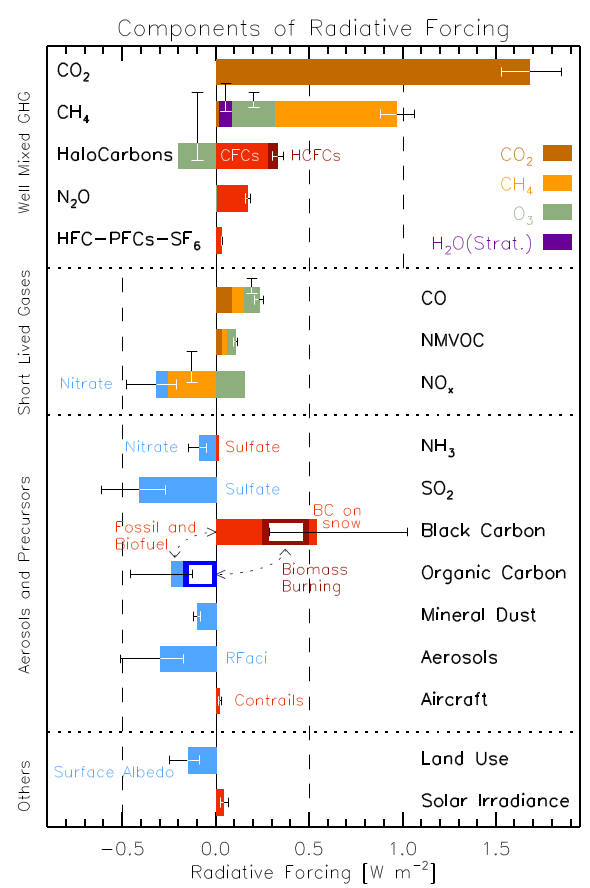
Why is the solar irradiance effect so tiny? Note that Total Solar Irradiance, or TSI, is also known as “the solar constant.” When solar activity ramps up and down from throwing wild solar flares to sleeping like a baby, TSI hardly varies a whit. That’s where the name comes from. While solar activity varies tremendously, solar irradiance remains almost constant.
This slight change in the solar radiation that shines on our planet is known to be too small an energy variation to explain any substantial change in temperature. In particular, it can’t begin to account for anything near to half of all past temperature change. It can’t begin to account for the large solar effect on climate that is evidenced in the geologic record.
Implication: some other solar effect besides TSI must also be at work. One of the solar variables that does vary when solar activity ramps up and down, like solar wind pressure, must be having some effect on climate, and this is certainly plausible. We in-effect live inside of the sun’s extended corona. When the solar wind is going full blast the earth’s immediate external environment is rather different than when the solar wind is down, and even if we don’t know the mechanism, we have powerful evidence that some solar effect other than the slight variation in TSI is driving global temperature.
This is what the IPCC admits in the Second Order Draft of AR5, which now includes the sentence in bold below (page 7-43, lines 1-4, emphasis added):
Many empirical relationships have been reported between GCR or cosmogenic isotope archives and some aspects of the climate system (e.g., Bond et al., 2001; Dengel et al., 2009; Ram and Stolz, 1999). The forcing from changes in total solar irradiance alone does not seem to account for these observations, implying the existence of an amplifying mechanism such as the hypothesized GCR-cloud link. We focus here on observed relationships between GCR and aerosol and cloud properties.
Sherwood’s response is to consider only one possible mechanism of solar amplification. He looks at the evidence for Henrik Svensmark’s proposed GCR-cloud mechanism and judges that the forcing effect from this particular mechanism would be small, then concludes that a greater role for the sun in global warming is “ridiculous.”
Hey Sherwood, read the added sentence again. It says that the evidence implies the existence of “an amplifying mechanism.” Presenting an argument against a particular possible mechanism does not in any way counter the report’s new admission that some such mechanism must be at work. (Guess he didn’t author that sentence eh? Since he doesn’t even know what it says.)
Sherwood is trying to use theory—his dissatisfaction with a particular theory of how solar amplification might work—to dismiss the evidence that some mechanism of solar amplification must be at work. The bad professor is inverting the scientific method, which requires that evidence always trump theory. If evidence gives way to theory it is not science. It is anti-science. It is the exact opposite of science.
The new sentence was added specifically to avoid the criticism that the authors were inverting the scientific method
My submitted comments on the First Order Draft ripped the authors up and down for inverting the scientific method. They were all doing what Sherwood is doing now. Here is the same passage from the FOD. It lacks the added sentence, but otherwise is almost identical (FOD page 7-50, lines 50-53):
“Many empirical relationships or correlations have been reported between GCR or cosmogenic isotope archives and some aspects of the climate system, such as SSTs in the Pacific Ocean (Meehl et al., 2009), some reconstruction of past climate (Kirkby, 2007) or tree rings (Dengel et al., 2009). We focus here on observed relationships between GCR and aerosol- and cloud-properties.”
The first sentence here, citing unspecified “empirical relationships” between cosmogenic isotopes (a proxy for solar activity) and “some aspects of the climate system” is the only reference in the entire report to the massive evidence for a solar driver of climate. Not a word about the magnitude of the correlations found, nothing about how these correlations are much too strong to possibly be explained by the slight variance in solar irradiance alone, and almost nothing (“many”) about the sheer volume of studies that have found these correlations. And that’s it: one oblique sentence, then the report jumps immediately to looking at the evidence for one proposed mechanism by which solar amplification might be occurring.
The evidence for that particular mechanism is judged (very prematurely) to indicate a weak effect, and this becomes the implicit rationale for the failure of the IPCC’s computer models to include any solar variable but TSI. Readers of the FOD have no idea about the mountain of evidence for some solar driver of climate that is stronger than TSI because the report never mentions it. A couple of the citations that were included mention it (in particular, Kirkby 2007, which is a survey paper), but the report itself never mentions it, and the report then goes on to ignore this evidence entirely. The enhanced solar forcing effect for which there is so much evidence is completely left out of all subsequent analyses.
In other words, the inversion of the scientific method is total. In the FOD, the authors used their dissatisfaction with the GCR-cloud theory as an excuse for completely excluding the vast evidence that some mechanism of enhanced solar forcing is at work. Theory was allowed to completely obliterate and remove a whole mountain of evidence. “Pure definitional anti-science,” I charged.
At least one of the co-authors seems to have decided that this was a bridge too far and added the sentence acknowledging the evidence that some mechanism of solar amplification must be at work. The added sentence declares in-effect, “no, we are not inverting the scientific method.” They are no longer using their dissatisfaction with a particular theory of how enhanced solar forcing might work as a ruse to pretend that the evidence for some such mechanism does not exist.
So good for them. In the sea of IPCC dishonesty there is a glimmer of honesty, but it doesn’t go very far. TSI is still the only solar effect that is included in the “consensus” computer models and the IPCC still uses this garbage-in claim to arrive at their garbage-out conclusion that observed warming must be almost entirely due to the human release of CO2.
One of the reason I decided to release the SOD was because I knew that once the Steven Sherwoods at the IPCC realized how the added sentence undercut the whole report they would yank it back out, and my submitted comments insured that they would indeed realize how the added sentence undercut the whole report. Now sure enough, as soon as I make the added sentence public Steven Sherwood publicly reverts to the FOD position, trying to pretend that his argument against one proposed mechanism of solar amplification means that we can safely ignore the overwhelming evidence that some such mechanism is at work.
We’ll find out in a year or so whether his co-authors are willing to go along with this definitional anti-science. Evidently there is at least some division. With Sherwood speaking up for the FOD position, any co-authors who prefer the new position should feel free to speak up as well. Come on real scientists, throw this blowhard under the bus!
In any case, it is good to have all of them stuck between a rock and a hard place. They can invert the scientific method and be exact definitional anti-scientists like Steven Sherwood, or they can admit that no one can have any confidence in the results of computer models where the only solar forcing is TSI, not after they have admitted strong evidence for some mechanism of solar forcing beyond TSI. That admission is a game changer, however much Sherwood wants to deny it.
He piles on with more of the same at the ridiculous “DeSmog Blog” (as if CO2 is “smog”), and is quoted front and center by the even more ridiculous Andrew Sullivan. Sherwood has become the go-to guy for the anti-science left.
The two dozen references documenting strong correlations between solar activity and various climate indicies
Jo wanted to include references so I sent along the list of citations that I had included in my FOD comment. Worth seeing again I think:
Bond et al. 2001, “Persistent Solar Influence on North Atlantic Climate During the Holocene,” Science.
Excerpt from Bond: “Over the last 12,000 years virtually every centennial time scale increase in drift ice documented in our North Atlantic records was tied to a distinct interval of variable and, overall, reduced solar output.”
Neff et al. 2001, “Strong coherence between solar variability and the monsoon in Oman between 9 and 6 kyr ago,” Nature.
Finding from Neff: Correlation coefficients of .55 and .60.
Usoskin et. al. 2005, “Solar Activity Over the Last 1150 years: does it Correlate with Climate?” Proc. 13th Cool Stars Workshop.
Excerpt from Usoskin: “The long term trends in solar data and in northern hemisphere temperatures have a correlation coefficient of about 0.7 — .8 at a 94% — 98% confidence level.”
Shaviv and Veizer, 2003, “Celestial driver of Phanerozoic climate?” GSA Today.
Excerpt from Shaviv: “We find that at least 66% of the variance in the paleotemperature trend could be attributed to CRF [Cosmic Ray Flux] variations likely due to solar system passages through the spiral arms of the galaxy.” [Not strictly due to solar activity, but implicating the GCR, or CRF, that solar activity modulates.]
Plenty of anti-CO2 alarmists know about this stuff. Mike Lockwood and Claus Fröhlich, for instance, in their 2007 paper: “Recent oppositely directed trends in solar climate forcings and the global mean surface air temperature” (Proc. R. Soc. A), began by documenting how “[a] number of studies have indicated that solar variations had an effect on preindustrial climate throughout the Holocene.” In support, they cited 17 papers, the Bond and Neff articles from above, plus:
Davis & Shafer 1992; Jirikowic et al. 1993; Davis 1994; vanGeel et al. 1998; Yu&Ito 1999; Hu et al. 2003; Sarnthein et al. 2003; Christla et al. 2004; Prasad et al. 2004; Wei & Wang 2004; Maasch et al. 2005; Mayewski et al. 2005; Wang et al. 2005a; Bard & Frank 2006; and Polissar et al. 2006.
The correlations in most of these papers are not directly to temperature. They are to temperature proxies, some of which have a complex relationship with temperature, like Neff 2001, which found a correlation between solar activity and rainfall. Even so, the correlations tend to be strong, as if the whole gyre is somehow moving in broad synchrony with solar activity.
Some studies do examine correlations between solar activity proxies and direct temperature proxies, like the ratio of Oxygen18 to Oxygen16 in geologic samples. One such study (highlighted in Kirkby 2007) is Mangini et. al. 2005, “Reconstruction of temperature in the Central Alps during the past 2000 yr from a δ18O stalagmite record.”
Excerpt from Mangini: “… a high correlation between δ18O in SPA 12 and D14C (r =0.61). The maxima of δ18O coincide with solar minima (Dalton, Maunder, Sporer, Wolf, as well as with minima at around AD 700, 500 and 300). This correlation indicates that the variability of δ18O is driven by solar changes, in agreement with previous results on Holocene stalagmites from Oman, and from Central Germany.”
And that’s just old stuff. Here are four random recent papers.
Ogurtsov et al, 2010, “Variations in tree ring stable isotope records from northern Finland and their possible connection to solar activity,” JASTP.
Excerpt from Ogurtsov: “Statistical analysis of the carbon and oxygen stable isotope records reveals variations in the periods around 100, 11 and 3 years. A century scale connection between the 13C/12C record and solar activity is most evident.”
Di Rita, 2011, “A possible solar pacemaker for Holocene fluctuations of a salt-marsh in southern Italy,” Quaternary International.
Excerpt from Di Rita: “The chronological correspondence between the ages of saltmarsh vegetation reductions and the minimum concentration values of 10Be in the GISP2 ice core supports the hypothesis that important fluctuations in the extent of the salt-marsh in the coastal Tavoliere plain are related to variations of solar activity.”
Raspopov et al, 2011, “Variations in climate parameters at time intervals from hundreds to tens of millions of years in the past and its relation to solar activity,” JASTP.
Excerpt from Raspopov: “Our analysis of 200-year climatic oscillations in modern times and also data of other researchers referred to above suggest that these climatic oscillations can be attributed to solar forcing. The results obtained in our study for climatic variations millions of years ago indicate, in our opinion, that the 200- year solar cycle exerted a strong influence on climate parameters at those time intervals as well.”
Tan et al, 2011, “Climate patterns in north central China during the last 1800 yr and their possible driving force,” Clim. Past.
Excerpt from Tan: “Solar activity may be the dominant force that drove the same-phase variations of the temperature and precipitation in north central China.”
Saltmarshes, precipitation, “oscillations.” It’s all so science-fair. How about something just plain scary?
Solheim et al. 2011, “The long sunspot cycle 23 predicts a significant temperature decrease in cycle 24,” submitted astro-ph.
Excerpt from Solheim: “We find that for the Norwegian local stations investigated that 30-90% of the temperature increase in this period may be attributed to the Sun. For the average of 60 European stations we find ≈ 60% and globally (HadCRUT3) ≈ 50%. The same relations predict a temperature decrease of ≈ 0.9°C globally and 1.1−1.7°C for the Norwegian stations investigated from solar cycle 23 to 24.”
Those two dozen there are just the start. Scafetta hasn’t even been mentioned. (Sorry Nicola.) But there is a lot in those 24.
Re: Svalgaard’s graph
-wrong resolution (one sample per decade)
-wrong delta rate (Hale cycle is appropriate to capture change)
– wrong presentation (too many things crammed in a limited space, with puzzling choice of 2 blue colours)
Not very professional or meant to confuse ?
http://www.vukcevic.talktalk.net/TSI-LSa.gif
vukcevic says:
December 19, 2012 at 12:35 am
……….
. “I look at the data and show what I find, you and others can read into it or not, whatever you like.
Dr. Dickey (NASA-JPL) spent life time studying the Earth’s interior, wrote numerous papers on the subject, her recent article may interest you.
http://www.nasa.gov/topics/earth/features/earth20110309.html
and then if you are man of inquiring mind
http://www.vukcevic.talktalk.net/EarthNV.htm”
I am sorry Vuk but this just another example of taking one thing and then searching around to see if it correlates with something else and then, when you find some sort of correlation (which is absolutely inevitable if you look at enough things), coming up with ‘suggestions’ or possibilities as to to a connection or cause and efffect.
I mean look at the words she uses to try and make a connection……..
“So what mechanism is driving these correlations? Dickey said scientists aren’t sure yet, but she offered some hypotheses.
Since scientists know air temperature can’t affect movements of Earth’s core or Earth’s length of day to the extent observed, one possibility is the movements of Earth’s core might disturb Earth’s magnetic shielding of charged-particle (i.e., cosmic ray) fluxes that have been hypothesized to affect the formation of clouds. This could affect how much of the sun’s energy is reflected back to space and how much is absorbed by our planet. Other possibilities are that some other core process could be having a more indirect effect on climate, or that an external (e.g. solar) process affects the core and climate simultaneously. “…………….
Could, possible, might………….. Very convincing!
You can waste your whole life just looking for correlations and then trying to explain it away with ‘possibilities’. What are the chances that you are going to hit on the right answer, on something as complicated as the Earth’s climate system, doing things this way? The odds must be astronomical.
It would be much more impressive if someone formulated a theory, giving connections and probable scale of subsequent effects and then subsequently looked for and found them in the data. Not proof but a damn sight better than the other way round, where you are inevitably going to find a match somewhere.
Alan
Alan Millar says:
December 19, 2012 at 2:49 am
……..
– formulate a theory. You meant hypothesis?
– then subsequently (not) found in the data
– Change the data ?.
Sounds familiar. For me it’s just a hobby, there I am beyond counsel.
When I read Doug Allen’s comment I interpreted its “something” as including by implication such internal fluctuations.
(I don’t know what DA’s position is on that, but Leif and Pam convinced me years ago (and Bob Tisdale more recently) that that was what was driving climate change, not the sun.)
vukcevic says:
December 19, 2012 at 4:08 am
……..
-” formulate a theory…………. You meant hypothesis?”
Common usage (Theory)………..’a proposed explanation whose status is still conjectural and subject to experimentation, in contrast to well-established propositions that are regarded as reporting matters of actual fact’
Alan
lsvalgaard said:
“Every complex enough non-linear system has internal stochastic fluctuations, this probably includes the Earth’s climate system. If you deny this and claim the cycles are in the Sun, then you have just moved the focus. Now you would have to explain why the Sun has all those [long-term] cycles. Again, those might just be internal stochastic fluctuations. Possibly both the Sun and the Earth have such ‘cycles’. The observed solar variations do not seem energetic enough to make themselves felt in our climate, and may not even be needed as the Earth has it own ‘cycles’.”
And may not even be needed *IF* the Earth has it own ‘cycles’, as you are basing this on:
“probably”, “might”, “possibly”, and “do not seem”.
What you are calling stochastic, isn’t stochastic, it can be hindcast and predicted from heliocentric planetary configurations. Which is why I said I would eat my hat if it didn’t get bitter cold in the second week of February 2012 for large parts of the Northern hemisphere. So you can’t tell me that the Sun is not responsible.
@silver ralph
oh the whale has a pelvis that proves it must have come from a land mammal. And I bet you can have a computer model perfectly draw what the animal looked like huh?
You can opine whatever you want but the empirical evidence gap between the dinosaurs and transitional species since then is far too massive to be computer modelled, sorry. Drawing a fake a picture of animal nobody has ever seen before takes quite a leap of faith Ralph, please do come back do science at some point.
lsvalgaard says:
December 17, 2012 at 7:52 pm
Bill H says:
December 17, 2012 at 7:35 pm
A fission reaction must have at its core a solid or semi-solid mass of expended material. As the fission reaction progresses the burned particles (bonded) are pulled to the magnetic center…., etc
No Bill, that is not the way it works. And BTW, the Sun is using fusion, not fission, and is a gas throughout. The rest of your comment is generally wrong as well.
===========================
So a Fusion Reaction (sorry for my error) is exempt from the laws of fluid dynamics? The fusing of two molecules does not increase the weight and thus they are not then pulled to magnetic center mass as in any other fluid?
Those molecules respond differently during different phases of the reaction, thus their output in frequency changes. I was unaware that our sun does not have to follow well established rules of molecular theroy.
While the sun may appear to be a stable unchanging reaction and output, such is not the case. The appearance is deceiving. The sun can not be perfectly mixed at all times. There must always be an imbalance or circulations would never occur. It is precisely this imbalance which causes the sun to go into a phase of low output. When the amount of fused molecules become great they slow core flows until the shear weight breaks the bonds and they separate. It is this lag time, until bonds break, which determines the length of any cooling phase. The last time the sun was this heavily laden with fused mass was over 240 years ago.
If you look at the LIA or Younger-Dryas events the preceding length of excited solar cycles tells the tale. Preceding each event there was phases of hightend solar output just like today. It is like controlling the air flow to a wood burning stove or any other fire. If you reduce the air or the fuel the reaction slows. When you place a lot of expended fuel in the mix on the sun the whole reaction slows. at some point the reaction stalls until a good mix is obtained/regained.. This is where I believe we are today.
The slowed UV frequency lowers total heat at the earths surface and oceans. The depth of heating sea water is reduced. The net impact is no warming or slight cooling. In 1998 the sun just switched off. This rapid change is consistent with an available fuel reduction. It is also when the UV bands changed where the majority of heat was being produced. TSI in total was not affected but over all heating was. More heat was being deflected into space due to the wave length changes.
Lief, its safe to assume you disagree. That however is OK. It is what science is all about. Differing points of observation will result in different hypothesis.
vukcevic says:
December 19, 2012 at 1:21 am
with puzzling choice of 2 blue colours
http://www.leif.org/research/Spurious-Vuk3.png
Alan Millar says:
December 19, 2012 at 6:38 am
Common usage (Theory)……….
In science: A scientific theory is “a well-substantiated explanation of some aspect of the natural world, based on a body of facts that have been repeatedly confirmed through observation and experiment.”
Bill H says:
December 19, 2012 at 8:51 pm
The fusing of two molecules does not increase the weight and thus they are not then pulled to magnetic center mass as in any other fluid?
No, in the Sun four hydrogen atoms fuse and form one helium atom, in the process losing mass. The lost mass is converted to radiant energy [about 4 million tons every second] which streams outwards from the core, reaching the surface about a quarter million years later [and us 8 minutes later than that]
Ulric Lyons says:
December 19, 2012 at 7:56 am
I would eat my hat if it didn’t get bitter cold in the second week of February 2012 for large parts of the Northern hemisphere.
It usually does,so your hat was safe.
LSvalgaard:
“No, in the Sun four hydrogen atoms fuse and form one helium atom, in the process losing mass. The lost mass is converted to radiant energy [about 4 million tons every second] which streams outwards from the core, reaching the surface about a quarter million years later [and us 8 minutes later than that]”
=======================================================================
Interesting. Then, is this mass conversion determined by measurements of radiance emitted from the Sun’s surface?
Furthermore, at any given moment, the suns contains radiant energy calculated at a quarter million years of mass conversion at 4 million T per second. Is this correct?
mpainter says:
December 19, 2012 at 10:28 pm
Interesting. Then, is this mass conversion determined by measurements of radiance emitted from the Sun’s surface?
No and Yes. The difference between four hydrogen and one helium atom can be [and is] measured in the laboratory. The total amount of energy converted can be calculated theoretically [because we know how the sun is constructed and how the fusion process works] but also simply measured by looking at the Sun’s output [that is what the TSI (Total Solar Irradiance) measurements do]
Furthermore, at any given moment, the suns contains radiant energy calculated at a quarter million years of mass conversion at 4 million T per second. Is this correct?
Yes, the Sun is big and hot
Re: Svalgaard’s graph
Still not good enough
-wrong resolution (one sample per decade, do annual)
-wrong delta rate, one per decade, same as the sampling rate, prone to large errors. For delta use Hale cycle in order to capture full change, sliding along time axis at annual rate, as compared here
http://www.vukcevic.talktalk.net/TSI-LSa.gif
The correlation is there, the correlation is strong, more attempts are made to deny the natural process involved, whatever it is, more questionable are the motives.
Sometimes even a cleverest scientist has to accept that there are natural events beyond his/her understanding. Advice: you are wasting your time, just accept it and move on.
lsvalgaard says:
December 18, 2012 at 7:50 am
… the solar wind is electrically neutral.
=================
Looking at the solar wind electron/proton flux, one can see that the solar wind has about 10^5 times greater electron flu than the proton flux, which suggests that the solar wind carries substantial electrical charge.
http://www.swpc.noaa.gov/rt_plots/SatEnv.gif
lsvalgaard says:
December 19, 2012 at 9:48 pm
“It usually does,so your hat was safe.”
Probably about one year in seven for cold like that in Feb, but the hat was safe anyway, as the forecast was deterministic.
ferd berple says:
December 20, 2012 at 6:40 am
which suggests that the solar wind carries substantial electrical charge.
No. If that were so, the Sun would get more and more positively charged which eventually would prohibit more electrons to escape. The reason for the different fluxes is that they refer to different energy ranges [slice of the distribution] determined by instrumental limitations.
vukcevic says:
December 20, 2012 at 1:28 am
-wrong resolution (one sample per decade, do annual)
The correlation is there, the correlation is strong,
All correlations improve by smoothing. Smooth until there are only two data points left and the correlation is perfect, but then the statistical significance is also lost.
The issue is not if there is a correlation between two [suitable manipulated] datasets, but whether the apparent correlation is spurious [i.e.does not reflect a physical relationship].
lsvalgaard says:
December 20, 2012 at 8:03 am
Smooth until there are only two data points left and the correlation is perfect, but then the statistical significance is also lost.The issue is not if there is a correlation between two [suitable manipulated] datasets, but whether the apparent correlation is spurious [i.e.does not reflect a physical relationship].
Wrong again. There is no smoothing in my graph, they are anual values in the Earth’s polar field and the TSI
http://www.vukcevic.talktalk.net/TSI-LSa.gif
Are you actually suggested that your TSI is ‘suitable manipulated’ dataset?
I see new IPCC ignored it anyway.
And what is this, could you elaborate?
lsvalgaard says:
The observed solar variations do not seem energetic enough to make themselves felt in our climate, and may not even be needed as the Earth has it own ‘cycles’.
You are not by any chance referring to the geo-magnetic oscillations as used in here:
http://www.vukcevic.talktalk.net/EarthNV.htm
which I discovered in the Jackson-Bloxham data and described on pages 14&15, of which the principal frequency is exactly sane as the Hale cycle?
Interesting that. Perhaps something to do with http://www.vukcevic.talktalk.net/TMC.htm
or both with : http://www.vukcevic.talktalk.net/LFC2.htm
vukcevic says:
December 20, 2012 at 9:33 am
Wrong again. There is no smoothing in my graph, they are annual values in the Earth’s polar field and the TSI
1: no, not of the Earth’s polar field, but of the change in the vertical component at the South Pole calculated over a 20 year window, stepped one year [as far as I can read your otherwise incomprehensible description]. Thus smoothed over 20 years. The dashed red curve looks like a smoothed version of TSI.
I see new IPCC ignored it anyway.
But they do cite our work as suggesting that the TSI varies less than assumed:
“Studies of magnetic field indicators suggest that changes over the 19th and 20th centuries were more modest than those assumed in the Shapiro et al. (2011) reconstruction (Lockwood and Owens, 2011; Svalgaard and Cliver, 2010)”
You are not by any chance referring to the geo-magnetic oscillations
Of course not as 1) they have nothing to do with the climate, and 2) are spurious anyway.
lsvalgaard says:
December 20, 2012 at 10:04 am
of the change in the vertical component at the South Pole calculated over a 20 year window, stepped one year [as far as I can read your otherwise incomprehensible description]. Thus smoothed over 20 years.
Wrong again. Your quote is nonsense.
Values in http://www.vukcevic.talktalk.net/TSI-LSa.gif
are calculated as a difference from 20 years before on the annual bases:
delta Bz(2000) = Bz(2000) – Bz(1980)
delta Bz(2001) = Bz(2001) – Bz(1981)
delta Bz(2001) = Bz(2002) – Bz(1982)
i.e. difference between two annual values separated by two decades, no averaging
delta Bz/delta t is differentiation which is gradient, rate of change (opposite to integration)
ntegration results is smoothing
Denial of the natural correlations will not make them disappear, but by all means do carry on running in circles, I got better things to.
vukcevic says:
December 20, 2012 at 11:16 am
Values in are calculated as a difference from 20 years before on the annual bases:
delta Bz(2000) = Bz(2000) – Bz(1980)
delta Bz(2001) = Bz(2001) – Bz(1981)
That is precisely what a 20-year window is as the difference between dBz(2001) and dBz(2000) have 19 years in common.
I got better things to
Yet having proclaimed that every time you are backed into a corner, you still come back here. Take your own advice and move on.
should be delta Bz(2002) = Bz(2002) – Bz(1982)
vukcevic says:
December 20, 2012 at 11:50 am
should be delta Bz(2002) = Bz(2002) – Bz(1982)
Makes no difference.
There is, of course, no spectral power in the time variation of the geomagnetic field as observed at the surface at the Hale-period: http://www.leif.org/research/Time-Spectrum-Geomagnetic-Field.png nor would we expect any.
lsvalgaard says:
December 20, 2012 at 12:13 pm
Wrong again.
You should know both the GUFM and the IGRF data resolution is to low to pick up 11 and 22 years, but at longer periods delta Bz has spectrum identical to the TSI, see graph five in
http://www.vukcevic.talktalk.net/TMC.htm
even 10Be correlation (local snow storms permitting) is there.
For high frequencies (Hale cycle and above frq) you have to go to Jackson-Bloxham, or see my article pages 14 & 17 for higher resolution.
It is time you realize that all your attempts have failed, you can’t deny nature for ever.
vukcevic says:
December 20, 2012 at 1:13 pm
You should know both the GUFM and the IGRF data resolution is to low to pick up 11 and 22 years
Yet you claim your correlation has annual resolution…
Delta Bz at the South Pole has nothing to do with variations in the core or with the climate or with the solar cycle. On this figure you can see that the external geomagnetic variations die out before reaching the core http://www.leif.org/research/Geomagnetic-Earth.png
It is time you realize that all your attempts have failed
I have known for quite some time that all attempts to educated you have met with failure and will probably meet the same fate in the future.
That is precisely what a 20-year window is as the difference between dBz(2001) and dBz(2000) have 19 years in common.
nonsense, it is nothing of a kind, it is diferentiation, gradient between two points has nothing to do with the gradient between next to points. Try it on anual temperatures and show the averaging and see your folly.
try this
1980 = 100
1981 = 1
2000 = 50
2001 =1
(2000)-(1980)=50
(2001)-(1981)=0
Nothing to do what is in between.
Now you made dozen or more wrong statements, whole polemic is becoming embarrassing.