Teaming up with Jo Nova to answer The Team down under: “Professor Sherwood is inverting the scientific method”
Guest post by Alec Rawls
My leak of the draft IPCC report emphasized the chapter 7 admission of strong evidence for solar forcing beyond the very slight variance in solar irradiance, even if we don’t know the mechanism:
The forcing from changes in total solar irradiance alone does not seem to account for these observations, implying the existence of an amplifying mechanism such as the hypothesized GCR-cloud link.
One of the fifteen lead authors of chapter 7 responded that the evidence for one of the proposed mechanisms of solar amplification, GCR-cloud, indicates a weak effect, and proceeded as if this obviated the IPCC’s admission that some such mechanism must be having a substantial effect:
[Professor Steven Sherwood] says the idea that the chapter he authored confirms a greater role for solar and other cosmic rays in global warming is “ridiculous”.
“I’m sure you could go and read those paragraphs yourself and the summary of it and see that we conclude exactly the opposite – that this cosmic ray effect that the paragraph is discussing appears to be negligible,” he told PM.
Sherwood uses theory—his dissatisfaction with one theory of how solar amplification might work—to ignore the (admitted) evidence for some mechanism of solar amplification. Putting theory over evidence is not science. It is the exact definitional opposite of science (see Feynman snippet above).
Since Sherwood is Australian, it seemed a visit Down Under was due, so Jo Nova and I teamed up to issue a reply on her website.
Jo knows Sherwood
Here is Jo Nova’s take on Sherwood’s shenanigans:
The IPCC are now adding citations of critics (so they can’t be accused of ignoring them completely), but they bury the importance of those studies under glorious graphic art, ponderous bureacrat-speak, and contradictory conclusions.
When skeptics point out that the IPCC admit (in a hidden draft) that the solar magnetic effect could change the climate on Earth, the so-called Professors of Science hit back — but not with evidence from the atmosphere, but with evidence from other paragraphs in a committee report. It’s argument from authority, it’s a logical fallacy that no Professor of Science should ever make. Just because other parts of a biased committee report continue to deny the evidence does not neutralize the real evidence.
Alec Rawls pulls him up. Sherwood calls us deniers, but the IPCC still denies solar-magnetic effects that have been known for 200 years. This anti-science response is no surprise from Sherwood, who once changed the colour of “zero” to red to make it match the color the models were supposed to find. (Since when was red the color of no-warming? Sure you can do it, but it is deceptive.) That effort still remains one of the most egregious peer reviewed distortions of science I have ever seen. — Jo
Earlier this week Nova posted about Sherwood’s glowing support for recent claims that the IPCC’s predictions of global warming have been accurate. Obviously Sherwood needs to take a closer look at the Second Order Draft which, in particular the following graph (SOD figure 1.4 on page 1-39, with a hat tip to Anthony):

Absolutely NOT falsified says Sherwood, but guess what he thinks IS falsified?
Steve Sherwood, Co-Director, Climate Change Research Centre at the University of New South Wales said the paper showed “that if you take natural year-to-year variability into account in any reasonable way, the predictions are as close as one could reasonably expect.”
“Those who have been claiming ad nauseum that the climate models have been proved wrong, should read this paper, even though for most of us it is not very surprising,” said Dr Sherwood, who was not involved in the Nature Climate Change paper.
“Though there is no contrarian analogue to the IPCC, individual contrarians have made predictions over a similar time frame that the warming would stop or reverse. The data since then have probably falsified many of those predictions (which the deniers continue to make today).”
Predictions that warming would stop have been falsified? By what? By the fact that, according to HadCRUT4, there has been no statistically significant warming for 16 years? Falsification in Steve Sherwood’s dictionary: “whatever preserves Steve Sherwood’s presumptions.” Just what we’d expect from a definitional anti-scientist.
My own response to Sherwood gets into the back-story on the Second Order Draft. Readers might be interested to know that the SOD admission of substantial evidence for solar amplification seems to be in response to my submitted comments on the FOD. I had charged them with, you guessed it, inverting the scientific method. That’s why Sherwood, in pretending that the new admission never happened, is also inverting the scientific method. He’s reverting to the FOD position. Well, some of his co-authors are apparently not willing to go there any more, and hopefully they will speak out.
My guest post at Jo Nova’s:
Professor Steven Sherwood inverts the scientific method: he is an exact definitional anti-scientist
My submitted comments on the First Order Draft of AR5 accused the IPCC of committing what in statistics is called “omitted variable fraud.” As I titled my post on the subject: “Vast evidence for solar climate driver rates one oblique sentence in AR5.”
How vast is the evidence? Dozens of studies have found between a .4 and .7 degree of correlation between solar activity and various climate indices going back many thousands of years, meaning that solar activity “explains” in the statistical sense something like half of all past temperature change (citations at the link above).
Solar activity was at “grand maximum” levels from 1920 to 2000 (Usoskin 2007). Might this explain a substantial part of the unexceptional warming of the 20th century? Note also that, with the sun having since dropped into a state of profound quiescence, the solar-warming theory can also explain the lack of 21st century warming while the CO2-warming theory cannot.
Now take a look the radiative forcing table from any one of the IPCC reports, where the explanatory variables that get included in the IPCC computer models are laid out. You will see that the only solar forcing effect listed is “solar irradiance.” In AR5 this table is on page 8-39:
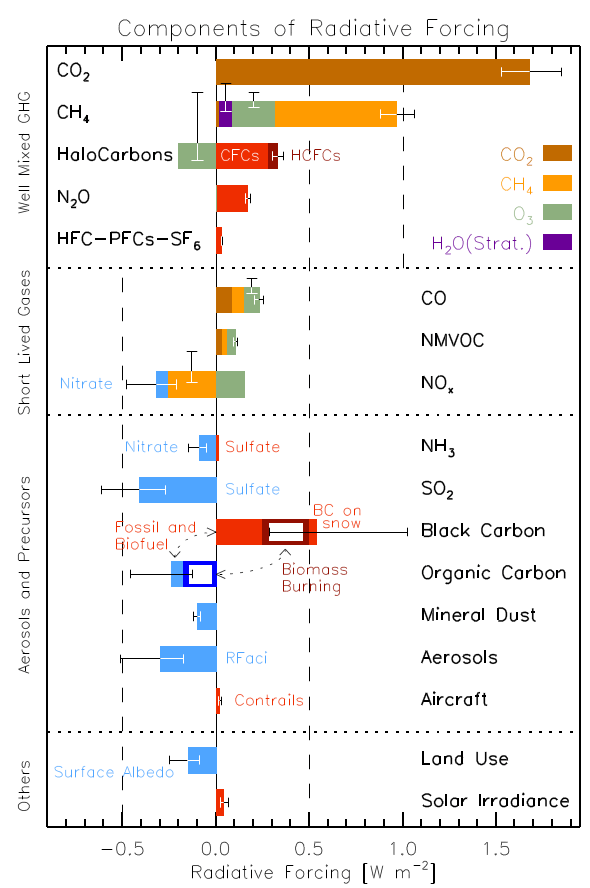
Why is the solar irradiance effect so tiny? Note that Total Solar Irradiance, or TSI, is also known as “the solar constant.” When solar activity ramps up and down from throwing wild solar flares to sleeping like a baby, TSI hardly varies a whit. That’s where the name comes from. While solar activity varies tremendously, solar irradiance remains almost constant.
This slight change in the solar radiation that shines on our planet is known to be too small an energy variation to explain any substantial change in temperature. In particular, it can’t begin to account for anything near to half of all past temperature change. It can’t begin to account for the large solar effect on climate that is evidenced in the geologic record.
Implication: some other solar effect besides TSI must also be at work. One of the solar variables that does vary when solar activity ramps up and down, like solar wind pressure, must be having some effect on climate, and this is certainly plausible. We in-effect live inside of the sun’s extended corona. When the solar wind is going full blast the earth’s immediate external environment is rather different than when the solar wind is down, and even if we don’t know the mechanism, we have powerful evidence that some solar effect other than the slight variation in TSI is driving global temperature.
This is what the IPCC admits in the Second Order Draft of AR5, which now includes the sentence in bold below (page 7-43, lines 1-4, emphasis added):
Many empirical relationships have been reported between GCR or cosmogenic isotope archives and some aspects of the climate system (e.g., Bond et al., 2001; Dengel et al., 2009; Ram and Stolz, 1999). The forcing from changes in total solar irradiance alone does not seem to account for these observations, implying the existence of an amplifying mechanism such as the hypothesized GCR-cloud link. We focus here on observed relationships between GCR and aerosol and cloud properties.
Sherwood’s response is to consider only one possible mechanism of solar amplification. He looks at the evidence for Henrik Svensmark’s proposed GCR-cloud mechanism and judges that the forcing effect from this particular mechanism would be small, then concludes that a greater role for the sun in global warming is “ridiculous.”
Hey Sherwood, read the added sentence again. It says that the evidence implies the existence of “an amplifying mechanism.” Presenting an argument against a particular possible mechanism does not in any way counter the report’s new admission that some such mechanism must be at work. (Guess he didn’t author that sentence eh? Since he doesn’t even know what it says.)
Sherwood is trying to use theory—his dissatisfaction with a particular theory of how solar amplification might work—to dismiss the evidence that some mechanism of solar amplification must be at work. The bad professor is inverting the scientific method, which requires that evidence always trump theory. If evidence gives way to theory it is not science. It is anti-science. It is the exact opposite of science.
The new sentence was added specifically to avoid the criticism that the authors were inverting the scientific method
My submitted comments on the First Order Draft ripped the authors up and down for inverting the scientific method. They were all doing what Sherwood is doing now. Here is the same passage from the FOD. It lacks the added sentence, but otherwise is almost identical (FOD page 7-50, lines 50-53):
“Many empirical relationships or correlations have been reported between GCR or cosmogenic isotope archives and some aspects of the climate system, such as SSTs in the Pacific Ocean (Meehl et al., 2009), some reconstruction of past climate (Kirkby, 2007) or tree rings (Dengel et al., 2009). We focus here on observed relationships between GCR and aerosol- and cloud-properties.”
The first sentence here, citing unspecified “empirical relationships” between cosmogenic isotopes (a proxy for solar activity) and “some aspects of the climate system” is the only reference in the entire report to the massive evidence for a solar driver of climate. Not a word about the magnitude of the correlations found, nothing about how these correlations are much too strong to possibly be explained by the slight variance in solar irradiance alone, and almost nothing (“many”) about the sheer volume of studies that have found these correlations. And that’s it: one oblique sentence, then the report jumps immediately to looking at the evidence for one proposed mechanism by which solar amplification might be occurring.
The evidence for that particular mechanism is judged (very prematurely) to indicate a weak effect, and this becomes the implicit rationale for the failure of the IPCC’s computer models to include any solar variable but TSI. Readers of the FOD have no idea about the mountain of evidence for some solar driver of climate that is stronger than TSI because the report never mentions it. A couple of the citations that were included mention it (in particular, Kirkby 2007, which is a survey paper), but the report itself never mentions it, and the report then goes on to ignore this evidence entirely. The enhanced solar forcing effect for which there is so much evidence is completely left out of all subsequent analyses.
In other words, the inversion of the scientific method is total. In the FOD, the authors used their dissatisfaction with the GCR-cloud theory as an excuse for completely excluding the vast evidence that some mechanism of enhanced solar forcing is at work. Theory was allowed to completely obliterate and remove a whole mountain of evidence. “Pure definitional anti-science,” I charged.
At least one of the co-authors seems to have decided that this was a bridge too far and added the sentence acknowledging the evidence that some mechanism of solar amplification must be at work. The added sentence declares in-effect, “no, we are not inverting the scientific method.” They are no longer using their dissatisfaction with a particular theory of how enhanced solar forcing might work as a ruse to pretend that the evidence for some such mechanism does not exist.
So good for them. In the sea of IPCC dishonesty there is a glimmer of honesty, but it doesn’t go very far. TSI is still the only solar effect that is included in the “consensus” computer models and the IPCC still uses this garbage-in claim to arrive at their garbage-out conclusion that observed warming must be almost entirely due to the human release of CO2.
One of the reason I decided to release the SOD was because I knew that once the Steven Sherwoods at the IPCC realized how the added sentence undercut the whole report they would yank it back out, and my submitted comments insured that they would indeed realize how the added sentence undercut the whole report. Now sure enough, as soon as I make the added sentence public Steven Sherwood publicly reverts to the FOD position, trying to pretend that his argument against one proposed mechanism of solar amplification means that we can safely ignore the overwhelming evidence that some such mechanism is at work.
We’ll find out in a year or so whether his co-authors are willing to go along with this definitional anti-science. Evidently there is at least some division. With Sherwood speaking up for the FOD position, any co-authors who prefer the new position should feel free to speak up as well. Come on real scientists, throw this blowhard under the bus!
In any case, it is good to have all of them stuck between a rock and a hard place. They can invert the scientific method and be exact definitional anti-scientists like Steven Sherwood, or they can admit that no one can have any confidence in the results of computer models where the only solar forcing is TSI, not after they have admitted strong evidence for some mechanism of solar forcing beyond TSI. That admission is a game changer, however much Sherwood wants to deny it.
He piles on with more of the same at the ridiculous “DeSmog Blog” (as if CO2 is “smog”), and is quoted front and center by the even more ridiculous Andrew Sullivan. Sherwood has become the go-to guy for the anti-science left.
The two dozen references documenting strong correlations between solar activity and various climate indicies
Jo wanted to include references so I sent along the list of citations that I had included in my FOD comment. Worth seeing again I think:
Bond et al. 2001, “Persistent Solar Influence on North Atlantic Climate During the Holocene,” Science.
Excerpt from Bond: “Over the last 12,000 years virtually every centennial time scale increase in drift ice documented in our North Atlantic records was tied to a distinct interval of variable and, overall, reduced solar output.”
Neff et al. 2001, “Strong coherence between solar variability and the monsoon in Oman between 9 and 6 kyr ago,” Nature.
Finding from Neff: Correlation coefficients of .55 and .60.
Usoskin et. al. 2005, “Solar Activity Over the Last 1150 years: does it Correlate with Climate?” Proc. 13th Cool Stars Workshop.
Excerpt from Usoskin: “The long term trends in solar data and in northern hemisphere temperatures have a correlation coefficient of about 0.7 — .8 at a 94% — 98% confidence level.”
Shaviv and Veizer, 2003, “Celestial driver of Phanerozoic climate?” GSA Today.
Excerpt from Shaviv: “We find that at least 66% of the variance in the paleotemperature trend could be attributed to CRF [Cosmic Ray Flux] variations likely due to solar system passages through the spiral arms of the galaxy.” [Not strictly due to solar activity, but implicating the GCR, or CRF, that solar activity modulates.]
Plenty of anti-CO2 alarmists know about this stuff. Mike Lockwood and Claus Fröhlich, for instance, in their 2007 paper: “Recent oppositely directed trends in solar climate forcings and the global mean surface air temperature” (Proc. R. Soc. A), began by documenting how “[a] number of studies have indicated that solar variations had an effect on preindustrial climate throughout the Holocene.” In support, they cited 17 papers, the Bond and Neff articles from above, plus:
Davis & Shafer 1992; Jirikowic et al. 1993; Davis 1994; vanGeel et al. 1998; Yu&Ito 1999; Hu et al. 2003; Sarnthein et al. 2003; Christla et al. 2004; Prasad et al. 2004; Wei & Wang 2004; Maasch et al. 2005; Mayewski et al. 2005; Wang et al. 2005a; Bard & Frank 2006; and Polissar et al. 2006.
The correlations in most of these papers are not directly to temperature. They are to temperature proxies, some of which have a complex relationship with temperature, like Neff 2001, which found a correlation between solar activity and rainfall. Even so, the correlations tend to be strong, as if the whole gyre is somehow moving in broad synchrony with solar activity.
Some studies do examine correlations between solar activity proxies and direct temperature proxies, like the ratio of Oxygen18 to Oxygen16 in geologic samples. One such study (highlighted in Kirkby 2007) is Mangini et. al. 2005, “Reconstruction of temperature in the Central Alps during the past 2000 yr from a δ18O stalagmite record.”
Excerpt from Mangini: “… a high correlation between δ18O in SPA 12 and D14C (r =0.61). The maxima of δ18O coincide with solar minima (Dalton, Maunder, Sporer, Wolf, as well as with minima at around AD 700, 500 and 300). This correlation indicates that the variability of δ18O is driven by solar changes, in agreement with previous results on Holocene stalagmites from Oman, and from Central Germany.”
And that’s just old stuff. Here are four random recent papers.
Ogurtsov et al, 2010, “Variations in tree ring stable isotope records from northern Finland and their possible connection to solar activity,” JASTP.
Excerpt from Ogurtsov: “Statistical analysis of the carbon and oxygen stable isotope records reveals variations in the periods around 100, 11 and 3 years. A century scale connection between the 13C/12C record and solar activity is most evident.”
Di Rita, 2011, “A possible solar pacemaker for Holocene fluctuations of a salt-marsh in southern Italy,” Quaternary International.
Excerpt from Di Rita: “The chronological correspondence between the ages of saltmarsh vegetation reductions and the minimum concentration values of 10Be in the GISP2 ice core supports the hypothesis that important fluctuations in the extent of the salt-marsh in the coastal Tavoliere plain are related to variations of solar activity.”
Raspopov et al, 2011, “Variations in climate parameters at time intervals from hundreds to tens of millions of years in the past and its relation to solar activity,” JASTP.
Excerpt from Raspopov: “Our analysis of 200-year climatic oscillations in modern times and also data of other researchers referred to above suggest that these climatic oscillations can be attributed to solar forcing. The results obtained in our study for climatic variations millions of years ago indicate, in our opinion, that the 200- year solar cycle exerted a strong influence on climate parameters at those time intervals as well.”
Tan et al, 2011, “Climate patterns in north central China during the last 1800 yr and their possible driving force,” Clim. Past.
Excerpt from Tan: “Solar activity may be the dominant force that drove the same-phase variations of the temperature and precipitation in north central China.”
Saltmarshes, precipitation, “oscillations.” It’s all so science-fair. How about something just plain scary?
Solheim et al. 2011, “The long sunspot cycle 23 predicts a significant temperature decrease in cycle 24,” submitted astro-ph.
Excerpt from Solheim: “We find that for the Norwegian local stations investigated that 30-90% of the temperature increase in this period may be attributed to the Sun. For the average of 60 European stations we find ≈ 60% and globally (HadCRUT3) ≈ 50%. The same relations predict a temperature decrease of ≈ 0.9°C globally and 1.1−1.7°C for the Norwegian stations investigated from solar cycle 23 to 24.”
Those two dozen there are just the start. Scafetta hasn’t even been mentioned. (Sorry Nicola.) But there is a lot in those 24.
Leif Svalgaard says:
December 17, 2012 at 11:50 am
Second, the magnetic field at the south pole has nothing to do with the sunspot number or with the temperature in the Northern Hemisphere.
==========
A mass of iron circling a much more massive rotating ball of plasma. The ball of plasma having an immense and variable magnetic field and associated stream of charged particles, but has no effect on the ball of iron circling within. Luckily the electric motor and generator were discovered before science made this great leap backwards.
Pamela Gray says:
December 18, 2012 at 6:37 am
I guess belief trumps data…..…….
Hi Ms. Gray
I’ll go by the data. There are some odd things about the summer and winter temperatures in the heart of the old colonial power:
http://www.vukcevic.talktalk.net/MidSummer-MidWinter.htm
Not certain why but worth noting.
BTW, from today the climate scientists have a new geographical reference ‘Queen Elizabeth Land’ in the Antarctica.
ferd berple says:
December 18, 2012 at 7:24 am
A mass of iron circling a much more massive rotating ball of plasma. The ball of plasma having an immense and variable magnetic field and associated stream of charged particles, but has no effect on the ball of iron circling within
So far, you are largely correct. The details are wrong: the magnetic field is not immense [10,000 times smaller than the Earth’s] and the solar wind is electrically neutral.
Luckily the electric motor and generator were discovered before science made this great leap backwards.
Heat the motor to a temperature above the Curie point [ http://en.wikipedia.org/wiki/Curie_temperature ] and it will no longer work.
Deb Baker, lead author from UCL Mullard Space Science Laboratory, says: “Solar wind is an outflow of million-degree gas and magnetic field that engulfs the Earth and other planets. It fills the entire solar system and links with the magnetic fields of the Earth and other planets. Changes in the Sun’s million-mile-per-hour wind can induce disturbances within near-Earth space and our upper atmosphere and yet we still don’t know what drives these outflows.
Julian Flood says:
December 17, 2012 at 9:02 pm
“I’ve been unable to tease out the results of enhanced UV on the overall phytoplankton community: does DMS change? If so there might be a UV up –> DMS response –> cloud change signal which is correlated with, but not caused by cosmic rays. It might not be sufficiently rapid in its response to show up after a Forbush event, though, and I’m not sure if the direction of the response is correct. I’ll think about it.”
While not focused on UV, there are illustrations of measured aerosol and cloud cover changes following increases and major Forbush decreases in cosmic rays, within the first image link in my comment of December 17, 2012 at 11:29 am:
http://wattsupwiththat.com/2012/12/16/a-rebuttal-to-steven-sherwood-and-the-solar-forcing-pundits-of-the-ipcc-ar5-draft-leak/#comment-1175822
I’d encourage reading the whole comment and looking at all the images in it since it fairly concisely counters propagandist falsehoods on a number of topics and much of the big picture (where I don’t have time to make countless posts per thread but often aim for at least one). However, the specific examples are Figure 10 and Figure 12 towards the bottom of http://s13.postimage.org/ka0rmuwgn/gcrclouds.gif (click to enlarge). Furthermore, see the source referenced there for Dr. Calder’s lengthier discussion and illustrations of the decrease in aerosols & cloud cover observed in the atmosphere after strong Forbush decreases:
http://calderup.wordpress.com/2010/05/03/do-clouds-disappear/
http://calderup.wordpress.com/2010/05/24/do-clouds-disappear-2/
http://calderup.wordpress.com/2010/08/09/do-clouds-disappear-3/
http://calderup.wordpress.com/2011/09/10/do-clouds-disappear-4/
lsvalgaard says:
December 18, 2012 at 7:50 am Heat the motor to a temperature above the Curie point [ http://en.wikipedia.org/wiki/Curie_temperature ] and it will no longer work.
=========
not correct. Here is what your link says:
In physics and materials science, the Curie temperature (Tc), or Curie point, is the temperature at which a ferromagnetic or a ferrimagnetic material becomes paramagnetic on heating;
So, heating an electric motor that uses permanent magnetic will stop the motor. It will not stop a motor that uses electromagnets, except of course by burning off the insulation on the wires.
What this means in the case of the earth is that you cannot self-induce a magnetic field in the earth’s core, because the molten core must be paramagnetic. You need an external magnetic field or electric current to induce the earth’s magnetic field.
lsvalgaard says:
December 18, 2012 at 7:16 am
…
Who is massaging the data I have no idea, Wang, Svalgaard , IPCC, or an unknown zombie.
I have shown both graphs since there are two sets of data, you sort it out with your peers, who is right who is wrong is nothing to do with me..
http://www.vukcevic.talktalk.net/TMC.htm
I come here with few graphs to show what I found in data from respectable data bases with occasional guess what it might mean.
I do not come here to be continuously insulted, but if that makes your science more credible, by all means curry on, bothers me not.
The solar magnetic field extends well beyond the Sun itself. The magnetized solar wind plasma carries Sun’s magnetic field into the space forming what is called the interplanetary magnetic field.[72] Since the plasma can only move along the magnetic field lines, the interplanetary magnetic field is initially stretched radially away from the Sun. Because the fields above and below the solar equator have different polarities pointing towards and away from the Sun, there exists a thin current layer in the solar equatorial plane, which is called the heliospheric current sheet.[72] At the large distances the rotation of the Sun twists the magnetic field and the current sheet into the Archimedean spiral like structure called the Parker spiral.[72] The interplanetary magnetic field is much stronger than the dipole component of the solar magnetic field. The Sun’s dipole magnetic field of 50–400 μT (at the photosphere) reduces with the cube of the distance to about 0.1 nT at the distance of the Earth. However, according to spacecraft observations the interplanetary field at the Earth’s location is around 5 nT, about a hundred times greater.[81] The difference is due to magnetic fields generated by electrical currents in the plasma surrounding the sun.
lsvalgaard says:
December 18, 2012 at 7:50 am
The details are wrong: the magnetic field is not immense [10,000 times smaller than the Earth’s] and the solar wind is electrically neutral.
=====
http://en.wikipedia.org/wiki/Earth%27s_magnetic_field
The intensity of the (earth’s) field is greatest near the poles and weaker near the Equator. ..The field ranges between approximately .. 0.25–0.65 G. By comparison, a strong refrigerator magnet has a field of about 100 G.[13]
In other words, a refrigerator magnet has a magnetic field more than 100 times stronger than the earth’s magnetic field. No need to worry about the earth’s magnetic field protecting us from the hazards of space. All we do is hold a fridge magnet pointed towards the sun to shield the earth from the solar wind.
Make sure to point the fridge magnet the right way. The magnetic field is aligned so that it only extends on the fridge side. The other side of the magnet the field cancels itself out.
ferd berple says:
December 18, 2012 at 8:08 am
You need an external magnetic field or electric current to induce the earth’s magnetic field.
There are electrical currents in the core to maintain the Earth’s field, but the skin depth at the core surface is so shallow that external induction is not possible [does not penetrate into the core].
vukcevic says:
December 18, 2012 at 8:09 am
I do not come here to be continuously insulted, but if that makes your science more credible, by all means carry on, bothers me not.
It is abundantly clear that you are immune to learning. You spreading pseudo-science bothers me and diminishes the credibility of WUWT.
ferd berple says:
December 18, 2012 at 8:14 am
However, according to spacecraft observations the interplanetary field at the Earth’s location is around 5 nT, about a hundred times greater.
Good to see you are learning about the Sun and the solar wind and have verified that the solar wind field is 10,000 times weaker than the Earth’s field [50,000 nT at the surface] and a million times weaker than the core field.
lsvalgaard says:
December 18, 2012 at 7:16 am
Comparison shows precisely why it all is spurious [made up, dishonest, etc]:
http://www.leif.org/research/Spurious-Vuk.png
Even if your TSI reproduction is the correct one, you are, as a true scientist wrong to reject possibility that the composite Earth’s magnetic field variability (solid blue curve) could have long term multi-millennial decaying component (dotted blue line)
http://www.leif.org/research/Spurious-Vuk.png
and a shorter term, multi-decadal variability (green curve)
That is precisely why you should not instantly declare it all as spurious [made up, dishonest, etc], because you don’t like what you see.
No need for an apology, I am getting used to it.
ferd berple says:
December 18, 2012 at 8:26 am
In other words, a refrigerator magnet has a magnetic field more than 100 times stronger than the earth’s magnetic field. No need to worry about the earth’s magnetic field protecting us from the hazards of space. All we do is hold a fridge magnet pointed towards the sun to shield the earth from the solar wind.
Pleasing to see that you are learning about magnets. Keep it up. The fridge magnet would be very useful if you could make as big as the Earth.
vukcevic says:
December 18, 2012 at 9:08 am
you are, as a true scientist wrong to reject possibility that the composite Earth’s magnetic field variability (solid blue curve) could have long term multi-millennial decaying component (dotted blue line)
First problem: ‘composite’
Second: South pole is not representative of whole Earth’s magnetic field. The secular variation is different at other places. There is nothing special about the South Pole.
Third: There is nothing wrong with the secular variation data, it it the correlation with the sunspot number (TSI) that is spurious. The decaying component would not match the errors in the Group Sunspot Numbers.
This is addressed to
Dr. Svalgaard and
Alan Millar
who concluded ‘vukcevic is dishonest’
I have updated my web page with the following clarification
“If the Svalgaard TSI reproduction is eventually shown to be the correct one, graph would demonstrate that the composite Earth’s magnetic field variability (solid blue curve) has a long term multi-millennial decaying component (dotted blue line) and a shorter term, multi-decadal variability .(green curve).”
http://www.vukcevic.talktalk.net/TMC.htm
Anyone glancing at Svalgaard’s TSI and geomagnetic field variability could have concluded so in matters of seconds.
Some also may conclude that your comment is out of place. Good day to both of you.
vukcevic says:
December 18, 2012 at 9:56 am
Some also may conclude that your comment is out of place.
The comment should be in the same place as your spurious claims.
lsvalgaard says:
The comment (vukcevic is dishonest) should be in the same place as your spurious claims.
http://www.vukcevic.talktalk.net/TMC.htm
I cannot prove what data shows is caused by sun, planetary configuration or another mutual driver.
Dr. Jean Dickey of NASA’s Jet Propulsion Laboratory, Pasadena:
or that an external (e.g. solar) process affects the (Earth’s) core and climate simultaneously.
http://www.nasa.gov/topics/earth/features/earth20110309.html
You can not disprove what data shows !
I will stick to a civilized exchange and the facts as data show.
You do as you wish….
Solar cycle length and climate.
http://www.tmgnow.com/repository/solar/lassen1.html
vukcevic says:
December 18, 2012 at 10:26 am
You can not disprove what data shows !
‘shows’ is your subjective judgement and that can be disproved easily. There is nothing special about the South Pole. If one absolutely wants to compare two unrelated times series, it would make more sense to use the location of the magnetic pole. Granted that that pole moves around a bit, but one can pick a point in the general neighborhood of its wanderings, e.g. 65S, 138E. Then compute the secular variation [using two sources: the IGRF from 1900 and GUFM from 1590]. Then compare with two TSI series: the one I would advocate and the ‘official one’ from IPCC’s AR5 leaked report. Here is the result: http://www.leif.org/research/Spurious-Vuk2.png
You whole thing has now fallen apart.
lsvalgaard says:
December 18, 2012 at 12:49 pm
………
One would expect better from a top solar scientist.
Magnetic field (if affected by sun directly, not planetary configuration) would be caused by geomagnetic activity, in the area that is practically observed by the southern Aurora’s oval
Coordinates you are using 65S,138E for your graphs are outside the Aurora oval
Aurora is not exactly concentric with the pole but it is close enough, which I’ve just recorded and added to my website
http://www.vukcevic.talktalk.net/TMC.htm
so no one else would repeat your mistake.
Your graphs are nonsense, but I shall attribute to your ignorance rather than desire to deceive, which you are so anxious to stick to my name. You have failed again, and I shell not respond any more to your comments.
Time for another celebratory Xmas drink.
Cheers all.
PS
Position of the south geomagnetic pole (blue) 1900.0-2015.0 estimated from the 11th Generation IGRF is shown here (Fig.2)
http://www.geomag.bgs.ac.uk/education/poles.html
Geomagnetic pole (see text) is not at the same coordinate location as the south dip pole.
vukcevic says:
December 18, 2012 at 9:56 am
“This is addressed to
Dr. Svalgaard and
Alan Millar
who concluded ‘vukcevic is dishonest’”
I never said you were dishonest.
I said I wish people would use a realistic scale on their graphs.
The scale you use on your TSI graphs give the impression that the miniscule changes in TSI represented by said graphs could be sufficient, on their own, to be directly responsible for the observed temperature changes. I don’t believe you think that that is possible if you do say so.
I think you are saying that there is some, as yet undiscovered or unproven, connected physical processes driving the change, a la Milankovitch.
If so be upfront (honest!) and label your graphs as unproven correlations.
Your graphs do show a correlation but you do not have any proven theory to back it up. If you do not, then you can only rely on the closeness of the correlation to have it accepted a la Milankovitch. However in the absence of a mechanism and due to the timescales involved it would take centuries for this to happen.
I think Dr Svaalgard is being very hard on you. You do have a correlation, involving very small changes in TSI, though there is no physics to back it up. He has no problem in accepting the Milankovitch Cycles as a significant climate driver even though this involves small changes in TSI which also remain unproven as to how they operate with the Earth;s climatic processes even though there are hypotheses out there.
You have to accept that no informed scientist is going to accept your conclusions based on such a short correlation unless you have some acceptable proof as to mechanism.
You may be right but we won’t b able to accept that for a few hundred years assuming your correlation continues to hold up.
I admire the effort you put into your work by the way.
Alan
vukcevic says:
December 18, 2012 at 2:23 pm
Coordinates you are using 65S,138E for your graphs are outside the Aurora oval
The Magnetic Pole Is the point on the Earth’s surface where the direction of the Earth’s magnetic field is vertical. You acknowledge that by plotting the Z [vertical] component. The ‘pole’ position depends on the altitude. The aurora comes from far out in the magnetosphere so are organized by the dipole [‘corrected geomagnetic latitude’]. At the surface and below the true pole is where the field is vertical. As you are postulating that the solar changes propagate inwards, the place where the field is vertical is the more appropriate. In any case, my exercise demonstrates that the ‘correlation’ depends on at which point on the Earth you measure the secular variation. The South pole is not special at all.
<i. I shell not respond any more to your comments
That would be a very welcome change. Hope you can keep it up.
Alan Millar says:
December 18, 2012 at 5:04 pm
You have to accept that no informed scientist is going to accept your conclusions based on such a short correlation unless you have some acceptable proof as to mechanism.
It is worse than that. The ‘correlation’ comes about by matching a real trend [at a rather arbitrary point] to an artificial trend caused by a flaw in the Group Sunspot Number. I may be hard on Vuk, but such is science. There is no kindness in weeding out wrongs. There are very good physical reasons why the correlation is not even plausible, in spite for being promoted incessantly.
vukcevic says:
December 18, 2012 at 2:46 pm
Geomagnetic pole (see text) is not at the same coordinate location as the south dip pole.
And is not the same as the South Pole either. Using the geomagnetic pole, the correlation is equally bad: http://www.leif.org/research/Spurious-Vuk3.png
Care was taken to take the slowly changing position of the pole into account.
Alan Millar says:
December 18, 2012 at 5:04 pm
……….
You may have misunderstood whole thing, the TSI has no effect on the geomagnetic field. Small changes in the TSI are assumed to be due to the close magnetic flux, etc. etc. etc. …. If you wish to see different graphs, please do go ahead and plot them to your preferencies.
Dr, Svalgaard is again firing blanks all over the place, trying to scare ‘nasty little predator’ , and in the process making even more mistakes. The movement of the geomagnetic pole is miniscule across period of two decades (bi-decadal change), in comparison to movement of the dip needle pole, as you can see from the link
http://www.geomag.bgs.ac.uk/images/polesfig2.jpg
I am not scientist, have no interest in the flat sun, variable sun, CO2 or anything else, and do not follow any agenda or anyone’s instructions. I look at the data and show what I find, you and others can read into it or not, whatever you like.
Dr. Dickey (NASA-JPL) spent life time studying the Earth’s interior, wrote numerous papers on the subject, her recent article may interest you.
http://www.nasa.gov/topics/earth/features/earth20110309.html
and then if you are man of inquiring mind
http://www.vukcevic.talktalk.net/EarthNV.htm
http://www.vukcevic.talktalk.net/CO2-Arc.htm
http://www.vukcevic.talktalk.net/LL.htm
Too many correlations make no case, but claim that all are ‘spurious’ is getting less and less credible.
I have heard of Milankovic too