Global warming kills spaghetti crop
Sigh, “The End of Pasta?” reads more like “The end of journalism”
 Some days, there appears such blatant stupidity in the MSM, you wonder if there isn’t some sort of award than can be handed out for it. I think Mark Hertsgaard is deserving of such an award for this moronically mendacious missive where he manages to work the two poster children for ridiculous climate alarmism into one paragraph:
Hurricane Sandy’s recent devastation of New York and neighboring states reminded Americans of what Hurricane Katrina demonstrated in 2005: global warming makes weather more extreme, and extreme weather can be extremely dangerous. But flooding coastlines aren’t our only worry. Climate change is also imperiling the very foundation of human existence: our ability to feed ourselves.
This colossal disconnect (name a hurricane that hit the wheat belt) makes me want to call him up and scream at him. His premise is this:
But if humans want to keep eating pasta, we will have to take much more aggressive action against global warming. Pasta is made from wheat, and a large, growing body of scientific studies and real-world observations suggest that wheat will be hit especially hard as temperatures rise and storms and drought intensify in the years ahead.
Now the important thing to note here is that his piece is being advertised as “science” yet I fail to find any science in it, only unsubstantiated opinion and talking points. Here’s some science; if only Hertsgaard had bothered to check some data like I did. The data plot shows US Department of Agriculture data for corn (in case his next story claims children of the future won’t know what Doritos are) and wheat yields in bushels per acre:

You can get all the source data right here at USDA, available to most anyone with the ability to open a web browser and do a search.
So looking at the graph above, it seems there’s no obvious worry about wheat or corn disappearing any time soon. Sure, there is a downspike in 2011, due to a summer heatwave and drought in the USA. There were other downspikes of similar magnitude in the last 100 years also, so the 2011 downspike isn’t particularly unique. Despite those downspikes in yield, the trend remains upwards.
The basis of the claim for “end of pasta” by Hertsgaard is this statement:
Frank Manthey, a professor at North Dakota State University who advises the North Dakota Wheat Commission. Already, a mere 1 degree Fahrenheit of global temperature rise over the past 50 years has caused a 5.5 percent decline in wheat production.
Well, I plotted the data, both for USA temperature (using the alarmist’s favorite temperature data, Jim Hansen’s GISS data) and USA wheat production from USDA, and I call bullshit on the claim:

Data sources:
http://data.giss.nasa.gov/gistemp/graphs_v3/Fig.D.txt
http://www.ers.usda.gov/data-products/wheat-data.aspx
Clearly, US wheat production is healthy, increasing, and shows no sign of the 5.5% decrease, and if anything it seems to indicate there is a positive effect from temperature on wheat yield. Improved farming practices and improved wheat seed stocks have helped too. If I really wanted to embarrass these two guys I could add the Keeling curve for CO2 also, and point out that crop yields increase with increases in CO2 as well.
How do people like this get a broad voice to such opinions that don’t stand up under the simplest of tests? I don’t know, but you can write them here to ask them:
http://www.ag.ndsu.edu/plantsciences/people/faculty/manthey
Frank.Manthey@ndsu.edu
David Lobell
dlobell@stanford.edu
There is no contact info for Hertsgaard, so you have to complain to the editors for this dreck:
editorial@thedailybeast.com
The professor may answer, but Hertsgaard is probably a lost cause to mental mendacity, as he also believes (according to some obscure activist group)that Climate Change is killing 1000 children a day.
If that were true, don’t you think the rest of the MSM would have daily headlines about it? So far, not a peep. Apparently, fact checking is not a journalism skill Hertsgaard possesses.
UPDATE – Commenter Richard III writes:
A quick look at the this page will show how just how dangerous a little knowledge can be. There’s a lot more than a 1 degree temperature difference between south Texas and Northern Montana. It used to be that a college professor would know that. http://www.smallgrains.org/whfacts/growreg.htm
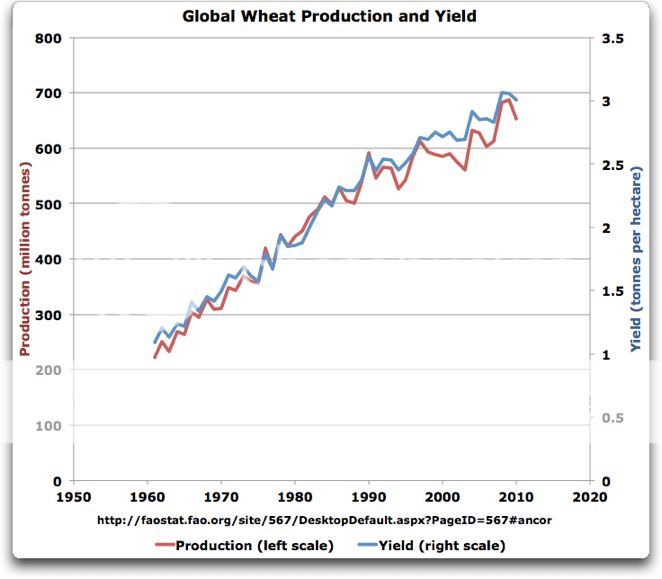
UPDATE2— I trust Anthony won’t mind me adding a little historical perspective to this. The best source for this kind of crop production and yield information is the FAO. Here is their history of wheat production and wheat yield.
![globalwheatproductionandyield[1]](http://wattsupwiththat.files.wordpress.com/2012/12/globalwheatproductionandyield1.jpg?quality=83)
Note that to put it mildly, Mark Hertsgaard’s pasta claims are true only in some alternate reality. In the larger sense, yield and total production are still rising. – Willis Eschenbach.
UPDATE3 – here is the source of the 5.5% claim by David Lobell of Stanford.
http://foodsecurity.stanford.edu/publications/climate_trends_and_global_crop_production_since_1980

Climate Trends and Global Crop Production Since 1980
Journal ArticleAuthors
David Lobell – Stanford University
Wolfram Schlenker – Assistant Professor in Economics at Columbia University
Justin Costa-Roberts – Stanford University
Published by
Science, May 2011
Efforts to anticipate how climate change will affect future food availability can benefit from understanding the impacts of changes to date. Here we show that in the cropping regions and growing seasons of most countries, with the important exception of the United States, temperature trends for 1980-2008 exceeded one standard deviation of historic year-to-year variability. Models that link yields of the four largest commodity crops to weather indicate that global maize and wheat production declined by 3.8% and 5.5%, respectively, compared to a counter-factual without climate trends. For soybeans and rice, winners and losers largely balanced out. Climate trends were large enough in some countries to offset a significant portion of the increases in average yields 16 that arose from technology, CO2 fertilization, and other factors.
Excuse me! You what Watts?
“Despite those downspikes in yield, the trend remains upwards.”
Temperature record anyone?
Don’t worry about the beer. If it gets too cold for wheat, barley grows well in cold as well as heat.
Actually in wheat growing country this Mark Hertsgaard guy would be said to be “Dumber then a wooden fence Post” pg
I trust this will be added to “A Complete List Of Things Supposedly Caused By Global Warming” at
http://www.numberwatch.co.uk/warmlist.htm
“The professor may answer, but Hertsgaard is probably a lost cause to mental mendacity, as he also believes (according to some obscure activist group)that Climate Change is killing 1000 children a day.”
Maybe it is. After all, aren’t ethanol subsidies making the price for world food increase? Oh, maybe not Global Warming, but the governments reaction the perceived global warming.
Roger Knights says:
December 12, 2012 at 6:13 pm
I trust this will be added to “A Complete List Of Things Supposedly Caused By Global Warming” at
http://www.numberwatch.co.uk/warmlist.htm
==============================================================
What came first? CAGW or the dumb ideas?
I see a grant in the future to develop warming resistant lobster vines for well connected “scientists”.
Sorry to rehash what has already been stated, but durum is more tolerant to drought than corn so the total supply of durum available for pasta production is predominately determined by the total acres seeded to the crop. When farmers sense that more money can be earned growing other crops and especially crops that feed the bio fuel market those are the crops they will seed and durum production will fall. If you want more durum and pasta production tell the US government to ease back on the bio fuel subsidies.
Global wheat production:
https://en.wikipedia.org/wiki/International_wheat_production_statistics
1996 585 (in Million Metric Tons)
2005 628
2010 651
2009 685 So I suppose you could make a 1 YEAR downtrend line… oh, wait, it was cold in 2010
I’m having trouble buying his thesis and I’m wondering if his editor ever heard the words “Fact Check”…
@gcapologist:
There isn’t one.
First off, there’s several kinds of wheat, broadly divided into “spring” and “winter”. (That right there gives you a clue about range…) I’ve seen it growing in Canada and in a part of California (as ‘spring’ wheat IIRC) where it gets to “110 in the shade and there ain’t no shade” (thats in F for you Metric Afflicted folks…)
I’ve never seen a hot limit on wheat, but when it gets too cold, you have to swap to barley or rye or triticale ( a wheat rye hybrid).
If you look in your Sunset Garden Book you will find one place listed where the summers are marked as “too hot to grow everything”. Phoenix Arizona is in that zone. In exchange, you can grow crops 10 OTHER months of the year (and swap to tomatoes in the hot summer 😉
http://www.arizonagrain.com/index.cfm?show=10&mid=9
Somehow I don’t think Canada is going to get warmer than Arizona any time soon…
@P.G.:
Please don’t insult wood fence posts like that!
“Dumber than a sack of rocks”… please…
Thank you, simple science: you know, propose a hypothesis, make predictions, test them against reality by experiment or observation. If the tests go against your hypothesis, it’s wrong! (Sorry, my version of Feynman’s talk in ‘The Character of Physical Law’).
I have added an update to the head post containing the following image:
w.
The number 5.5% came from this article:
Lobell, David B., Wolfram Schlenker, and Justin Costa-Roberts. “Climate trends and global crop production since 1980.” Science 333.6042 (2011): 616-620.
English is not my mother tongue but as far as I understand they used MODEL(!!!) to compare TRENDS(!!!) and found that production is growing 5.5% slower than it should, based on historical data.Also, I’m not an expert in agriculture, but I don’t see where they taking in account socio-economic factors like collapsing of collective farming in former Soviet Union, which lead to temporarily yields reduction in Ukraine, Russia, Kazakhstan etc.
Buzzed says:
December 12, 2012 at 10:14 am
Studies on projected climate change impact on agriculture I have seen say clearly that mild climate change can help production because of longer growing sessions and that CO2 it self stimulates plant growth. The concern is and always has been about the long term impact if human caused climate change continues. Pointing to recent crop data to refute this is like saying we don’t have to worry about the bridge ahead being out because the road here is free of pot holes.
I draw your attention to an assertion by Professor Frank Manthey, quoted in the original article:
Frank Manthey, a professor at North Dakota State University who advises the North Dakota Wheat Commission. Already, a mere 1 degree Fahrenheit of global temperature rise over the past 50 years has caused a 5.5 percent decline in wheat production.
Also from the original Hertsgaard article:
But if humans want to keep eating pasta, we will have to take much more aggressive action against global warming. Pasta is made from wheat, and a large, growing body of scientific studies and real-world observations suggest that wheat will be hit especially hard as temperatures rise and storms and drought intensify in the years ahead.
Without wandering into tortured metaphors about bridges and potholes, I submit that “scientific studies and real-world observations” suggesting that a “mere 1 degree Fahrenheit of global temperature rise of the past 50 years has caused a 5.5 percent decline in wheat production” are absolutely falsified by data which shows global wheat production and yield have both risen just shy of threefold in that period. Please examine the graphs Anthony has so thoughtfully provided. One assumes the North Dakota Wheat Commission would do as much before accepting any advice from Prof. Manthey.
My higher math is quite rusty, but I am unaware of any way to take a nearly threefold increase and honestly call it a 5.5 percent decline. Please enlighten me if you can.
Clearly either the temperature rise has had no negative effect on wheat yield or any effect has been overwhelmed by other factors. Either way, more people are eating more wheat produced from the same or fewer acres as 50 years ago.
And WUWT has already posted dozens of articles refuting assertions that extreme storms and draught are increasing, so agricultural production has not suffered in any sustained way for that reason.
So your claim that while “mild” climate change can be beneficial, we still need to be concerned about the long term impact of “continued” climate change is a different argument than offered by Hertsgaard, who clearly claims the future will be an extension of the recent past.
Hartsgaard supported his argument with demonstrably false data. If you are going to advance a different argument, you need to support it with some different data. So just where is any credible evidence we won’t have enough wheat to make pasta?
JFC says:
December 12, 2012 at 5:59 pm
Excuse me! You what Watts?
“Despite those downspikes in yield, the trend remains upwards.”
Temperature record anyone?
>>>>>>>>>>>>>>>>>>>>>>>>>>>>>>>>>>>>>>>>>>
SInce we are discussing plants in the midwest here is a much better graph
movement of Koppen Climate borders based on movement of native plant species.
P.G. Sharrow says:
December 12, 2012 at 6:06 pm
… Actually in wheat growing country this Mark Hertsgaard guy would be said to be “Dumber then a wooden fence Post” pg
>>>>>>>>>>>>>>>>>>>>>>>>>>>>>>>>>>>>>>
Or dumber than a post turtle? (Bush’s nickname) =>>> link =>>> link
Gunga Din says:
December 12, 2012 at 7:28 pm
What came first? CAGW or the dumb ideas?
>>>>>>>>>>>>>>>>>>>>>>>>>>>
Dumb Ideas. The Indiana Pi Bill, 1897
If you have got politicians then you have got dumb ideas.
Suppose you were an idiot, and suppose you were a member of Congress; but I repeat myself. ~ Mark Twain (November 30, 1835 – April 21, 1910)
Gunga Din says:
December 12, 2012 at 7:28 pm
What came first? CAGW or the dumb ideas?
>>>>>>>>>>>>>>>>>>>>>>>>>>>
On politicians and dumb ideas.
“The average age of the world’s greatest civilizations has been 200 years.” ~ attributed it to Alexander Fraser Tytler, Lord Woodhouselee (1747-1813)
It probably the cumulative effect of all those dumb ideas over 200 years that kill a civilization either that or the great weight of the ever increasing bureaucracy or both.
borssyk says:
December 13, 2012 at 5:29 am
The number 5.5% came from this article:
Lobell, David B., Wolfram Schlenker, and Justin Costa-Roberts. “Climate trends and global crop production since 1980.” Science 333.6042 (2011): 616-620.
English is not my mother tongue but as far as I understand they used MODEL(!!!) to compare TRENDS(!!!) and found that production is growing 5.5% slower than it should, based on historical data….
>>>>>>>>>>>>>>>>>>>>>>>>>>>>>>>>>>>>
Nice find.
They do not bother to look at three glaring points.
#1. Mechanization of Ag.
#2. Plant breeding and hybridization
#4. Commercial Fertilizers, pesticides, herbicides
The gains from these advances were seen during the 20th century BEFORE 1980. With the exception of GMOs we have not had any other ‘Break Through’ technology to continue the gains and GMOs have not really given much in gains despite the media propaganda. So you are looking at the leveling off of a ‘mature’ industry.
This is key point effecting farming today in both the USA and the EU. From the paper below:
This means a RETREAT from the practices giving maximum production.
More on the history of Ag in the USA. ( The USA raises a large portion of the world food supply )
Rather OT, but anyone ’round heah want to have a go at this?
http://arctic-news.blogspot.ch/2012/08/charting-mankinds-expressway-to-extinction.html
Charting Mankinds Expressway to Extinction – It looks interesting, toss it into Tips and Notes