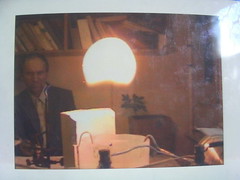
I wonder how long it will be before Al Gore tries to blame ball lightning on “dirty weather”? A neat video follows. From CSIRO:
Goodness, gracious, great balls of lightning
Sightings of balls of lightning have been made for centuries around the world – usually the size of a grapefruit and lasting up to twenty seconds – but no explanation of how it occurs has been universally accepted by science. Even more mysterious are sightings of balls of lightning forming on glass and appearing in homes and in aeroplanes.
CSIRO scientist John Lowke has been studying ball lightning since the sixties. He’s never seen it, but has spoken to eye witnesses and in a new scientific paper(paywalled at AGU, don’t bother) he gives the first mathematical solution explaining the birth of ball lightning – and how it can pass through glass.
Previous theories have cited microwave radiation from thunderclouds, oxidising aerosols, nuclear energy, dark matter, antimatter, and even black holes as possible causes. John disputes these theories.
He proposes ball lightning is caused when leftover ions (electric energy), which are very dense, are swept to the ground following a lightning strike. As for how they pass through glass, he says this is a result of a stream of ions accumulating on the outside of a glass window and the resulting electric field on the other side excites air molecules to form a ball discharge.
According to John ball lightning is rare, but it has been witnessed in Australia many times. People just don’t realise what it is when they see it.
NOTE: This video was provided by CSIRO in their press release. I don’t agree that all of the scenes in the video are relevant to the issue. Take it with a grain of salt. Anthony
==============================================================
For the record, here is what I sent to CSIRO:
Dear Simon,
I’m writing to complain about what I consider a sloppy job related to this press release as it appears on Eurekalert:
 Journal of Geophysical Research – Atmospheres
Expalination for ball lightning
Australian scientists have unveiled a new theory which explains the mysterious phenomenon known as ball lightning.
 Commonwealth Scientific and Industrial Research Organisation
Contact: Simon Hunter
61-395-458-412
1. The word Explanation is misspelled.
2. The title of the paper is not given, forcing anyone who wants to read it to have to figure out what it is by searching JGR.
3. The link to the paper immediately goes to a login page. Paywalls and press releases don’t work well together. At least provide the abstract if the paper is paywalled.
4. As I understand it, CSIRO is a publicly funded agency, so it would make more sense and be in the public interest to make a full copy of the paper available on the CSIRO website.
There has been a trend elsewhere for this sort of incompleteness in conveying science to the public, so I feel I must point it out.
Thank you for your consideration.
Anthony Watts
WUWT
Hey I’ve seen those globes of glowing material dancing across the floor when arc welding is going on. After they stop glowing, you find a mangled wad of metal. Ball lightning eh? (Nope).
There rest of them seem to be common UFOs…
Definitely one of the coolest things I’ve seen on this site.
About 20 years ago I was in a kitchen with some friends during some very intense nearby lightning activity. It was mid afternoon so the overhead kitchen light was off. At one point I had the feeling that things were rapidly getting worse and I called out “Get Down!” and crouched down myself. The window suddenly lit up oddly with a moderate flickery purplish glowing and then the kitchen overhead light ( I *think* a round tubular fluorescent ) started to light up kind of halfway redly in a flickering sort of glow. The whole “event” lasted perhaps 2 to 5 seconds. There MAY have been a big thunderclap immediately afterwards but I’m not sure — there was no “lightning flash” however.
Soooo… was there a big ball of purple lightning hovering outside that window? Dunno… but maybe!
:>
MJM
I once observed ball lightning during a violent thunderstorm in Nebraska from a basement window. It was glowing ball of energy about 4 feet off the ground which followed the road which was concrete with embedded wire mesh. The ball of energy actually made a right turn at the corner, following the road and disappeared over a small hill in front of our house. I could hardly believe my eyes.
So… how long before this armor penetrating plasma energy is weaponized? GK
Dense ions that fall to the ground? That makes no sense at all.
I used to work on radar in the army, as a technician. All the dishes had an old flourescent tube laying around for safety. If you ever had to go in front of the dish, you would hold up the tube, if the dish was transmitting the tube would light up.
It’s difficult to describe how spooky that is…to see an disconnected light start to glow and flicker like that.
My sisters kids saw basketball-sized ball lightning in their home following a lightning strike. If I remember right, it floated down their hallway. Her kids were pretty young and it totally freaked them out.
I once saw what I am convinced was ball lightning. Back in late 1957 I was based in Catterick Camp, Yorkshire. A group of us were returning to barracks from the mess hall when someone yelled, “Look at that”. I saw a glowing orange ball, quite bright, but not dazzling. It was still daytime. Looked to be about the size of a football. It seemed to be travelling along the ridge of the roof quite sedately. It seemed to bounce twice, quite gently, and then vanished into some trees beyond the barrack. Then there was an almighty bang! Startled us to say the least. Somebody came round the corner and said a tree had been struck by lightning. It seems they saw a bright flash. We went to look at the tree. There was a cut in the bark of the tree, starting at about roof height and running almost straight down the trunk. What was surprising was the cut, very narrow at the top but almost a foot wide at ground level. You could peel the bark back and see the bare smooth shiny wood. There was no sign of burning. Also the ground at the base of the tree looked as though something had sliced down into the ground. We couldn’t how deep, just the broken soil. A squaddie who had been in the washroom said all the taps sparkled just before the bang.
EternalOptimist says:
October 19, 2012 at 9:32 am
Hah! I used to work on the Decca transmitting stations. At the master station, we’d hand a flourescent tube to a visitor and ask for help to change it at mast base. As we walked towards the mast, at night time of course, the multipulse would cause the tube to flash. Much panic. We would then sooth the visitor with copious draughts of Scotlands finest.
Make your own. Light a birthday candle and put it in the microwave. You might want to use an old microwave
I’ve seen one two, after a lightning strike against a power line. The ball moved away from the power line for a little over 10 seconds on a trajectory that resembled a gradually condensing sine wave, then rushed back towards the line and expired with a bang.
Through a crack in the paywall: Lowke’s proposition is that the ball forms due to the ionisation of the air in the vicinity of the earth under the influence of the ground currents following a cloud-to-earth lightning strike. This paper explains possible charge distribution after a lightning strike and how that change can cause localised ionisation of air based on the reaction model proposed in the previous paper (http://deanostoybox.com/hot-streamer/TeslaCoils/OtherPapers/IOPpapers/d70417.pdf — see under 2. Theory; not paywalled)
In recent years there have been laboratory creations of luminous floating balls, persisting for up to a second or two.
Under some conditions, apparently a strong electrical discharge (eg, ‘normal’ lightning) can cause a plasma of silicon atoms to form into coherent, luminous ball. I’ve read that silicon can be a component of certain soils,
This explanation might be the basis for some of the the ball lightning reports, throughout history.
My quick search on the http://scitation.aip.org database, turned up a couple dozen recent articles on ball lightning, in some well respected journals.
Anthony my guess on the press release and paywall problem is the journal is trying to drumm up buisness and the press are happy to help! Ball lightning is something i have not heard of , but is an interesting phenomenon.
I know someone that was abducted by ball lightning. They said some very shocking procedures were performed on them. /sarc
A long time ago I saw a ball lightning.
Around 60 years ago, during a thunderstorm my grandfather was putting some coal on the living room fire with a metal shovel. A round glowing ball around fthe size of a tennis ball came down the chimney, bounced off the fire, hit the shovel and exploded with a loud bang and a bright flash of light. It was most certainly not a bolt of lightning, it was clearly a discrete ball and was travelling fairly slowly. My grandfather received a fairly substantial electric shock and the shovel was partially melted where the ball had hit it.
EternalOptimist says:
October 19, 2012 at 9:32 am
Try the same trick under high power transmission lines.
The question is how can an ionized mass stay together in the face of the powerful electrostatic repulsive forces that would act instantaneously to blow a ball of ionized material apart.
We’ve been trying to do just that for 50 years at great expense in the fusion program, with very slow progress.
So there must be more to the phenomenon than just ionized gas.
This guy is a fraud of the greatest magnitude. I can’t believe that anybody, I mean ANYBODY with even a partial knowledge of science wouldn’t understand that his “Lab created ball lightning” is just hot splatter from an arc welder. An arc welder that you can readily see in the video, welding rod and all. The reason it “dances” across the floor is because the floor is concrete. Concrete absorbs water. The hot ball of metal splatter is about 2000deg F. When hot ball of metal contacts water in concrete it creates steam that causes the ball to “dance”.
The only scientific wonder here is, how on earth is it possible this guy is smart enough to write.
My father had told me he saw ball lightning on an airplane. There was an electrical storm outside, and, from his aisle seat, he suddenly saw a glowing ball bouncing down the aisle toward the rear of the plane and disappear at the end of the plane. He said it was the most bizarre thing he had ever seen.
At last, an explanation of ball lightning. Males around the world can now hope that doctors will soon find an effective treatment for this painful and debilitating condition.
/misunderstanding 🙂
I was watching a storm outside my window as a youth, and oberved lightning strike the ground not too far away. The stroke decayed into a string of bright balls that dissipated over about two seconds, but did not fly around or anything like that. I also received a sharp shock to my nose which was touching the metal window screen at the time (lesson learned).
Later in life, while driving I observed a similar thing in a close strike on a tree.
I don’t think any of the things in the video look like what I’ve read about descriptions of ball lightning, and think I have a better explaination for most of them.
Gerry Parker
“He proposes ball lightning is caused when leftover ions (electric energy), which are very dense, are swept to the ground following a lightning strike. As for how they pass through glass, he says this is a result of a stream of ions accumulating on the outside of a glass window and the resulting electric field on the other side excites air molecules to form a ball discharge.”
Ions “are very dense”?? No, they are normal molecules or atoms carrying an electric charge. No more than any other gas. In fact they are less dense because like charges repel each other and if there was a mix of oppositely charged particles there would very soon not be any, as they would be attracted to each other and neutralise.
For the same reason any group of ions will disperse rapidly unless strenuous efforts are made to confine them. Were that not so, we’d already have fusion-powered electricity generation. I really don’t swallow the idea of free-floating plasmas passing through glass.
I think you accidentally misspelled “incompentence” as “incompleteness”.
I think this was J. B. S. Haldane, biologist and polymath, but could be wrong.
To Haldane: ” I hear you’ve been doing some work on ball lightning”.
Haldane (revealing burn scarring): “No, ball lightning did some work on me”.