Guest post by David Archibald
Robert Hargraves lives in Hanover, New Hampshire. Mr Hargraves believes that “Global warming is harming us all.” Using the temperature – solar cycle length relationship from Friis-Christensen and Lassen theory, for cycles 24 and 25, this is what Nature has in store for Hanover, New Hampshire:

So the coming years will be a severe test of his faith in the State-sponsored belief system.
In the meantime, he has done the World a good service by writing a book which describes why Liquid Flouride Thorium Reactors (LFTRs) are the solution to maintaining a high standard of living when the fossil fuels run out.
He starts the book by describing the basic physics of energy and then goes on to rehash IPCC material on global warming. Sometimes authors let slip, by their pronouncements, that they don’t have a good grip on the physical world. One of the better examples of that in Mr Hargraves’ case is this passage, ”Changes to life in the ocean will also be dire. Ocean life thrives in cold water; Caribbean water is blue and clear because it has less life than temperate and polar oceans.” Brian Fagin is another warmer author who betrays a lack of understanding of the physical world; in a number of his books he has describes arrow heads as weighing 1 kg. At any rate, on reading this sort of thing, the reader is alerted to not take any statement as being necessarily true.
The useful part of the book begins on page 115 with a discussion of the costs of existing energy sources – coal-fired power at 5.6 cents/kWh using coal at $45 per tonne and natural gas-based power at 4.8 cents/kWh using natural gas at $5/MBTU. Wind is far more expensive at 18.4 cents/kWh. Using pumped hydro storage to pacify it for the grid would add at least another 6 cents/kWh. Solar power is much the same cost at 23.5 cents/kWh.
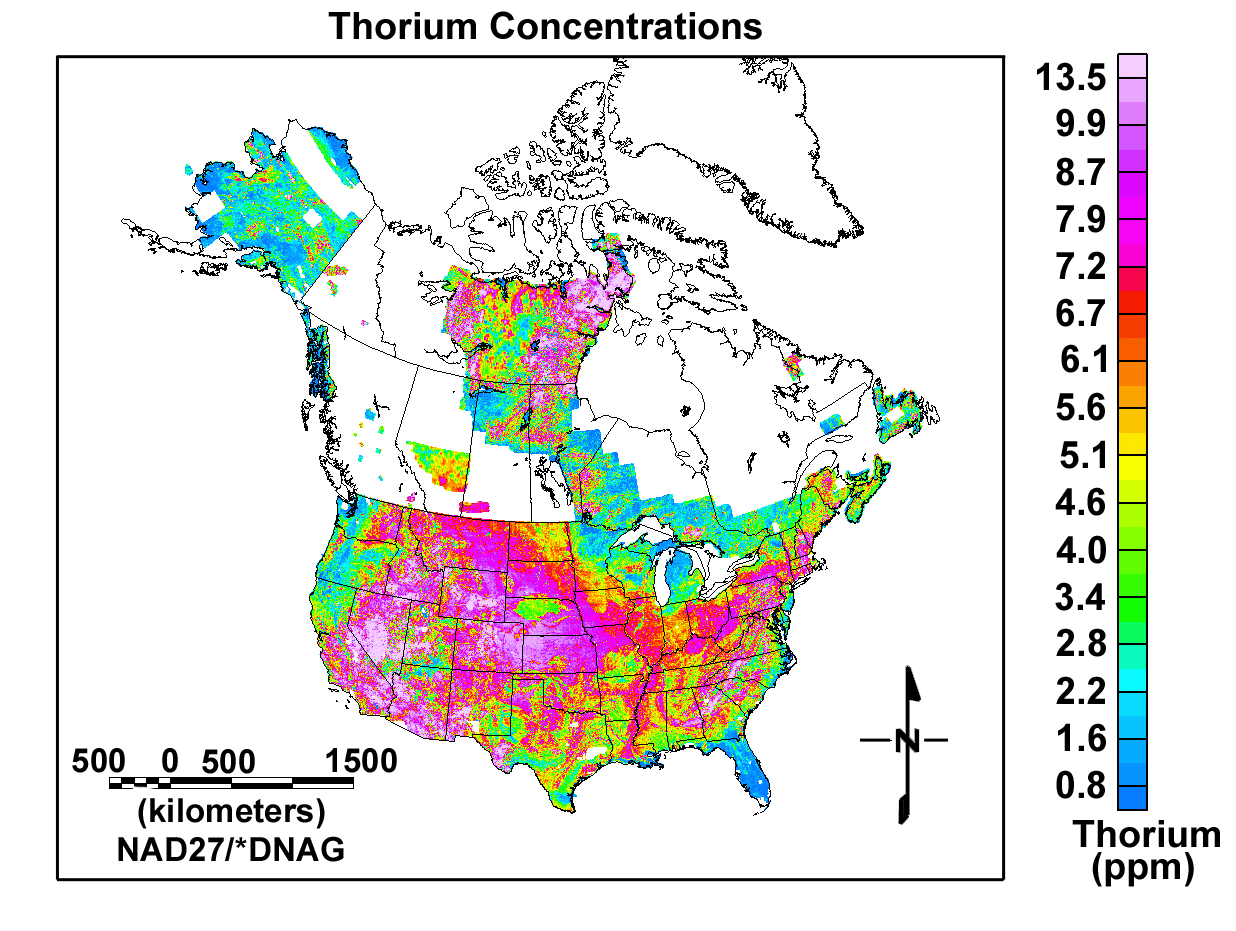
Discussion of nuclear power begins in Chapter 5 on page 176. LFTRs will operate by having neutrons from the reactor core irradiate thorium in a blanket, converting it to fissile U233. That U233 is periodically rinsed from the blanket salt and fed to the core. Power from LFTRs is expected to cost of the order of 3 cents per kWh all up. The LFTRs will need a starter fuel at the rate of 1 kg per MW. The best source of that is the more than 72,000 tonnes of spent fuel rods that has accumulated in the US. That contains at least 648 tonnes of plutonium which is enough to start more than 3,000 200 MW reactors. Those spent fuel rods that have accumulated over the decades are a precious resource.
There is an interesting section on China’s LFTR project starting on page 260. China’s interest was triggered by an article in July 2010 in American Scientist. A delegation visited Oak Ridge National Laboratories where molten salt reactor work was done in the mid-1960s. The Chinese LFTR project was announced at a meeting of the Chinese Academy of Sciences in January 2011. Oak Ridge had 1,894 Chinese visitors in 2011! The project currently employs 432 people, expected to rise to 750 in 2015. A working 2 MW (t) reactor is expected by 2017 and a 10 MW (e) by 2020. The Chinese reaction to that July 2010 article reminds me of John Boyd’s OODA loop. There was a mere six months between reading an article and committing to a major new thrust in nuclear research. The contrast between that and the billions spent in the West on recreating medieval fear and superstition, and calling it climate science, could not be more stark.
This book is also comprehensive. A section on synthetic liquid fuels and how they might be made using nuclear power starts on page 355. It is realised that sources of carbon might become so scarce that the cheapest source might be carbon dioxide extracted from the atmosphere. A scheme to do that is illustrated on page 361. This is ironic in a book that asserts that carbon dioxide is the scourge of Mankind.
King Hubbert, of peak oil fame, realised that Mankind’s fossil fuel use would only be a blip in time and that the future, of necessity, will be nuclear-powered. This is Figure 30 from his 1956 paper “Nuclear Energy and the Fossil Fuels”:

Mr Hargraves’ book has updated that insight and added flesh to the bones of the idea. His book is a useful addition to the comity. He is also to be lauded for self-publishing it. My edition is simply marked “Made in the USA; Lexington, KY; 09 September 2012”. The book’s website is: www.thoriumenergycheaperthancoal.com It can be purchased from Amazon.

===============================================================
Below is a video describing the concept. Long, but informative – Anthony
Did I mess up the blockquotes or is there a limit on them before you get spam-blocked?
Martin A says:
October 3, 2012 at 1:17 pm
Considering that a 2.5Mw nacelle alone is about 100 Tonne…
DaveE.
A good article on the challenges for a LFTR. I find the MSR types really interesting, far more than the renewable garbage. From my skimming, it appears traditional reactors in the III and IV generation might have some of the same benefits.
http://daryanenergyblog.wordpress.com/ca/part-8-msr-lftr/
http://en.wikipedia.org/wiki/Generation_IV_reactor
In case no one else caught it…
Doug Huffman says:
October 2, 2012 at 5:19 pm
@Tom, not that I know. MSR’s have been built. The most recent, the Japanese Monju has suffered a series of accidents and produced an hour of power at a cost of 10 -T- Trillion Yen.
……..
Wow dude, get your facts strait! Monju was a liquid SODIUM fast breeder. Seems every time folks try the fast breeder for U238 – Pu239, some trouble wrecks things. But don’t confuse this with a LFTR which is a thermal spectrum breeder. Totally different.
It is yet another proof that many are “illiterates” on nuclear energy. Just by reading something in the popular media they keep quoting that, what happened in TMI, what happened in Windscale, what happened in Shellafield, etc.
If you ask them what exactly happened and many people were affected, they will blink !
For example, if you ask what exactly is the problem in Monju, this gentleman will not know.
So, the common people shall understand the fact that we shall leave such decisions to the experts.
David Archibald says:
October 2, 2012 at 11:56 pm (Edit)
Willis Eschenbach says:
October 2, 2012 at 5:43 pm
I went to my spreadsheet and it has data from 1835. On the spreadsheet is a link to the data source, which is the Carbon Dioxide Information Analysis Center (CDIAC) at Oak Ridge National Laboratories. CDIAC is the nuclear industry’s contribution to the campaign against coal. They needn’t bother because coal will become too valuable for power generation soon enough. I try the link again and the data starts from 1895. So it seems that the forces of darkness have decided that pre-1895 temperature data is powerful juju that the public should no longer have access to. So this is an appeal for long term, uncorrupted US temperature data.
##########################
The data for New Hampshire includes records before 1850. It’s in berkeley earth data.
http://berkeleyearth.lbl.gov/regions/new-hampshire
Steven Mosher says:
October 4, 2012 at 9:29 am
Thanks, Steven, appreciated.
w.
But rgb, will solar panels ever produce enough energy in their lifetime to both manufacture themselves, all inclusive, *and* supply years of energy to consumers? Will they ever become energy neutral? Maybe so if they become both printable and durable.
Also, I don’t put much hope in fusion. Instead of making plants smaller and smaller, those installations would be huge best I can tell.
See where I am coming from? Liquid salt reactors produce enough temperature to manufacture enough energy to clone themselves, start to finish, fuse carbon into hydrocarbons, produce fertilizer, various chemicals, desalination using the waste heat, etc, etc let alone electrical generation. Don’t think even fusion holds all of those characteristics at a small enough scale to be feasible and inexpensive and distributed.
Of course, I am taking a thousand year view.
Of course they will. The cost of energy is built into their price. If one can buy a cell at full retail now (as one can) and turn a profit on it (as one can) during its lifetime you have by definition paid for the cost of the raw materials and all manufacture costs (including the energy required) plus a profit for not one but several middlemen. They already produce more energy in their lifetime, all inclusive, and supply years of energy to consumers. That’s obviously implicit in the assertion that one can buy a panel and amortize its cost over roughly 2/3 of its lifetime. I’d like the margins to be better, amortize its cost over 1/3 of its lifetime, but it already easily matches the investment cost-benefit of the three successive high-efficiency heating/air conditioning systems I’ve had to buy over the last four years as the original equipment for the house wore out. In fact, if I hadn’t just (sigh) spent some $20,000 over four years on those replacement systems I’d serious consider putting 5 kW on my roof right now. However, I’m old enough (57) that I wouldn’t recover the investment (made now) until I was 70, and who knows if I’ll be alive and in this house at this point. It’s also still a bit dubious that I’d be able to recover the remaining investment in higher sale price of the house — my house is probably already over improved for the neighborhood, with high end energy efficient windows and heater/AC units and a full walk up finished attic. Nice to live in, but housing is depressed and not necessarily a perfect investment.
Inside the decade, though, as prices fall, I rather expect to bite the bullet at a long-term profit. It’s simple arithmetic.
Fusion, of course, is a speculative technology at best. The latest report on /. was that at least one group thinks they have the SHORT run pathway to 1000x energy gain in special magnetic pinches — if they are right that isn’t a thousand year solution is is an “infinity” solution. Humans will have evolved to not be human by the time fusion fuel and energy is depleted in our solar system. Or we’ll have gone extinct, of course. Either way fusion equals the dawning of a new age, literally, the fusion age, where energy is never again a limiting resource for humanity and where whatever the reality of the CO_2 situation is, it won’t matter, as by MID century there simply won’t be any more burning stuff to make electricity, anywhere on the planet, ever again.
Thorium isn’t bad or crazy, but it isn’t as good as fusion if fusion at a megawatt (plus fuel) in per gigawatt out works out. Also, the cost of the fuel itself will be far smaller, as it is easier to extract deuterium from sea water than thorium from ore. Finally, it is a lot safer, and produces a lot less radioactive/toxic waste, and the nuclear proliferation risk from fusion plants is zero.
Of course, the 1000x gain may not work out. Or it may continue to be “ten years from now” like it has been for 30 years or more. Speculative, no doubt, but so is thorium to some (but a lesser) extent. In the meantime, solar is FWIW pretty much a sure thing — a marginal technology already but poised to become enormously profitable with the nearly inevitable progression of work already in progress that is very, very likely to maintain the downward progression in cost per watt that we’ve seen for the last twenty or thirty years. If storage technology “hits” on any of its many high-return (high risk) projects that are underway in the meantime, even fusion will have long term competition from PV solar. Or (if you like longer shots) if any breakthrough in transmission occurs — room temperature current tolerant superconductors made out of engineered nanomaterials or whatever.
The point is that coal is dandy, natural gas dandier, but they’re still basically transitional technologies and fuel sources for large scale energy production whether or not they have major negative environmental consequences. Personally, climate skeptic or not, it wouldn’t be that surprising to me if at least coal does (it’s hard to see any negative impact from burning methane unless CO_2 is catastrophically bad, and I doubt that it is). But there may be other negative aspects of mining methane. Time will tell. Building solar cells isn’t zero impact either. Nor is building nuclear plants of any sort. One of many things that annoys me about the environmental impact assessments is that they don’t really do a fair comparison of the “costs” and “benefits” of the alternative technologies. The free market doesn’t either — it’s too easy to foist hidden costs off on future generations or the commons (see Hardin’s “The Tragedy of the Commons” if you haven’t read it yet).
In the end, energy production and consumption is a Commons issue, one that requires regulation and a fair assessment of real costs and benefits. Sadly, the sociopolitical Universe of the human species so far has proven absolutely incapable of the rational solution of this sort of problem, so we just muddle along in a state of both ignorance and an appalling distance away from any sort of economic/environmental optimum. The free market does pretty well, as long as it is prevented from abusing the commons, but what are lobbyists for if not to extract commons exceptions that grant the recipient great wealth at everybody else’s expense (with little passed on benefit to compensate). But I digress.
rgb
I agree in entirety with your first few paragraphs, thereafter we disagree. I think we can agree that Thorium is now a problem of technology, much of which is already solved. it’s now down to best available technology and that is an engineering problem.
And the beauty of it all is, it is perfectly reasonable for us to disagree on things like this. Personally, I have thought for years that we should be pushing LFTR technology hard, and am aware of the sad story of how it got derailed in the first place in order to support the US military’s need for plutonium as a byproduct of power generation. And sure, perhaps it will work on a small scale, although that would require a major sea change in the way the entire electrical grid currently works. But given time and investment, who knows? I’m still not even fully convinced as to whether or not PV solar will be a bottom up (rooftops everywhere owned by private citizens selling back into the grid) or top down (massive solar owned by corporations) transformation for exactly that reason.
Corporations have the advantage of economy of scale, and can actually make money on solar now at rates that justify the investment (unsubsidized) in at least some venues. For private individuals the return is positive but not terribly attractive because they are at the wrong end of a retail chain and have to support lots of middlefolk. But corporation eventually will have the fixed cost of maintaining the distribution grid and providing bridge power to consider, which will limit the profitability no matter how cheap the cells themselves get, where private homes have total costs that still scale down strongly with the price of cells.
Storage is obvious a key here — invent a $1000 (perhaps zinc oxide) battery that can hold 200 kWh in a volume of half a cubic meter, or less and solar is a no-brainer almost everywhere, and power will decentralize so fast it will be downright scary not to the small corporate generator level but to the household level. Buy a house that has zero electrical costs, forever, beyond routine maintenance and replacement? Free AC, free heat, free refrigeration, free lights. Who wouldn’t? And electrical cars would be enabled at the same time — that’s finally getting close to the energy density of gasoline, which is its primary attractive feature. Put a few of these batteries in a house and a surplus of panels on the roof and you won’t run out of electricity even over a week of poor conditions and low production.
If I were king of the forest, I’d push money not into climate research (who cares!) but into energy research, specifically batteries, competing solar PV and other technologies, fusion, LFTR, efficient transmission schemes, even long shot borderline crank ideas. Some of these things are just a matter of good engineering and building pilots to work out the bugs, others require some serious work in physics to get to work, but they all have the characteristic of a relatively low cost (but too much to expect it to be done by private individuals at high risk) and an enormous payoff if they hit. Precisely the kind of thing the government CAN enable but the private sector usually does not on its own.
rgb
There are those who have grown weary, and think that Fusion is far away. But in reality it is NOT. ITERbuilding in France, is both the last Fusion physics experiment; and it is at the same time, the first protoype of a commercia lFusion reactor.
ITER will produce between 500 and 700 megwatts, thermal, of Fusion energy, ten times what it took to initiate the reaction, and will run for the better part of an hour each time it ignites a fusion plasma. That is far, far longer than the few portions of a second that instabilities take to form. ITER will show that the long list of plasma instabilities are now catalogued, understood, and now conquered, and ameliorated.
The large amount of energy produced for that length of time provides substantial amount of engineering data to makeclear we understand and know all the engineering problems constructing a commercial Fusion reactor. It’s succesor will be able to add power much more reliably to the grid than any windmill or solar array.
ITER will provide more power than any windmill or solar array. in existence by a factor or 50 for ITER and probably thousands of times for its succesor, and the succesor as planned will be the first to add Fusion generated power to the grid.
The only reason ITER is not harnessed to provide grid power is because we chose not to do so. Since after all, we want the flexibility to experiment, and we can save a few millions in not buying the generators and ancillary equipment. But we could do so, and it is more continuous than any windmill in existence!
We could start designing and building its succesor the first commercial Fusion plant within a mere five years. We could build five or six succesor Fusion plants for what has been wasted by the US alone by the present Administration, for quixotic windmills and solar arrays and failed crony capital Green companies.like Solyndra, First Green etc. .
People like us know Fusion is very much possible to commercialize soon. But what is the present status of the material for the electromagnetic Coil ? At what temperature it is having superconductivity ? This being the key for building the the successful commercial Fusion reactor, it will be nice if you can throw some light on this matter.
Steven Mosher says:
October 4, 2012 at 9:29 am
Yes, thanks for the reference to the BEST project. That graph shows the Dalton Minimum very well.
Now, in terms of getting data from that site, it wasn’t immediately apparent to me how to do that, if it is at all possible. If it is possible, posting instructions here would be very much appreciated.
As I was alluding to earlier with my reference to Nickel and hydrogen (but, I got no ‘bites’ either way), LENR has _not_ gone away and we are only now beginning to see (IMO) properly instrumented test apparatus (rather than the throwback test setups lashed together the last few years even using crude instrumentation dredged from the back-of-the-school-lab that had remained there since the 1950’s) using state-of the-art software (LabView) and data acquisition (NiDAQ) hardware such as shown in this demonstration of “Anomalous Heat Effect” at NIWEEK this year (2012) in Austin Texas:
Progress _is_ continuing with Rossi and Leonardo Co. and his device as well (e.g. the 1 MW commercial heat plant), but, more on that at a later date. In the meantime, anybody with some extra time-to-burn can delve into the materials and the very informative video of the conference as it was ongoing in Zurich this year (2012) on Sept. 8th and 9th where Andrea Rossi himself also took and answered a multitude of questions from the attendees:
http://pesn.com/2012/09/09/9602178_Rossi_Reports_Third-Party_Test_Results_from_Hot_Cat/#September_9_QnA
.
To be complete, an NI presentation that shows NI commitment to experimenters investigating what has become known as “Anomalous Heat Effects” among researchers of this phenomenon involving ‘quantum reactions’ (ostensibly LENR AKA ‘cold fusion’):
.
Of course, the real issue is not thorium per se, but liquid verses solid fueled nuclear reactors. The solid fuel cores must be replaced after only a small amount of the fuel has been consumed due to the accumulation of nuclear waste. These cores also contain dangerous long-lived transuranic waste products that energetically decay by fission. Solid fueled reactors are normally cooled by potentially explosive, super-heated water at high pressure.
The liquid fueled reactor design allows almost all the fuel to be consumed because the fluid is not damaged by fission products, which can be selectively removed from the liquid salt. Most of the fission fragments decay to safe levels in a few hundred years by electron emission. The high-temperature liquid salt runs at ambient pressure and is non-explosive. These reactors can be configured as complex thorium to uranium breeder reactors or simple uranium burners.
According to Dr. David LeBlanc in his presentation at the TEAC4 Future of Energy Conference, there appears to be gathering serious interest in Canada for developing liquid fueled uranium burner reactors, similar to the Molten Salt test unit built at Oak Ridge–to help recover petroleum from the tar-sands. This application could serve as a proving ground for the technology. He said that these burner reactors would be so efficient that if uranium prices rose to $500 per Kg, the impact would only be about 0.2 cents per kw-hr.
David LeBlanc – Molten Salt Reactor Designs,
Options & Outlook @ur momisugly TEAC4
“Published on Jul 20, 2012 by gordonmcdowell”
32 likes, 0 dislikes; 1480 views; 19:46 min
“Canadian David LeBlanc describes the benefits of liquid fuel Molten Salt Reactors over solid fuel reactors, emphasizing reactor design over any relative advantages of thorium or uranium.
“Come for the thorium, stay for the reactor!”