Re-posted from BernieL at Enthusiasm, Scepticism & Science
John Haughton writes of it under the heading: Meetings that Changed the World. He may be right but not only in the way he thinks. Here we consider whether this meeting in Madrid was the moment when climate science gave way under the monumental pressure of politics.

When Ben Santer arrived in Madrid in the late autumn of 1995, did he know that this conference would change his life forever? Undoubtedly ambitious, a rising star in the climate modelling scene, he was doing well at age 40 to be leading the writing of a key chapter in the IPCC Second Assessment Report. In fact, the convener of this IPCC Working Group, John Houghton, had asked him to take it on quite late in the day, only after more established scientists had turned down the offer. Perhaps they had a hunch of what was about to unfold, for it would be Santer’s fate that great forces of history would bear down on the editor of his chapter at this conference. When he was through with it, when Houghton had accepted the final draft a few days later, climate science would be changed forever. After a long struggle, the levees of science gave way to the overwhelming forces of politics welling up around it, and soon it would be totally and irrevocably engulfed.
The story of Ben Santer’s late changes to Chapter 8 of the Working Group 1 Report is familiar to most sceptical accounts of the climate change controversy (e.g. here & here and a non-sceptical account). However, it is often overshadowed by other landmark events, and so it is usually not put up there in the same league with Hansen‘s sweaty congressional testimony of 1988, with the establishment of the IPCC nor with the Hockey Stick controversy. Yet, if one looks at the greater controversy in terms of its impact on science, then this conference in Madrid might just surpass them all.
This was the tipping point. This was climate science’s Battle of Hastings, when political exigencies – the enemies of science – broke through the lines and went on to overrun all its institutions. Before Hansen there had always been the rogue scientists hawking some kind of scary scenario to the press or politicians. Indeed, sometimes they listened, and sometime they got all het up about it. Yet the institutions of science held firm. Before the IPCC there had been other politicised scientific institutions – the USA EPA is the prime example (see discussion here). And as for the Hockey Stick, well, by then it was all over, with the Climategate emails confirming that a culture of science-as-advocacy was already endemic in the science informing the IPCC assessments. The travesties of the Third Assessment would be unimaginable without the transformation that had already occurred in the writing of the Second Assessment. Madrid was the tipping point, when everything began to change. Not that everyone noticed it at the time. That the general shift begun at Madrid is much easier to see now with so many years of hindsight.
For example, consider the shift in the opposition; how after the breakthrough in Madrid there was a gradual change of the guard on the sceptical front. After the Second Assessment, after Kyoto, most of the usual corporate opposition was in retreat. Many went over to the other side, at least in their marketing – with the sins of their past quickly forgiven and forgotten. Does anyone even remember the Global Climate Coalition? If you have heard of ‘Big Oil,’ well this was it out there in the sunshine with the thinnest veil of disguise. These guys were seen on the job in Madrid passing notes to the Saudi delegation before its every intervention. A week after the conference a Science journal news headline trumpeted their failure to swing the conference against just such a pronouncement: It’s official: the first glimmer of greenhouse warming seen [Dec 8, 1995 p. 1565]. Then the following Spring, with the imminent publication of the new Assessment, and with similar headlines now mainstream, the Global Climate Coalition fought back by sparking the controversy over the late changes to Chapter 8.
This was picked up by Frederick Seitz, a notorious Merchant of Doubt associated with the tobacco lobby. But his Wall Street Journal op-ed [12Jun96] seemed to present some pretty damming evidence of politicised tampering with the conclusions of science. It caused quite a stir in the science press, with the contrarian climatologist, Fred Singer, coming in hard behind Seitz. Even if it seemed that every other climate scientist jumped in behind Houghton and Santer, a new scepticism now emerged to fight not for policy outcomes but in defence of science. Indeed, the political forces against emissions control were still corporate, and still on the right, but this was a new and powerful dimension to the debate. And yet it seemed that the scientists advocating for climate change science didn’t even notice—some not until Climategate, others not to this day (eg, The Royal Society presidents discussed here). They are still fighting ‘Big Oil.’ Perhaps it was convenient, or tactical, to tar the new with this old brush. Perhaps, and yet, when Bjørn Lomborg (1998) and Steve McIntyre (2003) came on the scene, it does seem that many found it truly inconceivable that they might not be motivated in some way by short-sighted self-interest, or capitalist greed.
It was just as inconceivable for scientists advocating for climate change science that they might be, themselves, complicit in the perversion of science, where, as Richard Lindzen observed, the legitimate role of science as a powerful mode of inquiry is replaced by the pretence to a position of political authority [see here pdf]. When did this all begin? Was it a gradual thing, or was there some dramatic breakthrough at that meeting in Madrid scheduled to finalize the second scientific assessment of climate change?
That the corruption of climate science began in Madrid, this is a proposal I would like to explore in a couple of posts on this blog. To begin this discussion let us first recount the events leading up to this extraordinary meeting.
Climate Science Uncorrupted
In many ways the Intergovernmental Panel on Climate Change is a rare beast. In some ways it is perhaps unique, especially in the way it forces international science to consent to an agreement with the full spectrum of inter-governmental political actors. We will get to that later. But there is one way in which the IPCC operates that is familiar and ordinary to long-established practices of national scientific academies (and even some international organisations). The IPCC follows such organisations in making scientific assessments and offering recommendations upon the request of governments. In order to get a flavour of this regular and ordinary function, let us consider this extended quote from the introduction to a report by the Australian Academy of Science:
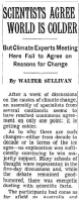
Pronouncements about the climate from scientists in a number of different fields, and pressure on the world’s food supplies, have resulted in the production of reviews of two kinds. The first is the investigation by committees and conferences organized by natural scientists of the existence, nature and extent of the purported climatic changes (e.g. Inter-departmental Committee, 1974; World Meteorological Organization, 1975a; National Academy of Science, 1975, Australian Academy of Science/Australian Branch, Royal Meteorological Society, 1976). The second consists of a series of papers and conferences organized by social scientists, but with contributions from natural scientists, examining the political, social and economic consequences of such climatic changes, should these develop as predicted (e.g. Rockefeller Foundation, 1974; International Federation of Institutes of Advanced Study, 1974, 4975a, 1975b). Such a flurry of activity in the scientific world, rippling out to political and social scientists and so impinging on politicians, as at the World Food conference in November 1974, naturally provoked the publication of general scientific articles in journals like Science and Nature, and popular presentation and comment in magazines such as the New Scientist and Ecologist as well as the daily press. In the more popular accounts, notably those by T. Alexander (1974) and [Nigel] Calder (1974), the issues were inevitably over-simplified and extreme points of view given greater currency than was their due. It is in the stark simplistic terms of the popular scientific articles that the world’s press has interpreted the situation, with forebodings of an imminent return to the cold of the last glacial period.
Deep concern about climatic change amongst social scientists, politicians and the public is justified only if the underlying proposition that we are in the throes of a substantial climatic change is correct. However, even if the prediction of imminent adverse change proves unsubstantiated, or if a continuing trend of climatic change cannot be demonstrated, the concern generated by these views has been useful in emphasising the natural variability of climate, which should itself be a component in economic planning.
In terms of the popular controversy and the government response, there are many similarities between the New Ice Age scare of the 1970s and the Global Warming scare – at least as the latter manifested up to 1995. In the New Ice Age scare we had:
- Scientists making the most alarming claims drawing the attention of the press and of some receptive social scientists
- Social scientists and others exploring the social implications of these alarming claims
- Concern developing among the public and politicians
- Governments anxious for a sober assessment of the risks turn to the various international organisations and national academies.
And there are lots of similarities in the scientific response.
As our Report of a Committee on Climatic Change explains above, governments commissioned scientific investigations in order to determine whether there were any scientific grounds for concern. And what were they told? In most cases the alarm was assessed on balance to be with little scientific foundation. In our quoted report for example, the Australian government was given a marvellously readable summary of the science showing how the climate is always changing, before being told that there is no reason to think that the climatic variations will be heading inexorably in one direction during the foreseeable future. The Report concludes that there is no evidence that the world is now on the brink of a major climatic change. And this is pretty much how public science helped to moderate the New Ice Age scare into a forgettable chapter of social history.
Now consider John Zillman’s insiders account [1997 pdf] of the impetus behind the formation of the IPCC:
The Intergovernmental Panel on Climate Change (IPCC) originated from proposals put forward during debate at the Tenth Congress of the World Meteorological Organization (WMO) in Geneva in May 1987. Several Directors of National Meteorological Services, especially from developing countries, called on WMO to establish a mechanism that would enable them to respond authoritatively to the increasingly frequent requirements to brief their Governments and national communities on the reality or otherwise of the threat of global warming as a result of increasing atmospheric concentrations of greenhouse gases. For the most part, Governments, at that stage, were reacting to sensationalised media coverage of predictions of future climate change promulgated by a number of individual scientists and climate modelling groups, as well as the then recently released report of the Brundtland Commission on “Our Common Future” (The World Commission on Environment and Development, 1987) which had dramatically lifted the profile of enhanced greenhouse warming as a threat to the future of the planet.
We have been there before. And sure enough, the IPCC’s First Assessment of the science of climate change (Working Group 1) had a sobering impact, concluding along much the same lines of the Australian Academy’s report on climatic change 14 years earlier. Sure, the climate models were more advanced and more respected in 1990. But whatsoever the models predict, the IPCC Report concluded there is yet no evidence in the real world data to warrant alarm.
Two years later another report was commissioned where the Working Groups was asked to update their assessment ‘in the light of new data and analysis.’ This was in anticipation of ‘the need in 1992 for the latest information on climate change, in the context of the ongoing negotiations on the Framework Convention on Climate Change and the United Nations Conference on Environment and Development (Rio de Janeiro, June 1992).’ In this Supplementary Report prepared especially for the Rio ‘Earth Summit,’ the conclusion was again much the same: Whatsoever the models predict, there is yet no evidence of the need for alarm, for the evidence is inconclusive that any detected changes might be anything more than nature variations.
Detection and Attribution
In 1988 James Hansen had told the US Congress that ‘there is only a 1% chance of an accidental warming of this magnitude.’ Under oath he proclaimed that ‘the greenhouse effect has been detected, and it is changing our climate now.’ Two years later, after sensational media coverage, the IPCC assessment’s implicit message was that such an assessment was at best premature, or at worst over-simplified and extreme. Another two years on, when they were asked to review their assessment for Rio, the scientific working group came to pretty much the same verdict. Of the detected ½ degree or so of warming over a century, all they could manage to say was that this amount of warming is
…broadly consistent with predictions of climate models, but it is also of the same magnitude as natural climate variability. Thus the observed increase could be largely due to this natural variability; alternatively this variability and other human factors could have offset a still larger human-induced greenhouse warming
And then the punch line:
…the unequivocal detection of the enhanced greenhouse effect from observations is not likely for a decade or more.
This seemed to be saying that we would have to wait for at least another 10 years of real world data before the science could be settled. And yet that year the Rio summit went ahead and delivered the Framework Convention on Climate Change (FCCC). The politics was marching relentlessly ahead of the science. As Aynsley Kellow once put it to me, ‘by design, the IPCC was accorded a central place in the development of the Framework Convention on Climate Change, with the parties committing themselves to future action on the basis of future IPCC findings.’ But the content of these future IPCC findings was clearly anticipated by the political framework. Kellow continues:
While under Article 2 of FCCC, the Parties committed to no more than a vague undertaking to stabilise concentrations of Greenhouse Gases at a level which would prevent dangerous anthropogenic interference with the climate system, they also committed to review their commitments at the First Conference of the Parties (COP-1) in Berlin in 1995 and regularly thereafter in the light of the best available scientific information. Having undertaken such a review they are legally bound (under Article 4.2(d)) to take appropriate action which may include the adoption of amendments to the commitments. The Berlin Mandate which led to the negotiation of the Kyoto Protocol was thus effectively decided by the IPCC rather than the COP.
The political framework, as the political rhetoric, was saying that the scientific assessment of the IPCC was driving the politics, but at this stage the inconclusive conclusions of Working Group 1 couldn’t be used to mandate anything. All they had was the model predictions, and with so many uncertainties tabled in the reports, these would surely not suffice.
The political pressure upon the IPCC was becoming all too apparent. It was coming from above—from the United Nations. It was coming from the science lobby, and it was coming from a global environmental lobby engorged with public funding (see discussion in a following post). They were all looking for a conclusive ‘detection’ of warming, and the ‘attribution’ of this warming to carbon emissions. And this pressure was only exacerbated by the divisions of labour accorded to the IPCC. While Working Group 1 was assigned to assess the science of climate change, there was also Working Group 2 assessing the impact of climate change, and Working Group 3 assessing how best to mitigate it. Clearly the work of these groups depended on the conclusions of Group 1. Yet for expedience in the midst of a perceived emergency, Groups 2 & 3 were set to work right away so as to support preparations for the change, and to support planning to mitigate the cause. But how could the impacts of warming be assessed when it had not even been detected? And how could mitigation advice be given, when the cause had not yet been attributed?
With the FCCC in place and COP-1 coming and going in Berlin, next was Kyoto, the event where a legally binding commitment would be on the table. Meanwhile, work was progressing on yet another assessment. Again, and more than ever, what the politics desperately need from the Second Assessment was for the IPCC to come to the party and announce that dangerous anthropogenic warming is happening…or at least …is unlikely not to be happening…perhaps…it is just beginning to be detected,…the first glimmer? As a conclusive result from Working Group 1 appeared more and more elusive, clutching at straws became the norm. And it all came down to what was said in Chapter 8.
Chapter 8 was critical because this is where research on the ‘detection’ and ‘attribution’ of climate change is assessed. This is where the science goes beyond the fancy of the models; where a warming is detected in the actual atmosphere that can be confidently attributed to an anthropogenic global effect.
Alas, by the early autumn of 1995 the signs were not good. Although a draft leaked in September managed to say that the warming is unlikely to be entirely due to natural causes, this was hardly in dispute, and this was not exactly announcing imminent catastrophe. Moreover, there remained extraordinary strong caveats, especially in Chapter 8, to every positive conclusion. The draft that was circulated to the participants at the Madrid conference, and formally approved by it, also stated in its introduction that results of recent studies point towards a human influence. This was the strongest statement yet, but the body of the document and the concluding summary were not so confident. Some of the boldest retractions were as follows:
- Of studies of Changes in Global Mean Variables (8.4.1): ‘While none of these studies has specifically considered the attribution issue, they often draw some attribution conclusions, for which there is little justification.’
- Of the greenhouse signal in studies of modelled and observed spatial and temporal patterns of change (8.4.2.1): ‘none of the studies cited above has shown clear evidence that we can attribute the observed changes to the specific cause of increases in greenhouse gases.’
- Of pattern studies ‘fingerprinting’ the global warming (see discussion in later post): While some of the pattern-base studies discussed have claimed detection of a significant climate change, no study to date has positively attributed all or part [of the climate change observed] to [anthropogenic ] causes. Nor has any study quantified the magnitude of a greenhouse gas effect or aerosol effect in the observed data—an issue of primary relevance to policy makers.
- Of the overall level of uncertainty: Any claims of positive detection and attribution of significant climate change are likely to remain controversial until uncertainties in the total natural variability of the climate system are reduced.
- Of the question: When will an anthropogenic effect on climate be identified? (8.6): It is not surprising that the best answer to this question is, `We do not know.’
[A copy of the 9 Oct 1995 draft of Ch 8 has not been obtained. Unverified sources: here and here]
As the Global Climate Coalition pointed out when they broke the scandal, these statements were removed from the final draft of the Working Group 1 Assessment that Houghton presented for acceptance by the full meeting of the IPCC in Rome two weeks later. Moreover, these inconclusive conclusions were not inserted elsewhere, while more positive statements were substituted, strengthened or added. Nature’s first editorial response to the scandal was all about not disrupting the political message before the US election. Yet it conceded that the complaints about the changes to Chapter 8 ‘are not entirely groundless.’
IPCC officials claim that the sole reason for the revisions was to tidy up the text, and in particular to ensure that it conformed to a ‘policymakers’ summary’ of the full report that was tortuously agreed by government delegates at the Madrid meeting. But there is some evidence that the revision process did result in a subtle shift in the relative weight given to different types of arguments, and that – not surprisingly – this shift tended to favour arguments that aligned with the report’s broad conclusions. Conversely, some phrases that might have been (mis)interpreted as undermining these conclusions, particularly if, as IPCC officials feared, they were taken out of context, have disappeared. [13/6/96]

How these changes came about we will discuss in another post, but what I wish the reader to consider for the moment is the state of play when Ben Santer arrived for that conference in Madrid.
Late in the belated preparations of its 3rd report (the ‘Second Assessment’), now under the sole direction of John Houghton, the IPCC Working Group 1 was still saying that the science was inconclusive, uncertain and disputed. Moreover, despite enormous pressure, including his own personal interests and opinion, Ben Santer’s chapter continued to proclaim that the evidence for the detection and attribution of a catastrophic warming trend was in many ways uncertain and certainly inconclusive—hardly the bases for a legally binding global commitment to radical reform.
Climate science did not just roll over under the pressure of politics. Until the Madrid meeting, IPCC science had managed to keep on doing its thing mostly uncorrupted by the monumental political forces building up around it.
In this view, one is drawn to speculate that if only somehow the whole turnaround in and after Madrid had not happen, what then? What of Kyoto? What of all the rest? Would this episode in the history of the UN have become as forgettable after 1996 as the Ice Age Scare after 1976?
But it did happen. The Assessment delivered just enough of what was needed for Kyoto. In the realpolitik of the situation, it could hardly be otherwise. In another post I will explain why.
—BernieL
_________________________________________
Following posts will give a more detailed account of the Madrid conference and also of the political pressure imposed from many sides during the reviewing of the Second Assessment.
While the author considers this document (SAR WkGp 1), this time (1995-6) and this place (Madrid) of the highest significance to this controversy, nontheless he lacks many original documents required to study it. Any assistance in locating such documents would be appreciated.
Seeking the following Documents:
- Michaels, P. Forging Consensus: Climate Change and the United Nationals. 1996
- The IPCC: Institutionalized “Scientific Cleansing,” Global Climate Coalition, Global Climate Coalition memorandum, Donald Rheem, May 17, 1996.
- Doctoring the Documents? Energy Daily 24(98): 1-2 (ISSN 0364-527)
- IPCC Working Group 1 Second Assessment Report. Draft version (9 Oct 1995) circulated to the participants in the Madrid Plenary, Nov 1995.
- Any national Delegation Reports (I have Australia’s)
_____________________________________________
22AprilUPDATE: Follow the discussion on Bishop Hill
“Institutionalized “Scientific Cleansing””….
Sounds bad….Wonder who the “Gruppen-Fuhrer” was…
Andrew W says:
September 6, 2012 at 1:13 pm
I’m pleased, though surprised you linked the post to the Wiki page “The Hockey Stick controversy” given that it refutes claims that the “hockey Stick” shape for NH temperatures over the last thousand years isn’t correct.
____________________________________________________________________
“Refutes”? Add this to your calibration: manufacture English wine of quality and quantity that not only competes with French wine but renders imports unnecessary (as in the MWP). Wikipedia’s climate science is controlled by believers. Look elsewhere for competent discussion. –AGF
Who claimed that English wine produced during the MWP was any good? I’ve no doubt it could’ve been sold locally no matter how bad it was given the then cost of long distance (even within Europe was then long distance) trade, this would have pushed the cost of imported wine out of the reach of all but the wealthy.
Andrew W:
re your post at September 6, 2012 at 4:19 pm
I love warmist’s desperate attempts to hide from reality.
Nobody is talking about the quality of British wine produced a millenium ago when it was warmer than now. The Doomsday Book records that vineyards existed as far north as Hadrian’s Wall. Today they could not exist that far north: they only exist – but struggle against the cold – in Southern England.
Richard
“they only exist – but struggle against the cold – in Southern England.”
Since when has Lancashire been in Southern England? And of course, because of transport limitations, a greater variety of crops were grown locally hundreds of years ago than today, even when the local climate was less than ideal.
I have a major problem with this libelous sentence, “This was picked up by Frederick Seitz, a notorious Merchant of Doubt associated with the tobacco lobby.” which cites Oreskes propaganda book. Why am I reading this garbage here?
Dr. Seitz was a highly credentialed and respected scientist,
Frederick Seitz, A.B. Mathematics, Stanford University (1932), Ph.D. Physics, Princeton University (1934), Proctor Fellow, Princeton University (1934–1935), Instructor in Physics, University of Rochester (1935–1936), Assistant Professor of Physics, University of Rochester (1936–1937), Research Physicist, General Electric Company (1937–1939), Assistant Professor of Physics, University of Pennsylvania (1939–1941), Associate Professor of Physics, University of Pennsylvania (1941-1942), Professor of Physics, Carnegie Institute of Technology (1942-1949), Research Professor of Physics, University of Illinois (1949-1965), Chairman, American Institute of Physics (1954-1960), President Emeritus, American Physical Society (1961), President Emeritus, National Academy of Sciences (1962-1969), Graduate College Dean, University of Illinois (1964-1965), President Emeritus, Rockefeller University (1968-1978), Franklin Medal (1965), American Institute of Physics Compton Medal (1970), National Medal of Science (1973), (Died: March 2, 2008)
His involvement with the tobacco industry has nothing to do with Oreskes’ smear,
http://www.ideasinactiontv.com/tcs_daily/2006/04/vanity-scare.html
“To find out if the startling claim was true — that Seitz “directed a 45M tobacco industry effort to hide health impacts of smoking” — I called him at his apartment in Manhattan. Unless there is more to the story, the accusation appears to be a willful distortion, if not an outright lie.
“That’s ridiculous, completely wrong,” Seitz told me. “The money was all spent on basic science, medical science,” he said.
According to Seitz, the CEO of RJ Reynolds — the tobacco company — was on the board of Rockefeller University while Seitz was a full-time employee there. “He was not a scientist,” Seitz said of the executive, but he believed in supporting the University’s dedication to basic research — in a little over a century, Rockefeller University has had 23 Nobel Prize winners affiliated with it, in fields of medicine and chemistry. RJ Reynolds allocated $5 million a year to Seitz to direct basic research.
To figure out how to distribute the money, Seitz says he assembled some top folks in different fields of scientific research — such as James Shannon, the director of the National Institutes of Health for 13 years, and Maclyn McCarty, the legendary geneticist — to help direct the funds.
What kind of research did they support? Seitz mentioned the work of Stanley Prusiner, who won the Nobel prize for his research into prions (Prusiner even thanks Seitz and RJ Reynolds in his Nobel Prize acceptance speech which you can read here).
When I asked Seitz if he ever spent money to try to debunk a link between smoking and ill-health, he said no. When I asked him if he himself had ever denied a link between smoking and cancer, Seitz (who, remember, is almost 100 years old) again said no and told me “my father was a 19th century man, and even he told me from when I was young that there was a connection between smoking and cancer” and that “we often talked about the hazards of smoking.” In other words, Seitz was aware of the ill-effects of smoking for a very long time, and has never tried to deny that.”
You can read more here,
Clouding the Truth:
A Critique of Merchants of Doubt (PDF)
Andrew W:
Your post at September 6, 2012 at 5:20 pm is another example of warmist escapism from reality.
You claimed that that in the Middle Ages English wine was probably grown where it could be now but was of poor quality. I replied saying
Now, you reply
Are you seriously claiming you could now grow vines as far North as Newcastle On Tyne?
Perhaps you also think you could raise cattle in the pastures of Greenland which were used by the Vikings but are now tundra?
Cattle are now farmed further south in Greenland as vines are now farmed further south in England.
It was warmer a thousand years ago. Live with it.
Richard
richardscourtney says:
September 6, 2012 at 4:44 pm
“The Doomsday Book records that vineyards existed as far north as Hadrian’s Wall. Today they could not exist that far north: they only exist – but struggle against the cold – in Southern England.”
Do you ever check anything before you present your own opinions as facts?
http://yorkshire.greatbritishlife.co.uk/article/vineyard-owners-in-yorkshire-are-turning-the-notion-of-wine-making-on-its-head-37141/
Ryedale isn’t all that far from Hadrian’s Wall…
John R. Walker:
Thankyou for your link to the newspaper article which that you provide at September 7, 2012 at 4:12 am and updates my information. The link is
http://yorkshire.greatbritishlife.co.uk/article/vineyard-owners-in-yorkshire-are-turning-the-notion-of-wine-making-on-its-head-37141/
And the articles first paragraph says:
So, on the basis of that information alone, we have now returned to temperature levels of the Roman and Medieval warm periods.
However the following two paragraphs say
(emphasis added)
Do you ever read your links before posting them in attempt to mislead from the truth?
It was warmer than now in the Roman and Medieval Warm Periods. Live with it.
Richard
It was always easier to ship wine by sea (and river) than overland, but it was rarely duty free. That provided the incentive when climate allowed. British acreage dedicated to viticulture constitutes 1% of French last I heard. –AGF
Are you seriously claiming you could now grow vines as far North as Newcastle On Tyne?
Yes.
Perhaps you also think you could raise cattle in the pastures of Greenland which were used by the Vikings but are now tundra?
The vikings only occupied 2 or 3 valleys in southern Greenland, those valleys are now pasture again.
It was warmer a thousand years ago. Live with it. (again)
You obviously think repeating something often enough makes it true.
Trolls:
I admit it. I fell for it.
This thread is about “Madrid 1995: Was this the Tipping Point in the Corruption of Climate Science?”: i.e. the ‘Chapter 8’ controversy.
You have turned the thread into dispute of the fact (which you and I all know) that the Medieval Warm Period was warmer than now. And – because we all know it – that ‘red herring’ can run for ever.
However, your using that ‘red herring’ is proof that you are frightened of publicity about ‘Chapter 8’.
Richard
Andrew W says (in part):
September 7, 2012 at 11:49 am
“The vikings only occupied 2 or 3 valleys in southern Greenland, those valleys are now pasture again.”
You might want to have a look at this, Andrew W. It appears to contradict your assertion.
http://www.archaeology.org/online/features/greenland/
You might want to have a look at this, Andrew W. It appears to contradict your assertion.
Don’t know how, unless you’re suggesting the area occupied by the Viking was far larger than the impression I gave, maybe, but temperatures are now claimed to be warmer than they were in Eric The Red’s time: “But now the mild temperatures of the early Middle Ages have not only returned, but are even warmer than in the days of Eric the Red.”
certainly now with thousands of square km’s of grazing land Greenland is now more green than during the middle ages.
Regarding Richard Courtney’s ad hom.
It was not me who brought up the wine issue, I was actually hoping to discuss the link in the post to the Wiki page on the Hockey Stick controversy.
Sorry, I left out the link for the quote in my comment above:
http://www.spiegel.de/international/spiegel/arctic-harvest-global-warming-a-boon-for-greenland-s-farmers-a-434356-2.html
Andrew W:
In your post at September 9, 2012 at 1:04 am you say
My post at September 7, 2012 at 12:46 pm made an admission of my gullibility and a factual observation of your (and others) behaviour.
I made no ad hom. (but your claim that I did is an ad hom.).
In your statement I quote in this post, you now admit that your intention was to troll by deflecting the thread onto the “Hockey Stick controversy” using the “link in the post” as an excuse to do this by inciting debate of the warmist-controlled “Wiki page”.
Trolling is trolling.
Richard
@Andrew W
When one has to dig a farm out from under the permafrost, I take it as an indicator that it was warmer when the farm was occupied. Also, there is recent evidence that the Greenland settlers grew barley, which can’t be done under current climate conditions.
http://sciencenordic.com/vikings-grew-barley-greenland
It does seem Greenland’s climate is getting very close to where it was before the Vikings got frozen out, though. We’re almost there.
It’s one thing to sink money into experimental grape strains, another to achieve large scale profitability. Here are the data for English and Welch viticulture:
http://www.englishwineproducers.com/stats.htm
And this is just a small part of the picture for evaluating the MWP, which until the advent of militant climatology was accepted by mainstream science as anomalous by modern standards. More important is the recognition that the LIA was more disruptive for most of the world than the MWP. Cooling remains more to be feared than warming. To claim the reverse is to prefer “aren’t I” over “ain’t I,” or to insist that Columbus was out to prove the earth is round. –AGF
H.R. I don’t know if barley can be grown in parts of Greenland now or not, but I didn’t see any evidence that it can’t be grown. Also in the picture in your link it’s obvious that pastoral farming is being done at the excavation site.
Andrew W:
Thanks for your link! I was aware of the research group that was actually growing things in Greenland – no models! – but had long ago lost track of the article where I read about it. Your link wasn’t to the same article, but it covered similar ground and was very good. Thanks again.
Growing barley wasn’t a large-fields proposition even in the Vikings’ time. It seems they may have had small sheltered plots, perhaps taking advantage of the heat retained in stone walls around the plots. Still, as best I know barley can’t be grown there just quite yet.
Also, the Vikings did manage to screw up the land with their farming practices. There was quite a bit of birch covering the land when the first settlers arrived. They used some of it for fuel, some for construction, and just plain burned a lot of it off to create pastures and hay fields. Their practices led to a lot of erosion and what soil was left became depleted.
What we don’t know is if all of the Viking farms have been found. If Greenland continues to warm more farms may (or may not!) be uncovered. I do know Greenland is getting close to a similar climate as in Viking times. At best, the climate is just beginning to equal the the climate at the time of the Vikings and one can’t grow squat because the land was screwed up by the Vikings. However, I’m not seeing any evidence, based on the ag experiments, that the current climate is milder than Viking times.