From the AGU Journal Highlights:
Replacing coal with natural gas would reduce warming
A debate has raged in the past couple of years as to whether natural gas is better or worse overall than coal and oil from a global warming perspective. The back-and-forth findings have been due to the timelines taken into consideration, the details of natural gas extraction, and the electricity-generating efficiency of various fuels. An analysis by Cathles, which focuses exclusively on potential warming and ignores secondary considerations, such as economic, political, or other environmental concerns, finds that natural gas is better for electricity generation than coal and oil under all realistic circumstances.
To come to this conclusion, the author considered three different future fuel consumption scenarios: (1) a business-as-usual case, which sees energy generation capacity continue at its current pace with its current energy mix until the middle of the century, at which point the implementation of low-carbon energy sources dominates and fossil fuel–derived energy production declines; (2) a gas substitution scenario, where natural gas replaces all coal power production and any new oil-powered facilities, with the same midcentury shift; and (3) a low-carbon scenario, where all electricity generation is immediately and aggressively switched to non–fossil fuel sources such as solar, wind, and nuclear.
The author finds that the gas substitution scenario would realize 40 percent of the reduction in global warming that could be achieved with a full switch to low-carbon fuel sources. The benefit for mitigating warming revolves around the fact that to produce an equivalent amount of electricity burning natural gas would release less carbon dioxide than burning oil or coal. Though atmospheric methane traps more outgoing radiation than carbon dioxide does, at reasonable leakage rates its atmospheric concentration is much lower and what is released decomposes much more quickly. The author suggests that over timescales relevant to large-scale warming—decades to centuries—the effect of any methane released during natural gas extraction would be inconsequential.
Source:
Geochemistry, Geophysics, Geosystems,doi:10.1029/2012GC004032, 2012
Title:
“Assessing the greenhouse impact of natural gas”
Authors:
- L. M. Cathles
- Department of Earth and Atmospheric Sciences, Cornell University, Ithaca, New York, USA.
-
Key Points
- Natural gas substitution achieves 40% warming reduction of low carbon fuels
- Duration of substitution does not affect 40% benefit
- Full benefit at gas leakage 1% of production or less
Abstract
The global warming impact of substituting natural gas for coal and oil is currently in debate. We address this question here by comparing the reduction of greenhouse warming that would result from substituting gas for coal and some oil to the reduction which could be achieved by instead substituting zero carbon energy sources. We show that substitution of natural gas reduces global warming by 40% of that which could be attained by the substitution of zero carbon energy sources. At methane leakage rates that are ∼1% of production, which is similar to today’s probable leakage rate of ∼1.5% of production, the 40% benefit is realized as gas substitution occurs. For short transitions the leakage rate must be more than 10 to 15% of production for gas substitution not to reduce warming, and for longer transitions the leakage must be much greater. But even if the leakage was so high that the substitution was not of immediate benefit, the 40%-of-zero-carbon benefit would be realized shortly after methane emissions ceased because methane is removed quickly from the atmosphere whereas CO2 is not. The benefits of substitution are unaffected by heat exchange to the ocean. CO2 emissions are the key to anthropogenic climate change, and substituting gas reduces them by 40% of that possible by conversion to zero carbon energy sources. Gas substitution also reduces the rate at which zero carbon energy sources must eventually be introduced.

If shale gas replaces coal and oil, there would be a reduction of CO2 generated.
But what about the increase generation of Dihydrogen monoxide! If the supreme court could define that the Clean Air act was also intended for CO2, who knows what could be next. Obviously Dihydrogen monoxide is one of those evil byproducts of burning shale gas. 🙂
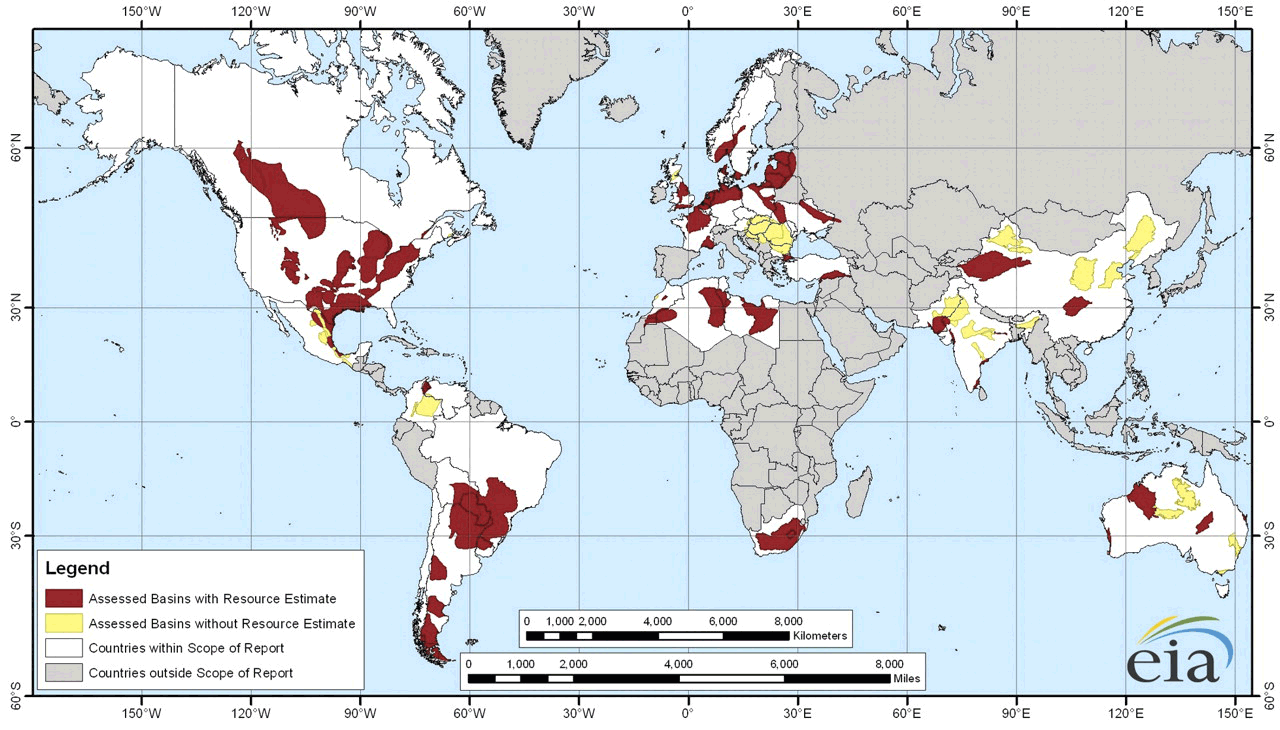
“Map of major shale gas basis all over the world from the EIA report World Shale Gas Resources: An Initial Assessment of 14 Regions Outside the United States .”
Very odd, as if shale gas basins are an onshore phenomenon. Shale gas is essentially the source rock for most oil and gas accumulaions and should therefore occur in most areas where oil and gas has been found and that includes all the offshore oil and gas regions in the world?
True, but then you lose the the signature benefit of gas plants – combined cycle efficiencies. Now you’re down in coal plant territory.
“””””…..Ian H says:
July 17, 2012 at 4:19 am
Yet another map without New Zealand on it. I’m sick of idiot geographers dropping my entire country off the map like it doesn’t exist…….”””””
It’s the new feel good mathematics Ian. So long as you think a full circle is somewhere between 350 and 370 degrees, then you probably have grasped the idea of spherical geometry.
And a ruddy great piece of Eastern Siberia seems to have
fallen into disrepair as well. So where the hell, is the world going to get good sailors now, with Kiwis, no longer available.
Look up the motto; “Our Kiwis, are faster than your Kiwis !”
TRM says:
July 17, 2012 at 10:45 am
” Petrossa says:July 17, 2012 at 2:29 am
One huge problem here. The author assumes facts not in evidence. That Anthropogenic CO2 is
detrimental to earths climate.”
And there you have it in a nutshell. With all the real pollutants to worry about all you ever hear about is the “evil CO2″. When you look at natural gas with huge reductions in sulfur, mercury, nitrites it is a wonderful technological bridge for our energy needs for the next 50-100+ years.
So will they work on making coal as clean? LFTR nukes? Nah they’ll just ban fracking. Sigh.
True according to the track record.
http://hauntingthelibrary.wordpress.com/2012/07/12/liberal-media-how-it-works-coal-is-bad-except-when-its-socialist-and-subsidised/
Anthea Collins says:
July 17, 2012 at 3:37 am
Are we talking gas, as in a vapour, or gas as in gasoline. I’m confused.
Just as an aside – The uk govt. is planning to electrify a large amount of our railway system – I wonder, given their enthusiasm for “renewable” and “sustainable” energy production, where all this extra electricity is going to comefrom!
Anthea
___________________________________
I would be more worried about where the tax payer dollars to pay for it are coming from as all the jobs are killed. Or is the Regulating Class just going to sell the entire country to the City of London and be done with it.
Edward Chlapowski says:
July 17, 2012 at 4:21 am
The United States instead of regulating coal plants out of existience , should promote putting gas turbines at the front of coal plants and make them combined cycle plants and use existing rail and distribution infrastructure for cheap transport and reindustrializing with steel plants and other heavy industry….
_______________________________
Sorry Ed, it ain’t gonna happen. WHY? UNIONS.
You forget that the union leaders are solidly behind the current “kill manufacturing” administration. WHY the heck rank and file union members support the outsourcing of their jobs and destruction of their home is completely beyond me but that is what is happening. Any try at explaining what is happening is met with fingers in the ears and singing, La La La, I can’t hear you. BTDT and have the sore head from hitting the brick wall to prove it.
mddwave says:
July 17, 2012 at 11:00 am
If shale gas replaces coal and oil, there would be a reduction of CO2 generated.
But what about the increase generation of Dihydrogen monoxide! If the supreme court could define that the Clean Air act was also intended for CO2, who knows what could be next. Obviously Dihydrogen monoxide is one of those evil byproducts of burning shale gas. 🙂
_____________________________
Join the Ban Dihydrogen Monoxide! crusade TODAY!
Coalition to Ban DHMO
211 Pearl St.
Santa Cruz CA, 95060
~ Do I really need the /sarc tag at thsi website? ~
mddwave says:
July 17, 2012 at 11:00 am
If shale gas replaces coal and oil, there would be a reduction of CO2 generated.
“But what about the increase generation of Dihydrogen monoxide! If the supreme court could define that the Clean Air act was also intended for CO2, who knows what could be next. Obviously Dihydrogen monoxide is one of those evil byproducts of burning shale gas. :)”
Also, H2O is a GHG which has more impact than CO2, and H2O is more of what you get when you burn methane than when coal is burned, not that either actually matter as far as the climate is concerned however.
“Replacing coal with natural gas would reduce warming.”
It can make the sun cooler?
It’s astounding how abundant natural gas is. And that map doesn’t even show how much there really is.
This video with Freeman Dyson gives one theory, which has evidence, as to why natural gas is so abundant—and likely not to reach any “peak”.
The part about natural gas starts at 0:57 of the video:
Here is an interesting factoid. Brown coals and black coals produce about the same amount of CO2 per MW generated. Brown coals have a lower heating value per pound (lots of rocks in it) but they make up for it by having much more methane trapped inside. Both produce about twice as much CO2 as natural gas when generating power. I’d dispute the 40% figure.
Also, I’m not so sure about the delta Methane plot. I am thinking that it assumes fugitive gas emissions are a much higher proportion of atmospheric methane than they really are. Atmospheric methane concentrations have been relatively flat these past fifteen years despite increased gas use. http://www.windows2universe.org/earth/Atmosphere/images/methane_atmosph_concentr_1984_2004_big.gif
Amino Acids in Meteorites says: It’s astounding how abundant natural gas is. And that map doesn’t even show how much there really is.
The gray regions aren’t even included in the study.
Appendix: extraterrestrial oil shale
Some comets contain “massive amounts of an organic material almost identical to high grade oil shale,” the equivalent of cubic kilometers of such mixed with other material;[79] for instance, corresponding hydrocarbons were detected in a probe fly-by through the tail of Comet Halley during 1986.
http://en.wikipedia.org/wiki/Oil_shale
The link for reference 79 was an interesting read:
http://www.neofuel.com/zuppero-1995-water-ice-nearly-everywhere-114647.pdf
On one page the author claims that tiny Comet Halley (around 22 x 8 x 8 kms) will, over the course of its life, spew the equivalent of 500 years of OPEC oil output!
NYTimes article: Shale gas might be nothing more than a giant Ponzi scheme
http://www.nytimes.com/2011/06/26/us/26gas.html
DInostratus @ur momisugly 8.11pm
Sorry but your figures and interpretation of the amount of CO2 per MW generated by brown and black coals are incorrect. Depending on which clasification you use brown coal (lignites) have on an as supplied basis approx contained energy (SE) of 7-10 Mj/kg, sub-bituminous (PRB coals – sometimes also called brown coal) approx 15-20 Mj/kg and true black coals 20-30 Mj/kg. (Mj/kg = Btu/lb / 429.9 – 20Mj/kg= 8600 Btu/lb). Any type of coal brown or black can have, using your term “lots of rocks in it”, commonly known as ash value, for thermal coals this is normally < 15%, ideally < 10%. Unlikely that any coal has any methane in it when burnt, which if ever present is lost naturally at shallow depths. By the way the peak methane content in coal is normally within the black coals and brown coals generally have much much less.
CO2 emmissions from a power station is proportional to the energy generated and given by
3600 x (3.667 x Ult C%)/SE(gross) x E/100 = tonnes CO2/GWh where E is the power station efficiency (sent out) derived from gross SE. Low rank (brown coals) yield more CO2 per net energy produced than high rank (black coals).
Definitely natural gas produces less CO2 per energy unit produced than coal at burning, but there is a slight hitch in that many conventional natural gas deposits can contain significant amounts (10-20%) of CO2 along with the methane. At the moment this is typically vented into the atmosphere at the production site and not counted as part of the CO2 output.
“””””…..Alan says:
July 17, 2012 at 11:52 pm
DInostratus @ur momisugly 8.11pm
Sorry but your figures and interpretation of the amount of CO2 per MW generated by brown and black coals are incorrect……”””””
Thanx for the numbers Alan; nice to get info from folks who have it at their fingertips.
Would you happen to know offhand the heats of combustion of Hydrogen and Carbon, which seem to be the main sources of stored chemical energy in “fossil” fuels.
And how much does the HOC go down if you “preburn” some of the fuel by “oxygenating” it to turn it into an alcohol or ether ? It always seemed to me to be the same as adding water to the gas.
Natural gas has sharply reduced the once-dominant position of coal as a power source – from 52% to around 34%
As for solar and wind (or any uncontrollable power source), their introduction into the grid
results in indirect costs, since they must be backed up by controllable power sources, which results in duplication of much of the cost of power generation, since a large portion of the cost
of operating/maintaining those backup plants are non-fuel related. In the case of nuclear, only about 15% of its operating cost goes for its uranium fuel. Ironically,the introduction of such power sources guarantees the continued existence of those backup plants, which usually are (or have to be) fossil fuel powered.
These are ironic times, the USA, traditionally the eco-Satan, is now reducing its CO2 emissions due to gas fracking, while Europe, while self-righteously preaching eco-Luddite-ism, is increasing its CO2 emissions due to its superstitious fear of fracking and its superstitious fear of and retreat from nuclear power. WUWT?
“Unlikely that any coal has any methane in it when burnt, which if ever present is lost naturally at shallow depths.”
Nope. Here is just the first link I found from Google. http://www.dggs.dnr.state.ak.us/webpubs/dggs/rdf/text/rdf2003_001.PDF
Note the volatile content.
I’m sure you can find other proximate analysis. A little circumspection in your writing style would do you well.
George E Smith @ur momisugly 12.30pm
Little out of my league as a geologist however wikipedia has a full list if you look up “Heat of Combustion”. The higher heating value (defined in the article) for hydrogen is 141.8 Mj/kg and carbon is 32.8 Mj/kg. HHV doesn’t exactly equate to coal analysis which are generally carried out on an air-dried basis, but is close. Coal contains a lot more than C and H such as N,S,O moisture and mineral matter, commonly reported as the ash. Coal doesn’t actually contain “ash” as such but it is the material left following combustion. The C content increases with coal rank (the transition from peat through to anthracite) and moisture decreases. H is variable and is more related to the type of vegeation that formed the original swamp – alagal matter is high in H and woody matter low.
Dinostratus @ur momisugly 9.25pm
Now what was that about being circumspect? I can find many sets of proximate analysis, I deal with them on a daily basis – also ultimate analysis and a whole bunch of other coal analyses. Had a quick look at your Alaskan coal analysis, did you notice anything unusual about the ultimate analysis results especially the O?. Tip O results also include errors and the values are rather high. These coals look to be sub-bituminous, possibly weathered and pity about the high ash.
Now to the volatile content or volatile matter as it is generally referred to. Do you know how this analysis is carried out?
Def:- Volatile matter is the percentage loss in mass, excluding that due to moisture when coal is heated in the absence of air at high temperature (eg 900C – depending on the standard you are using) for a given time(again varies with standard). It represents the proportion of volatile components released by decomposition of the organic matter together with some components released on the heating of minerals also present (eg CO2 from carbonates). As Speight in his “Handbook of Coal Analysis” states …”The term volatile matter content (of coal) is actually a misnomer, insofar as the majorityof the volatile matter is the volatile product of the thermal decompostion of coal through the application of high temperatures.” It does not equate with methane. If you research coalbed methane or coal seam methane you will find that methane, if present, is released from the coal by dewatering or depressurising.
“””””…..Alan says:
July 19, 2012 at 12:41 am
George E Smith @ur momisugly 12.30pm
Little out of my league as a geologist however wikipedia has a full list if you look up “Heat of Combustion”. The higher heating value (defined in the article) for hydrogen is 141.8 Mj/kg and carbon is 32.8 Mj/kg. HHV doesn’t exactly equate to coal analysis which are generally carried out on an air-dried basis, but is close. Coal contains a lot more than C and H such as N,S,O moisture and mineral matter, commonly reported as the ash. Coal doesn’t actually contain “ash” as such but it is the material left following combustion. The C content increases with coal rank (the transition from peat through to anthracite) and moisture decreases. H is variable and is more related to the type of vegeation that formed the original swamp – alagal matter is high in H and woody matter low.
…..”””””
Thanks Alan, I thought that Hydrogen was the higher heat fuel, but then I guess one needs to allow for the carbon being seven times the density of hydrogen (per molecule), or a kg of hydrogen having seven times as many molecules, so I guess that means that carbon per molecule has about 50% greater heat of combustion as hydrogen; and that would jibe with Anthracite being the best of coals. Just goes to show, I always though Hydrogen was better than carbon as a fuel; but I guess not.
I’m also under the impression that so-called “low sulphur” western coals that Clinton tied up for his Chinese buddies, is actually not low sulphur, when considered on a Btu basis; but is much worse than good Eastern anthracite.
“Now to the volatile content or volatile matter as it is generally referred to. Do you know how this analysis is carried out?”
Yeah. Back when I was a researcher I would fire laser beams at coal particles suspended in pico balances and determine the rate of vocalization as a function of heat flux, coal type, particle shape, diameter, etc. I’m fairly familiar with the process of devolitalization. Perhaps you’d like to explain it to me more though.
Well DInostratus it looks like you know it all so no need for any further explaination
I usually like to let these quibbling discussions die but after being lectured I found this paragraph to be too good to pass up.
George, Alan’s wrong. It’s as simple as that.
“Little out of my league as a geologist however wikipedia has a full list if you look up “Heat of Combustion”. The higher heating value (defined in the article) for hydrogen is 141.8 Mj/kg and carbon is 32.8 Mj/kg. “
Alan and I agree on the former. As for the rest, the “Heat of Combustion” for hydrogen has no relevance to coal as coal has little if any H2. Alan quoted the change in energy as H2 goes to H2O. The H in coal is bonded in the form of C-H bonds and not H-H bonds. Methane, Ethane, Ethylene, PAH’s, etc. all have this C-H bond.
“HHV doesn’t exactly equate to coal analysis which are generally carried out on an air-dried basis, but is close. “
What a curious statement. First, LHV is the common unit of measure. It’s the first question of people that look into coal analysis ask, i.e. “What is the difference between LHV and HHV?” Someone tells them then they forget about HHV except for those cases where it truly is the right measure to use. Sometimes tables only have the HHV but the heat of vaporization is calculated and one walks away with the LHV. Second, it’s not “close.” The LHV of coal has only a passing relationship to the fundamental bond strengths you can calculate from the JANAF tables. True, fundamentally chemical bonds are being broken and formed but the nature of those bonds is so varied, even within a single seam, no one concerns themselves. Most just quote the LHV at different stages of processing and let it go at that.
“Coal contains a lot more than C and H such as N,S,O moisture and mineral matter, commonly reported as the ash. Coal doesn’t actually contain “ash” as such but it is the material left following combustion.“
Again, another curious statement. Coal contains “N,S,O moisture and mineral matter”. Ash only contains the “N,S,O moisture and mineral matter” from the coal and stuff from the air but coal doesn’t contain ash. That’s almost an argument against a tautology.
“The C content increases with coal rank (the transition from peat through to anthracite) and moisture decreases. H is variable and is more related to the type of vegeation that formed the original swamp – alagal matter is high in H and woody matter low.”
OMG. Alan understands this but can’t understand that low rank and high rank coals produce about the same amount of CO2 per MW generated because of the additional CH bonds in the lower rank coals.
It’s easy to do the math. Get some analysis from Google and divide the LHV by the pounds of carbon and I think you’ll be surprised at the Btu’s/lbm carbon staying roughly constant across coal types. I never suspected such a simple and easily verifiable statement to get such static.