Guest post by David Archibald
A number of solar parameters are weak, and none is weaker than the Ap Index:

Figure 1: Ap Index 1932 to 2026
Figure 1 shows the Ap Index from 1932 with a projection to the end of Solar Cycle 24 in 2026. The Ap Index has not risen much above the previous floor of activity in the second half of the 20th Century. It is also now far less volatile. With now less than a year to solar maximum in 2013, the Ap Index is now projected to trail off to a new low next decade.

Figure 2: Mean Field, TSI, F10.7 Flux and Sunspot Count from 2008
This figure is from: http://www.leif.org/research/TSI-SORCE-2008-now.png
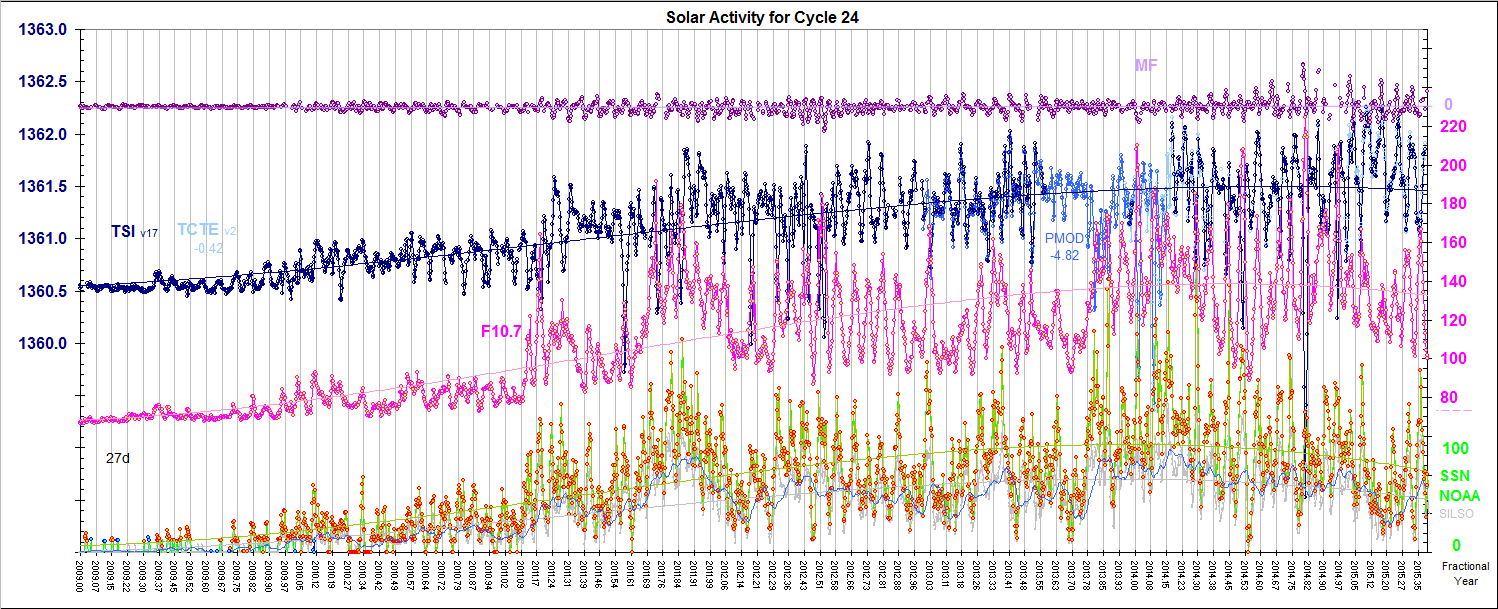
What is evident from Figure 2 is that the spikes down in the F10.7 flux and sunspot count are almost to absolute minimum levels. The underlying level of activity is only a little above that of solar minimum.

Figure 3: Oulu Neutron Count 1964 – 2026
Similar to the Ap Index, activity is only slightly above levels of previous solar minima. The figure includes a projection to the end of Solar Cycle 24 in 2026 which assumes that the neutron count in the next minimum will be similar to that of the 23/24 minimum. Previous cold periods have been associated with significant spikes in Be10 and C14. Perhaps the neutron count might get much higher yet into the 24/25 minimum.

Figure 4: UAH Monthly Temperature versus Low Global Cloud Cover
The cloud cover data for this figure was provided by Professor Ole Humlum. There is a significant relationship between low global cloud cover and global temperature. Assuming that the relationship is linear and remains linear at higher cloud cover percentages, this figure attempts to derive what cloud cover percentage is required to get the temperature decline of 0.9°C predicted by Solheim, Stordahl and Humlum in their paper entitled “The long sunspot cycle 23 predicts a significant temperature decrease in cycle 24” available at: http://arxiv.org/pdf/1202.1954v1.pdf
Figure 4 suggests that the predicted result will be associated with a significant increase in cloudiness.

Figure 5: Low Level Cloud Cover plotted against Oulu Neutron Count
This figure, most likely repeating other people’s work, suggests that there is little correlation between neutron count and cloud cover. Higher neutron counts may be a coincident with colder climate than a significant causative factor. Perhaps EUV, the Ap Index and other factors are more significant in climate change. Also, on a planet with a bistable climate of either ice age or interglacial, it may be that accidents of survival of snowpack over the northern summer are also important.
Perth-based scientist David Archibald is a Visiting Fellow of the Institute of World Politics in Washington where he teaches a course in Strategic Energy Policy.
HenryP says, July 3, 2012 at 8:45 am
However, my mathematics tells me that this is all part of a natural process. Man had little or nothing to do with it. Please tell me if anyone here disagrees with me?
You may be overlooking ozone depletion by CFCs etc., which appears to be on the mend but may take a good while yet. You might like to look at the paper published in 2006 that Leif recently posted a link to on WUWT, published by his daughter-in-law (Signe) who Leif says is “the ozone expert in the family”.
http://www.leif.org/EOS/Nature/nature04746-Ozone-Recovery-Signe.pdf
Henry Clark says:
July 3, 2012 at 9:07 am
This article’s figure 5 for cosmic ray flux versus cloud cover gives no source for its data beyond Humlum, but it is most likely graphing cloud cover as reported by the ISCCP. …
However, there is a giant problem with that, using a compromised data source (the analogue of using Mann’s hockey stick for temperature history) which is contradictory to other sources which in contrast rather show the effect of cosmic rays.
You might benefit from reading about independent measurements of the Earth’s albedo: http://www.leif.org/EOS/Palle_etal_earthshine.pdf
AJB says
You may be overlooking ozone depletion by CFCs etc., which appears to be on the mend but may take a good while yet…
Henry says
yes, I was actually thinking about that, i.e.
that some AGW was caused by ozone depletion, due to CFC’s, etc
but then you would not expect to find typical hyperbolic curves (for ozone depletion)
or parabolic curves (for the dropping of maxima), as we now know, actually happened
http://www.letterdash.com/henryp/global-cooling-is-here
I know the graph referring to ozone, shows the “linear” developments from 1970 (down) and from 1995 (up)
as if man had some kind of a hand in it,
\
but what if it was more nature playing with us?
Just by doing “quickfit” in my head I can see that the ozone depletion and increase since 1970 would fit much better into a hyperbolic curve?
in which case most of the observed warming in the past becomes part a “schedule”?
Dr. S.
Thanks for the link
Sunspot’s last 6 months daily record shows 23.32 days rotation period for the ‘preferred’ longitude.
I would like to take a look at 6-12 months of daily Aa or Ap index, but can’t find a download link.
vukcevic says:
July 3, 2012 at 12:39 pm
Sunspot’s last 6 months daily record shows 23.32 days rotation period for the ‘preferred’ longitude.
I would like to take a look at 6-12 months of daily Aa or Ap index, but can’t find a download link.
It doesn’t make much sense to look for a rotational signal in only a few months of data. To forestall meaningless ‘analysis’ I better not tell you how to find the data 🙂
But anyway, one place is here http://www.geomag.bgs.ac.uk/data_service/data/magnetic_indices/aaindex.html
Leif Svalgaard says:
July 3, 2012 at 12:47 pm
But anyway, one place is here http://www.geomag.bgs.ac.uk/data_service/data/magnetic_indices/aaindex.html
P.S. if you leave the ‘month’ blank, you get the whole year.
Tanks, for last 12 months Aa spectrum
3 peaks of interest
first peak 23.81 days, likely SSN ? Amplitude 0.6
main peak 27.30 days, average rotation? (Carrington is 27.2753) Amplitude 0.7
next peak 30.77 days, polar coronal hole ? Amplitude 0.57
vukcevic says:
July 3, 2012 at 1:14 pm
Thanks, for last 12 months Aa spectrum 3 peaks of interest
Rotational signals based on 12 months don’t make much sense.
vukcevic says:
July 3, 2012 at 1:14 pm
for last 12 months Aa spectrum 3 peaks of interest
There are three basic periods in the solar wind [and thus Aa]: 28.5 days due to mid-latitude coronal holes,
26.85 days during first half of the solar cycle, and 27.15 days during the last half of the cycle. The two latter ones [with average 27.0 days] due to low-latitude coronal holes. Due to overlaps, for short intervals, you may find just about anything you want in the range 26-29 days, depending on when. Sunspots are sporadic and don’t give you any long duration period.
HenryP says:
July 3, 2012 at 10:50 am
“Up until some time ago I would have tended to agree with that statement. Yet, now, after my recent discovery,
http://wattsupwiththat.com/2012/07/02/the-sun-has-changed-its-character/#comment-1023587
I think that is only a minor factor.”
Look closely at http://www.pensee-unique.fr/images/pallesciencefig.jpg
Such depicts a change estimated as ranging up to 11 W/m^2 between part of 1985 and mid-way through 1997, as a consequence of up to around a 3% change in albedo, in the reflectivity of Earth (which is hit by several hundred watts/m^2 of average solar radiation if averaging day and night from poles to the equator).
The peak-to-peak change in global average cloud cover from the highest to lowest points over that period in a monthly graph was about 6% meanwhile, up to near 70% versus down to about 64%. Aside from the questionable part on the right, even http://climate4you.com/images/CloudCoverTotalObservationsSince1983.gif shows that.
I can not understate the enormous magnitude of a fluctuation of up to 11 W/m^2, of up to 3% in albedo, and of up to a 6% in global average cloud cover. The overall change from albedo variation sustained for multiple years, more averaged over time, was less — more like several W/m^2. Still that’s relatively a lot.
Just for initial perspective, when alarmists claim that doubling CO2 would cause such as 3 K temperature rise, they are claiming a climate sensitivity of around 0.8 K/(W*m^-2), as in claiming 3 K of warming from a far lesser around 3.7 W/m^2 of hypothetical radiative forcing ( http://www.sciencebits.com/OnClimateSensitivity ). (Also, when some, assuming similar is true, do calculations for geoengineering, they end up with an estimate of reflecting around 1% or at the very most 2% of sunlight to cancel all hypothetical global warming over the next century under similar assumptions, which is part of why the magnitude of observed albedo change due to clouds instantly stood out to me).
Ozone is a separate topic, but the albedo change was outright major in its radiative forcing. Earth’s climate sensitivity is rather limited, to allow how the peak-to-peak warming over near that period was only about 1.3 K while only several tenths of a Kelvin in multi-year-average terms*; of course, external forcings are superimposed on internal forcings like the ENSO oscillation.
* Seen in http://www.drroyspencer.com/wp-content/uploads/UAH_LT_1979_thru_May_2012.png
Also see:
http://wattsupwiththat.com/2007/10/17/earths-albedo-tells-a-interesting-story/
which remarks:
“The most interesting thing here is that the albedo forcings, in watts/sq meter seem to be fairly large. Larger than that of all manmade greenhouse gases combined.”
Leif Svalgaard says:
July 3, 2012 at 11:32 am
“You might benefit from reading about independent measurements of the Earth’s albedo: http://www.leif.org/EOS/Palle_etal_earthshine.pdf”
Their implied goal is to make the ISCCP data fit and utilize it, e.g. such as:
“Our models use ISCCP mean cloud amount data as an input to ERBE scene models (Goode et al., 2001) from which we retrieve apparent and Bond albedo values.”
Statements like the following examples highlight how much depends on their choice of details in recalibration and adjustments, details not directly seen by an outside observer or reader:
“Outliers were cast out and the process repeated until it converged (after about five iterations). This had the consequence of systematically casting out about 10% of the nights, which is only a few percent more than were cast out in our old, night-by-night evaluation.”
“However, since the publication of the earlier results, a calibration error in one of the SW filters was identified and the CERES TOA albedo anomalies have been re-analyzed using an improved six year-long climatology (Takmeng Wong, priv. comm.).“
Leif Svalgaard says:
July 3, 2012 at 1:29 pm
vukcevic says:
July 3, 2012 at 1:14 pm
“for last 12 months Aa spectrum 3 peaks of interest”
There are three basic periods in the solar wind [and thus Aa]
Compare with http://www.leif.org/research/Solar%20Sector%20Structure.pdf
especially slides 12ff
Henry Clark says:
July 3, 2012 at 1:47 pm
“You might benefit from reading about independent measurements of the Earth’s albedo”
Their implied goal is to make the ISCCP data fit and utilize it
Absolutely not. I know Enric Palle personally and I know that their goal is to accurately measure the albedo. If their measurements validate ISCCP so be it. You should not attribute dishonesty and manipulation just because you don’t like what the data shows.
Henry@Henry
I stand with what I said before. It seems ozone concentration largely determines the variation in the amount of energy received by earth
…there are other factors…
but they are still minor
Dr.S.
When you take spectrum over too long period you get lot of spurious stuff. Here I compared Ap (slightly different to Aa calculation) and one from your paper:
http://www.vukcevic.talktalk.net/ApSpectrum.gif
Nice and clean, SSN, Carrington and polar coronal holes, no sign of the lot of bits you got in there.
You pays your money, you takes your choice.
vukcevic says:
July 3, 2012 at 3:12 pm
When you take spectrum over too long period you get lot of spurious stuff.
When you take spectrum over too short period you get just some of the temporary messy stuff and can not deduce much about the fundamentals. I call that ‘butterfly collecting’. Who cares what the period is over a given 12 months? What is important is if you can get some physics out of that, other than just a temporary description of a flash in the pan. If you take a different interval you get different periods, not very ‘nice and clean’, but the junk you get by not paying enough.
HenryP says:
July 3, 2012 at 2:29 pm
“…there are other factors…
but they are still minor”
For that after my prior reply, somehow I get the feeling that writing more would not be productive…
This is not really either, but:
Leif Svalgaard says:
July 3, 2012 at 2:06 pm
I know Enric Palle personally and I know that their goal is to accurately measure the albedo.”
That’s an appeal to personal lack of bias, basically “trust me” if not “trust us.” In the cases I’ve seen where people at Skeptical Science have commented specifically, they consider your efforts as part of what they want: http://lmgtfy.com/?q=svalgaard+site%3Askepticalscience.com . Can you link to any several posts in a row, anywhere out of hundreds to thousands of posts, on WUWT or elsewhere else where you spent paragraphs seriously arguing against any substantial element of the CAGW movement’s claims, in a manner not helpful to it? I don’t even mean 10% of posts or even 1% but just a few, something that someone unbiased and interested only in promoting scientific truth should end up engaged in sooner or later.
I don’t mean a throw-away one-liner which obviously would never really be harmful to the CAGW movement, not just something in passing aimed at getting skeptics to let down their guard. I don’t mean merely the same idea by once in a while submitting a link tip at WUWT to a solar-climate connection paper or an article debatedly unfavorable to CAGW but already published anyway, with none of it your own words. And I don’t mean a web page post equivalent to a few one-liners, just listing what you want people to think your beliefs are without actively really trying to convince someone of anything counter to CAGW, without a tenth of the passionate motivation you show for aiming to counter solar-GCR climate linkage studies and data.
I don’t pretend to be unbiased myself: I’ve watched false claims on major rise in hurricanes (global frequency flat to declining in recent decades as Florida State University shows if going beyond Skeptical Science’s North Atlantic cherrypicking), tornadoes, mosquitoes, sea level (no faster rise in the late 20th century than the late 19th despite more than a factor of 10 rise in human emissions as discussed in my comment on the latest “official” falsehood of 1 foot California sea level rise within 10 years at http://www.popsci.com/science/article/2012-06/study-says-california-sea-levels-will-rise-more-five-feet-century ), droughts, floods, polar bears, the Medieval Warm Period, the Holocene Climate Optimum, etc. At some point, I’m not inclined to trust the ??th claim from individuals funded by an overlapping alliance of groups who basically never apologize for supporting falsehoods on any of the rest of these matters. I don’t trust without asking exactly why.
Henry Clark says:
July 3, 2012 at 5:32 pm
“I know Enric Palle personally and I know that their goal is to accurately measure the albedo.”
That’s an appeal to personal lack of bias, basically “trust me” if not “trust us.” In the cases I’ve seen where people at Skeptical Science have commented specifically, they consider your efforts as part of what they want
I’m not responsible for what other people think of my ‘effort’. Here is what I think about the sun’s influence on climate http://www.leif.org/research/Does%20The%20Sun%20Vary%20Enough.pdf
If you look at slide 3 and 20 you may want to assert that I attribute the MWP to them darn vikings and their SUVs as the logical conclusion of your rant.
And sometimes you have to trust people [in particular me] especially if they don’t have a dog in the race. I know Enric and what he does [and how he does it]. There is no ‘implied’ goal. Let the data show us what is going on.
Henry Clark says:
July 3, 2012 at 5:32 pm
without actively really trying to convince someone of anything counter to CAGW, without a tenth of the passionate motivation you show for aiming to counter solar-GCR climate linkage studies and data.
The CAGW cult is a lost cause to begin with and trying to counter them by playing the shaky solar card is worse than useless, as the CAGW crew also needs the solar connection to account for changes before modern times. Perhaps the best way to counter CAGW is to show that their beloved solar connection doesn’t work, forcing them to accept that there are (perhaps) a multitude of other natural variations in the complex climate system. But, I feel that arguing that point with you and your ilk is just as fruitless as with the CAGW cult. Each side has their own religion and associated set of dogmas and ad-hom patterns. The only thing I can do is to present data and conclusions about a subject of which I happen to actually know something. What you do with it [or not – at your peril] is up to you.
When we relate cloud-cover to temperature, I think it is important to realize that most of the clouds in question are symptomatic of convection plumes. More importantly, they indicate convection plumes that are extended by warming due to addition of the heat returned by condensing water. More clouds, for whatever reason, indicate increased convective activity and thus, increased convective transport of heat from the surface.
A rising plume of hot air will cool at the dry adiabatic lapse rate of about 9.8 ⁰C/km and quickly be arrested by becoming more dense after cooling below the temperature of the surrounding air, which, in the troposphere, only cools with altitude at a typical environmental lapse rate around 6.5 ⁰C/km. Once condensation begins, however, the moist adiabatic lapse rate of about 5 ⁰C/km applies, allowing the plume to continue rising as long as it has water to condense. I believe this process allows most of the heat from the surface to punch through the barrier of greenhouse gas absorption.
I think that talking about clouds as isolated entities is like talking about people as if only the hair on their heads were significant–but perhaps understandable, if they were invisible, except for that hair,.
Ref: http://en.wikipedia.org/wiki/Lapse_rate
Leif Svalgaard (July 3, 2012 at 6:03 pm)
“[…] playing the shaky solar card is worse than useless […] beloved solar connection doesn’t work”
The sun modulates westerly winds (via equator-pole temperature gradients):
http://i49.tinypic.com/219q848.png
This robust observation from LOD is rigidly founded on:
A. Law of Conservation of Angular Momentum.
B. Central Limit Theorem.
LS;
“you and your ilk”. Nice.
Well, you and your ilk ooze sneering argument from authority (especially your own) from every pore. On the evidence, doing so is a fundamental goal, not a symptom.
Paul Vaughan says:
July 3, 2012 at 9:44 pm
The sun modulates westerly winds (via equator-pole temperature gradients)
It does more than that. Also provides the energy that makes the Earth habitable and enables there to be a climate at all.But solar activity [being energetically weak] modulates the basic input at the barely observable limit.
Brian H says:
July 3, 2012 at 10:17 pm
Well, you and your ilk ooze sneering argument from authority (especially your own) from every pore.
Presenting data and discussing evidence for everyone to make up his/hers mind in an informed manner is the right thing to do. The authority is in the data not in the person. Time for you to discover the difference.
Leif Svalgaard says:
July 3, 2012 at 3:46 pm
…………..
As a practical and experienced engineer I respectfully disagree.
-12 months have 13 full rotations (at ~27 days) which is perfectly adequate for the purpose.
-Last 12 months was also good period, since the sun was relatively quiet, some sunspots on more or less constant latitude and few coronal holes at poles, enough activity to determine principal rotation number
http://www.vukcevic.talktalk.net/ApSpectrum.gif
but not too active with too many spots popping in and out and making a ‘mess’ as shown in your paper
http://www.leif.org/research/Solar%20Sector%20Structure.pdf (p 13)
I leave it there, have an article with some interesting passages to complete .
Leif Svalgaard says:
July 3, 2012 at 6:03 pm
………Perhaps the best way to counter CAGW is to show that their beloved solar connection doesn’t work, forcing them to accept that there are (perhaps) a multitude of other natural variations in the complex climate system…….
Absolutely. The claimed solar-climate link actually supports AGW at the moment. It’s becoming increasingly apparent that if there really is (or was) a strong link then it’s broken down over the past 20 years or so and has been replaced by a more dominant driver.