From the University of Wisconsin:
Greenland ice may exaggerate magnitude of 13,000-year-old deep freeze
Ice samples pulled from nearly a mile below the surface of Greenland glaciers have long served as a historical thermometer, adding temperature data to studies of the local conditions up to the Northern Hemisphere’s climate.
But the method — comparing the ratio of oxygen isotopes buried as snow fell over millennia — may not be such a straightforward indicator of air temperature.
“We don’t believe the ice cores can be interpreted purely as a signal of temperature,” says Anders Carlson, a University of Wisconsin–Madison geosciences professor. “You have to consider where the precipitation that formed the ice came from.”
According to a study published today by the Proceedings of the National Academy of Sciences, the Greenland ice core drifts notably from other records of Northern Hemisphere temperatures during the Younger Dryas, a period beginning nearly 13,000 years ago of cooling so abrupt it’s believed to be unmatched since.
Such periods of speedy cooling and warming are of special interest to climate scientists, who are teasing out the mechanisms of high-speed change to better understand and predict the changes occurring in our own time.
In the case of the Younger Dryas, average temperatures — based on the Greenland ice — plummeted as much as 15 degrees Celsius in a few centuries, and then shot back up nearly as much (over just decades) about 1,000 years later.
“In terms of temperature during the Younger Dryas, the only thing that looks like Greenland ice cores are Greenland ice cores,” Carlson says. “They are supposed to be iconic for the Northern Hemisphere, but we have four other records that do not agree with the Greenland ice cores for that time. That abrupt cooling is there, just not to the same degree.”
Working with UW–Madison climatologist Zhengyu Liu, collaborators at the National Center for Atmospheric Research and others, Carlson found their computer climate model breaking down on the Younger Dryas.
While it could reliably recreate temperatures in the Oldest Dryas — a similar cooling period about 18,000 years ago — they just couldn’t find a lever in the model that would simulate a Younger Dryas that matched the Greenland ice cores.
“You can totally turn off ocean circulation, have Arctic sea ice advance all the way across the North Atlantic, and you still will have a warmer climate during the Younger Dryas than the Oldest Dryas because of the carbon dioxide,” Carlson says.
By the time the Younger Dryas rolled around, there was more carbon dioxide in the air — about 50 parts per million more. The warming effects of that much CO2 overwhelmed the rest of the conditions that make the Oldest and Younger Dryas so alike, and demonstrates a heightened sensitivity for Arctic temperatures to rising greenhouse gases in the atmosphere.
The researchers zeroed in on the Northern Hemisphere’s temperature outlier, Greenland ice cores, and found that the conversion of oxygen isotope ratio to temperature typically used on the ice cores did not account for the sort of crash climate change occurring during the Younger Dryas. It assumes prevailing winds and jet streams and storm tracks are providing the moisture for Greenland precipitation from the Atlantic Ocean.
“The Laurentide ice sheet, which covered much of North America down into the northern United States, is getting smaller as the Younger Dryas approaches,” Carlson says. “That’s like taking out a mountain of ice three kilometers high. As that melts, it allows more Pacific Ocean moisture to cross the continent and hit the Greenland ice sheet.”
The two oceans have distinctly different ratios of oxygen isotopes, allowing for a different isotope ratio where the water falls as snow.
“We ran an oxygen isotope-enabled atmosphere model, so we could simulate what these ice cores are actually recording, and it can match the actual oxygen isotopes in the ice core even though the temperature doesn’t cool as much,” Carlson says. “That, to us, means the source of precipitation has changed in Greenland across the last deglatiation. And therefore that the strict interpretation of this iconic record as purely temperature of snowfall above this ice sheet is wrong.”
By the study’s findings, Greenland temperatures may not have cooled as significantly as climate headed into the Younger Dryas relative to the Oldest Dryas, because of the rise in atmospheric carbon dioxide that had occurred since the Oldest Dryas.
“You can say at the end of the Younger Dryas it warmed 10, plus or minus five, degrees Celsius. But what happened on this pathway into the event, you can’t see,” Carlson says.
It’s a fresh reminder from an ancient ice core that climate science is full of nuance, according to Carlson.
“Abrupt climate changes have happened, but they come with complex shifts in the way climate inputs like moisture moved around,” he says. “You can’t take one difference and interpret it solely as changes in temperature, and that’s what we’re seeing here in the Greenland ice cores.”
The National Science Foundation and Department of Energy funded the research.
=======================================================
Note: as of this writing, the article is not yet online at PNAS – I’ll update this post when it becomes available – Anthony
=========================================
Commenter and Contributor Bill Illis submitted this comment to Tips and Notes with the request that it be moved here. Since we cannot move comments from one thread to another and since the comment is quite relevant to this thread, I decided to post this as an update. (Bill if you had trouble posting the comment, please let us know what the trouble was.) -REP
=================
(A long post meant to explain the problem with the Greenland ice core temperature reconstructions thread posted earlier today. If this could be moved there, I consider it an important problem which is not noted that often).
The problem with the Greenland temperature reconstructions is that, starting about 20 years ago, they began calibrating the isotope data with “borehole temperature” reconstructions rather than the typical measured formula.
This has overstated the temperature change by more than twice what the normal isotope formula for Greenland’s circumstances would have indicated and set-back the science 20 years.
The Borehole temperature profile for the Greenland ice cores at this link (just slightly different in each location). The ice sheet is melting at the bottom since it is -2.4C which is just enough to melt the ice at the pressure levels at the bottom of the ice-sheet (the new recently completed Neem ice core, however, is at -3.0C and appears to be unmelted).
http://www.iceandclimate.nbi.ku.dk/images/images_research_sep_09/Temp.jpg/
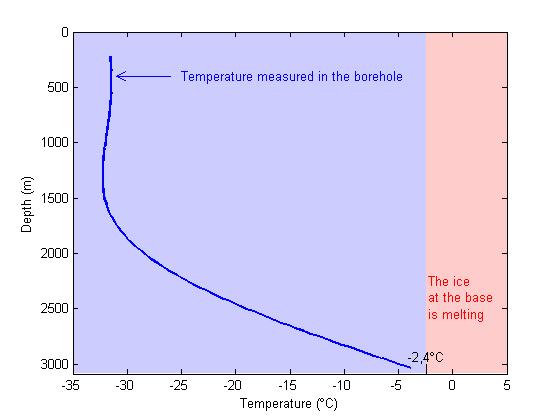
So they use a model about how temperatures at the surface and temperatures at bedrock migrate through the 3 km deep ice-sheet and they can guesstimate what the surface temperatures were in the past. They then recalibrate the dO18 isotopes to those guesstimates rather than the known conversion formula. The problem is that the borehole models appear to be wrong by a factor of 2.
If one used a more typical formula for the isotopes in Greenland’s ice cores, we get temperatures that are more consistent with what we know about the North Atlantic, Northern Hemisphere, Antarctica and Europe (during the ice ages and during the Younger Dryas). In addition, now that the Greenland ice cores go all the way back to the Eemian interglacial, 123,000 years ago, we can say the borehole temperature conversion formula is wrong because it has temperatures in Greenland at +9.0C for the Eemian. This would have melted out most of the glaciers given a few thousand years and this did not happen. The typical isotope formula provides a number of +4.0C which is more consistent with Antarctica, sea level and global conditions during the Eemian.
The Younger Dryas temperatures only declined by about half what is typically quoted.
Related articles
- Younger Dryas -The Rest of the Story! (wattsupwiththat.com)
- New evidence of Younger Dryas extraterrestrial impact (wattsupwiththat.com)
Well, my urban legend detector started to ring with this one:
Average CO2 in the Younger Dryas (YD), according to the paper, was about 240 ppmv. During the Older Dryas (OD) it averaged about 200 ppmv. That is, quite obviously, far less than a doubling. Assuming the IPCC figures of 3° per doubling of CO2, we would expect that CO2 change would be associated with a temperature rise of under one degree C.
Even assuming the worst, that the CO2 went up by 50 ppmv from the start of the OD to the start of the YD, means that their whiz-bang model is predicting a 5°C temperature rise from about a third of a doubling of CO2.
Which means that to get their model to work, they have had to assume a climate sensitivity of no less than 15°C per doubling … how does this nonsense ever make it past peer review? … Never mind, I know the answer …
w.
The main problem I have always had with trying to use ice cores as precise records of climate conditions of our paleo past is that it seems to be based on an implicit fallacy that the ice sheets of Greenland and Antarctica are monolithic and static i.e. that if you go to some particular xyz and drill an ice core down to bedrock the ice you collect in your core will represent a record of the precipitation that fell in that place over the entire sweep of time. The mass balance of an ice sheet is just that, a balance between the precipitation that accumulates each year and the ice and melt water that makes its way back to the sea each year. The only thing we can meaningfully say about all that ice and melt water flowing into the sea is that it originally fell somewhere very far away and sometime very long ago. Given the probable range of rates of accumulation, if the snows that fell over time stayed in exactly the same spot, the thickness of the ice sheets would be tens to perhaps a hundred times or more what they actually. This suggests, to me at least, that of all the ice that has accumulated in Greenland and Antarctica an overwhelming majority of it is long gone. Of course it is always possible that, despite the incredible dynamism occurring within the ice, some areas remain stable enough to preserve a long term record, but given the general inadequacy of what we have determined about the ongoing internal dynamics of the ice, I’m less than sanguine about whether we have or could identify them if they do exist.
Ice cores certainly have the potential to provide us with valuable information about our paleoclimate past, but I would suggest that it is incumbent on us all to recognize that the accuracy of that information is at a much grosser level than all these obsessive ice shavers would like us to believe.
Don J. Easterbrook said @ur momisugly June 26, 2012 at 6:39 am
The problem here I think is that oxygen isotope ratios are more in the nature of a thermoscope, rather than a thermometer. We know that temperatures changed, but not by how much. Of course in order to input such things into a numerical model, a numerical scale has to be attached to the oxygen isotope thermoscope and that requires a considerable bunch of questionable assumptions. I agree with you that understanding the Younger Dryas is key to understanding Earth’s climate and we are a looooong way from there at this point in time.
Willis,
Please read the paper before you get your B.S. meter all worked up. The authors discuss that about 1.5 C of that 5 degrees warming is a consequence of different insolation between the BA and YD (despite a poorly worded abstract that would give the reader the impression it was all a CO2 signal); even more fundamental is that they are specifically talking about Greenland temperatures, not global, and it is pretty well established that Greenland temps are amplified tremendously relative to the global mean. A sensitivity of about 10 C/2xCO2 for Greenland during a glacial time period is not unreasonable.
–Chris Colose
(I cannot post with my name now, which is odd since I have done nothing wrong here)
Dave Dodd, the real problem is that the computer and it’s software do funny things like rounding off numbers and approximating functions, and that’s not a problem for most uses, but in climate models the algorithms are applied to large amounts of data, which provides the data for the next iteration, soon the results will spiral off into absurdity no matter how validated the software is. One of the first climate models, that I’m aware of was one built by one Edward Lorenz considered a pioneer of Chaos Theory, “He discovered the strange attractor notion and coined the term butterfly effect.”, a Meteorology professor at MIT and one of Kevin E. Trenberth’s professors(possibly his doctoral advisor). Odd that two people, one whose work showed the futility of long range computer predictions and one so associated with our current climate models are so intimately linked.
“…but we have four other records that do not agree with the Greenland ice cores for that time…”
From Wikipedia -http://en.wikipedia.org/wiki/Younger_Dryas these might include those four proxies. “The end of the Younger Dryas has been dated to around 11.55 ka BP, occurring at 10 ka BP (radiocarbon year), a “radiocarbon plateau” by a variety of methods, with mostly consistent results:
11.50 ± 0.05 ka BP — GRIP ice core, Greenland[27]
11.53 + 0.04 − 0.06 ka BP — Kråkenes Lake, western Norway.[28]
11.57 ka BP — Cariaco Basin core, Venezuela[29]
11.57 ka BP — German oak/pine dendrochronology[30]
11.64 ± 0.28 ka BP — GISP2 ice core, Greenland[24]”
I don’t understand the implications of this graph, but the O18 drop is not nearly as precipitous as the rise. http://www.nature.com/ngeo/journal/v4/n5/fig_tab/ngeo1140_F1.html
Real-climate has a good article by Chris Colose who has been over a Judith’s place recently. Check out the maps which show estimated YD cooling in the NH. Greenland is definitely the cold spot.
http://www.realclimate.org/index.php/archives/2010/07/revisiting-the-younger-dryas/
In 2010, Chris’s interpretation of the data is that the amount of cooling had significant spatial distribution and no one seemed to be concerned. Now it appears that the models demand that we “disappear” the large Greenland cooling that has been hitherto generally accepted. Models trump measurements. Similar to how the climatology needed to “disappear” the MWP and LIA to make the current warming “unprecedented.”
If this is true, is there any paleo measurement of any quantity that remains safe from redefinition based on computer models?
While I do believe that there was an approximately 40-50 ppm increase in CO2 round about the start of the Younger Dryas, that is far as I wish to agree with Dr. Carlson and company. I think that if I may so,Dr. Carlsonis grasping at straws to say the least. All one has to do is look elsewhere for the very large increases that accompanied the beginning of the Younger Dryas 13,000 years ago. Proxy from western Europe based upon insect (beetle) remains,suggests as much as of a drop in winter temperatures as in Greenland). Summer temperatres though they are estimated to have dropped less (5 to 6 degrees Celsius), nonetheles decreased significantly. (see Atkinson et al 1987 Nature p. 325) Other places in the world including the tropics had decreases in ocean surface temperatures approaching 6 degrees C ( see work by Flower and kennett). Now as to the very large flux of CO2, i think by accepting the cosmic premsise talked about in early posts here, we can see that with a very large dust cloud and all the other insidious fall out, that a very large sudden killing of huge tracts of Vegetation could well induce the very large flux of CO2 that we see discussed here. As a small example of this one need examine the CO2 record from Mauna Loa Hawaii since 1955,they will see that during the winter months as decidious vegetation dies off, there is a significant increase in CO2 in the atmosphere. Signed,Rod Chilton.
“–Chris Colose
(I cannot post with my name now, which is odd since I have done nothing wrong here)”
Several of us seem to have this problem. See comments in Tips&Notes toward the bottom. Specific to this thread. I have to come in with my Facebook ID instead of RobertInAz.
I don’t know what is going on here, some wordpress oddity. Nobody is being blocked – Anthony
Robert Monical-
//”If this is true, is there any paleo measurement of any quantity that remains safe from redefinition based on computer models?”//
The data is what it is. What’s up for question is the interpretation of the data, which in this case is inconsistent with other data…this has nothing to do with making everything converge with what models show, but people need to actually read the paper and the relevant references.
It is becoming increasingly well-accepted that d18O is not just a temperature signal (this is certainly not the case in the tropics, my area of research). See my comment in response to an inquiry about this http://www.realclimate.org/?comments_popup=12200#comment-237960
Hi Chris,
I think that you and I are saying the same thing:
“..any paleo measurement of any quantity that remains safe from redefinition :
“..What’s up for question is the interpretation of the data, which in this case is inconsistent with other data…”
Since the magnitude of the cooling has always varied by region/proxy, why is this suddenly inconsistent?
Proceeding nationally, a comedy of sciences. “My model is broken and it’s the data’s fault!”
Robert-
The topic in question is a very specific one…was the Younger Dryas cooler or warmer than the Older Dryas? That is what the authors sought to answer. To be sure, the authors feel that the YD should be warmer given the increased radiative forcing from boreal insolation and +50 ppm CO2, while the meltwater forcing from AMOC was comparable (To me this is a reasonable hypothesis, but as with any hypothesis, it’s only a starting point to a study).
There are a number of independent temperature reconstructions (see e.g., http://www.agu.org/pubs/crossref/2008/2008PA001631.shtml or http://adsabs.harvard.edu/abs/2006QSRv…25.3312S) at sites close to Greenland that show a warmer YD relative to OD, in support of the main hypothesis, while ice cores show a cooler YD relative to OD, in contrast to the hypothesis. Such a discrepancy is interesting scientifically. In order to interrogate the reason for that discrepancy, it is necessary to revisit the assumptions used in interpreting the data derived from ocean and ice-core reconstructions. No models involved yet.
The model comes into play in reconstructing the temperatures with imposed forcings from insolation, ice sheets, greenhouse gases, and so forth, and comparing with all of the data. The transiently-forced CCSM3 has been widely used by Zhengyu Liu and his team at UW-Madison since (I believe) 2009 with rather remarkable success in simulating important features of the LGM to Holocene evolution (as it happens, I did my Atmospheric Science undergrad in Madison, and worked a bit with Liu and had a very small contribution in one of many studies that took advantage of the transient simulations developed in their Center of Climate Research…I was also a student in one of Ander Carlson’s glacial geology course. I wish I got involved more, but on to different things now).
The model replicates the cooling in the Northern Hemisphere from the LGM to Holocene, including the OD cooling, Bolling-Allerod warming, and YD cooling, and is largely consistent with reconstructed temperatures over many areas of the globe (my RC post sheds some light on this; see the Shakun and Carlson paper too), and this agreement carries over to the leading principal components of the SST reconstructions and the model simulated PC. This, to me at least, gives some confidence that this model is useful in simulating the global and regional temperature responses to the imposed forcings, in this case in the North Atlantic. Now some people criticize models because they are models, but it’s not possible to do any sort of real attribution or sensitivity test without a physically-based model. With no model for a physical phenomenon, you’re just left with data that you don’t know how to interpret, other than with your gut feeling. This applies in any field, particularly in the Earth/Space sciences where we can’t do repeated, careful laboratory tests with a beaker and test tube.
The model agrees well with the SST reconstructions that the YD is warmer than the OD, though this is in contrast to the Greenland ice cores. But keep in mind that the calibrations for Greenland were not meant for such rapid changes, and you also need to keep in mind what d18O is. Isotopes are embedded within a proxy (whether it be an ice core, speleothem, etc) and are integrators of the hydrological cycle from source to sink. You can observe even in the modern day, in South America for example, that the isotopic signature will change over the course of the seasonal cycle since water vapor is transported via different pathways, even independent of temperature (which has a small seasonal cycle in the tropics). We expect that the atmospheric circulation to be different between the YD and OD, since for example, the great Laurentide ice sheet was several kilometers lower in the latter period. One thing to note is that the warming of YD relative to OD is year-round, and it is clear from the seasonal cycle response of d18O in precipitation and temperature that there is a strong correlation, but the relationship that relates the two must be influenced by changes in the background dynamical field.
Michael R not working from my work computer either, same browser but work is a PC home is a Mac. Trying from Twitter based login. It seems to be only relating to this particular thread as another one I commented on earlier worked fine.
I gave the link to the PNAS Paper in Tips & Notes as it was also not allowing me to post here last night. Gave a link for the paper as well but I also note that a commenter in this thread also gave a link already so that is fine. For reference, this appears to be the link to the paper at PNAS:
http://www.pnas.org/content/early/2012/06/21/1202183109.abstract
And a second link to the paper as a backup if you need it:
http://www.fileden.com/files/2012/6/20/3318419/PNAS-2012-Liu-1202183109.pdf
Chris,
What would you expect the changes in amospheric circulation to be as a result of the Laurentide ice sheet thinning? More zonal? Granted that Greenland was gorund central for Wisconsin glaciation at least and one might expect a more amplified signal there, it is not clear to me that thicker vs thinner ice is important to the atmosphere.
gymnosperm (sorry I am having trouble with this thread posting under various names),
There is good evidence for this, though the dynamics involved is a bit elusive to me personally (and more generally, the re-organization of the atmospheric circulation due to ice sheet size, as well as the direct local temperature response via the adiabatic lapse rate, is critical for the LGM-Holocene climate evolution)…
If you’re interested, the authors note that
//”… The lower δ18Op over Greenland during the YD relative to the OD is likely caused by increased delivery of moisture sourced from the North Pacific (18, 19). The lowering of the Laurentide Ice Sheet by up to 2 km between the OD and YD (20) induced a northward migration of the storm track over the North Atlantic region (21), with an intensified low-level westerly jet (Fig. 3 C and D) that increased moisture delivery to Greenland from the North Pacific and North America. This remote delivery depleted precipitation δ18O relative to a North Atlantic source, overwhelming the warmer YD and causing to the lower δ18O over Greenland during the YD relative to the OD.”//
(I’d follow the references for more (at the bottom of this post)…See also Li and Battisti 2008; Roe and Lindzen also have a 2001 paper investigating this along more idealized lines…also note that increasing/decreasing the altitude at which the precipitation falls from also has a direct effect on the isotopes, since the heavier isotope will preferentially condense out as an air mass moves upward over topography)
P.S. I received an e-mail from one of the studies authors supporting my response above FWIW, but he wanted to remind me (and it is worth mentioning) that they also ran simulations with interactive isotopes (which is becoming more routine among some groups, and something I’m playing with for last millennium simulations). These simulations match the ice core record well ( it’s encouraging when you can model the data before you interpret the data); the model can also reproduce the result that Greenland is an exception at the YD from the general rule that higher temps lead to increased d18O, due to circulation changes.
The corresponding references to the quoted text:
18. Charles C, et al. (1994) Glacial-interglacial changes in moisture sources for Greenland: Influences on the ice core record of climate. Science 263:508–511.
19. LeGrande AN, Schmidt G (2009) Sources of Holocene variability of oxygen isotopes in paleoclimate archives. Clim Past 5:441–455.
20. Peltier WR (2004) Global glacial isostasy and the surface of the ice-age Earth: The ICE-5G (VM2) model and GRACE. Annu Rev Earth Planet Sci 32:111–149.
21. Eisenman I, Bitz CM, Tziperman E (2009) Rain driven by receding ice sheets as a cause of past climate change. Paleoceanography 24:PA4209.
Thanks Chris,
I checked those out but found nothing to change my opinion that source moisture for Greenland is unlikely to have changed significantly as a result of ice thinning or even glacial retreat. For a contrary view based on Duterium signature that Greenland moisture derived then as now from the Atlantic see:
Greenland palaeotemperatures derived from GRIP bore hole temperature and ice core isotope profiles
An interesting question would be: where did the moisture for the Laurentian ice sheet come from? I’ve thought since the seventies when I first saw maps of the ice distribution that the glacial front essentially mapped the mean Rossby waves of polar air.
Why was western North America so lightly glaciated when western Eurasia was buried?
The North American Cordillera was well developed at the beginning of the Pleistocene and continued to grow, particularly in the south, so that the Sierra Nevada and Southern Rockies were at their present elevations by Wisconsin time.
I believe the Laurentian ice was moisture from the Gulf of Mexico frozen by polar outbreaks east of the Cordillera similar to outbreaks that occur every winter today.