 Reposted from Jo Nova’s site
Chinese 2485 year tree ring study shows shows sun or ocean controls climate, temps will cool til 2068
A blockbuster Chinese study of Tibetan Tree rings by Lui et al 2011 shows, with detail, that the modern era is a dog-standard normal climate when compared to the last 2500 years. The temperature, the rate of change: it’s all been seen before. Nothing about the current period is “abnormal”, indeed the current warming period in Tibet can be produced through calculation of cycles. Lui et al do a fourier analysis on the underlying cycles and do a brave predictions as well.
In Tibet, it was about the same temperature on at least 4 occasions — back in late Roman times — blame the chariots, then again in the dark ages — blame the collapse of industry; then in the middle ages — blame the vikings; in modern times — blame the rise of industry. Clearly, these climate cycles have nothing to with human civilization. Their team finds natural cycles of many different lengths are at work: 2-3 years, 100 years, 199 years, 800 years, and 1324 year. The cold periods are associated with sunspot cycles. What we are not used to seeing are brave scientists willing to publish exact predictions of future temperatures for 100 years that include rises and falls. Apparently, it will cool til 2068, then warm again, though not to the same warmth as 2006 levels.
On “tree-rings”
Now some will argue that skeptics scoff at tree rings, and we do — sometimes — especially ones based on the wrong kind of tree (like the bristlecone) or ones based on small samples (like Yamal), ones with abberant statistical tricks that produce the same curve regardless of the data, and especially ones that truncate data because it doesn’t agree with thermometers placed near airconditioner outlets and in carparks. Only time will tell if this analysis has nailed it, but, yes, it is worthy of our attention.
Some will also, rightly, point out this is just Tibet, not a global average. True. But the results agree reasonably well with hundreds of other studies from all around the world (from Midieval times, Roman times, the Greenland cores). Why can’t we do good tree-ring analysis like this from many locations?
Jo
Amplitudes, rates, periodicities and causes of temperature variations in the past 2485 years and future trends over the central-eastern Tibetan Plateau [Chinese Sci Bull,]
 Figure 5 Prediction of temperature trends on the central-eastern Tibetan Plateau for the next 120 years. Blue line, initial series; orange line, calibration series, 464 BC–834 AD; purple line, verification series, 835–1980 AD; red line, forecasting series, 1980–2134 AD. (Click to enlarge)
There are beautiful graphs. Have a look at the power spectrum analysis and the cycles below…
ABSTRACT:
Amplitudes, rates, periodicities and causes of temperature variations in the past 2485 years and future trends over the central-eastern Tibetan Plateau
Amplitudes, rates, periodicities, causes and future trends of temperature variations based on tree rings for the past 2485 years on the central-eastern Tibetan Plateau were analyzed. The results showed that extreme climatic events on the Plateau, such as the Medieval Warm Period Little Ice Age and 20th Century Warming appeared synchronously with those in other places worldwide. The largest amplitude and rate of temperature change occurred during the Eastern Jin Event (343–425 AD), and not in the late 20th century. There were significant cycles of 1324 a, 800 a, 199 a, 110 a and 2–3 a in the 2485-year temperature series. The 1324 a, 800 a, 199 a and 110 a cycles are associated with solar activity, which greatly affects the Earth surface temperature. The long-term trends (>1000 a) of temperature were controlled by the millennium-scale cycle, and amplitudes were dominated by multi-century cycles. Moreover, cold intervals corresponded to sunspot minimums. The prediction indicated that the temperature will decrease in the future until to 2068 AD and then increase again.
…
Figure 1 Tree-ring-based temperature reconstruction for the central-eastern Tibetan Plateau during the past 2485 years (gray line), the 40-year moving average (thick black line) and the 40-year running standard deviation (thin black line); the horizontal line is the mean temperature for the 2485 years. (Click to enlarge)
…
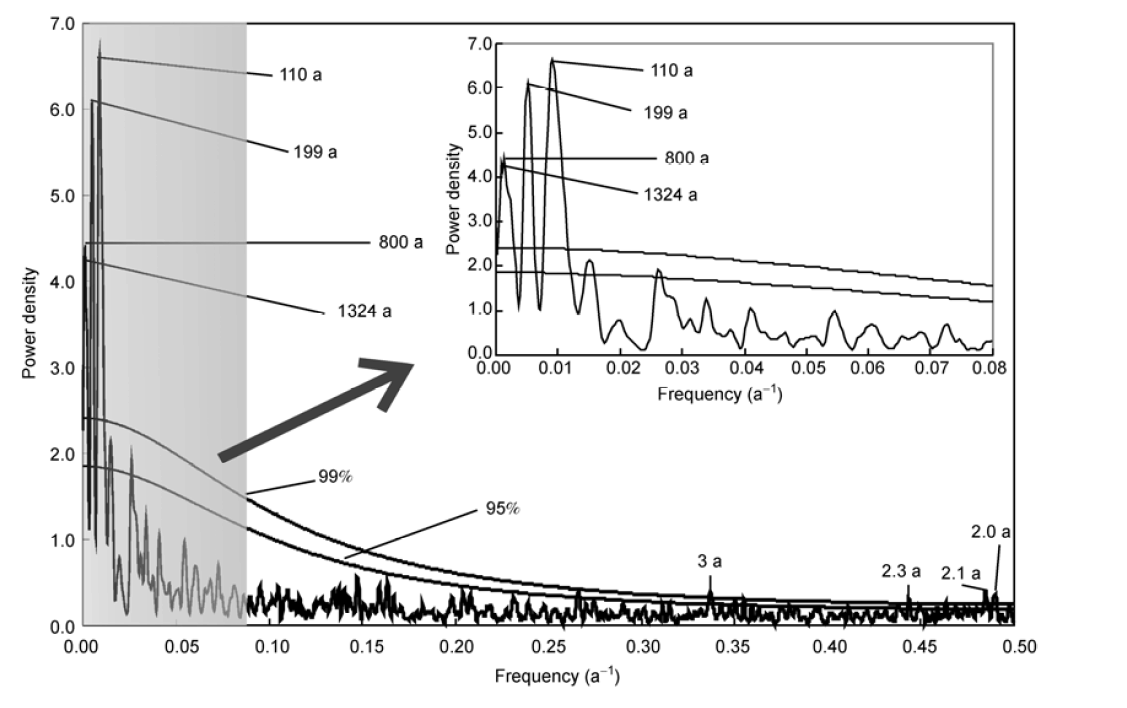 Figure 2 Power spectrum analysis of the 2485-year temperature series. (Click to enlarge)
…
 Figure 3 Millennium-scale cycle in the temperature variation during the last 2485 years. (Click to enlarge)
…
 Figure 4 Decomposition of the main cycles of the 2485-year temperature series on the Tibetan Plateau and periodic function simulation. Top: Gray line,original series; red line, 1324 a cycle; green line, 199 a cycle; blue line, 110 a cycle. Bottom: Three sine functions for different timescales. 1324 a, red dashed line (y = 0.848 sin(0.005 t + 0.23)); 199 a, green line (y = 1.40 sin(0.032 t – 0.369)); 110 a, blue line (y = 1.875 sin(0.057 t + 2.846)); time t is the year from 484 BC to 2000 AD. (Click to enlarge)
…
…
Conclusions
Climate events worldwide, such as the MWP and LIA, were seen in a 2485-year temperature series. The largest Figure 6 Temperature comparison between the forecast and observation data taken from seven stations on the central-eastern Tibetan Plateau (seven stations: Delingha, Dulan, Golmud, Lhasa, Nagqu, Dachaidan and Bange). amplitude and rate of temperature both occurred during the EJE, but not in the late 20th century. The millennium-scale cycle of solar activity determined the long-term temperature variation trends, while century-scale cycles controlled the amplitudes of temperature. Sunspot minimum events were associated with cold periods. The prediction results obtained using caterpillar-SSA showed that the temperature would increase until 2006 AD on the central-eastern Plateau, and then decrease until 2068 AD, and then increase again. The regularity of 600-year temperature increases and 600-year decreases (Figure 3) suggest that the temperature will continue to increase for another 200 years, since it has only been about 400 years since the LIA. However, a decrease in temperature for a short period controlled by century- scale cycles cannot be excluded. Obviously, solar activity has greatly affected temperature on the central-eastern Plateau. However, there are still uncertainties in our understanding of climate change, and the concentration of CO2 affects the climate. Further investigations are thus needed. –
————————–
REFERENCES
Liu Y, Cai Q F, Song H M, et al. Amplitudes, rates, periodicities and causes of temperature variations in the past 2485 years and future trends over the central-eastern Tibetan Plateau. Chinese Sci Bull, 2011, 56: 29862994, doi: 10.1007/s11434-011-4713-7 [ Climate Change over the Past Millennium in China.] … Hat Tip: Geoffrey Gold.
I did a similar thing about a year ago (using the 1000-1900 time frame as a callibration period) and pretty much got the same exact results as the Chinese are getting when projecting out to the year 2200.
So, is this study going to be listed in the IPCC report? Or is it going to be “kept out somehow” even if means redefining what is peer-reviewed literature?
I seriously question their error bars. They seem far too close even for 200 years ago, much less 2000.
I digitised (not perfectly) the 40 year moving average temperature ( top chart above ) then messed about fitting sinusiods to it using ‘PAST’ – nothing very strong came out.
THEN I put the series into Eureqa; it bumbled along for a few minutes fitting away. All of sudden everything was gone , replaced by fits explaining 97% or more of the variation:
Try this :
T= 2.1717854 + 0.35482275*cos(0.53979379 – 20.583712*YR)
for R2 = 0.97
Or this for R2 ~ 0.999:
T= 2.1842875 + 0.51722431*sin(2.1544902 + 0.39110953*sin(2.14483 – 20.583714*YR) – 20.583714*YR)
Maybe I am losing my marbles Tallbloke? …….Nurse!?……Nurse!!??……..
And I suspect so has Keith Briffa and Michael Mann and Phil Jones and the rest of the now-discredited “hockey team”. I am guessing they knew full well in the early 1980’s that we were going to likely see (barring any unusual solar grand minimum) a rather steady rise until about 2000 and knew they had 20 years in which to campaign. Now I will give deference to Briffa because he seemed rather reluctant to be portrayed as a raving AGW fanatic and maybe this is exactly why. That also might be exactly why some saw this alarmism as not being wise in the long run. I note in some of the climategate emails a sense from some people that this could be cyclical and a reluctance to go along with CO2 being any primary activation component in any of this change we are seeing.
But this might be why the ranting from the purveyors of this now-discredited hypothesis became so shrill and so desperate; because they realized their time window was closing. And that may now be why we hear barely a whimper out of Durban; because now we are sliding down the other side of that slope and they know it and it will only become more difficult to convince people it is warming when more and more records will require more and more “adjustment” in order to show any warming is taking place. We have probably reached or have nearly reached the tipping point where they can no longer adjust things enough to show warming and will have to come up with a different scare to keep the money flowing.
Does this data use thermometer data for the last hundred years, like Mann’s hockey stick, or did tey use tree ring data for the entire plot. If the latter, this study doesn’t suffer from the divergence problem, and may be a more accurate local temperature record.
I forget to include in the earlier post that the 1000-1900 time frame I fitted is from the 1990 IPCC graph (pre Hockey stick)
The evidence in this paper is entirely consistent with the following post that I placed on another forum because it shows exactly the sort of pattern one would expect to see in a single region as the climate zones overhead shift latitudinally to and fro in the process of maintaining overall thermal equilibrium despite variations in forcing factors.
“Note that the ONLY effect of ALL factors capable of changing climate is to influence the rate of energy flow through the system. At any given moment all those factors are netted out to cause either slight warming or slight cooling.
The system can only respond to changes in the rate of energy flow through the troposphere in one way, namely the surface air pressure distribution which is intimately connected to the size and/or speed of the water cycle.
When the surface air pressure distribution changes significantly it does so by altering the relative sizes, intensities and average latitudinal positions of ALL the permanent climate zones.
If the net forcing effect of ALL variables is towards warming then the surface pressure redistribution acts to speed up the rate of energy flow through the system to maintain equilibrium by shifting everything towards the poles.
If the net forcing effect of ALL variables is towards cooling then the surface pressure redistribution acts to slow down the rate of energy flow through the system to maintain equilibrium by shifting everything towards the equator.
Once that is understood the only question to be determined is as to how far human CO2 emissions change the surface air pressure distribution as compared to sun and oceans.
Given the scale of the surface air pressure redistribution between MWP and LIA it cannot be much.
One can still debate the relative contribution of all the available variables so that is the next step.”
crosspatch says:
December 8, 2011 at 12:34 pm
“And we can point to the temperature response since 2000 to show that the analysis apparently does have some predictive pattern. The tree ring survey does not contain data for those years yet the resulting waveform accurately depicts what we see in actual observations.”
Sorry, crosspatch, but extrapolating from graphs has never amounted to prediction and never will. It is quite easy to prove in a common sense way. If the actual observations turned out not to be what the “waveform depicts,” what would be falsified? Graphs are neither true nor false. If a graph can be true then what is it true about?
By the way, I love this comment over at CA:
Vukcevic the graph I posted was Loehle with the instrumental record added. Notice your graph ends in 1920 or so, so it doesn’t contain the past 90 years rendering comparisons with current temperature impossible.
I don’t see any peak in that reconstruction at 1200AD. It peaks at 1000AD
“So the relative strength of the various signals can vary according to region of the planet. If there is movement of weather patterns such as the ITCZ with the 800 year cycle, it might have a profound impact in one area and much less (or opposite) in another.
So the energy distribution among the various cycles found might be different in different regions (or even hemispheres) of the planet and the cycles could be out of phase between locations.”
Just so, and the main effect of a faster transmission of energy through the system from equator to space would be ‘excess’ warming at the poles just as we see now but in the Antarctic the effect would be much reduced because warm water cannot get under the ice and the continent is so large that warm winds don’t get to the centre though they do affect the West Antarctic Peninsula.
The global thermostat is actually a planetwide extension of Willis Eschenbach’s idea. It isn’t ‘just’ more convection in the tropics. It is actually the ability of the permanent climate zones covering the entire planet to shift latitudinally so as to provide the necessary negative response to ANY forcing so as to keep global temperatures within a relatively narrow range.
This paper is a picture of the process in action above one specific region.
Ian W says:
December 8, 2011 at 11:47 am
Good challenge. No doubt you would agree that it needs to be set out in more detail.
crosspatch says:
December 8, 2011 at 11:47 am
So, you think tree ring width is a linear function of temperature? Please explain.
Tony Brown did with lot of hard work at the MetOffice archive and reconstructed temperature from 1550-1650:
http://judithcurry.com/2011/12/01/the-long-slow-thaw/
He sent me his data file and asked to back-track extrapolation; result is here:
http://www.vukcevic.talktalk.net/CET-TB-NV.gif
Not perfect, but Tony was happy with it, so am I, considering difficulties Tony had to overcome to get the numerical values.
I’m suspecting that if you took the SST data and ran it through you are going to see the 60 year cycle as the dominant energy lobe and I would speculate that will be activated by the thermohaline circulation cycle.
I agree that it’s great this paper was published.
However, my informed rejection of temperature as the initial determinant of ring growth applies equally to both this paper and the Mann-O-Matic. Increasing temps may induce additional precipitation and therefore are somewhat related to growth, but precipitation remains the dominant driver.
I do agree with Briffa that in certain locations, temperature is the primary growth constraint. This doesn’t hold in a global sense, only in very local conditions. The tree in my front yard is not a good temperature proxy. A tree near the edge of the boreal tree line might be. A tree that grows in an area that gets no rain during its growing season (so there is no variation in precipitation in June/July) in a mountain area near the high altitude tree line might also be.
In places where temperature is the overall constraint on annual growth, it may be a good proxy. But we can not say that a tree in such conditions NOW was always in such conditions. As I also said, things change. That same tree might have been under a persistent storm track 400 years ago. Giant Sequoia might be a better rainfall than temperature proxy, for example. A tree that has lived a very long time might alternate from being a rainfall proxy for some period of the record to being a temperature proxy. O18 analysis of the wood in each ring might be a better temperature signal than the width.
Generally, I don’t like trees being thermometers. If you find one that is, it is more luck than science. Traditionally trees have been used more as precipitation proxies than temperature.
But MOST importantly, this SAME sort of analysis has been run with actual temperature records and shows the same composite.
Also, for this case, it probably doesn’t matter if they are temperature or rainfall because the two often go hand in hand. You rarely see a significant multidecadal change in precipitation trend without it also being accompanied by a change in temperature. So bottom line is that overall growth conditions changed in a way that the graph depicts. Running a real temperature series (not a temperature PROXY), in this case CET, shows exactly the same cycles in play.
This is NOT a result unique to these trees.
I’m always skeptical of “reconstructions”, particularly if relying on 16th century chronicles. Though one might find some interesting data from Chinese observation. I wonder to what extent some old chroniclers recorded weather observations going back thousands of years.
Observer says:
December 8, 2011 at 4:25 am
Liu Yu :
“In northern China, the warmest period occurred from AD401-413, which had an annual mean temperature 0.16 degrees Celsius higher than today’s. Other periods, including 604-609, 864-882 and 965-994 had temperatures higher than in recent decades. Our results are supported by historical documents from the period.”
There seems to be some very cold NH winters in 407 and 411: http://booty.org.uk/booty.weather/climate/100BC_499AD.htm
in 604: http://booty.org.uk/booty.weather/climate/500_750.htm and in 608 the Euphrates froze.
874 and 881: http://booty.org.uk/booty.weather/climate/751_999.htm
Now the chinese have copied the tree ring method too. They take everything they can from the west and just copycat. However, this graph clearly shows they have yet to catch up; since it is no hockey stick they still have to learn how to fudge data 😉
/sarc off
Can you give an example of this excess warming that we see now? I have been having trouble finding any. Southern Ocean sea surface temperatures seemed to have been trending flat from 1982 through 2007 but seem to have recently “stepped down” and appear to be establishing a new trend line about 0.2 degrees lower.
http://bobtisdale.files.wordpress.com/2011/12/13-southern.png
The Arctic Ocean is interesting in that it did trend upwards from 1997 to about 2005 but now appears to be reversing that trend.
http://bobtisdale.files.wordpress.com/2011/12/12-arc.png
At the same time, the temperature trend in the Indian Ocean appears to be the only ocean with an increasing trend. It was flat in trend from 1982 to 1996, rose from 1997 to 2002, trended down until 2008 and has had a significant uptrend since then.
http://bobtisdale.files.wordpress.com/2011/12/11-indian.png
Equatorial Pacific temperatures have been trending generally downward since the early 1980s:
http://bobtisdale.files.wordpress.com/2011/12/2-nino-monthly.png
Here is a plot of the simplest (4 parameter) fit, r2~0.97 , av abs residual ~0.02 degress
http://i41.tinypic.com/wswmzn.jpg
A Plot of the actual grabbed 40 year temperature versus the fit:
http://i42.tinypic.com/aopbt1.jpg
The more complex fit mentioned in the previous post seems to be simply a straightening this curve (which brings the average absolute error down to only ~0.002 degrees )
I am surprised by the complicated behaviour of such a simple equation, -Maybe I have made a terrible mistake.
Does anyone happen to have a copy of the actual dataset???
Thanks
Here is the more complex Eureqa fit :
http://i40.tinypic.com/riyjc8.jpg
crosspatch says:
December 8, 2011 at 2:18 pm
“But MOST importantly, this SAME sort of analysis has been run with actual temperature records and shows the same composite.”
I trust those temperature records just as much as I trust the tree ring proxy records. And I am not talking about simply calibration or quality of thermometers. I am talking about management of thermometer records. The best evidence for management of temperature records is Anthony’s website on siting of weather stations. It proves beyond a shadow of a doubt that management was ridiculous. Our benighted climate scientists will not touch the point because it takes away one of their toys.
By the way, you clearly agree with me on empirical design and testing.