 Reposted from Jo Nova’s site
Chinese 2485 year tree ring study shows shows sun or ocean controls climate, temps will cool til 2068
A blockbuster Chinese study of Tibetan Tree rings by Lui et al 2011 shows, with detail, that the modern era is a dog-standard normal climate when compared to the last 2500 years. The temperature, the rate of change: it’s all been seen before. Nothing about the current period is “abnormal”, indeed the current warming period in Tibet can be produced through calculation of cycles. Lui et al do a fourier analysis on the underlying cycles and do a brave predictions as well.
In Tibet, it was about the same temperature on at least 4 occasions — back in late Roman times — blame the chariots, then again in the dark ages — blame the collapse of industry; then in the middle ages — blame the vikings; in modern times — blame the rise of industry. Clearly, these climate cycles have nothing to with human civilization. Their team finds natural cycles of many different lengths are at work: 2-3 years, 100 years, 199 years, 800 years, and 1324 year. The cold periods are associated with sunspot cycles. What we are not used to seeing are brave scientists willing to publish exact predictions of future temperatures for 100 years that include rises and falls. Apparently, it will cool til 2068, then warm again, though not to the same warmth as 2006 levels.
On “tree-rings”
Now some will argue that skeptics scoff at tree rings, and we do — sometimes — especially ones based on the wrong kind of tree (like the bristlecone) or ones based on small samples (like Yamal), ones with abberant statistical tricks that produce the same curve regardless of the data, and especially ones that truncate data because it doesn’t agree with thermometers placed near airconditioner outlets and in carparks. Only time will tell if this analysis has nailed it, but, yes, it is worthy of our attention.
Some will also, rightly, point out this is just Tibet, not a global average. True. But the results agree reasonably well with hundreds of other studies from all around the world (from Midieval times, Roman times, the Greenland cores). Why can’t we do good tree-ring analysis like this from many locations?
Jo
Amplitudes, rates, periodicities and causes of temperature variations in the past 2485 years and future trends over the central-eastern Tibetan Plateau [Chinese Sci Bull,]
 Figure 5 Prediction of temperature trends on the central-eastern Tibetan Plateau for the next 120 years. Blue line, initial series; orange line, calibration series, 464 BC–834 AD; purple line, verification series, 835–1980 AD; red line, forecasting series, 1980–2134 AD. (Click to enlarge)
There are beautiful graphs. Have a look at the power spectrum analysis and the cycles below…
ABSTRACT:
Amplitudes, rates, periodicities and causes of temperature variations in the past 2485 years and future trends over the central-eastern Tibetan Plateau
Amplitudes, rates, periodicities, causes and future trends of temperature variations based on tree rings for the past 2485 years on the central-eastern Tibetan Plateau were analyzed. The results showed that extreme climatic events on the Plateau, such as the Medieval Warm Period Little Ice Age and 20th Century Warming appeared synchronously with those in other places worldwide. The largest amplitude and rate of temperature change occurred during the Eastern Jin Event (343–425 AD), and not in the late 20th century. There were significant cycles of 1324 a, 800 a, 199 a, 110 a and 2–3 a in the 2485-year temperature series. The 1324 a, 800 a, 199 a and 110 a cycles are associated with solar activity, which greatly affects the Earth surface temperature. The long-term trends (>1000 a) of temperature were controlled by the millennium-scale cycle, and amplitudes were dominated by multi-century cycles. Moreover, cold intervals corresponded to sunspot minimums. The prediction indicated that the temperature will decrease in the future until to 2068 AD and then increase again.
…
Figure 1 Tree-ring-based temperature reconstruction for the central-eastern Tibetan Plateau during the past 2485 years (gray line), the 40-year moving average (thick black line) and the 40-year running standard deviation (thin black line); the horizontal line is the mean temperature for the 2485 years. (Click to enlarge)
…
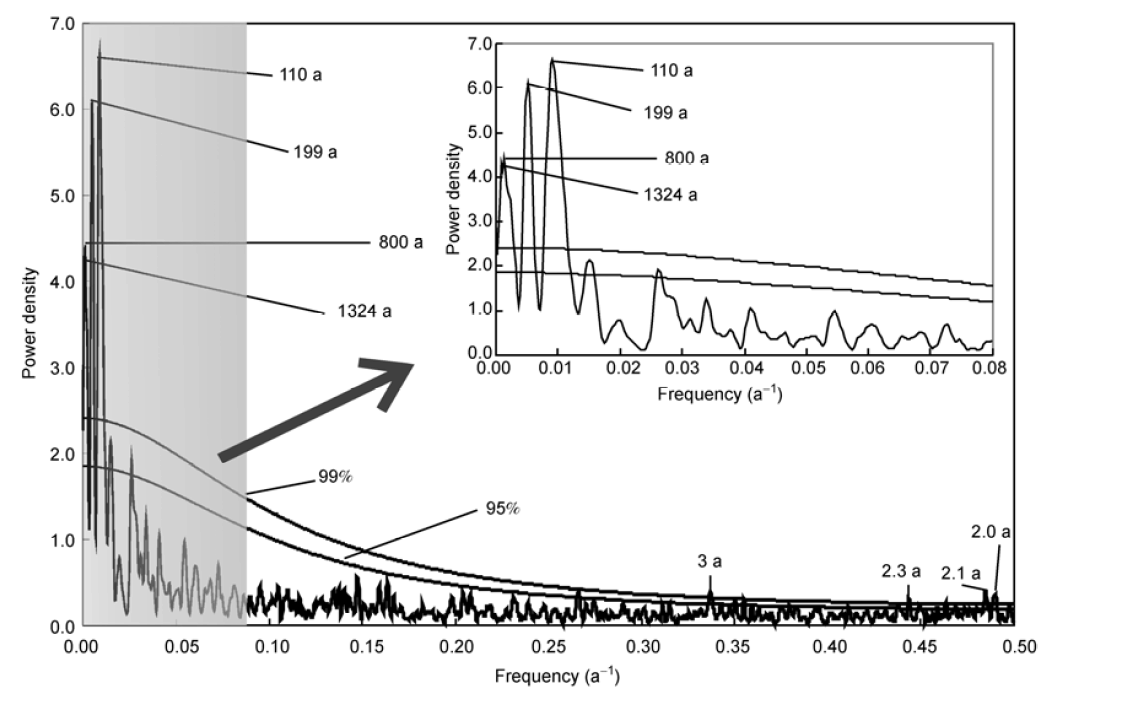 Figure 2 Power spectrum analysis of the 2485-year temperature series. (Click to enlarge)
…
 Figure 3 Millennium-scale cycle in the temperature variation during the last 2485 years. (Click to enlarge)
…
 Figure 4 Decomposition of the main cycles of the 2485-year temperature series on the Tibetan Plateau and periodic function simulation. Top: Gray line,original series; red line, 1324 a cycle; green line, 199 a cycle; blue line, 110 a cycle. Bottom: Three sine functions for different timescales. 1324 a, red dashed line (y = 0.848 sin(0.005 t + 0.23)); 199 a, green line (y = 1.40 sin(0.032 t – 0.369)); 110 a, blue line (y = 1.875 sin(0.057 t + 2.846)); time t is the year from 484 BC to 2000 AD. (Click to enlarge)
…
…
Conclusions
Climate events worldwide, such as the MWP and LIA, were seen in a 2485-year temperature series. The largest Figure 6 Temperature comparison between the forecast and observation data taken from seven stations on the central-eastern Tibetan Plateau (seven stations: Delingha, Dulan, Golmud, Lhasa, Nagqu, Dachaidan and Bange). amplitude and rate of temperature both occurred during the EJE, but not in the late 20th century. The millennium-scale cycle of solar activity determined the long-term temperature variation trends, while century-scale cycles controlled the amplitudes of temperature. Sunspot minimum events were associated with cold periods. The prediction results obtained using caterpillar-SSA showed that the temperature would increase until 2006 AD on the central-eastern Plateau, and then decrease until 2068 AD, and then increase again. The regularity of 600-year temperature increases and 600-year decreases (Figure 3) suggest that the temperature will continue to increase for another 200 years, since it has only been about 400 years since the LIA. However, a decrease in temperature for a short period controlled by century- scale cycles cannot be excluded. Obviously, solar activity has greatly affected temperature on the central-eastern Plateau. However, there are still uncertainties in our understanding of climate change, and the concentration of CO2 affects the climate. Further investigations are thus needed. –
————————–
REFERENCES
Liu Y, Cai Q F, Song H M, et al. Amplitudes, rates, periodicities and causes of temperature variations in the past 2485 years and future trends over the central-eastern Tibetan Plateau. Chinese Sci Bull, 2011, 56: 29862994, doi: 10.1007/s11434-011-4713-7 [ Climate Change over the Past Millennium in China.] … Hat Tip: Geoffrey Gold.
nomnom says:
December 8, 2011 at 12:52 pm
Neither of those estimates match empirical observation, do they. You are entitled to your opinion, but you are not allowed to rewrite known history.
crosspatch,
Interesting data, thank you.
As regards the Arctic it was the 1997 to 2005 period I had in mind. I think the warming effect of that warmer water peaked as regards ice melt in 2007 and is now on the turn.
An interesting issue is that warmth in the Arctic can occur when the globe is warming, from more warm water under the ice AND when it is cooling from more frequent ingress of warm air flows due to more meridional jets.The water effect would be the stronger due to the thermal capacity of water.
When the globe is warming the poles get cut off by faster and closer circulation of winds around them (more zonal jets) so the Arctic is warmed primarily by water at such times.
Anthony and Observer, thank you.
This goes into the evidence necessary for making decisions. I expect to see more records in the upcoming decade. It would be a mistake to give this data set and the resultant model too much or too little weight.
It will be interesting to see how close the observed tree ring widths are to the modeled tree ring widths in the future.
“Southern Ocean sea surface temperatures seemed to have been trending flat from 1982 through 2007 but seem to have recently “stepped down” and appear to be establishing a new trend line about 0.2 degrees lower.”
As per Bob Tisdales work the SSTs are a fine balance between El Nino discharge mode and La Nina recharge mode. We had a run of strong El Ninos in the late 20th century after a period of negative PDO recharge so one would expect to see a decline during the period as the discharge progressed.
However the odd feature of the late 20th century was that even while El Ninos were strong the ocean heat content still seems to have risen even if the surface waters did cool off a bit.
Likewise now that the El Ninos have faded a bit with the negative PDO the recharge process seems rather puny.
To deal with those aspects I have introduced a cloudiness factor which if correct would have allowed more solar energy into the oceans when those strong El Ninos occurred for a net rise in ocean heat content despite the ongoing discharge process.
Now the cloudiness factor would be restricting the recharge process despite the negative PDO.
I need a few years of ongoing observations to validate that idea.
OK, forget about proxy reconstructions. This data shows the growth of these trees is rapid in the last few hundred years. It also shows they have grown at this rate or faster in the past. That by itself casts some serious doubt over the current warming trend being “unprecedented”.
That is assuming the data is not corrupted. That’s a pretty big nail in the AGW coffin all by itself.
Tangentially related: how warmers are trying to get rid of the 13th century cold period and create a Mongolo-genic cold period. Some traditional climatologists have considered this drop in temps as a precursor of the Little Ice Age.
I remember being taught in school that the Mongol invasions of the 13th century were likely kicked off by Arctic cold driving across the Steppes from Siberia. Drought conditions may have ensued, robbing the nomads of their fertile grasslands as cold winds scoured the taiga and Gobi to the south. Such a dip in mid-13th century temperature are shown in the above chart from Jo Nova, as well as other proxies of the area. See:
http://pages.science-skeptical.de/MWP/Zhang-2003.html
http://pages.science-skeptical.de/MWP/Paulsen-2003.html
Moreover, recent press coverage has spotlighted the return of devastating arctic temperatures to Mongolia in the last few years; it has wiped out livestock, and caused a massive migration of mongols into the cities. Looking at contemporary pictures of Mongolia in wintertime, it isn’t that hard to imagine comparable cold driving Ghengis and his Horde off the Steppes during the 13th Century.
http://news.xinhuanet.com/english2010/world/2010-01/30/c_13157184.htm
But if you Google “Mongol Migrations” and “Climate”, the Mongol hordes weren’t escaping the cold. They apparently were causing it.
These days (based on a single post-grad *study published in the journal, Holocene) hundreds of articles (page after page in search engine Google) reveal how the Mongols themselves caused a global reduction of CO2 in their bloody conquest. By killing off so many people, forests were allowed to regenerate across Asia, the Middle East and Europe. The renewed greenery gobbled up the CO2. The lesson is clear for modern man: wipe out civilization in order to reduce the CO2 in the atmosphere and restore the killing cold of the Mongolian Steppes.
http://news.discovery.com/earth/mongols-vikings-and-romans-connected-to-climate.html
Weather change causing human migration? Such a fantasy!
Humans causing CO2 (and possibly the weather) to change? Now, that’s the way to do history nowadays!
* J. Pongratz, K. Caldeira, C.H. Reick, and M. Claussen, 2011: Coupled climate-carbon simulations indicate minor global effects of wars and epidemics on atmospheric CO2 between AD 800 and 1850, The Holocene, doi: 10.1177/0959683610386981.
Press coverage: Interview on BBC World Service.
The fundamental problem is that we do not have any good high-resolution temperature proxies in temperate regions that pre-date the thermometer. Every single one that I can think of would be “disturbed” by precipitation changes, flooding, etc. There are some fairly low resolution proxies but these aren’t good enough to “catch” things in the recent (Holocene) past that vary on annual or even decadal time scales. I would be interested in any speleothem research done in someplace like Mammoth Cave. I can find such work for the tropics in South America. The South American work seems to be another validating point showing the ITCZ greatly influencing rainfall and its general migration South in response to the decline of solar insolation decline in the Northern Hemisphere starting about 9000 years ago. What is most interesting to me is the sudden appearance of “noise” which they wonder is an ENSO signal that begins to appear only 4000 years ago. See figure 6 on the 126th page of this PDF thesis (page 104 of the document)
http://dare.ubvu.vu.nl/bitstream/1871/13246/5/8837.pdf
And I would also be interested in this paper if I can find it for free someplace:
http://geology.gsapubs.org/content/38/5/455.abstract
It looks like we can find some rather good data if it is located in exotic places to which someone might want to travel. We can’t seem to find anyone willing to travel to Kentucky to do it, though.
El Nino is a little counter-intuitive. El Nino is basically the ocean dumping heat into the atmosphere and La Nina is the ocean gaining heat. During La Nina you have strong trades and reduced clouds. While you do have surface cooling at the very, very surface due to increased winds, you also have more sunlight so just below that surface you have a net gain of energy during La Nina relative to El Nino. This water gets pushed into the Western Pacific and Indian Ocean. You will see an increase in ocean temperatures off of Japan when you see a reduction in temperatures off of California and then the reverse will be true when PDO changes phase.
So La Nina results in a reduction surface temperature in the equatorial Pacific but a net gain in heat energy that then gets distributed around. At least that’s how I understand it, albeit very simplified, from reading Tisdale.
Hmmm, I think my fits must be some kind of artifact of the digitisation; If the Eureqa functions are fed with equally spaced years then only a slightly distorted sine wave comes out . Getdata digitiser seems to digitise continuous lines by taking points that are equaly spaced along the distance of the line i.e not equally spaced in time, So it is probably some very wierd form of aliasing.
Oh well 🙂
In an overall sense, I agree with you. CET is a different animal, though, from something like GISS or HadCRUT. This would have been done, I believe, with the raw CET observations. But I am confident that you will get a similar result from stations at a similar latitude in the same hemisphere. As you migrate away from that latitude the strength of some of those cycles may change and the same as you migrate inland from the sea. I would expect Amarillo, for example, to maybe have less of a teleconnection to the NAO and probably more of one to ENSO than CET does.
A place like Venezuela would show a very strong signal from variations in the position of the ITCZ while Kansas City would show none.
I see that “nomnom” is the nom du jour of the troll assigned to WUWT by The Team…
Well, OK, I’ll take a small bite out of the Troll Bait:
Dear NomNom, the globe does not ‘all go together as it goes’. It has time lags in some areas relative to others. It has oscillations that move in counterpoint. It has feedback loops and natural oscillations and teleconnections. Sometimes moving in opposite directions in different parts of the world.
Look up the AMO and the PDO and the ENSO. Learn about the way that the southern hemisphere often moves in opposition to the northern hemisphere in some time scales.
This is what is called “complex” behaviour. (As opposed to “the hobgoblin of small minds”, or a foolish consistency…)
So, you see, you can have a process that has onset in one place (like Europe) and takes a hundred years, or maybe even 200, to spread around the globe to other places.
I’ve frequently complained about the “over averaging” done to temperature data. (And been assaulted by the foolish for that statement). The simple fact is that averaging is done to HIDE things. (Often with very good results). I use a 25 day simple moving average to HIDE daily price movements in stock as they are largely news event driven. I want to see the longer term forces at work, not the daily noise. Hiding can be good… But sometimes hiding is bad.
In the case of global climate and weather cycles, averaging over the whole globe is bad. We know it is bad as we know there are longer cycle changes that affect different parts of the globe in opposition. (Yes, I really do want you to learn what the ENSO is and how the N vs S hemispheres have things that move in opposition). So averaging them together can HIDE what we want to FIND. Like the decline… (but I digress…)
Oh, and on the topic of cycles, I see that someone posted a link to Timo. He has a GREAT page on all the possible solar cycles. (I’m figuring folks can find it on their own…). There is also this interesting page that finds a lunar position driven cycle:
http://www.pnas.org/content/97/8/3814.full
Or, rather, many cycles. Plenty of real physical things that can drive the weather (even the long term weather cycles that warmers like to call climate, even though it isn’t…) on changes of durations up to 1800 and 5000 years.
Unfortunately for the warmers, things are kind of cold right now (and have been getting colder since we hit a peak in 1998 … you know last MILLENNIUM 😉
On the question of “did they know”: I suspect they did. Not only the Hansen synch change with the cold / warm 60 year cycle, but the way the “narrative” changes in sync with expectations just BEFORE those events ought to happen…
So we had “Global Warming” up to the late ’90s, then it morphed into “climate CHANGE” just as we hit the peak. Then just about the time the sun was about to go very sleepy, causing a UV plunge, shortening of the atmospheric height, and more violent winds – about like they were in the last similar event… Suddenly then we get “climate chaos” and stories of more wind related damage (hurricanes, tornadoes, ‘extreme events’) just a few years BEFORE they ought to happen from the shorter air column giving higher wind speeds (though of colder air…)
There is only so much “perfect accident” you can see before you start wondering where Remo is right now… (Google Remo Williams… 1985 or so, has Kate Mulgrew in it too)
So Occam’s Razor says the most simple explanation that accounts for all the known facts is that folks were seduced by power, believed in their own ability to pull off the dodge, and thought they were doing ‘the right thing’… but were wrong… THEN the schedule did not go as planed… Gang Agley as it were. They forgot that folks, especially the apathetic “rubes”, could take a Very Long Time to get on the band wagon. We had things building to a fever pitch in about 1985 – 1990… and The Folks didn’t quite notice… Took until about 2000 to really get on board. And by then they were behind schedule. Instead of a decade to show how The Solution Had Worked!, the were past the inflection point and into damage control… Time for “Climate Chaos”…
So now they are doing the last ditch histrionic SCREAM!!!!
And the rest of us are doing a “What? You overactor!” (in a Jim Carry kind of way:
http://youtu.be/eju7zSmHklA )
At any rate, we will now see, IMHO, a long drawn out process as folks both try to continue the effort ( This time for sure!) while trying to find ways to “distance themselves” from the inevitable fiasco as things go obviously cold. Very Cold…
BTW, for folks wondering where I’d gone:
I got a job on the other side of the continent. Then came home, Then had two wisdom teeth removed… (Yes, nearly 60 and still teething…. it’s those slow genes from the Neanderthal side, I’m sure 😉 but, to quote Independence Day: I’m BaaAAAAK!!!
Yeah, back short a couple of teeth… but hey, I can always gum ’em to death 😉
Per the posting: I think the Chinese have always done careful detailed (and sometimes over complicated) work. Looks to me like they are still doing careful work…
Oh, and per things that make trees grow: In the Pacific NorthWest they found that much of the nitrogen and phosphorus that got to the pine forest came from Salmon caught by bears, then carted off into the forest where bears do what they do in the forest… (“Does a bear Shxx … in the forest?”) So to the drivers of Tree Rings one must add salmon run size and Bear Poo….
I’m willing to assume that bear poo is not a major factor in Tibet Junipers… but you have to watch out for it. Especially in places with a lot of salmon… Like maybe Yamal… (Mann, have you looked at the POO climate driver? Maybe that’s the cause of the decline… not enough bear pooing in the forest… I’m sure POO is involved some way or another in the results…)
Theo Goodwin says:
December 8, 2011 at 1:41 pm
…” extrapolating from graphs has never amounted to prediction and never will”.
This is not entirely true. If a process goes in cycles and you have enough data to cover multiple cycles, you can with a high degree of probability predict what will happen next even you you don’t understand what causes the cycles. You don’t always have to know WHY before you can make a prediction that is likely to be correct. For example, I don’t know why radioactive elements decay, but I can say with a high probability of success that HALF of them will undergo radioactive decay after X amount of time. Using an example of earth climate,. ancient geologic and ICE core data reveal cyclic variations that indicate there are cyclic patterns that of very warm periods and ice ages. Even without knowing about Milankovich cycles, it would still be highly likely that the earth is soon to be entering another ice age(geologically speaking). This prediction can be made because there are cyclic patterns in the data…. you don’t need to know WHY those cycles are there…. you just need to know they are there.
JJThoms says:
Wow… Just Wow!!
I looked up ‘Irony’ on Wikipedia, and this is what it told me:
“Irony (from the Ancient Greek εἰρωνεία eirōneía, meaning dissimulation or feigned ignorance)[1] is a rhetorical device, literary technique, or situation in which there is a sharp incongruity or discordance that goes beyond the simple and evident intention of words or actions.”
Just so you know, for future reference etc
Alcheson says:
December 8, 2011 at 4:17 pm
To predict an event is show that it is an instance of a well confirmed hypothesis. The prediction is made by identifying some factual statements describing the present situation, such as the date, time, and location, substituting those factual statements (constants) into some universally quantified general statement, and deducing a future event from the combination of the hypothesis and the initial conditions. (If the deduced event description proves to be false, one or more of the hypotheses used to deduce it is likely false. I just told you how falsification works with hypotheses which have cognitive content. Tell me how it works with a line on a graph which has no cognitive content.)
For example, you can use the date and time where you are as the initial conditions, and plug them into Newton’s formulation of Kepler’s Laws to deduce the next date and time that you can see Venus in full phase.
The well confirmed hypotheses (called Laws when they are sufficiently central to our science) describe the natural regularities that make up the solar system taught to all grammar schoolers. The purpose of science is to discover or create the laws that describe all the interesting physical processes in the universe.
Notice that Newton’s Laws do not reduce gravity to a mechanism. Neither do Einstein’s Laws. However, they do describe all the natural regularities regarding the behavior of objects in a gravitational field that we know at this time.
The event predicted is explained by the hypotheses which describe the behavior of the solar system. If someone asks “Why is Venus in full phase now?” you can explain to them Kepler’s Laws and show them on a chart the relative positions of Earth, Venus, and the Sun. That is scientific explanation. Explain to me how you can point to a line on a graph as an explanation of a particular event.
In the case of radioactive decay, the hypotheses are just like Kepler’s Laws except that they are statistical laws. But statistical laws are just as deterministic as non-statistical laws as long as the scientists are using objective statistics. The statistical laws of radioactive decay are objective in the sense that all the events that can be predicted from the laws are events whose conditions are fully specified. In other words, the events described always satisfy the same set of conditions; that is, there is no comparison of apples and oranges. It does not matter whether the decaying item rests on top of Mt. Ranier or at the bottom of Death Valley.
Another interesting example is Population genetics which uses statistical laws. The objectivity of their laws is maintained by the fact that the statistical hypotheses are referenced to particular populations which actually exist and are available for study; hence, their name.
In climate science, we rarely know that a tree ring width reading from a particular tree can be compared to another such reading from another tree. That is because climate scientists, so-called, have not done the empirical work to specify the conditions in the tree and in the environment that cause changes in growth patterns. We cannot compare a tree at the top of Mt. Ranier with another of the same variety and age at the bottom of Death Valley. For that matter, we cannot compare a tree in a dense forest to a tree resting on an otherwise bare knoll though they might be separated by a hundred meters. Climate scientists must do the experimental work to specify conditions causing changes in tree growth so that they are not comparing apples to oranges. They can do this work in labs monitored by graduate students. If they were serious they would have done it long ago. This work would produce the regularities in the trees and in the environment that govern changes in tree growth. They do not have to cover all environments in which a specific kind of tree grows but only those environments that are useful for temperature measurement.
It would be nice if there was a bit of recognition of simple sampling criteria rules. Looking at Figure 2 for example, Nyquist theory dictates that to properly observe/capture a specific frequency, one needs to record at a rate of at least double that frequency, and that’s assuming that the sampling is not out of phase in any way (imagine measuring daily temperature fluctuations by measuring twice a day. The waveform looks completely different if you measure at noon and midnight than if you measure at 6 PM and 6 AM). Furthermore, most experts would say that you shouldn’t assign any value or statistical merit until you have a sampling frequency of at least 6 to 10 times greater than the frequency being observed. If you don’t observe these parameters, you run the risk of aliasing your data, which will show up in a noise power spectra as incorrect frequencies amplitudes and, if memory serves, incorrect frequencies, too, particularly in more complex spectra where multiple discrete frequencies contribute.
Given that tree rings give you a 1 year frequency, they really should be putting a huge caveat with everything to the right of 0.166 (1/6) or even 0.1 (1/10).
On the flip side, the frequencies at 1324 A^-1 and 800 A^-1 should be considered dubious as well because only two full cycles of the 1324 frequency were experienced and 3 cycles for 800.
I do think a document like this is a very good step in the right direction (in contrast to the material put out by Mann, etc.), but the measurement science still has a very long way to go before the data is “tight” enough to merit the claims that many want to make about AGW. I suspect it will never get there w/o an enormous involvement from individuals expert in the measurement sciences.
I’d also say that I think a natural data set is infinitely more complex and less prone to high precision than a simple physical science calibration (perhaps calibration of a thermocouple), so the scientists are dealing with a very difficult hand. However, they should acknowledge that and temper their opinions accordingly.
JMHO,
HF
I have to assume that people who complain about it being tree rings haven’t read through the comments. The same pattern emerges when the same analysis is done on thermometer readings (not in Russia). So I would say that the method of analysis seems to be robust in that the output matches thermometer data and also matches other known signals such as NAO.
E.M.Smith says:
December 8, 2011 at 4:05 pm
“So, you see, you can have a process that has onset in one place (like Europe) and takes a hundred years, or maybe even 200, to spread around the globe to other places.”
Spot on. (It is called Empiricism – science, that is.)
Thanks for doing this spade work. Nomnom and his climate propaganda circle are working to wear us down. Their time is running short.
crosspatch says:
December 8, 2011 at 4:02 pm
Well, crosspatch, (insert broad smile here) we have to do the empirical work if we are to know.
Your good instincts will drive you to give up the hypothesis that known proxy data in climate science, so-called, is objective.
What is really most interesting is that you will see about a 0.5C drop in temps during the Maunder minimum with lesser drops in the preceding minima. If we are at the same time as these cycles are due to naturally drop, also entering into a solar minimum (assuming frequency of solar minima are not cyclical and already included as one of the activation mechanism of the cycles shown) then we might be in for an even more substantial decline that this data would predict. We could be looking at a temperature regime in the CET like that not seen since the late 1800’s.
So either
(a) Tree-ring analysis does not give a good indication of past temperatures.
or
(b) Tree-ring analysis does give a good indication of past temperatures.
If a, then the hockey-stick claims are unfounded.
If b, then the hockey-stick claims are seriously challenged.
Not good for the hockey-stick either way.
Well, I have access to data in many cases but I don’t have the tools. I might possibly be able to obtain the tools, though, if they are open source. Then there would be a bit of a learning curve associated but I am willing to take on the project. I have access to a reasonable powered Linux computer and some storage capacity.
I would also like to do such analysis on precipitation records as they likely go farther back in time with substantial accuracy and we also likely have reasonable proxies along with very early calibration period overlaps (the ruler was invented long before the thermometer).
Remember, these are CLIMATE SCIENTISTS, so you can’t question them. I hope Alarmist crowd remembers that.
Kasuha says: December 7, 2011 at 10:51 pm
Fourier analysis on time series may be a lot of fun but until physical background of identified cycles is demonstrated it’s not more than just playing with numbers with zero predictive potential.
I think he’s right. The predictive ability has to be taken with a lot of salt. The importance of the Fourier analysis may be in what it points to. Is there an underlying mechanism that is predictable? That’s the interesting question.
We can question the now-discredited climate scientists, though. Along with their now-discredited hockey stick and the now-discredited AGW hypothesis.
UN FAO Fisheries Technical Paper 410 (2001) at http://www.fao.org/docrep/005/y2787e/y2787e00.htm provides examples of an approximate 60-year cycle based on fisheries. The paper references Japanese records going back to about 1600.