 Reposted from Jo Nova’s site
Chinese 2485 year tree ring study shows shows sun or ocean controls climate, temps will cool til 2068
A blockbuster Chinese study of Tibetan Tree rings by Lui et al 2011 shows, with detail, that the modern era is a dog-standard normal climate when compared to the last 2500 years. The temperature, the rate of change: it’s all been seen before. Nothing about the current period is “abnormal”, indeed the current warming period in Tibet can be produced through calculation of cycles. Lui et al do a fourier analysis on the underlying cycles and do a brave predictions as well.
In Tibet, it was about the same temperature on at least 4 occasions — back in late Roman times — blame the chariots, then again in the dark ages — blame the collapse of industry; then in the middle ages — blame the vikings; in modern times — blame the rise of industry. Clearly, these climate cycles have nothing to with human civilization. Their team finds natural cycles of many different lengths are at work: 2-3 years, 100 years, 199 years, 800 years, and 1324 year. The cold periods are associated with sunspot cycles. What we are not used to seeing are brave scientists willing to publish exact predictions of future temperatures for 100 years that include rises and falls. Apparently, it will cool til 2068, then warm again, though not to the same warmth as 2006 levels.
On “tree-rings”
Now some will argue that skeptics scoff at tree rings, and we do — sometimes — especially ones based on the wrong kind of tree (like the bristlecone) or ones based on small samples (like Yamal), ones with abberant statistical tricks that produce the same curve regardless of the data, and especially ones that truncate data because it doesn’t agree with thermometers placed near airconditioner outlets and in carparks. Only time will tell if this analysis has nailed it, but, yes, it is worthy of our attention.
Some will also, rightly, point out this is just Tibet, not a global average. True. But the results agree reasonably well with hundreds of other studies from all around the world (from Midieval times, Roman times, the Greenland cores). Why can’t we do good tree-ring analysis like this from many locations?
Jo
Amplitudes, rates, periodicities and causes of temperature variations in the past 2485 years and future trends over the central-eastern Tibetan Plateau [Chinese Sci Bull,]
 Figure 5 Prediction of temperature trends on the central-eastern Tibetan Plateau for the next 120 years. Blue line, initial series; orange line, calibration series, 464 BC–834 AD; purple line, verification series, 835–1980 AD; red line, forecasting series, 1980–2134 AD. (Click to enlarge)
There are beautiful graphs. Have a look at the power spectrum analysis and the cycles below…
ABSTRACT:
Amplitudes, rates, periodicities and causes of temperature variations in the past 2485 years and future trends over the central-eastern Tibetan Plateau
Amplitudes, rates, periodicities, causes and future trends of temperature variations based on tree rings for the past 2485 years on the central-eastern Tibetan Plateau were analyzed. The results showed that extreme climatic events on the Plateau, such as the Medieval Warm Period Little Ice Age and 20th Century Warming appeared synchronously with those in other places worldwide. The largest amplitude and rate of temperature change occurred during the Eastern Jin Event (343–425 AD), and not in the late 20th century. There were significant cycles of 1324 a, 800 a, 199 a, 110 a and 2–3 a in the 2485-year temperature series. The 1324 a, 800 a, 199 a and 110 a cycles are associated with solar activity, which greatly affects the Earth surface temperature. The long-term trends (>1000 a) of temperature were controlled by the millennium-scale cycle, and amplitudes were dominated by multi-century cycles. Moreover, cold intervals corresponded to sunspot minimums. The prediction indicated that the temperature will decrease in the future until to 2068 AD and then increase again.
…
Figure 1 Tree-ring-based temperature reconstruction for the central-eastern Tibetan Plateau during the past 2485 years (gray line), the 40-year moving average (thick black line) and the 40-year running standard deviation (thin black line); the horizontal line is the mean temperature for the 2485 years. (Click to enlarge)
…
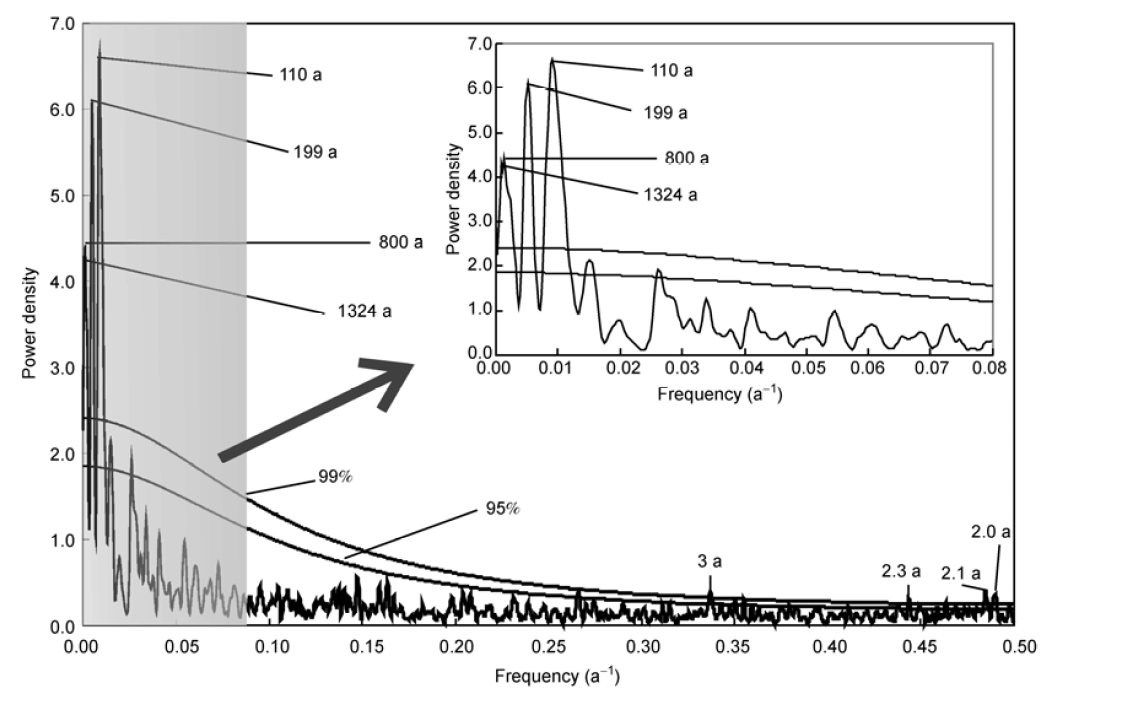 Figure 2 Power spectrum analysis of the 2485-year temperature series. (Click to enlarge)
…
 Figure 3 Millennium-scale cycle in the temperature variation during the last 2485 years. (Click to enlarge)
…
 Figure 4 Decomposition of the main cycles of the 2485-year temperature series on the Tibetan Plateau and periodic function simulation. Top: Gray line,original series; red line, 1324 a cycle; green line, 199 a cycle; blue line, 110 a cycle. Bottom: Three sine functions for different timescales. 1324 a, red dashed line (y = 0.848 sin(0.005 t + 0.23)); 199 a, green line (y = 1.40 sin(0.032 t – 0.369)); 110 a, blue line (y = 1.875 sin(0.057 t + 2.846)); time t is the year from 484 BC to 2000 AD. (Click to enlarge)
…
…
Conclusions
Climate events worldwide, such as the MWP and LIA, were seen in a 2485-year temperature series. The largest Figure 6 Temperature comparison between the forecast and observation data taken from seven stations on the central-eastern Tibetan Plateau (seven stations: Delingha, Dulan, Golmud, Lhasa, Nagqu, Dachaidan and Bange). amplitude and rate of temperature both occurred during the EJE, but not in the late 20th century. The millennium-scale cycle of solar activity determined the long-term temperature variation trends, while century-scale cycles controlled the amplitudes of temperature. Sunspot minimum events were associated with cold periods. The prediction results obtained using caterpillar-SSA showed that the temperature would increase until 2006 AD on the central-eastern Plateau, and then decrease until 2068 AD, and then increase again. The regularity of 600-year temperature increases and 600-year decreases (Figure 3) suggest that the temperature will continue to increase for another 200 years, since it has only been about 400 years since the LIA. However, a decrease in temperature for a short period controlled by century- scale cycles cannot be excluded. Obviously, solar activity has greatly affected temperature on the central-eastern Plateau. However, there are still uncertainties in our understanding of climate change, and the concentration of CO2 affects the climate. Further investigations are thus needed. –
————————–
REFERENCES
Liu Y, Cai Q F, Song H M, et al. Amplitudes, rates, periodicities and causes of temperature variations in the past 2485 years and future trends over the central-eastern Tibetan Plateau. Chinese Sci Bull, 2011, 56: 29862994, doi: 10.1007/s11434-011-4713-7 [ Climate Change over the Past Millennium in China.] … Hat Tip: Geoffrey Gold.
ob says:
December 8, 2011 at 12:57 am
i’d love to know what mcintyre and jeff id think about that reconstruction. guess they would debunk it.
well they would debunk it if the people that did this used bad science or made major mistakes. they look at things to see if it is scientifically valid or not if not they call it out.
Kasuha says: Kasuha says: December 7, 2011 at 10:51 pm
“Fourier analysis on time series may be a lot of fun but until physical background of identified cycles is demonstrated it’s not more than just playing with numbers with zero predictive potential.”
Fourier Analysis is but one of many tools, that attempt to understand complex systems & predict future directions. The climate system has yet to be completely understood, and use of different tools aid to that understanding.
Below is a comparison between Fourier & Empirical Mode Decomposition filtering, using the CRU data. Note there seems to be very good comparison in the results, by two very different mathematical.methods.
http://www.4shared.com/photo/2foIw4k7/CRU-Fig-6a.html
However it might be worthwhile to look at Signal Conditioning literature. The IEEE has a designated Group relating to that area. Or you can pick up a copy of “Measurement of the Power Spectra”, Blackman & Tukey, for a basic understanding of the Fourier methods, and Applications.
A side note, was that Drs. Norbert Wiener & Charles Draper worked together, using Fourier methods, to develop the Navy MK 14 gun sight during WWII. This later morphed into a A/C gun sight (B-29, F-86)..
As far as use of Fourier methods in the stock market, check out the TradeStation package, for starters.
.
Take a look a my graph at:
http://astroclimateconnection.blogspot.com/2010/10/1470-year-do-events-transition-from.html
Using a much longer ice-core record – The last two (-6 and -7) and next (-8) 1470 year Dansgaard–Oeschger (D.O.) warming events STARTED at:
800 B.C. – with temperatures reaching maximums around 600 B.C. (200 year rise)
680 A.D. – with temperatures reaching maximums around 1100 A.D. (400 year rise)
and 2150 A.D.
In addition, there are secondary warm peaks at 200 A.D. and the present.
In the Northern Hemisphere, they take the form of rapid warming episodes, typically in a matter of decades, each followed by gradual cooling over a longer period [typically a few hundred years].
Wikpedia] http://en.wikipedia.org/wiki/Dansgaard%E2%80%93Oeschger_event
Figure 4 of Liu Yu et al.’s paper shows that the 1324 years long term warming events peak at:
680 B.C. – with long-term temperatures reaching maximum maximum 350 B.C. (~ 350 year rise)
620 A.D. – with long-term temperature reaching maximums around 920 A.D (~ 300 year rise).
and 2200 A.D. [obtained by extrapolation of their period)
Other than the roughly 100 year shift, I suspect that the 1324 year cycle that Liu Yu et al. (2011) are finding in their truncated tree ring record is really just the is the 147-0 year DO phenomenon.
Another arrow in the elephant. We’re approaching a toppling point.
Sorry, this comment in my last post:
Figure 4 of Liu Yu et al.’s paper shows that the 1324 years long term warming events peak at:
Should read: Figure 4 of Liu Yu et al.’s paper shows that the 1324 years long term warming events START at:
I’m sure that the Team will roll out a “peer-reviewed” study in a few weeks attempting to refute this study. It seems to me that the only way they can try to refute this is to question the accuracy of “treemometers” which will cast doubt on the Mannian hockey stick. The Team’s other alternative is to ignore it. I can’t wait to see what they do (or don’t do).
Timo Niroma:
1410-1500 ? cold (Sporer minimum)
1510-1600 107 warm
1610-1700 61 cold (Maunder minimum)
1710-1800 114 warm
1810-1900 95 cold (Dalton minimum)
1910-2000 151 warm
2010-2100 ? cold?
http://personal.inet.fi/tiede/tilmari/sunspot5.html#historic
I’m only a highly interested civilian when it comes to the study of global climate. But, it has always seems logical that cycles within cycles would dictate global climate. Starting with the sun and then adding things like the “Chandler wobble.”
Is there any research into the length of the cycle of the migration on magnetic north? This appears (to me) to be the best measure of the earth’s wobble.
http://en.wikipedia.org/wiki/File:NASA_54556main_nmppath2001_med.gif
Magnetic north was fairly stable for decades (centuries?) at it southern extreme and now is moving quickly toward Siberia. Will it reach a southern extreme and stay there for decade or centuries?
Could this be the 1324 cycle? The NH/world warmer when magnetic north is in Canada and colder when it is in Siberia? With relatively quick transitions in between the two cycles….
I wish I had the proper training to tackle this project myself…all I have is a hypothesis.
Hello – I applaud Mr. Brown’s analysis. Will someone e-mail this to the IPCC & the 12,000 freeloaders at COP17. Another day of discovery at WUWT!
The second paper Liu Yu referred to is:
Annual temperatures during the last 2485 years in the mid-eastern Tibetan Plateau inferred from tree rings
LIU Yu, AN ZhiSheng, Hans W. LINDERHOLM, CHEN DeLiang, SONG HuiMin, CAI QiuFang, SUN JunYan & TIAN Hua
Science in China Series D: Earth Sciences
Received July 25, 2008; accepted December 22, 2008; published online February 3, 2009
http://cadata.cams.cma.gov.cn/nianlun/upfile/China%20Science.pdf
Supported by National Natural Science Foundation of China (Grant Nos. 40525004, 40599420, 40890051), National Basic Research Program of China (Grant Nos. 2007BAC30B00, 2004CB720200, 2006CB400503) and the Swedish International Development Cooperation Agency (SIDA, Grant to Hans W. Linderholm).
So this Tibet record shows the “MWP” happened before 1000AD
Yet the Central England Temperature record derived graph shows the MWP happened after 1000AD
http://andyrussell.files.wordpress.com/2010/05/ipcc_far_1000.png
Explain that one skeptics.
I have to agree with Matt … if this study showed an unusual warming in the 20th Century this blog would be tearing the paper to shreds lol
Kasuha said: Fourier analysis on time series may be a lot of fun but until physical background of identified cycles is demonstrated it’s not more than just playing with numbers with zero predictive potential.
Lucy S. replied: I’m sorry to see this faux argument keep on reappearing.
But actually, it’s a correct argument. Fourier spectral analysis assumes that the data record for the window size represents a periodic function with mean value c_0. It therefore excludes by assumption the possibility that mean temperature could change to some other value outside that window. It assumes that climate — long term climate — does not change over the window.
That said, this paper is important because it puts forward a hypothesis to compete with AGW: that increasing temperatures really *are* caused by natural variability. This places a greater burden on Mann et al to falsify this hypothesis if they are to win the argument.
It’s interesting how well this matches what we know from historical records from Europe. I especially noted the very steep drop from ca 1550 to 1600. The 16th century was very warm in its first half, with some of the warmest summers ever in Europe, but the climate cooled dramatically in the second half of that century.
Of course people here fail to talk about the sample depth in the W3 and W4 warming periods.
See figure 4. The sample depth there is Less than Yamal.
reading the paper helps.
nomnom says:
December 8, 2011 at 8:55 am
Started at 900ad, ended around 1350ad. Just as the graph you posted says. Before and after. See? Or were making a joke?
Or were you making a joke? Moderators do not correct. I am human, after all. Thank you.
The Medieval Warm Period is portrayed differently depending on what proxy you are looking at. Liu’s graph shows a sharp peak just before the year 1000. It is similar in that respect to the graph produced by: Esper, E.R. Cook, and F.H. Schweingruber (2002). “Low-Frequency Signals in Long Tree-Ring Chronologies for Reconstructing Past Temperature Variability”. Science 295 (5563): 2250-2253.
There are lots of proxies. They don’t agree very well. Don’t get your shirt in a knot by trying to read too much into them. Historical evidence and proxies tell us that there probably was a Medieval Warm Period. It may have been warmer than it is now. That’s all we can say with much confidence.
http://en.wikipedia.org/wiki/Medieval_Warm_Period
http://en.wikipedia.org/wiki/File:2000_Year_Temperature_Comparison.png
p.s. I was a warmist until Mann tried to erase the MWP; that made me sit up and pay attention to the science.
steven mosher says:
December 8, 2011 at 9:20 am
Of course people here fail to talk about the sample depth in the W3 and W4 warming periods.
See figure 4. The sample depth there is Less than Yamal.
reading the paper helps.
==============================================
lol, only if one believes in fairy tales and unicorns. Until someone explains how we can come to know the low of the temps that aren’t expressed in the rings (but inferred?) there’s no reason to waste any more time on it than what already has been. One hand clapping stuff.
But I agree, this is every bit as valid as the studies that have the Yamal series in it.
Do we have all code and all data – used and not used – for this?
Matt says: “Does Bull stand for bulletin or bullshit? – ”
If you knew anything about science, you would not find it necessary to ask that question.
For everyone who see the HS in the first graph, here is the HS overlaid on Liu et al’s graph:
http://i40.tinypic.com/35c4bw9.jpg
Mann lacks 50-70% of variation in his reconstructions that Liu, Loehle and Moberg all seem to find. Is it not interesting what the HS would have looked like if it started only 50 years prior=FAIL.
Loehle with HS: http://i39.tinypic.com/2q3arlw.jpg
Loehle and Moberg: http://i46.tinypic.com/2lcvct1.jpg
Re: “And thank god someone is doing a Fourier Analysis instead of this statistical drivel about principal components. Given we live of a rotating planet with a large orbiting satellite and are part of a spinning and orbiting solar system with all this evidence of cyclical effects from sun spots to whatever , the idea that one would not go to a Fourier Analysis FIRST is simply mad or utterly incompetent as far as I can see. Me, I am and engineer who chases vibration signals and ocean wave spectra but what would I know?”
This whole CAGW nonsense just makes me grind my teeth. I thought for sure that this *must* have been done (Fourier) and that it came up empty. However, I was on the verge of dragging out my textbooks and doing it myself because it only makes sense and since they got everything else wrong, maybe they messed this up too. I guess they did.
My experience with real world data is that signals work just the way we see here. I think it is likely to be real. I expect this will be replicated and confirmed. Once this has been shown to match up with other data sets, we will have about as good an answer as we are going to get. The rest of the short term variability is likely not predictable except for very short term weather prediction as we have it now.
The CAGW hypothesis does not pass the ‘smell test’ in many different ways. I never gave it any credence at all. It was not until Climagegate that I paid much attention to it. It is nonsense on its face. Since then, though, I have done a little digging and followed CA/WUWT/JoNova for the past couple of years. This particular thread and its comments that I am responding to here is a nice little view on the problem. People have said that they don’t trust the Fourier analysis. WTF? This is absolutely the ideal circumstance to do such a thing and it is plain that it works. Fourier analysis does not and cannot attribute causes to the signals. That has no effect at all on its predictive power as can be clearly seen in the paper under discussion. The analysis predicts that those are the component signals. Next steps are to identify the underlying causes and I would predict, as implied by the posting I quote above, that they will be ‘cyclical’. The obvious things to investigate are things that periodically affect the light we get from the sun. Seems to me that includes stuff like gravitational effects on planetary orbits.
I quoted the comment above, because it expresses a sentiment similar to mine that the CAGW analysis is simply illiterate. Where do you start? McIntyre was, so I understand, immediately aware that something was wrong when he saw the ‘hockey stick’. Me too. The curve did not look like anything I see in real data sets. A brief inspection of what is known about this stuff shows this one curve in conflict with just about everything we know. You don’t even see the hockey team themselves promoting this original ridiculous graph any more, even though they claim it was fundamentally correct. What they are showing in places like Wikipedia now, though still misleading, is closer to reality and contrary to their claims that the original hockey stick is vindicated, their new ‘hockey stick’ is not nearly as pathological as the old one. In some ways, the original ‘hockey stick’ was “not even wrong”. It was incoherent.
I have not done a fit to the original curve, but eyeballing the original hockey stick blade, the original has been refuted by the last decade of empirical data as supplied by the planet itself. Would it not be considerably warmer already if they had been correct? There is no reasonable defense of the original, but the alarmist camp persists.
Why would the alarmists keep going back to ‘warmest decade on record’ as if this is somehow remarkable? That is the way sinusoidal curves work. If we were near the high point of a sinusoidal curve we would expect exactly what we see. In fact, were we still climbing the curve, we would be expecting to be setting new highs constantly. The fact that we are not is an indication that we are near the top or even past the top and on the way down. This is absolutely the commonplace situation that anyone with a bachelor’s degree in a real science or engineering or even pure mathematics would expect. The ‘climate scientists’ must have missed a few classes or be fibbing. Likely both.
The ‘hockey stick’ graph was wrong. Similarly, the ‘hide the decline’ graphs are wrong and just as obviously so. In fact, the error/deceit is even more obviously wrong on both scores where it has been criticized. You can’t honestly stitch a second data set measuring something else on to a graph. I realize that their data is sketchy, but this does not improve it in any way. As a whole, the spaghetti graph is absolutely dishonest. The addition of different data is wrong, but you can maybe understand why people would be confused by the rationale provided. The deletion of the data at the end of the set being graphed is wrong, at least at an undergraduate level and I doubt even a good high school would tolerate it. My old one wouldn’t. Choosing end-points that you know or should know are not appropriate for the thing you are illustrating is also dishonest. Putting everything together in a single graph and pretending that the monster you have created is a result of the underlying data is academic fraud. Unless and until the perpetrators are called up on the carpet for this, it besmirches the entire scientific enterprise. If you are involved in ‘science’, your reputation is taking a hit over this.
There have been many references to the old chestnut “if you torture data long enough, eventually it will confess”. If you keep re-choosing starting points and end points and do things like the IPCC’s mutant math, you get howlers like this: “The linear warming trend over the last 50 years is nearly twice that for the last 100 years”. If you look at the treatment of the topic at WUWT (http://wattsupwiththat.com/2010/04/12/the-new-math-ipcc-version/), it is plain that the ‘scientists’ at the IPCC flunk high school math. The hockey team specializes in misleading half-truths and I find it impossible to attribute all of that to incompetence. To be sure, they are incompetent enough to think that their sophistry is convincing to educated non-experts. It clearly is not. However they can’t consistently choose the mistakes that support the lie without being somewhat committed to the lie itself.
When you look at real data that contains a real signal, the signal is fairly easy to find and not very ambiguous. There *is* a signal in the climate data and the signal looks, I expect, very much like the paper under discussion (Lui et al 2011). Rather than some arcane sequence of ‘torture’ a la Michael Mann, Lui et al have done what I would do and what my engineer friend above would do FIRST and they appear to have gotten an excellent match to the data with a predictive fit that I find convincing. Real data and real data analysis looks like this, not like the ‘hockey stick’ or the ‘hide the decline’ graphs.
I apologize for the long TL/DR rant covering ground covered over and over and OVER by the skeptical community. Like our engineer friend above (note: I don’t know any non-climate-skeptic engineers), I find the analysis or lack thereof by ‘climate scientists’ unconvincing. Actually, I find it irritatingly witless.
The Lui et al paper is a bracing breath of fresh air and LONG overdue. This paper may well mark a turning point in this dreadful political episode. Even for non-interested people with a technical background, this must be infinitely more compelling than ‘CO2 forcing’ pushing climate to a catastrophic tipping point.
The CAGW ‘climate science’ climate zombie has proven extremely adept at popping nails from its coffin, but I have a good feeling that this one may stick.
This is scary. Feeding 6 billion people requires warmer, wetter weather with lots of CO2.
Just look at the graphs and compare the dates of the cool periods and the warm periods with economic boom and bust periods of the past.
If you want to read more, try Climate, History and the Modern World by H.H. Lamb. 2nd Ed. I have both 1st and 2nd.
During the cooling around the mid-1970s, Lamb thought an ice-age might be coming but in the 1990s decided that the Earth would continue warming. So he is no more reliable than anyone else about the future.
But about the impact of climates of the past he was a world class expert and well worth the read. The book sells for a ridiculous price on Amazon, but libraries can order it on inter-library loan.
To give you an inkling: Lamb describes the hardship caused by the Little Ice Age in Europe. Iceland was completely ice-bound for 2 years making it impossible to get the fish people needed to survive.
I wish I could rate comments because that one would get a 10.