 Reposted from Jo Nova’s site
Chinese 2485 year tree ring study shows shows sun or ocean controls climate, temps will cool til 2068
A blockbuster Chinese study of Tibetan Tree rings by Lui et al 2011 shows, with detail, that the modern era is a dog-standard normal climate when compared to the last 2500 years. The temperature, the rate of change: it’s all been seen before. Nothing about the current period is “abnormal”, indeed the current warming period in Tibet can be produced through calculation of cycles. Lui et al do a fourier analysis on the underlying cycles and do a brave predictions as well.
In Tibet, it was about the same temperature on at least 4 occasions — back in late Roman times — blame the chariots, then again in the dark ages — blame the collapse of industry; then in the middle ages — blame the vikings; in modern times — blame the rise of industry. Clearly, these climate cycles have nothing to with human civilization. Their team finds natural cycles of many different lengths are at work: 2-3 years, 100 years, 199 years, 800 years, and 1324 year. The cold periods are associated with sunspot cycles. What we are not used to seeing are brave scientists willing to publish exact predictions of future temperatures for 100 years that include rises and falls. Apparently, it will cool til 2068, then warm again, though not to the same warmth as 2006 levels.
On “tree-rings”
Now some will argue that skeptics scoff at tree rings, and we do — sometimes — especially ones based on the wrong kind of tree (like the bristlecone) or ones based on small samples (like Yamal), ones with abberant statistical tricks that produce the same curve regardless of the data, and especially ones that truncate data because it doesn’t agree with thermometers placed near airconditioner outlets and in carparks. Only time will tell if this analysis has nailed it, but, yes, it is worthy of our attention.
Some will also, rightly, point out this is just Tibet, not a global average. True. But the results agree reasonably well with hundreds of other studies from all around the world (from Midieval times, Roman times, the Greenland cores). Why can’t we do good tree-ring analysis like this from many locations?
Jo
Amplitudes, rates, periodicities and causes of temperature variations in the past 2485 years and future trends over the central-eastern Tibetan Plateau [Chinese Sci Bull,]
 Figure 5 Prediction of temperature trends on the central-eastern Tibetan Plateau for the next 120 years. Blue line, initial series; orange line, calibration series, 464 BC–834 AD; purple line, verification series, 835–1980 AD; red line, forecasting series, 1980–2134 AD. (Click to enlarge)
There are beautiful graphs. Have a look at the power spectrum analysis and the cycles below…
ABSTRACT:
Amplitudes, rates, periodicities and causes of temperature variations in the past 2485 years and future trends over the central-eastern Tibetan Plateau
Amplitudes, rates, periodicities, causes and future trends of temperature variations based on tree rings for the past 2485 years on the central-eastern Tibetan Plateau were analyzed. The results showed that extreme climatic events on the Plateau, such as the Medieval Warm Period Little Ice Age and 20th Century Warming appeared synchronously with those in other places worldwide. The largest amplitude and rate of temperature change occurred during the Eastern Jin Event (343–425 AD), and not in the late 20th century. There were significant cycles of 1324 a, 800 a, 199 a, 110 a and 2–3 a in the 2485-year temperature series. The 1324 a, 800 a, 199 a and 110 a cycles are associated with solar activity, which greatly affects the Earth surface temperature. The long-term trends (>1000 a) of temperature were controlled by the millennium-scale cycle, and amplitudes were dominated by multi-century cycles. Moreover, cold intervals corresponded to sunspot minimums. The prediction indicated that the temperature will decrease in the future until to 2068 AD and then increase again.
…
Figure 1 Tree-ring-based temperature reconstruction for the central-eastern Tibetan Plateau during the past 2485 years (gray line), the 40-year moving average (thick black line) and the 40-year running standard deviation (thin black line); the horizontal line is the mean temperature for the 2485 years. (Click to enlarge)
…
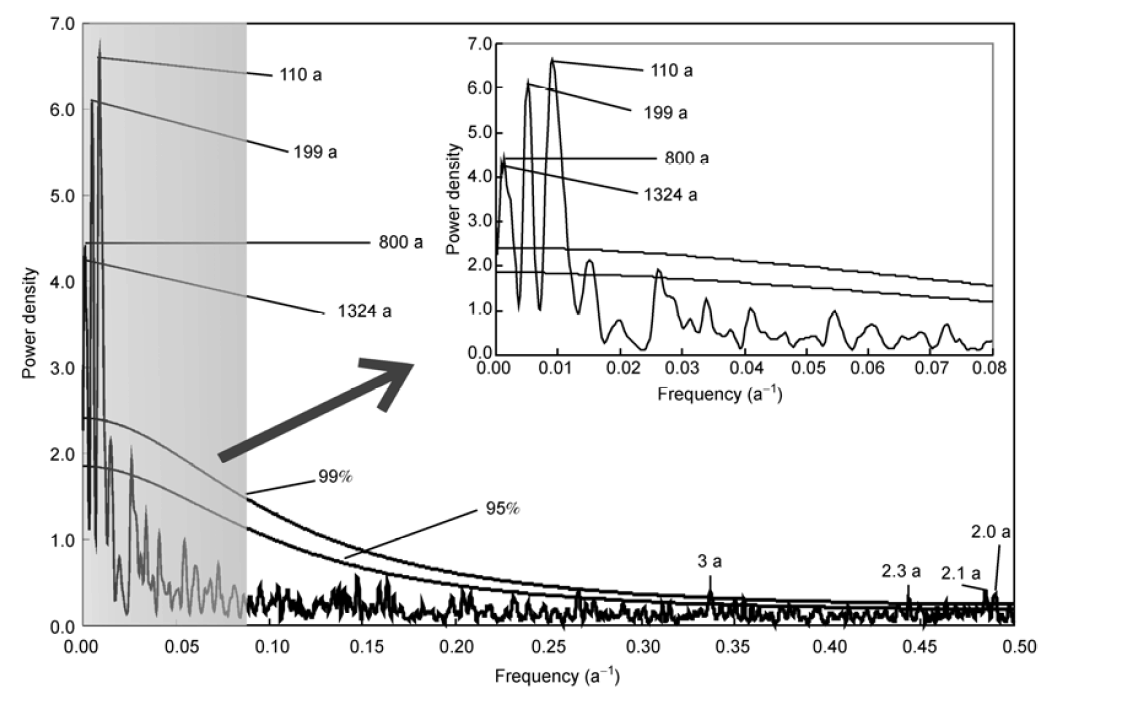 Figure 2 Power spectrum analysis of the 2485-year temperature series. (Click to enlarge)
…
 Figure 3 Millennium-scale cycle in the temperature variation during the last 2485 years. (Click to enlarge)
…
 Figure 4 Decomposition of the main cycles of the 2485-year temperature series on the Tibetan Plateau and periodic function simulation. Top: Gray line,original series; red line, 1324 a cycle; green line, 199 a cycle; blue line, 110 a cycle. Bottom: Three sine functions for different timescales. 1324 a, red dashed line (y = 0.848 sin(0.005 t + 0.23)); 199 a, green line (y = 1.40 sin(0.032 t – 0.369)); 110 a, blue line (y = 1.875 sin(0.057 t + 2.846)); time t is the year from 484 BC to 2000 AD. (Click to enlarge)
…
…
Conclusions
Climate events worldwide, such as the MWP and LIA, were seen in a 2485-year temperature series. The largest Figure 6 Temperature comparison between the forecast and observation data taken from seven stations on the central-eastern Tibetan Plateau (seven stations: Delingha, Dulan, Golmud, Lhasa, Nagqu, Dachaidan and Bange). amplitude and rate of temperature both occurred during the EJE, but not in the late 20th century. The millennium-scale cycle of solar activity determined the long-term temperature variation trends, while century-scale cycles controlled the amplitudes of temperature. Sunspot minimum events were associated with cold periods. The prediction results obtained using caterpillar-SSA showed that the temperature would increase until 2006 AD on the central-eastern Plateau, and then decrease until 2068 AD, and then increase again. The regularity of 600-year temperature increases and 600-year decreases (Figure 3) suggest that the temperature will continue to increase for another 200 years, since it has only been about 400 years since the LIA. However, a decrease in temperature for a short period controlled by century- scale cycles cannot be excluded. Obviously, solar activity has greatly affected temperature on the central-eastern Plateau. However, there are still uncertainties in our understanding of climate change, and the concentration of CO2 affects the climate. Further investigations are thus needed. –
————————–
REFERENCES
Liu Y, Cai Q F, Song H M, et al. Amplitudes, rates, periodicities and causes of temperature variations in the past 2485 years and future trends over the central-eastern Tibetan Plateau. Chinese Sci Bull, 2011, 56: 29862994, doi: 10.1007/s11434-011-4713-7 [ Climate Change over the Past Millennium in China.] … Hat Tip: Geoffrey Gold.
It has been known for a while that the anchovies and sardines trade places between Japan and California about every 30 years.
higley7 says:
December 8, 2011 at 6:31 am
But higley, may I point out that simply stating “the concentration of CO2 affects the climate” doesn’t say in which direction they say it affects it–it could make the climate warmer, it could make the climate colder, or not much at all; they didn’t specify which. And we all know the climate is continually changing. (Surprising that Chinese scientists leave their study open-ended for an additional sequel or two, just like Hollywood, but then, they’re in it for the duration.)
Theo Goodwin says:
December 8, 2011 at 5:25 pm
“To predict an event is show that it is an instance of a well confirmed hypothesis. ”
“Explain to me how you can point to a line on a graph as an explanation of a particular event.”
Very well, since it is known that many things in nature tend to be cyclic (seasons, day/night, etc), I hypothesize that earth’s temperatures tends to go in cycles. I now examine all the long term data we have for the earth’s history. We find when the data is plotted into a graph that there indeed appears to be a very cyclic pattern arising in the data. My hypothesis has now been confirmed, thus I can make a prediction. The earth is due to enter another ice age very soon (geologically speaking). I do NOT need to explain what causes the cycles before a prediction can be be made.
Your second point in quotes above is a strawman. You presume that it is just a random collection of points on a graph that one is trying to make a prediction from. I would agree that you cannot make a prediction based on a set of randomly generated numbers. However, the graph were are making a prediction from is NOT a random collection of data points, it is an estimate of earth temperature versus time. Based on the very cyclic pattern displayed in the data, predictions about future temperatures can be made. That is not to say that if something occurs in the future that did not occur in the data collected to date, that your prediction will be right. However, if nothing new happens in the future that hadn’t already happened in the known past, then the prediction is likely to correct.
Theo Goodwin also says:
December 8, 2011 at 5:25 pmIf someone asks “Why is Venus in full phase now?” you can explain to them Kepler’s Laws and show them on a chart the relative positions of Earth, Venus, and the Sun.
Another strawman. If someone asks “When will the next full phase of Venus occur?” You do not need to know any of Kepler’s Laws in order to make that prediction. In fact, Kepler’s laws were developed AFTER they were able to make predictions about the phase. It is because of the periodic and predictable nature of the planets movements that Kepler’s Laws came about!
One thing that comes to my mind in all of this is that we are seeing first hand part of the problem that comes from specialization in science and not enough generalization. Given a signal like the one from the tree rings the very first thing that would occur to an electrical engineer is to run a spectrum analysis on it, see if there were any dominant cyclical components and then attempt to find out what those are. Same with a mechanical engineer who might (as one poster noted earlier) work on things having to do with vibration. I worked in both. My background was in flight qualified electronic hardware and before that in certain signals analysis work. In order to get qualification for gear to be sold to the Air Force, it has to meet certain vibration requirements. Same goes for the Navy for stuff that goes on submarines (Navy goes a lot more for “shock” testing for obvious reasons).
That folks in the climate sciences didn’t run this stuff through a spectrum analysis isn’t really their fault. It is the fault of being too specialized. Having stuff like this more open allows people with backgrounds in many different disciplines to look at things and possibly spot something that to them is rather obvious but never occurred to someone else without a background that requires doing that sort of analysis all the time.
I sincerely believe there really is something to this and I also believe that if we get more cross-discipline eyeballs on problems, we might solve a lot of problems a lot sooner.
That was the obligatory “hockey mask” statement. They had to pay tribute to Jones et al. in order that someone doesn’t try to revoke their doctorate or “discredit” the journal in which it was published. The nod to AGW is now obligatory in order to keep your job.
Regarding Loehle 2007 – the original paper had errors. He thought he had enough data to run a temp series to 1980, but later discovered that was not so. When he corrected the paper in 2008, the series ran to 1935. He made some comments in the correction regarding late 20th century temperatures.
http://www.terrabruciata.com/climate-history.pdf
Putting it plainly, the smoothed value at 1992 is 0.07C cooler than the peak of the MWP.
crosspatch says:
December 8, 2011 at 5:30 pm
I have to assume that people who complain about it being tree rings haven’t read through the comments.
Is this the same Crosspatch who says:
Generally, I don’t like trees being thermometers. If you find one that is, it is more luck than science. Traditionally trees have been used more as precipitation proxies than temperature.
What I was meaning to point out was that the SAME analysis was done on THERMOMETER readings (not tree rings) and the result was the same. See my comment at
crosspatch says:
December 7, 2011 at 10:58 pm
CET is a thermometer data set, not a tree ring set. Same result.
What makes you think they have not? Have you researched to check that assumption?
One hit on the first page in a google scholar search has Jones and Briffa as co-authors on this..
Search terms were ‘medieval climate spectrum analysis’.
Slight changes in the search terms brought up spectrum analysis by Mann, Esper, Moberg and others for millennial reconstructions.
It’s amazing the confidence with which skeptics assume scientists have not thought of x, y or z possibility or method, and how easy it is to discover that these assumptions are incorrect 99.9% of the time.
barry says:
“It’s amazing the confidence with which skeptics assume…”
After barry preposterously wrote:
“Putting it plainly, the smoothed value at 1992 is 0.07C cooler than the peak of the MWP.”
barry assumes that he knows global temperatures almost a thousand years ago to 0.07°C. I wonder what barry’s qualifications are? Or maybe he has the new Mann-O-Matic Climate Calibration Meter that can read tree ring temperatures to 0.07°C back to the Cretaceous.☺
But I’m glad barry has come around to my view that the MWP was as warm or [more likely] warmer than now. And since CO2 was very low during the MWP, Occam’s Razor says that it isn’t causing the current warming. Although it may have something to do with the fevered imaginations of the warmist cult.
eyesonu says:
December 8, 2011 at 1:41 am
…..What is interesting in all of this (and now we get our tin foil hats) is if maybe some of these people knew this was coming. I mean, running paleo climate data through a spectrum analysis would be something one would think would have been done in the 1960′s. I wonder if they knew these cycles were going to peak at about this time and knew it was a great time to become rich and famous.
>>>>>>>>>>>>>>>>>>>>>>>>>>>>>>>>>>>>>>>>>.
It was known.
Sometime back I did a time line and all the CAGW propaganda was done after a bunch of scientific discovers were made.
The continued emphasis on over population and the movement of Capital to Africa, India, Latin America and China, as well as the CIA writing a report entitled Global Governance 2025 at a Critical Juncture, are all consistent with a belief among the World’s Movers and Shakers that a descent into another Ice Age is on the horizon. This belief is based on initial papers by Milankovitch (1938) and Geissberg (1939 & 1971), Kukla & Mathews alerting President Nixon in 1972 and the validation of the Milankovitch Cycle by Hays, Imbrie & Shackelton in 1976
The typical propaganda we are seeing:
POLITICAL TIMELINE
The Committee for Economic Development (CED) was founded in 1942 by the Bankers and Corporate CEOs of the USA.
The group went international:
The Bretton Woods Articles of Agreement established the World Bank and IMF in 1944
The founding of the Bilderberg in 1954
1970 “Who controls the food supply controls the people; who controls the energy can control whole continents; who controls money can control the world” – Henry Kissinger.
In 1972 UN First Earth Summit chaired by Maurice Strong “Environmentalism” and “Global Warming” becomes a politicized
Funding for Climate Research Unit (CRU) at the University of East Anglia
“The Climatic Research Unit (CRU) was established in the School of Environmental Sciences (ENV) at the University of East Anglia (UEA) in Norwich in 1972.”
British Petroleum (Oil, LNG)
Central Electricity Generating Board
Eastern Electricity
KFA Germany (Nuclear)
Irish Electricity Supply Board (LNG, Nuclear)
National Power
Nuclear Installations Inspectorate (Nuclear)
Shell (Oil, LNG)
Sultanate of Oman (LNG)
UK Nirex Ltd. (Nuclear)
Source: http://www.cru.uea.ac.uk/cru/about/history/
White House Office of Science and Technology Director John P. Holdren along with “Paul and Anne H. Ehrlich in the “recommendations” concluding their 1973 book Human Ecology: Problems and Solutions.
De-development means bringing our economic system (especially patterns of consumption) into line with the realities of ecology and the global resource situation,” http://www.liveleak.com/view?i=e41_1284655982&comments=1
The CIA document dated 1974 predicting an Ice Age. http://omniclimate.wordpress.com/2009/12/03/world-exclusive-cia-1974-document-reveals-emptiness-of-agw-scares-closes-debate-on-global-cooling-consensus-and-more/
SCIENCE TIMELINE
Gleissberg (1939 & 1971) identified an 88 yr cycle in the weather patterns http://www.agu.org/pubs/crossref/2003/2002JA009390.shtml
Note In 1972 the world was in a cool phase and did not start the warming for a couple more years. This made Maurice Strong’s “Catastrophic Antropgenic Global Warming” in 1972 very weird.
Milankovitch”s “Astronomical Methods for Investigating Earth’s Historical Climate” 1938
1963 International Geophysical Year – Interest in Milankovitch Cycle
Hays, Imbrie and Shackleton research on Milankovitch Cycle
George Kukla and Robert Matthews of Brown University, convened a conference in 1972 “The Present Interglacial: How and When will it End?” (1972)
“…Kukla and Matthews alerted President Richard Nixon, and as a result the US Administration set up a Panel on the Present Interglacial involving the State Department and other agencies…” http://calderup.wordpress.com/2010/05/14/next-ice-age/
From the Global Warming types:
barry says: December 8, 2011 at 11:52 pm
Time and again climate scientists assume that no work has been done on x, y or z. They should research before commenting.
Mann et al tried to rewrite hundreds of years of historical observations. Maybe he should have studied the history he is still trying to fake.
Two questions comes to my mind:
1. Where is the sunspot cycle in the spectrum?
2. What would the spectra of a set of random walks of the same data size look like?
Raymond says:
December 9, 2011 at 6:08 am
Two questions comes to my mind:
1. Where is the sunspot cycle in the spectrum?
Here: http://www.vukcevic.talktalk.net/SSN-T.htm
crosspatch, December 8, 2011 at 11:21 pm
We used Fourier and Spectral Analysis, in the 60’s to isolate inertial sensor “noise” sources. While the “noise” freq., shown in the spectral graphs were “smeared” & not perfect, they did lead to the cause of this “noise”. As a result we had a much better understanding of these sensors, as subsequent missions proved. .
Fourier methods was just one, of a number of tools, including statistics, probability, math models & computer simulations. Engineers use these tools in the design process, in order to understand the system they are working with.
I will agree, that many of the climate science people, seem to me anyway, stuck in a statistics “rut”.
P.S.
Interesting paper, show how the French Pinot Noir grape harvest, was used a temp. proxy since the 17th century.
http://www.int-res.com/articles/cr_oa/c046p243.pdf
The paper also used Spectral methods in it’s analysis .
Interesting, all this banter.
High altitudes, high latitudes…… someone please tell me how the low value of the temps are determined?
I actually did speculate in an earlier comment that I suspected they would have as it seems like a natural thing to do. My later statement that they hadn’t done so was due to the lack of any discussion of it in any of the major papers I had read. I did not go back and check *all* of their papers. So if they had actually done the analysis, this discredits them all the more as there would be no good reason for their long flat handle of the now-discredited hockey stick to be published. They would have already known that wasn’t true. I suppose I hear “damning with faint praise”.
By the way, I happened across a paper today: Late Holocene glacial and periglacial evolution in the upper Orco Valley. (Carlo Giraudi 2008) He shows that glacial advance in the alps was coincident with periods of high precipitation and periods of retreat with low precipitation as evidenced by flooding on the Po river. There were three exceptions to that: Roman Warm Period, Medieval Warm Period and Modern Warm Period (so he certainly finds the MWP in the data, by the way). Generally it was drought that most often causes glacial retreat, not temperatures, except in the three periods noted above. He also says that the current regime is more consistent with that of the Roman Warm Period than with the Medieval Warm Period.
crosspatch: Well, I have access to data in many cases but I don’t have the tools. I might possibly be able to obtain the tools, though, if they are open source. Then there would be a bit of a learning curve associated but I am willing to take on the project. I have access to a reasonable powered Linux computer and some storage capacity.
It sounds as though you need R. Search out CRAN: http://cran.r-project.org/.
There are books, among them “The R Book” by Michael J. Crawley. For analysis of time series with examples in R, there is “Time Series Analysis and its Applications: With R Examples by robert H. Shumway and David S. Stoffer.
Dendrogenerativity:
From a conservative point of view, I would think it would be best to say these scientific studies were measures of ‘dendrogenerativity,’ assuming that ‘generativity’ means ability to grow. That, I think, is all one can really say for sure about studies of tree-ring widths; such-and such tree grew a measured number of millimeters or micrometers in a given year. One could build up plots for the average generativity of various tree species over the years and compare them without having to define exactly what unknown environmental conditions were responsible.
I love the paper’s final paragraph:
“Obviously, solar activity has greatly affected temperature on the central-eastern Plateau. However, there are still uncertainties in our understanding of climate change, and the concentration of CO2 affects the climate. Further investigations are thus needed.”
It’s as if the Laboratory Director from Central Planning came in and said, “You guys really need to put this CO2 sentence in somewhere.”
I started playing with r a very long time ago but it wasn’t as evolved then as it is now (say 1998, 1999) and I set it aside. I can get transform routines in practically every language there is. I am more comfortable with python than r. Here is an example in a neurology application: http://www.sci.utah.edu/~eranders/Erik_Anderson/Publications_files/python_processing.pdf and there is a python interface I can use that can directly call r functions someone else might have. http://www.astro.cornell.edu/staff/loredo/statpy/
Smokey,
That was Loehle’s value. I merely reported it. I’ve no idea as to the truth of the matter, only what is published by other people
Ahhh, So YOU know what the global temps were a thousand years ago. Your qualifications must be impressive. 🙂