From Slashdot:
After years of beautiful concept cars, envy-inspiring demos, and missed production targets starting in 2008, high-efficiency car startup Aptera is liquidating its assets.
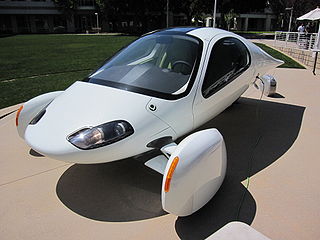
A pointed excerpt from Wired’s account:
“The truth is, Aptera always faced long odds and has been in trouble for at least two years. The audience for a sperm-shaped, three-wheeled, electric two-seater was never anything but small. It didn’t help that production of the 2e — at one point promised for October 2009 — was continually delayed as Wilbur ordered redesigns to make it more appealing to the mainstream.
Aptera had a small window in which to be a first mover in the affordable EV space, and that window closed the moment the Nissan Leaf and Chevrolet Volt hit the market. At that point, Aptera teetered on the brink of irrelevance.”
While I like the idea of electric cars for city travel (I have one a bit more practical than that above) I’ll admit that they don’t make much sense for an everyday family car, and making a car that looks like something out of a Woody Allen movie puts an even greater damper on the marketability issue.
The reason that many electrics are three wheelers are due to arcane laws in the USA that allow three wheelers to be licensed as motorcycles, with no upwards spped limit or crash testing required, while four wheelers must be limited to 25mph (40km/hr) as NEV’s (Neighborhood Electric Vehicles) or must go through crash testing that cost upwards to half a million dollars. While Leaf and Volt have passed that (Since Nissan and GM have deep pockets) it leaves the smaller companies struggling to find a niche outside of the limited “Ed Begely Junior” market.
Here’s a look at Leaf and Volt EV sales in the US from The Daily Bayonet:
===================================================
Nissan sold 672 Leaf vehicles and GM sold 1139 Volts.

Nissan is still far in the lead with a grand total for the calendar year at 8720, though GM is slowly closing the gap at 6142 sales. Note that for comparison purposes, the 326 Volts sold in December 2010 are not included. To balance this, Volts which spontaneously combust are not deducted from total sales, despite the total loss of vehicle, and sometimes the home too.
Whether or not stories of fiery Volts will affect future sales remains to be seen, though for a car in its early stages of adoption to require complex ‘power-down’ procedures in the event of accidents isn’t a good sign. Imagine if Ford had advised Pinto owners to follow a protocol to drain the gas tank after a collision. Not good.
DMarshall says:
December 17, 2011 at 9:57 am
@JustaJoe With sufficient numbers of EVs in an area, the use of them as distributed storage is potentially valid. But some car owners will want to play, if the price is right, and many (or most) won’t.
———————————————
I don’t see how the number of EV’s in an area can relate to an individual making a decision to attempt to save some money by using their EV as “distributed storage”. In fact more EV’s would seem to mitigate against “distributed storage” savings because it would lessen the differential betweem peak and off-peak rates. Peak rates would become 24 hrs. a day.
Brian H says:
December 18, 2011 at 7:08 am
Ludicrous. The distinction between “fanboy” and “satisfied user” is exactly what, pliz??
———————————————-
You’re kidding, right? Try as you may you’re not going to be able to present a self selected sample of owners of a $109000 – $128500 novelty act limited edition roadster and extrapolate that to the wants and needs of the general public. enough already
The $109000 – $128500 Tesla roadster would get it’s doors blown off by a $50K C5 Corvettes so if you’re looking for performance the bang for the buck isn’t there. The early adopters of the Tesla of which there are only some 2000 are in it for the novelty of the technology. For reference There were 13,596 Corvettes produced during the 2011 model year alone.
Almost every car has it’s devoted fans. There are actually people who love the 70’s era Mustang II and praise it to the hilt… So what.
@JustaJoe Not the individual, but the utility. If there are enough EVs with enough charge in an area of high demand, the utility might decide to purchase power from the car owners rather than fire up a peaker plant (which are usually the most inefficient) for a brief period.
JaJ;
More nonsense. Comparing a personal sports car to a touring racecar, with 7-liter V8! And I think the Roadster’s doors are safe. 0-60 in 3.7, vs 3.8 for the C5.
P.S.;
The Model S, now entering production, is their first actual “general public” oriented product. Deliveries begin mid-year, and are sold out well into 2013, with reservations (with large deposits) accelerating. Next up, the Model X crossover, same “flat-bed” platform, with first prototypes due to be shown any day.
Brian, You’re getting in way over your head. In real world performance I’m sure a Corvette C5 (1997 through 2004 model years) would shame a Tesla roadster, but let’s go with with a Corvette that is actually contemporary with the Tesla, the C6 Corvette (2005 – present). BTW a C5 Corvette never had an engine bigger than 5.7L. Only Since you brought up the monster 7L LS7 equipped C6 Corvette, the 2 respective cars are similarly priced (The Tesla costs much more), and they’re both supposed to be 2 seater sports cars let’s let the Tesla carnage begin.
Naturally aspirated 2007 Corvette Z06
The Z06’s LS7 7.0L engine delivers 505 horsepower (377 kW) in a 3,132-pound (1,421 kg) package – a combination that delivers 0-60 performance of 3.7 seconds in first gear, quarter-mile times of 11.7 seconds at 125 mph and a top speed of 198 mph (as recorded on Germany’s Autobahn).
Supercharger Corvette 2009 ZR1
2009 Chevrolet Corvette ZR1 priced at $105,000
ZR1’s supercharged, 6.2-liter LS9 engine that pumps out an SAE-certified 638 horsepower and 604 lb-ft of torque
* 0-60 mph in 3.4 seconds
* Quarter-mile elapsed time of 11.3 seconds at 131 mph
* 205 mph top speed
2008 Tesla Roadster – 4.6 seconds (0 to 60) 13.4 seconds E.T. 1/4 mile
2010 Tesla Roadster 2.5 – 3.7 seconds (0 to 60) E.T. 1/4 mile none found
The Roadster Sport starts at $128,500
The Roadster Sport does 0 to 60 mph in 3.7 seconds, compared with 3.9 seconds for the standard Roadster.
2012 Tesla Roadster Final Edition
net power of 248 HP.(snicker) The car will sprint from 0 to 60 mph in 3.9 seconds
There’s a dirth of actual performance info on the Tesla out there. The best E.T I can find is Factory Tesla Roadster runs a quarter mile in 12.76 @ur momisugly 104.7 mph.This is slower than the base C6 Corvette (12.6 seconds at 114 mph),and the trap speed indicates that Tesla is making much less power.
I’ve found top speed numbers for Tesla roadster ranging from 122mph – 130mph. Not very impressive especially compared to the c6 Vettes, which range from 190 – 205 mph. Corvette blows the doors off Tesla. Let theTesla excuses begin.
Yawn. Like I said, you’re comparing a monster gas-gulper touring Le Mans racecar with a personal sportscar. Your comments, a fortiori, would apply to the actual comparable 2-seaters which cost up to 2 or 3X as much as the Roadster.
As for the top speed, it’s electronically limited. It’s a single gear transmission; adding additional gears was impossible because there’s too much torque, and none of the transmission specialist companies could make a gearbox for them that didn’t break.
Brian H says:
December 20, 2011 at 10:41 am
Yawn. Like I said, you’re comparing a monster gas-gulper touring Le Mans racecar with a personal sportscar.
——————–
Yawn… Definition of SPORTS CAR: a low small usually 2-passenger automobile designed for quick response, easy maneuverability, and high-speed driving
I’m not sure where you’re from, but A Corvette, and a Tesla/Lotus Elise fall into the same category of car. They’re both 2 seater sports cars. Of course, the Corvette is MUCH faster as everyone can see. A Vette isn’t a Racecar. There is the C6-R, which is a racecar, but it’s not sold to the general public. The Z06 & ZR1 Vettes could be considered super cars, but they cost much less than the Tesla.
Too bad that they can’t make a gear box capable of handling that massive 250 HP. Of course, if they did it would also cost the Tesla on it’s acceleration numbers and weight.
http://www.merriam-webster.com/dictionary/sports%20car