From Slashdot:
After years of beautiful concept cars, envy-inspiring demos, and missed production targets starting in 2008, high-efficiency car startup Aptera is liquidating its assets.
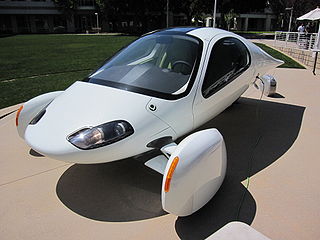
A pointed excerpt from Wired’s account:
“The truth is, Aptera always faced long odds and has been in trouble for at least two years. The audience for a sperm-shaped, three-wheeled, electric two-seater was never anything but small. It didn’t help that production of the 2e — at one point promised for October 2009 — was continually delayed as Wilbur ordered redesigns to make it more appealing to the mainstream.
Aptera had a small window in which to be a first mover in the affordable EV space, and that window closed the moment the Nissan Leaf and Chevrolet Volt hit the market. At that point, Aptera teetered on the brink of irrelevance.”
While I like the idea of electric cars for city travel (I have one a bit more practical than that above) I’ll admit that they don’t make much sense for an everyday family car, and making a car that looks like something out of a Woody Allen movie puts an even greater damper on the marketability issue.
The reason that many electrics are three wheelers are due to arcane laws in the USA that allow three wheelers to be licensed as motorcycles, with no upwards spped limit or crash testing required, while four wheelers must be limited to 25mph (40km/hr) as NEV’s (Neighborhood Electric Vehicles) or must go through crash testing that cost upwards to half a million dollars. While Leaf and Volt have passed that (Since Nissan and GM have deep pockets) it leaves the smaller companies struggling to find a niche outside of the limited “Ed Begely Junior” market.
Here’s a look at Leaf and Volt EV sales in the US from The Daily Bayonet:
===================================================
Nissan sold 672 Leaf vehicles and GM sold 1139 Volts.

Nissan is still far in the lead with a grand total for the calendar year at 8720, though GM is slowly closing the gap at 6142 sales. Note that for comparison purposes, the 326 Volts sold in December 2010 are not included. To balance this, Volts which spontaneously combust are not deducted from total sales, despite the total loss of vehicle, and sometimes the home too.
Whether or not stories of fiery Volts will affect future sales remains to be seen, though for a car in its early stages of adoption to require complex ‘power-down’ procedures in the event of accidents isn’t a good sign. Imagine if Ford had advised Pinto owners to follow a protocol to drain the gas tank after a collision. Not good.
“People swap 5-gallon propane tanks all the time. You own the tank while it’s in your possession.”
A five-gallon propane tank always holds five gallons of propane, whether it’s a day old or ten years old. A battery might hold enough charge to drive you a hundred miles or it might hold enough charge to drive you five miles. A defective five-gallon propane tank probably won’t leave you stranded in the middle of nowhere with no way to get home, and doesn’t cost thousands of dollars to replace.
Swapping driver-owned batteries simply will not work when you might be swapping a day old battery on your new car for a ten year old battery that’s been charged three times a day throughout its life. Are you going to pay thousands of dollars to replace that battery — after all, no charging station will knowingly want to take it from you if it’s worn out — and then hand it over to the first charging station you stop at?
As mentioned above, swapping can only work if drivers don’t own the batteries and just rent them somehow. But then you’re tied into what will probably be a single-source charging network which will gouge you to the point where there’s no longer any fuel cost benefit over buying gas.
Electric cars are just a crazy idea for general use. There’s a reason why we abandoned them over a century ago when the internal combustion engine came along.
People who forget history are doomed to repeat it:
Let me present a sorta opposing, better view of the electric car.
Here’s a video of a local Florida company, Rebirth Auto, that makes conversion kits and does conversions of ICE cars to electric.
RebirthAuto Classic Beetle Lithium Conversion. Highway run.
Evnetics Soliton1 Controller
Netgain Warp9 Motor
179V GBS 100AH Lithium Battery Pack.
http://youtu.be/A3FcScjTjuY
Lost the Aptera, did we? That’s a shame. They had some interesting ideas. I suspect they might have wanted to sell their patents to a big car company instead of finish developing the infrastructure themselves. But they started with the question what it would take to make a car that could actually get 100+ MPG. Like Messerschmitt 40 years ago (see wikipedia), they began with no-excuses aerodynamic design. Never mind details like rearview windows or mirrors, or being able to roll down the funny shape windows inside the funnier-shape door. Airplanes don’t need those frills, either. They had some ideas about how to solve those things without conventional design. And the results will keep rolling a long, long time. I for one will miss ’em.
That these electric cars can avoid safety assessments is a scandal. I don’t know the exact criteria under which they can be given a free pass on to the roads here in the UK, but I do know that the G-Wiz (four doors, supposedly four seats, no crash protection whatever) qualified. When a reputable accident-testing facility ran the G-Wiz through the standard tests, anyway, the UK “Daily Telegraph” observed that the results indicated that the driver in an equivalent real-life crash would, at the very least, have lost his or her legs. The Telegraph went on to point out that the rear seats, able to accommodate only small children and presumably intended for that purpose, are even more vulnerable to rear shunts, the most common form of urban collision. I am not aware that the DT’s revelations had any impact whatever on the privileged status of the G-Wiz deathtrap.
And here is an example of why it matters. The G-Wiz may look like a joke, but it isn’t:
http://www.telegraph.co.uk/news/obituaries/science-obituaries/8135403/Judit-Nagy.html
All in all autonomy is still a big issue in electric cars. I wish I could drive 100 miles without the recharge
John Brookes asks (December 3, 2011 at 11:02 pm)
Why the snide & gleeful tone?
Because the remedies to (nonexistent) global warming are doomed to failure. The quicker this becomes apparent the smaller the damage to society by green taxes, gravy-train subsidies, pie-in-the-sky renewables, brownouts, and ten thousand parasites jetting to a jolly in Durban to talk bollix. Another One Bites The Dust indeed. Yee-hah!
D.Marshall says:
December 4, 2011 at 9:12 am
Has no one on WUWT ever heard of Better Place? Their model won’t work everywhere right off the bat but it should fulfill the needs of most of us.
============================================================
You’re assuming that “most of us” will continue to reside within 5 miles or so of all of our needs (work, food, entertainment, etc. ) in ever larger megalopolises. I was under the impression that the leftie utopia was 500,000,000 total population spread around the globe in tiny little “self-sustaining” villages. In which case, no motorized transport of any kind would be needed. And in the rare event that someone had to go someplace else, a 100 mile range would be totally inadequate. Think trucking, or visiting grandma, among other things. Make up your mind.
Old fashioned pre-computer cars at least had other options possible in case of drastic situations. I had a friend who ran a VW bug all over Hungary during the war on schnapps.
Also, during the war, in Russia they converted trucks to wood burners, I assume steam generators. Then there are old VW diesels converted to biodiesel. I understand some Italian tractors can be converted to run on olive oil. Lots of options there with old technology.
Owen Morgan says:
December 4, 2011 at 2:06 pm
“And here is an example of why it matters. The G-Wiz may look like a joke, but it isn’t:
http://www.telegraph.co.uk/news/obituaries/science-obituaries/8135403/Judit-Nagy.html
”
Photo of the car after the crash.
http://www.dailymail.co.uk/news/article-1323012/Top-scientist-killed-G-Wiz-electric-car-horror-smash.html
I am supprised that no one has brought up the fact that we seem to be regressing in technology when using electric vehicles. If you look at automotive history some of the first non-horse drawn carriages were powered by batteries and the battery technology really has not changed much. At this rate we all may have to pull that carriage out of the barn and get some real horses in order to be environmently friendly.
DirkH says:
December 4, 2011 at 11:21 am
No need for snark, Joe; Arnold was polite, and his misconceptions are what ordinary people get from the media.
Sorry about that, but the guy didn’t think twice about trashing US auto engineering.
Are EV’s given a waiver for Federal Motor Vehicle Safety Standards. Not only would this Aptera not pass any type of collision test it doesn’t even have a front (or rear) bumper.
@CuriousGeorge It seems that you gave either an off-the-cuff response without fact-checking.
Please try again, after looking into the Better Place plan. Founder Shai Agassi has numerous interviews, presentations, a website, etc. There are YouTube vids, an interview with Charlie Rose, if you’re interested in learning more.
“I designed and built an electric bicycle many years ago”…..
In temperate climates with small quiet roads they are probably the answer for people who don’t want to drive a car. They are relatively inexpensive, as safe a cycling because little faster, the power to weight ratio is acceptable because there’s no shell to carry around.
But, you are exposed to the elements, you won’t be able to carry much shopping, the range is limited to probably 20 miles (which is quite enough anyway in the colder weather). I am enthusiastic about the idea in those terms, and if I were unable to afford a car, and lived in the country in Europe or even in some US cities would probably buy one. But haven’t done so yet. The modest sized car still has all the advantages of comfort and range and ability to transport. And its warm in winter!
How about a federal Law that ALL Government purchased vehicles (State, local and federal) be required to be all electric vehicles. No “hybrids”, which are just overly complicated gasoline vehicles.
@george E. Smith My opinion from the outset was that, at least initially, that EVs should be targeted towards gov’t / utilities / taxis /company fleets rather than individuals – with incentives to match.
Their usage is quite predictable, they’re usually not far from home base, even when logging lots of miles and they would mostly charge overnight. The consumer car market is tough to break into and hard to please. The commercial market wants utility and reliability, style and amenities are secondary.
The recent launch of the Renault Kangoo ZE was followed with an announcement of an order for over 15000 units, spread across 19 companies, with 2/3 going to the post office
@george E. Smith EVs should have been targeted, from the outset, to gov’t / utilities / company fleets, etc instead of Joe Consumer. The commercial vehicles have more predictable usage patterns and won’t be paying 30k+ for a vehicle that will mostly be parked.
The consumer market is difficult and fickle – commercial buyers want utility and reliability; the frills and styling aren’t a show stopper.
Renault recently announced an order for 15000 of their Kangoo ZE van spread across 19 companies, 2/3 going to the post office.
Maxbert says:
December 4, 2011 at 1:11 am
“Two cheers for coal-powered cars. Oh well; nobody’s going to buy the silly things anyway.”
Actually, there have been coal-powered cars. One of the many factors contributing to Germany’s defeat in WW2 was a shortage of petrol. Apparently they did not have enough Fischer-Tropsch plants to satisfy their needs. During the Battle of the Bulge, some of their tanks ran dry, and had to be abandoned on the battlefield.
Anyway, the Germans adapted coal power for some of their smaller military vehicles. A cannister fllled with coal was fitted on the side of the car. The carbon monoxide fumes therefrom went directly to the engine. Although that wasn’t very energy-efficient, it was a lot more practical than wind-turbine-powered cars! 🙂
Bernd Felsche says:
December 3, 2011 at 10:58 pm …
Spontaneously igniting cars? Great, let’s market them in Berlin. Those Germans are suckers for the dumbest kind of green bull[snip . . you know the rules here] anyone might care to cook up.
And blazing cars are the coolest craze over there.
What the electric cars need is to be able to do in route re-fueling, like fighter aircraft (which are fast and short range) do when distance is a problem. We could have massive iron-nickel batteries (they don’t wear out, can last 100 years) on semi-trailers roving the highways with charge cables flying out the back. When your battery was low you simply pull up to a few feet behind one of these units and link-up and charge without stopping. The semi-trailers could transport the electons from solar arrays in the deserts of the west to the highways without the need for long power lines (like home oil delivery does not require a pipeline to each house). We would only need 1 or 2 of these iron-nickel semis per car. We could even have special ‘charging-lanes’ and it would cost less per day then teraforming Mars.
DirkH says:
December 4, 2011 at 5:37 am
IIRC, the weight of the engine and the average weight of the fuel are definitely comparable to the weight of the batteries and electric engine. The overall performance is also comparable because of the lack of need for gears, I am also told.
I’ve not tried, it, but I know someone who has, and what they say is sensible.
A Honda S2000 converted to electric. Funny the manufacturers can’t do this.
[youtube http://www.youtube.com/watch?v=HZqf-UgfEhk?rel=0&w=960&h=720%5D
I’ve always said that the easiest way to spot a malcontent (liberal greenie progressive socialist neo-comm whatever) is by their lack of a sense of humor. Fortunately we normal people do not have this problem, on the contrary some of the funniest stuff ever written comes from the skeptic (true science) community. Both of these guys are responsible for soda stains all over my computer …
ROTFLMAO! And seriously, Survival of the Skeptical is brilliant!
Excellent visual. Someone has got to make a photoshop illustrating this! An electron tanker fleet. LOL.
There are better and safer batteries on the rather short term horizon (Kung – Northwestern University – commercialized circa 2015-2017) , but, much more importantly, much cheaper
batteries (75% to 90% cheaper), which are both lighter weight and can recharge plenty fast
enough. Tesla Motors has spent a lot more time and has a lot more experience that either GM or Nissan in this game with respect to safety. Their roadsters have clocked millions of miles with no fire problems – their design isolates each cell and doesn’t allow one that experiences “thermal runaway” to affect the others. The main problem with the $35 to $45K electrics out there today is their restricted range (75 to 100 miles) and most importantly, their very costly batteries. The Leaf is essentially a $11K vehicle selling for three times that. With the promised Kung (or DBM-Energy) batteries selling for 10% to 20% of current prices, gas powered cars become hopelessly obsolete.
And good riddance – they are extraordinarily complicated machines that are very expensive to both buy, maintain and fuel. A 30MPG gas car could easily obtain, as an electric, 4 to 5 miles per kilowatthour (about 10 cents). I won’t miss gas powered cars with their transmissions, exhaust systems, etc.
… short term horizon … circa 2015-2017 … the promised … selling for 10% to 20% of current prices…yada, yada, yada
That and $4.50 will get you a coffee in New York today.
…good riddance