From Slashdot:
After years of beautiful concept cars, envy-inspiring demos, and missed production targets starting in 2008, high-efficiency car startup Aptera is liquidating its assets.
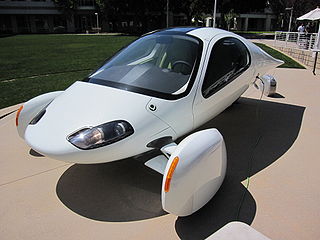
A pointed excerpt from Wired’s account:
“The truth is, Aptera always faced long odds and has been in trouble for at least two years. The audience for a sperm-shaped, three-wheeled, electric two-seater was never anything but small. It didn’t help that production of the 2e — at one point promised for October 2009 — was continually delayed as Wilbur ordered redesigns to make it more appealing to the mainstream.
Aptera had a small window in which to be a first mover in the affordable EV space, and that window closed the moment the Nissan Leaf and Chevrolet Volt hit the market. At that point, Aptera teetered on the brink of irrelevance.”
While I like the idea of electric cars for city travel (I have one a bit more practical than that above) I’ll admit that they don’t make much sense for an everyday family car, and making a car that looks like something out of a Woody Allen movie puts an even greater damper on the marketability issue.
The reason that many electrics are three wheelers are due to arcane laws in the USA that allow three wheelers to be licensed as motorcycles, with no upwards spped limit or crash testing required, while four wheelers must be limited to 25mph (40km/hr) as NEV’s (Neighborhood Electric Vehicles) or must go through crash testing that cost upwards to half a million dollars. While Leaf and Volt have passed that (Since Nissan and GM have deep pockets) it leaves the smaller companies struggling to find a niche outside of the limited “Ed Begely Junior” market.
Here’s a look at Leaf and Volt EV sales in the US from The Daily Bayonet:
===================================================
Nissan sold 672 Leaf vehicles and GM sold 1139 Volts.

Nissan is still far in the lead with a grand total for the calendar year at 8720, though GM is slowly closing the gap at 6142 sales. Note that for comparison purposes, the 326 Volts sold in December 2010 are not included. To balance this, Volts which spontaneously combust are not deducted from total sales, despite the total loss of vehicle, and sometimes the home too.
Whether or not stories of fiery Volts will affect future sales remains to be seen, though for a car in its early stages of adoption to require complex ‘power-down’ procedures in the event of accidents isn’t a good sign. Imagine if Ford had advised Pinto owners to follow a protocol to drain the gas tank after a collision. Not good.
You have missed the component where an original energy source such as coal has to be converted to electrical power, then transmitted to the charging station to charge the battery, loosing quantities of energy all along the way.
As for the battery swap idea. I grew up in the manufactured energy crisis years of the 70’s, had a keen interest in all things renewable energy back then, did a presentation to my science class in grade 11 (plus or minus 2 years) on solar power. It would be a couple of decades before “green” replaced “energy efficient”. And that battery swap idea was mentioned in articles I read during the energy crisis era. 40 plus years later and its all Déjà Vu to me today.
none of these ever seem to account for needing to heat the vehicle.
in maine I see -15f or lower easily, and heating with a battery fails.
“sperm shape” ?? WTF? Looks like a plane without wings to me. They had lots of people willing to buy but they just couldn’t deliver. At around 30k a pop for a 2 seater it was a niche market all along and a long shot.
Volkswagen will have one out in 2013 that will be a bit more practical with 4 wheels and 313 MPG. We’ll see if they can pull it off.
http://inhabitat.com/volkswagen-to-unveil-235mpg-car-at-2011-qatar-motor-show/
There is one reason why electric cars are not selling. People don’t want them.
Pure EVs that only rely on stored energy will never be prime-time as a result of lacking energy density and recharge times. They’ll have a niche in short and mid-range transportation. To bring the benefits of EV to bear, a limited amount of storage capacity must be combined with on-board generation of power (comparable to diesel-electric trains). A useful partner would be a generator powered by compressed natural gas, a small turbo-diesel engine and at the end of the decade hydrogen fuel cell technology should be ready to deployment.
My view was that until cars have a 400 mile range, and quick recharging times, they will never become popular.
However, I read something recently that made me change my mind. What matters is hybrids, with batteries for a 50 mile range. That covers most journeys, and with regenerative breaking, it becomes longer. You don’t need the long range, you need a short range in an existing car, so that most journeys become electrical, and so long as the cost is cheap, people will go for it.
Don K says:
A valid point. If you read the article a.jones links to above http://noconsensus.wordpress.com/2009/11/13/electric-cars/ , It’s entirely possible that you will never be able to charge an electric battery at that rate. Too many watts. Too little time. Their answer — which might work — was that you haul into a “gas” station and a machine swaps your (standardized) battery for a fully charged battery in a couple of minutes.
This isn’t even a new idea. I recall seeing an artist’s impression of such a station 30 odd years ago. Though there are some rather difficult engineering issues when it comes to being able to have a 50kg battery which can be easily replaced, but will stay firmly in position at all other times. (Including in the case of a collision.)
dmacleo says:
December 4, 2011 at 7:40 am
none of these ever seem to account for needing to heat the vehicle.
in maine I see -15f or lower easily, and heating with a battery fails.
=======
Right on. And how are you supposed to keep your windshield clear of frost without heat? The answer is probably either a simple kerosene heater, or heat from a so called “serial hybrid” where the battery is continuously charged by a small gasoline engine that runs at a fixed speed and is tuned for maximum power at that speed.
>>dmacleo says: December 4, 2011 at 7:40 am
>>None of these ever seem to account for needing to heat the vehicle.
>>In Maine I see -15f or lower easily, and heating with a battery fails.
No problems, Dmacleo, its all in the small-print of your car owners manual.
Summer range of vehicle — 80 miles.
Winter range of vehicle, with cabin heater, seat heater, lights, windscreen wiper and window de-misters all in operation — 5 miles.
Come, come, now Sir – did you not read the small print when you bought the vehicle??
.
Oh, these Greens, don’t you love-em? I regard this as Darwin’s Evolution in action – science operating in front of our very eyes, with the stupid and gullible going bankrupt and back to the Dark Ages in quality of life.
A colleague (a physicist) has already suffered a divorce and complete loss of quality of life due his Green obsession. He went for solar heating, but stupidly disconnected the gas heating system. After two winters with no heating, his wife divorced him – and, this being the UK, it was he that was kicked out of the house.
What did Darwin call it? Ah, yes, I remember — Survival of the Skeptical.
.
In 2011 “GM sold 1139 Volts.”
Down with the 0.03%! To make us equal we must all be “given” Volts!
Mark says:
December 4, 2011 at 8:23 am
“This isn’t even a new idea. I recall seeing an artist’s impression of such a station 30 odd years ago. Though there are some rather difficult engineering issues when it comes to being able to have a 50kg battery which can be easily replaced, but will stay firmly in position at all other times. (Including in the case of a collision.)”
A Jones experiences date back to the 70ies. Also, “a 50kg battery”? Well that’s a battery for a hybrid with a few km of electric range. Make it more like 1000kg for an EV with 100 miles range. 40, 50kg give you 5 kWh.
Has no one on WUWT ever heard of Better Place? Their model won’t work everywhere right off the bat but it should fulfill the needs of most of us.
John Brookes says:
December 3, 2011 at 11:02 pm
Why the snide & gleeful tone?
___________________________________
Because of the insanity.
The USA is closing down Hydro electric plants because of the little fishes and “Scenic Wild Rivers.” The USA is closing down Coal plants because of the EPA. The USA is has not brought any new Nuclear on line for decades and is planning to close at least one Nuclear plant (Oyster Creek ) early. NIMBYs are agitating to have the rest of the US nuclear plants shut down. Over 14,000 wind mills have been abandoned in the USA and Abandoned Solar Farms Clutter California Desert
So where the heck are we going to get our electricity? TREADMILLS in every school???
We are looking at major brownouts across the country and you want to ADD the power draw of a few million electric vehicles?
Because of the physics and engineering.
When you produce electric energy the conversion efficiency is from 40% to 85% to 90% (hydro) the world average is 39%
“…lead-acid batteries dominate the energy storage markets is that the conversion efficiency of lead-acid cells at 85%-95% is much higher than Nickel-Cadmium (a.k.a. NiCad) at 65%, Alkaline (a.k.a. NiFe) at 60%…” http://www.vonwentzel.net/Battery/00.Glossary/
Electric motors convert 75% of the chemical energy from the batteries to power http://www.fueleconomy.gov/feg/evtech.shtml
So the conversion efficiency is ~40% X ~70% X ~ 75% or about 20% That is about the same as a stock gas engine.
Combustion engines are 10-50% Stock gas engine is 20% efficient (high performance 34%) http://ffden-2.phys.uaf.edu/102spring2002_web_projects/z.yates/zach%27s%20web%20project%20folder/eice%20-%20main.htm
Research on Internal Combustion engines and Hydrogen as fuel: http://www1.eere.energy.gov/hydrogenandfuelcells/pdfs/28890yy.pdf
It would seem from this paper the poor energy efficiency of Internal Combustion engines is due to nothing more than poor engine design. I know of a researcher (old boy friend) who had been part of the team who came up with an engine modification that turned a 12 MPG 8 cylinder gas guzzler into an efficient 50-plus mile an hour car. We went out to dinner to celebrate the successful pilot tests on a stock vehicle in 1986. But as usual the invention disappeared. Heck my 8 cylinder 1976 cutlass got better gas milage (27 MPG) than any of my recent 6 cylinder, lighter weight vehicles.
From my point of view, if you want an electric car couple it with back yard solar panels that either charge a second set of batteries or are used to charge the batteries in the vehicle. That makes a lot more sense than all the chasing our tails with feeding back and forth to the National grid.
Also I sure as heck hope you are pushing thorium nuclear.
It is a most interesting line of research. They are even looking at thorium for ships and for cars. Should work for locomotives too.
U.S. Researcher Preparing Prototype Cars Powered by Heavy-Metal Thorium: http://wardsauto.com/ar/thorium_power_car_110811/
A Metal for the U.S. Navy (2009) http://www.defensenews.com/story.php?i=4376842
Thorium Nuclear report for UK Gov’t (The issue was brought up to the House of Lords) http://www.thorea.org/publications/ThoreaReportFinal.pdf
Mark
Just put wheels and a tongue on the battery packs and tow them around as little trailers. ^_^
Then we can all watch secretaries try to parallel park in the middle of city traffic.
The only solution to the battery problem is to get rid of the batteries by using electrified roads, but the problems with that are probably even worse.
Buy all you can, you rich(er than you think) 25-year olds):in 30 years these will be historic, worth-a-fortunes. Like the DeLorean. Or an Edsel. Unfortunately, unlike my current Jeep-with-a-snorkel gas-guzzling pig.
Here’s another thought: Just act as if the electric car is a “horseless carriage” and limit the speed to 5 MPH. At that speed you no longer need a windshield (and probably don’t need doors, either). Everyone just bundles up for whatever the ambient temperature is. Your battery would probably last about the same amount of time that you could stand being in the car. And after your trip, you would probably put off being in the car long enough that the battery could easily be recharged. It’s not a bug, it’s a feature.
Arnold Ring (@ArnoldRing) says:
I’m not sure why you feel the need to promote “EV’s”, but I have many disagreements with some of the things that you have stated, which are completely unrealistic. I won’t even mention your inaccurate disparagement of US auto manufacturers.
Electric cars balance well with a heavy wind infrastructure, allowing intermittent charging at cheap rates during the average 23 hours per day when a car is not in use.
Since when does “wind infrastructure” provide for cheap electricity? My daily driven car is not in use for only one hour per day, and I don’t think that most people will be able to charge their car unless they are at their personal residence. Even if you can look at the average amount of daily time that a car is not in use and come up with a low number you still must allow for the times when the car is in use for extended periods of time like ALL DAY LONG.
domestic electricity could come from your car battery which had stored the power during a cheap period.
This is the kind of nutty retionalization, which is the staple of green zealots worldwide. NEWS FLASH; batteries are expensive. The life of a battery pack is quantified by cycles. A battery has a finite number of times that it can be charged and discharged. Why would I degrade my very expensive car battery in a likely futile attempt to save a couple a bucks on my domestic electricity bill… FAIL
…we have 5 minute charging stations at every gas station then we’ll see how it goes.
FYI; Lith-Ion and lead acid batteries have charging profiles, which don’t allow them to achieve full charge in very short periods of time. High rate charging is ineffecient, dangerous, and destructive to batteries, Think about it. We can’t even do this with our small rechargeable devices. Other posters have already poited out various other problems with your ‘plan’.
My suggestion is to get in your Nissan Leaf, which by all accounts is a sales loser, and drive off into the sunset.
@son of mulder
Interesting …are wind turbines for the home in widespread use in Great Britain presently?
There are still many places in the US where a 50 mile charge won’t get us to the grocery store and back. I live 25 miles from the nearest grocery store. When I go to “town” I do all my errands at that time, stopping at the library, hardware store, drug store etc. That 50 mile charge wouldn’t allow me to even get the basics done and get home without having to re-charge the battery. Then I would want heat in the winter. And what of battery life when it approaches 0 degrees? If I spend an hour shopping, would I even have power when I got back to the car? And if I had to head into a 20 MPH wind on my way home, how much would that drain the battery?
Probably not too many people on those back country dirt roads have a long enough extension cord to help out if you run out of power.
Justa Joe says:
December 4, 2011 at 10:34 am
[to Arnold Ring] “My suggestion is to get in your Nissan Leaf, which by all accounts is a sales loser, and drive off into the sunset.”
No need for snark, Joe; Arnold was polite, and his misconceptions are what ordinary people get from the media.
INFRASTRUCTURE.
I mean, even if you get past the weight, charging time, cost and hazard issues, and get the public to either pay a huge premium or swallow huge subsidies, the infrastructure is barely adequate for the power use we have now. We’re going to double or triple it in a few years?!?!
“I guess you haven’t seen a Smart car. The first one I saw was on its side.”
Can’t be any worse than a Reliant Robin:
From the look of it, I’m guessing the Aptera would have been more stable than that three-wheeler.
Core issue: like politics, diet, and climate science in general, “the electric car” as an idea has transformed from an idea into an article of faith – a religion whose tenets people will accept once they adopt the idea, and they will respond to criticism as if it was heresy, and they will press to impose it as a “good idea” on others even if it happens to be a spectacularly bad idea.
No real way around it, unfortunately.
Vince Causey says:
December 4, 2011 at 6:42 am
“There is no solution to the battery problem.”
Never say never. Nothing on the horizon but 50 years ago no one imagined a smart phone. Now you’ve got more computing power in your pocket than the starship Enterprise had on its bridge.
“Any attempts to increase charge capacity is little more than tinkering with the problem. Unless you can get recharging times down to the order of 5 minutes, then rolling out recharging stations is an expensive waste of effort.”
A fuel cell where you merely replace some fluid would work fine.
“Imagine the queues that would form with even a 30 minute recharging time.”
They wouldn’t. That’s not practical and would never be rolled out. The idea is to recharge while the vehicle isn’t being used which of course isn’t practical either in large scale because of insufficient grid capacity.
“The idea that has been floated, of swapping batteries instead of recharging them, also won’t work. These batteries weigh 200kg. How many cars visit an average filling station every hour? Several stations I know almost always have queues of cars waiting impatiently for the ranks of 8 or more pumps to become free. Where they are going to store thousands of batteries each bigger than the suitcase a celebrity takes on holiday beats me.”
Presumably the drained batteries would be recharging so with a one-hour charge time about 10 batteries would service as many customers as a single gas pump. A typical gas station has 8-16 pumps and a really large gas station might have 64 pumps.
“Then there is the ownership issue. At the moment, all batteries are the property of the car owner who is ultimately responsible for replacing them. No motorist would allow a new battery to be swapped for an older one. So before you even begin such a program, battery ownership would have to be separated from car ownership, a matter that has not even been considered so far.”
People swap 5-gallon propane tanks all the time. You own the tank while it’s in your possession. Tanks have a 10-year service life (here anyway) after which they must be taken out of service. The reason people don’t care is because if they get an old tank they know they can go trade it for a better one because no one insects the trade-in.
“Batteries suck!”
For transportation at this point in time that’s true enough.
Devon says:
December 4, 2011 at 10:39 am
@son of mulder”
Interesting …are wind turbines for the home in widespread use in Great Britain presently?”
No, I’ve seen a house with a shark sticking through the roof but I’ve never seen a domestic wind turbine or a straight banana. Some wealthier people have invested in a roof covered in Solar Cells but the government has just reduced the grossly high feedin tariff so it will be bye-bye to new investment in them soon.
On the larger scale I’ve seen quite a few land based and sea based wind turbines, interestingly they were mainly stationary.