From Slashdot:
After years of beautiful concept cars, envy-inspiring demos, and missed production targets starting in 2008, high-efficiency car startup Aptera is liquidating its assets.
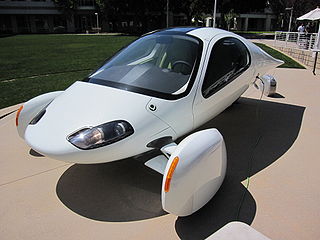
A pointed excerpt from Wired’s account:
“The truth is, Aptera always faced long odds and has been in trouble for at least two years. The audience for a sperm-shaped, three-wheeled, electric two-seater was never anything but small. It didn’t help that production of the 2e — at one point promised for October 2009 — was continually delayed as Wilbur ordered redesigns to make it more appealing to the mainstream.
Aptera had a small window in which to be a first mover in the affordable EV space, and that window closed the moment the Nissan Leaf and Chevrolet Volt hit the market. At that point, Aptera teetered on the brink of irrelevance.”
While I like the idea of electric cars for city travel (I have one a bit more practical than that above) I’ll admit that they don’t make much sense for an everyday family car, and making a car that looks like something out of a Woody Allen movie puts an even greater damper on the marketability issue.
The reason that many electrics are three wheelers are due to arcane laws in the USA that allow three wheelers to be licensed as motorcycles, with no upwards spped limit or crash testing required, while four wheelers must be limited to 25mph (40km/hr) as NEV’s (Neighborhood Electric Vehicles) or must go through crash testing that cost upwards to half a million dollars. While Leaf and Volt have passed that (Since Nissan and GM have deep pockets) it leaves the smaller companies struggling to find a niche outside of the limited “Ed Begely Junior” market.
Here’s a look at Leaf and Volt EV sales in the US from The Daily Bayonet:
===================================================
Nissan sold 672 Leaf vehicles and GM sold 1139 Volts.

Nissan is still far in the lead with a grand total for the calendar year at 8720, though GM is slowly closing the gap at 6142 sales. Note that for comparison purposes, the 326 Volts sold in December 2010 are not included. To balance this, Volts which spontaneously combust are not deducted from total sales, despite the total loss of vehicle, and sometimes the home too.
Whether or not stories of fiery Volts will affect future sales remains to be seen, though for a car in its early stages of adoption to require complex ‘power-down’ procedures in the event of accidents isn’t a good sign. Imagine if Ford had advised Pinto owners to follow a protocol to drain the gas tank after a collision. Not good.
The range of modern electric cars is around the same as those made in 1895 – nothing like Green Government funding, using taxpayers money, to prove how utterly out of touch with reality our Western Politicians are!
Missed the link!
http://www.lowtechmagazine.com/overview-of-early-electric-cars.html
@John Marshall et al
You see that’s where this one was different. It has that Jetson shape because it is more efficient allowing the batteries to take you further than 50 miles (and at real driving speeds) The hybrid (tiny ic engine in the nose) wasn’t going to be used to power the wheels but only to recharge the battery. So the battery charging problem and the hours it takes are solved while you are away from home.
That’s why I am sad to see the Aptera bite the dust, This one genuinely made more efficient use of resources. An improvement over our current technologies.
Going forward doesn’t always have to mean more of the same
Dave
This is the first year of the only series production EV: NIssan Leaf. Sales cannot exceed production and Nissan will naturally price gouge early adopters and suck up the subsidies.
Chevy Volt is just a poor quality hybrid with a large battery. It’s a reminder of how far behind US car technology has slipped. nobody outside the US is going to buy one no more than non-americans want to buy a chrysler or a cadillac. Hybrids lose one advantage of EVs which is the low depreciation and maintenance costs of a car with no engine.
Gasoline price in Europe is 2X US pump price ($7.50-$8/ US gallon), so that changes the decision to purchase. Many families have a 2nd car used for city driving which a leaf can handle. Nissan has clearly made progress at reducing the $/kwh but we don’t know how far they’ve gone or will go.
Electric cars balance well with a heavy wind infrastructure, allowing intermittent charging at cheap rates during the average 23 hours per day when a car is not in use. There is also the possibility of the car battery being used to arbitrage electricity for domestic use; Leaf has both AC & DC connectors so your domestic electricity could come from your car battery which had stored the power during a cheap period.
So, early days yet. Range is only half what it should be and fast charging stations are not rolled out yet and not fast enough. When there are a few more cars in the marketplace and production is over 1million/year and we have 5 minute charging stations at every gas station then we’ll see how it goes.
If you like electric, it makes a whole lot more sense to buy a golf cart. Same short range, same total lack of safety, same low cost of operation when used within its proper limits. But the initial cost is vastly less than these super-fancy concept cars, and it uses plain old lead-acid batteries available everywhere.
Many cities are making golf carts legal for travel inside residential zones.
This is what Jerry Pournelle said about Ed Begley Jrs’ wind mill when asked recently:
http://jerrypournelle.com/chaosmanor/?p=3751
“Ed took down his little wind turbine the last time he had the roof worked on. It just wasn’t cost effective, which is hardly surprising; winds strong enough to generate real power are rare in Los Angeles except in a Santa Ana season and when that happens the wind may be too strong. It was an experiment.
Ed is not naïve about all this, and he keeps good records about the cost of living off the grid, or trying to. I’m trying to get him and Niven together to do solar panels for Niven’s house: given the tax credits and subsidies it might be a good idea for Niven, who doesn’t live in the LA power district. Without the subsidies it wouldn’t be a consideration, but if you are already paying a lot in taxes, the tax credits for doing “green” can cover a great deal of the capital costs, and that changes the picture a lot. Solar works for some times and places; wind is a great deal less likely to be cost effective or even affordable.”
Here in the UK, slavering ecoMENTAList Minister for Energy and Climate Change, Chris (I was not driving that speeding car!) Huhne plans 32000 more bird shredders and has equally rabid plans to replace all petrol and diesel powered cars and vans (30 million of them) by 2050.
The Sunday Times
…’Huhne plans to build 32,000 wind turbines.’ And many thousand more transmission pylons.
…The energy secretary wants to convert all Britains vehicles and homes to run on electricity by 2050. Doubling electricity production. Almost all of it to come from wind and nuclear.
…End of the road for petrol cars.
He announced this from Westminster while jumping up and down furiously on a pogo stick, and playing a sousaphone. Several doves flew out out of a large green balloon as it exploded high over the speakers chair, as he waved his report in the air, which changed unexpectedly into a bunch of begonias, to great cheers and clapping from the benches.
People are at last realising that as long as we have fossil fueled electrical production, a European turbo-diesel is much more efficient (and practical) than an electric vehicle.
When we finally go to 100% Thorium power the scales will tip in favour of electric vehicles, but we will still be in need of a much better energy storage medium.
.
I drove an electric vehicle yesterday. We call it a golf cart.
The future of electric vehicles is the unicycle.
Honda:
http://www.youtube.com/watch?v=0pkn8Ko-q74
One independent tinkerer:
http://www.youtube.com/watch?v=XCVMvLvASj4
As far as federal subsidies, they had been trying for two years to get 150 million dollars. They said they were close ……. Thankfully not close enough.
This article does not comment on any previous subsidies they may have obtained. They definitely would have qualified for some form of tax credits or tax break or both which is probably what kept them in “business” for this long.
http://www.detnews.com/article/20111202/AUTO01/112020441/1361/California-auto-start-up-Aptera-shuts-down
It really is hard to beat gasoline as a way of storing energy. Coal powered car? Most of Germany’s fighter aircraft in WWII were coal powered. They made aviation gasoline from coal.
Arnold Ring (@ArnoldRing) says:
December 4, 2011 at 2:40 am
“So, early days yet. Range is only half what it should be and fast charging stations are not rolled out yet and not fast enough. When there are a few more cars in the marketplace and production is over 1million/year and we have 5 minute charging stations at every gas station then we’ll see how it goes.”
The problem is not the charging station but the batteries who just refuse to be charged in five minutes. But let’s just assume we pump 50 kWh into a battery in 5 minutes. What amperage do we need? Let’s assume 200V DC, a typical voltage for larger battery bundles.
200V at 1A would charge 200W, or 200 Wh per hour.
At 5A we would charge 1 kWh per hour. At 250 A we would charge 50kWh per hour.
Sounds realistic. Let’s now assume a 90% efficiency of the charging process, so we have 10% heat loss, some in the battery and some in the charger. We lose a total of 5kWh (10% of 50 kWh), and we lose these 5kWh within 5 minutes (our charging time) – so we have a heating power of 1kWh/minute or 60kW.
Now imagine 10 cars at the E-station charging simultaneously, on a hot summer day, 100 deg F outside temperature, together heating up their environment with a grand total of 600 kW…
I could go on for hours like this… Next imagine the wiring you have to install to supply all the E-Stations in a city with electricity.
Electric car proponents simply have no idea what huge amounts of energy constantly flow through our gas pipelines, and how much cables and transformers and pylons would be needed to replace that with electricity infrastructure…
realtime energy im + export for Denmark; electricity and Natgas pipelines:
http://www.energinet.dk/Flash/Forside/index.html
Jer0me says:
December 4, 2011 at 1:44 am
“I am not sure why you would bother, when you can get an old Porche 911 and fit it with a decent electric engine. It can even give the original model a decent challenge, apparently as the engine is that much lighter, I am told. The balance is better because the batteries re mid-car, and the rest is pretty much the same. ”
Jerome, do you have any idea how heavy a Li-Ion battery is? The battery used in current Mercedes S class hybrids is Li-Ion; 42 kg of these batteries contain, when charged, as much energy as 100g TNT, as we once computed for fun.
http://en.wikipedia.org/wiki/Energy_density
The weight of the engine becomes rather irrelevant in this regard.
Simeon Higgs says:
December 3, 2011 at 11:24 pm
The real fundamental problem with them as I see it is that with a car that runs on liquid (or gas) fuels, you can “recharge” them within the space of 4-5 minutes, whereas an electric requires many hours to fully recharge the battery.
======
A valid point. If you read the article a.jones links to above http://noconsensus.wordpress.com/2009/11/13/electric-cars/ , It’s entirely possible that you will never be able to charge an electric battery at that rate. Too many watts. Too little time. Their answer — which might work — was that you haul into a “gas” station and a machine swaps your (standardized) battery for a fully charged battery in a couple of minutes.
Might work.
It’s a good article.
DirkH says:
December 4, 2011 at 5:29 am
“200V at 1A would charge 200W, or 200 Wh per hour.
At 5A we would charge 1 kWh per hour. At 250 A we would charge 50kWh per hour. ”
Oh – I completely forgot, we wanted to charge the battery not in an hour, but in 5 minutes; so make that 12*250 = 3 kA. How big will the cable be? At 30 A/mm^2 we get 100mm^2. Not too impractical. Heat loss will be the bigger problem, as detailed above.
“Gary Mount says:
December 4, 2011 at 3:19 am
…..but if you are already paying a lot in taxes, the tax credits for doing “green” can cover a great deal of the capital costs,”
At who’s expense? About 2 years ago, there was an article in in our local newspaper. A local auto dealership owner had solar system installed at his home. Cost $50,000.00. His cost $26,000.00: Taxpayer’s cost $24,000.00. And, he is allowed to sale electricity to AEP.
I just wanted to clarify that in no normal situation did the Ford Pinto explode after being rear ended by another vehicle. However, in some cases the gas tank was punctured by the steel bumper hitting it and gas was released from the tank. This issue was over hyped by some ABC reporters that could only get the vehicle to explode if they detonated a small amount of explosive after the impact and well, there is no story if there is no big boom or fire. This sounds a lot like what is happening right now with regards to the Volt. Oh, and the factory recall fix for the Pinto was to bolt a 1/4″ piece of plastic between the bumper and the gas tank.
What I find astounding is that companies like Aptera thought there was actually a profitable market for this kind of thing. Didn’t they do any market research?
First the good stuff. Electric motors are great! They acheive nearly 100% efficient power conversion, produce tremendous torque even from standstill, are beautifully quiet and emit no nonsene fumes. Unfortunately, they will never replace the dirty inefficient internal combustion engine.
There is no solution to the battery problem. Any attempts to increase charge capacity is little more than tinkering with the problem. Unless you can get recharging times down to the order of 5 minutes, then rolling out recharging stations is an expensive waste of effort. Imagine the queues that would form with even a 30 minute recharging time.
The idea that has been floated, of swapping batteries instead of recharging them, also won’t work. These batteries weigh 200kg. How many cars visit an average filling station every hour? Several stations I know almost always have queues of cars waiting impatiently for the ranks of 8 or more pumps to become free. Where they are going to store thousands of batteries each bigger than the suitcase a celebrity takes on holiday beats me.
Then there is the ownership issue. At the moment, all batteries are the property of the car owner who is ultimately responsible for replacing them. No motorist would allow a new battery to be swapped for an older one. So before you even begin such a program, battery ownership would have to be separated from car ownership, a matter that has not even been considered so far.
Batteries suck!
Bernd Felsche says:
December 3, 2011 at 10:58 pm
“A little unfair to the Chevy Volt, which won’t burst into flames until a few days after the event. Apparently something of a trickling time bomb”
I guess that depends on the severity of the accident.
Reminds me of the Man vs Wild episode, where Bear Grylls cuts into a cell phone Lithium battery to start a fire. Lithium reacts with the O2 in the atmosphere with fiery results.
GM’s pockets are only as deep as the American tax payers pockets are deep, and my pocket is getting shallower and shallower.
Just to clarify, this is what Jerry pournelle says, not I.
I hope none of this foolishness makes its way to my province (B.C.), our carbon tax and forced carbon offset regime for schools and hospitals is bad enough.
The next election in B.C. will be lost to the socialists N.D.P. if we join the Western Climate Initiative.
Let Christy Clark know that everybody 😉 (The BC Conservative Party will be stealing her votes, already at 13%, enough for her to lose) Thank goodness the election isn’t until 2013.
Vince Causey says:
Batteries suck!
==============
Indeed they do.
The battery the British were looking at for their EV was a Nickel-Zinc Drumm Cell. Might be cheap enough for battery exchange to be feasible. … If the mechanics of who is liable for the cost of defective batteries can be dealt with. Maybe the cost of battery failure insurance is built into the cost of the recharged battery … Maybe … or maybe that can’t work.
===============
I’m a bit skeptical that a reliable 5 minute recharge of a battery that can trundle a vehicle hundreds of kilometers is possible. That seems a lot of Energy that has to drive chemical reactions without exploding anything, boiling working fluids, creating metallic whiskers that short the battery, or welding stuff that wasn’t intended to be welded together.