From the Carnegie Institution – maybe we should build more cooling towers.
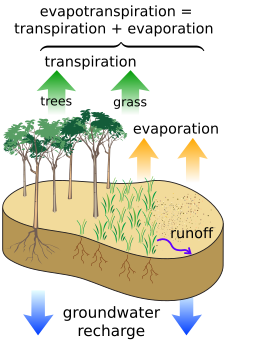
Washington, DC. — Scientists have long debated about the impact on global climate of water evaporated from vegetation. New research from Carnegie’s Global Ecology department concludes that evaporated water helps cool the earth as a whole, not just the local area of evaporation, demonstrating that evaporation of water from trees and lakes could have a cooling effect on the entire atmosphere. These findings, published September 14 in Environmental Research Letters, have major implications for land-use decision making.
Evaporative cooling is the process by which a local area is cooled by the energy used in the evaporation process, energy that would have otherwise heated the area’s surface. It is well known that the paving over of urban areas and the clearing of forests can contribute to local warming by decreasing local evaporative cooling, but it was not understood whether this decreased evaporation would also contribute to global warming.
The Earth has been getting warmer over at least the past several decades, primarily as a result of the emissions of carbon dioxide from the burning of coal, oil, and gas, as well as the clearing of forests. But because water vapor plays so many roles in the climate system, the global climate effects of changes in evaporation were not well understood.
The researchers even thought it was possible that evaporation could have a warming effect on global climate, because water vapor acts as a greenhouse gas in the atmosphere. Also, the energy taken up in evaporating water is released back into the environment when the water vapor condenses and returns to earth, mostly as rain. Globally, this cycle of evaporation and condensation moves energy around, but cannot create or destroy energy. So, evaporation cannot directly affect the global balance of energy on our planet.
The team led by George Ban-Weiss, formerly of Carnegie and currently at Lawrence Berkeley National Laboratory, included Carnegie’s Long Cao, Julia Pongratz and Ken Caldeira, as well as Govindasamy Bala of the Indian Institute of Science in Bangalore. Using a climate model, they found that increased evaporation actually had an overall cooling effect on the global climate.
Increased evaporation tends to cause clouds to form low in the atmosphere, which act to reflect the sun’s warming rays back out into space. This has a cooling influence.
“This shows us that the evaporation of water from trees and lakes in urban parks, like New York’s Central Park, not only help keep our cities cool, but also helps keep the whole planet cool,” Caldeira said. “Our research also shows that we need to improve our understanding of how our daily activities can drive changes in both local and global climate. That steam coming out of your tea-kettle may be helping to cool the Earth, but that cooling influence will be overwhelmed if that water was boiled by burning gas or coal.”
These people must know about latent heat of evaporation and condensation and the heat lost/gained in this process. This is hardly ‘new’ research. I was doing experiments on this 55 years ago in physics class.
The mind boggles.
We just spent 24 hours listening to intelligent rebutals of the false theory of agw and now we are to believe the earth is getting warmer because of CO2? And of course evaperation causes cooling. Looking forward to apple harvest here in Oregon. Thank you all for the last 24 hours, it was interesting and informative.
So increased CO2 makes flora grow bigger and better and stronger and respires more, thus we have a negative feed back, negating any warming from CO2. Perfect natural balance, what is the problem, I see none.
“Increased evaporation tends to cause clouds to form low in the atmosphere, which act to reflect the sun’s warming rays back out into space. This has a cooling influence.”
In all the discussion of global warming (cooling) I have never read of the contribution of the heat generated by using electrical energy. An easy sum shows that it is not negligible. Have I missed something . Oliver OFlynn
How much tax money has this Carnegie Institution report cost us?
Inreased CO2, increased plant growth, more evaporation, more clouds, more reflection, cooler planet.
“The Earth has been getting warmer over at least the past several decades, primarily as a result of the emissions of carbon dioxide from the burning of coal, oil, and gas, as well as the clearing of forests.”
That’s a given, then?
Dang! Just when I’d been convinced the science was not settled.
Interesting read however, its a well established fact trees have an “air conditioning” effect, not just their shade. So no surprise here for me.
Except that burning gas or coal adds water to the atmosphere. And since they don’t actually have a clue as to how much warming each molecule of CO2 causes, nor how much cooling each molecule of H2O causes, they haven’t the slightest hint of the beginning of a notion of the barest clue of an idea of what the overall effect* is.
*Haha, sorry, that funny lookin’ word there is a synonym for the common Illiterate English term “impact”
How did this paper get past the climate sensors Do I see another rebuttal paper in 18 days?
According to environmentalists … we’ve been cutting down forests. We’ve certainly been putting more land to farmland which doesn’t have vegetation when ploughed. We now have a plausable explanation for the dramatic change in “urban heating” even when population density in the US changed by a few 10s of people per km.
Like a blow from a hidden assailant out of the dark:
1. Bang goes the claims that urban heating is not affecting most temperature sensors — even in rural areas.
2. We now have another plausible explanation for any temperature rise which is not CO2 (I now count, solar activity, reduced global dimming, CO2 as other prime contenders)
3. The science is settled … is it really?
4. We now have a paper which in effects supports sunspots as it is the same basic mechanism of cloud cover.
5.And to top it all, there is now good reason to believe increasing bio-fuel output by changing farmland to crops will increase warming.
I am reminded of the scene in Jurassic Park, when the hunter is hunting the Velociraptor and with all his attention on the one before him, he fails to see the other about to hit him from the side.
More post-normal CAGW-inspired gobbledygook. It is absurd to think that land-use decision making, which is entirely a local decision should even consider whether or not vegetation, particularly trees might have a cooling effect on the Earth. The gist of their argument seems to be to discourage development of any sort, particularly in (what else) developing countries, with the possibility of developed countries like the U.S. of paying them not to develop, “for the good of The Planet”.
Nice that they give a nod to the cooling effect of clouds, though.
This has always been one of my pet theories. In fact folks, anthropogenic warming may slowly be occurring due to deforestation. Its possible both cosmic ray fluxuation and forest cover changes are the primary variables affecting cloud cover changes. Unfortunately there has been not enough science done on cloud formation and its impact on global climate change. Pity we rushed to cut primary forests to put up oil palm plantations when we knew so little about the science of climate change.
There are so many land use effects on local climate, that these climate scientists seems unaware of, that it makes me wonder if there’s not an issue with basic education, or at least cross discipline basics.
Most pre 1950 land management/agricultural books will tell you to plant a copse of trees if you want to increase local rainfall, most old farmers will say the same thing in my experience.
The Holistic Management grazing techniques (increased herd numbers on smaller rotated ranges, mimicking natural herd movements) reversed desertification in Zimbabwe, during a drought!
Another example I heard about was about how prairie dogs effect local rainfall. They were seen as pests, so were eradicated in a certain area (I can’t remember where), it was found that this caused a reduction in downwind rainfall. How so? Prairie dogs build lots of tunnels, each entrance has a raised edge, like a small volcano. As the wind blows across these entrances, the higher opening creates low pressure, which exchanges air inside the tunnels, the air which is removed is loaded with +ive ions, which are attracted to the -ive ions at the cloud base, seeding clouds. Removing the prairie dogs edged the local downwind environment towards desertification. Keyline ploughing (P.A. Yeoman) mimics this tunnel system, so besides being effective in influencing run-off water to stay in the landscape (by ploughing along contour lines at the keyline), it actually increases downwind rainfall too.
Land use issues are key to local climate IMO, much more so than any possible effects of a trace gas, but then there’s not much money in it for climate scientists, or governments, so we’re stuck with the current paradigm.
When this evaporated water condenses, it is many thousands of feet in the air, so that the heat released escapes to space much more easily. So even if that were the only affect, increased evaporation from plants would result in a net cooling. Not the balanced out that is assumed by the authors.
BTW, increased CO2 results in more plants. So CO2 results in cooling. Very interesting.
So the burning down of the rain forests in S America and SE Asia over the last 30 years or so could well have been responsible for the recent warming and now that there’s none left the rise has levelled off?
NB I was in Singapore during the great Indonesian burn off in ’96
Who would have “thunk” evaporation of water would have a cooling effect? Do we live in a big “swamp cooler” or what?
Hmmm.
More CO2 soon leads to more and bigger plants in more locations. Perhaps the additional evaporative cooling amounts to more than the projected CO2 warming?
At the very least it would reduce sensitivity to more CO2 in the air.
So that is another negative system response to add to the negative system response from clouds and a faster water cycle.
“Also, the energy taken up in evaporating water is released back into the environment when the water vapor condenses and returns to earth, mostly as rain. ”
Crikey, that is just daft. Rain is colder than the air around it because the energy released by condensation higher up gets radiated out to space faster than it would have been if the energy had been retained at the surface.
Evaporation DOES affect the global energy balance by transporting energy upwards for a quicker loss to space thereby offsetting the slower loss to space that would otherwise arise from the thermal characteristics of GHG.
This article concedes more evaporation but then denies the well known thermal effects of more evaporation in order to preserve the faulty CO2 paradigm.
The evapotranspiration cycle may be energy neutral, but if it helps to transport energy to higher altitudes it is likely to increase the heat lost to space.
Some folks have been saying this for years! Although the last sentence is still based on pathological science!
“The Earth has been getting warmer over at least the past several decades, primarily as a result of the emissions of carbon dioxide from the burning of coal, oil, and gas, as well as the clearing of forests.”
And ~96% of total global CO2 emissions come from other sources other than anthropological sources, i.e. natural sources. In a few years time, we may be more concerned with global cooling than global warming. Oh, and we haven’t seen any global warming since about 1998 (unless you use James Hansen’s tainted surface temperature products).
Also related is Anna Makarieva’s hypothesis about the generation of winds covered here a while back.
http://wattsupwiththat.com/2011/01/21/an-appeal-to-the-climate-science-blogosphere/#more-32135
>>>But because water vapor plays so many roles in the climate
>>>system, the global climate effects of changes in evaporation
>>>were not well understood.
But the science was, nevertheless, settled.
.
Willis is not going to like this statement. Dr. Spenser, neither.
I’m amazed people don’t see the importance of this paper. Think it from the point of view of the “treehugger”. We need a way to explain to them that there are other things that effect climate. They want to believe that chopping down trees is bad, they also want to believe warming is bad.
So, now we can encourage them to say: chopping down trees causes global warming
Which is the same as saying:
Chopping down trees caused global warming
This is the equivalent of throwing a bitch in heat into the foxhounds. How can they resist making the connection? They can’t … it ticks all boxes. But as soon as they start saying: “chopping down the amazon causes global warming”, they are also saying that: “CO2 isn’t causing that global warming”, and more importantly: “we also don’t think the science is settled … not when it suits us”.