
UPDATE: see some reactions to this announcement here
From the GWPF
This refers to the CLOUD experiment at CERN.
I’ll have more on this as it develops (updated twice since the original report now), but for the short term, it appears that a non-visible light irradiance effect on Earth’s cloud seeds has been confirmed. The way it is posited to work is that the effect of cosmic rays (modulated by the sun’s magnetic variations which either allow more or deflect more cosmic rays) creates cloud condensation nuclei in the Earth’s atmosphere. With more condensation nuclei, more clouds form and vice-versa. Clouds have significant effects on TSI at the surface.
Even the IPCC has admitted this in their latest (2007) report:
“Cloud feedbacks are the primary source of inter-model differences in equilibrium climate sensitivity, with low cloud being the largest contributor”.
Update: From the Nature article, Kirkby is a bit more muted in his assessment than the GWPF:
Early results seem to indicate that cosmic rays do cause a change. The high-energy protons seemed to enhance the production of nanometre-sized particles from the gaseous atmosphere by more than a factor of ten. But, Kirkby adds, those particles are far too small to serve as seeds for clouds. “At the moment, it actually says nothing about a possible cosmic-ray effect on clouds and climate, but it’s a very important first step,” he says.
Update: Bizarrely, New Scientist headlines with: Cloud-making: Another human effect on the climate
================================================================
CERN Experiment Confirms Cosmic Rays Influence Climate Change.
by Nigel Calder
Long-anticipated results of the CLOUD experiment at CERN in Geneva appear in tomorrow’s issue of the journal Nature (25 August). The Director General of CERN stirred controversy last month, by saying that the CLOUD team’s report should be politically correct about climate change (see my 17 July post below). The implication was that they should on no account endorse the Danish heresy – Henrik Svensmark’s hypothesis that most of the global warming of the 20th Century can be explained by the reduction in cosmic rays due to livelier solar activity, resulting in less low cloud cover and warmer surface temperatures.
Willy-nilly the results speak for themselves, and it’s no wonder the Director General was fretful.
Jasper Kirkby of CERN and his 62 co-authors, from 17 institutes in Europe and the USA, announce big effects of pions from an accelerator, which simulate the cosmic rays and ionize the air in the experimental chamber. The pions strongly promote the formation of clusters of sulphuric acid and water molecules – aerosols of the kind that may grow into cloud condensation nuclei on which cloud droplets form. What’s more, there’s a very important clarification of the chemistry involved.
A breach of etiquette
My interest in CLOUD goes back nearly 14 years, to a lecture I gave at CERN about Svensmark’s discovery of the link between cosmic rays and cloudiness. It piqued Kirkby’s curiosity, and both Svensmark and I were among those who helped him to prepare his proposal for CLOUD.
By an unpleasant irony, the only Svensmark contribution acknowledged in theNature report is the 1997 paper (Svensmark and Friis-Christensen) on which I based my CERN lecture. There’s no mention of the successful experiments in ion chemistry and molecular cluster formation by the Danish team in Copenhagen, Boulby and latterly in Aarhus where they beat CLOUD to the first results obtained using a particle beam (instead of gamma rays and natural cosmic rays) to ionize the air in the experimental chamber – see http://calderup.wordpress.com/2011/05/17/accelerator-results-on-cloud-nucleation-2/
What will historians of science make of this breach of scientific etiquette? That Kirkby was cross because Svensmark, losing patience with the long delay in getting approval and funding for CLOUD, took matters into his own hands? Or because Svensmark’s candour about cosmic rays casting doubt on catastrophic man-made global warming frightened the national funding agencies? Or was Kirkby simply doing his best (despite the results) to obey his Director General by slighting all things Danish?
Personal rivalries aside, the important question is what the new CLOUD paper means for the Svensmark hypothesis. Pick your way through the cautious prose and you’ll find this:
“Ion-induced nucleation [cosmic ray action] will manifest itself as a steady production of new particles [molecular clusters] that is difficult to isolate in atmospheric observations because of other sources of variability but is nevertheless taking place and could be quite large when averaged globally over the troposphere [the lower atmosphere].”
It’s so transparently favourable to what the Danes have said all along that I’m surprised the warmists’ house magazine Nature is able to publish it, even omitting the telltale graph shown at the start of this post. Added to the already favourable Danish experimental findings, the more detailed CERN result is excellent. Thanks a million, Jasper.
Enlightening chemistry
And in friendlier times we’d be sharing champagne for a fine discovery with CLOUD, that traces of ammonia can increase the production of the sulphuric clusters a thousandfold. It’s highlighted in the report’s title: “Role of sulphuric acid, ammonia and galactic cosmic rays in atmospheric aerosol nucleation” and it was made possible by the more elaborate chemical analysis in the big-team set-up in Geneva. In essence, the ammonia helps to stabilize the molecular clusters.
Although not saying it openly, the CLOUD team implies a put-down for the Danes with this result, repeatedly declaring that without ammonia there’d be little cluster production at low altitudes. But although the Aarhus experimenters did indeed assume the simpler reaction (H2SO4 + H2O), differing results in successive experimental runs made them suspect that varying amounts of trace impurities were present in the air cylinders used to fill their chamber. Now it looks as if a key impurity may have been ammonia. But some members of the CLOUD consortium also favoured (H2SO4 + H2O) and early runs in Geneva used no intentional ammonia. So they’ve little reason to scoff.
In any case, whether the basic chemistry is (H2SO4 + H2O) or (H2SO4 + H2O + NH3) is an academic rather than a practical point. There are always traces of ammonia in the real air, and according to the CLOUD report you need only one molecule in 30 billion. If that helps to oil Svensmark’s climatic motor, it’s good to know, but it calls for no apologies and alters the climatic implications not a jot.
 The experiment’s logo. The acronym “Cosmics Leaving Outdoor Droplets” always implied strong interest in Svensmark’s hypothesis. And the roles of the Galaxy and the Sun are acknowledged.
Technically, CLOUD is a welcome advance on the Danish experiments. Not only is the chemistry wider ranging but molecular clusters as small as 1.7 nanometres in diameter are detectable, compared with 4 nm in Denmark. And the set-up enables the scientists to study the ion chemistry at lower temperatures, corresponding to increasing altitudes in the atmosphere. Cluster production soars as the temperature goes down, until “almost every negative ion gives rise to a new particle” [i.e. molecular cluster]. The lowest temperature reported in the paper is -25 oC. That corresponds to an altitude of 6000 metres, so unless you wish to visualize a rain of cloud-seeding aerosols from on high, it’s not very relevant to Svensmark’s interest in the lowest 3000 metres.
How the warmists built their dam
Shifting from my insider’s perspective on the CLOUD experiment, to see it on the broader canvas of the politicized climate science of the early 21st Century, the chief reaction becomes a weary sigh of relief. Although they never said so, the High Priests of the Inconvenient Truth – in such temples as NASA-GISS, Penn State and the University of East Anglia – always knew that Svensmark’s cosmic ray hypothesis was the principal threat to their sketchy and poorly modelled notions of self-amplifying action of greenhouse gases.
In telling how the obviously large influences of the Sun in previous centuries and millennia could be explained, and in applying the same mechanism to the 20th warming, Svensmark put the alarmist predictions at risk – and with them the billions of dollars flowing from anxious governments into the global warming enterprise.
For the dam that was meant to ward off a growing stream of discoveries coming from the spring in Copenhagen, the foundation was laid on the day after the Danes first announced the link between cosmic rays and clouds at a space conference in Birmingham, England, in 1996. “Scientifically extremely naïve and irresponsible,”Bert Bolin declared, as Chairman of the Intergovernmental Panel on Climate Change.
As several journalists misbehaved by reporting the story from Birmingham, the top priority was to tame the media. The first courses of masonry ensured that anything that Svensmark and his colleagues might say would be ignored or, failing that, be promptly rubbished by a warmist scientist. Posh papers like The Times of London and the New York Times, and posh TV channels like the BBC’s, readily fell into line. Enthusiastically warmist magazines like New Scientist and Scientific Americanneeded no coaching.
Similarly the journals Nature and Science, which in my youth prided themselves on reports that challenged prevailing paradigms, gladly provided cement for higher masonry, to hold the wicked hypothesis in check at the scientific level. Starve Svensmark of funding. Reject his scientific papers but give free rein to anyone who criticizes him. Trivialize the findings in the Holy Writ of the Intergovernmental Panel on Climate Change. None of this is paranoia on my part, but a matter of close personal observation since 1996.
“It’s the Sun, stupid!” The story isn’t really about a bunch of naughty Danish physicists. They are just spokesmen for the most luminous agent of climate change. As the Sun was what the warmists really wanted to tame with their dam, they couldn’t do it. And coming to the Danes’ aid, by briefly blasting away many cosmic rays with great puffs of gas, the Sun enabled the team to trace in detail the consequent reduction in cloud seeding and liquid water in clouds. See my posthttp://calderup.wordpress.com/2010/05/03/do-clouds-disappear/ By the way, that research also disposes of a morsel of doubt in the new CLOUD paper, about whether the small specks made by cosmic rays really grow sufficiently to seed cloud droplets.
As knowledge accumulated behind their dam and threatened to overtop it, the warmists had one last course to lay. Paradoxically it was CLOUD. Long delays with this experiment to explore the microchemical mechanism of the Svensmark effect became the chief excuse for deferring any re-evaluation of the Sun’s role in climate change. When the microchemical mechanism was revealed prematurely by the SKY experiment in Copenhagen and published in 2006, the warmists said, “No particle accelerator? That won’t do! Wait for CLOUD.” When the experiment in Aarhus confirmed the mechanism using a particle accelerator they said, “Oh that’s just the Danes again! Wait for CLOUD.”
Well they’ve waited and their dam has failed them.
Hall of Shame
Retracing those 14 years, what if physics had functioned as it is supposed to do? What if CLOUD, quickly approved and funded, had verified the Svensmark effect with all the authority of CERN, in the early 2000s. What if the Intergovernmental Panel on Climate Change had done a responsible job, acknowledging the role of the Sun and curtailing the prophecies of catastrophic warming?
For a start there would have no surprise about the “travesty” that global warming has stopped since the mid-1990s, with the Sun becoming sulky. Vast sums might have been saved on misdirected research and technology, and on climate change fests and wheezes of every kind. The world’s poor and their fragile living environment could have had far more useful help than precautions against warming.
And there would have been less time for so many eminent folk from science, politics, industry, finance, the media and the arts to be taken in by man-made climate catastrophe. (In London, for example, from the Royal Society to the National Theatre.) Sadly for them, in the past ten years they’ve crowded with their warmist badges into a Hall of Shame, like bankers before the crash.
As I reported on May 14th, 2011 in Update on the CERN CLOUD experiment:
From Physics World Head in a CLOUD:
In this special video report for physicsworld.com CLOUD project leader Jasper Kirkby explains what his team is trying to achieve with its experiment. “We’re trying to understand what the connection is between a cosmic ray going through the atmosphere and the creation of so-called aerosol seeds – the seed for a cloud droplet or an ice particle,” Kirkby explains.
The CLOUD experiment recreates these cloud-forming processes by directing the beamline at CERN’s proton synchrotron into a stainless-steel chamber containing very pure air and selected trace gases.
One of the aims of the experiment is to discover details of cloud formation that could feed back into climate models. “Everybody agrees that clouds have a huge effect on the climate. But the understanding of how big that effect is is really very poorly known,” says Kirkby.
Here’s the video, click image below to launch it.

=====================================================
More coverage: Big hat tip to WUWT reader “Andrew20”
Cosmic rays get ahead in CLOUD
http://www.rsc.org/chemistryworld/News/2011/August/24081102.asp
Cloud formation may be linked to cosmic rays
http://www.nature.com/news/2011/110824/full/news.2011.504.html
Cloud formation study casts a shadow over certain climate models
======================================================
Update: From Nigel Calder’s blog
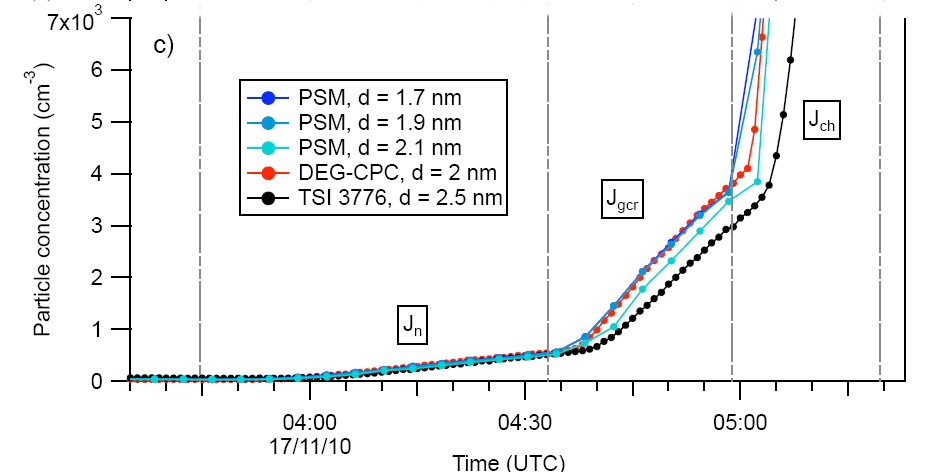 A graph they’d prefer you not to notice. Tucked away near the end of online supplementary material, and omitted from the printed CLOUD paper in Nature, it clearly shows how cosmic rays promote the formation of clusters of molecules (“particles”) that in the real atmosphere can grow and seed clouds. In an early-morning experimental run at CERN, starting at 03.45, ultraviolet light began making sulphuric acid molecules in the chamber, while a strong electric field cleansed the air of ions. It also tended to remove molecular clusters made in the neutral environment (n) but some of these accumulated at a low rate. As soon as the electric field was switched off at 04.33, natural cosmic rays (gcr) raining down through the roof of the experimental hall in Geneva helped to build clusters at a higher rate. How do we know they were contributing? Because when, at 04.58, CLOUD simulated stronger cosmic rays with a beam of charged pion particles (ch) from the accelerator, the rate of cluster production became faster still. The various colours are for clusters of different diameters (in nanometres) as recorded by various instruments. The largest (black) took longer to grow than the smallest (blue). This is Fig. S2c from supplementary online material for J. Kirkby et al., Nature, 476, 429-433, © Nature 2011
Huh – don’t happen often but I had to look up “willy nilly”
1. Whether desired or not: After her boss fell sick, she willy-nilly found herself directing the project.
2. Without order or plan; haphazardly.
because the only definition I knew of was 2 and that didn’t seem to fit well in context.
Henrik Svenmark’s work goes back to 1996 and earlier; the warmists have been very successful in suppressing it or even rubishing it because it certainly hasnt had much publicity in the last 14 years or so!
Bruce Cobb says:
August 25, 2011 at 6:34 am
R. Gates says:
August 24, 2011 at 1:43 pm
pochas says:
August 24, 2011 at 12:55 pm
“Lets not get too elated here….a reasonable skeptic must allow that CO2 may be a part of it.”
_____
Three cheers for all reasonable skeptics!
Wow, you cheer easily! I think we all agree that C02 has some warming effect.
_____
It is not just that CO2 has “some” warming effect, it is this…without CO2 and its related positive feedbacks during Milankovitch initiated warming of interglacials, there would be no interglacial.
Here’s a counter question. If these “related positive feedbacks” are responsible for interglacial, what slows them down? What negative feedback stops the progression to ever-warmer temperatures? Why is the system stable after reaching interglacial temperatures? Also, since we are presumably in an interglacial, and all other interglacials have not gone into positive-feedback-runaway, why should we fear excess CO2 in the air now since history hasn’t shown that temperature ever runs away from us during the interglacials?
Your answer will be amusing. Not might be, will be.
Eric Gisin says:
August 25, 2011 at 9:26 am
Warren Meyer has an article at Forbes explaining the science to the public. Wish the MSM were this good.
Did CLOUD Just Rain on the Global Warming Parade?
http://www.forbes.com/sites/warrenmeyer/2011/08/25/did-cloud-just-rain-on-the-global-warming-parade/
andrew says:
August 24, 2011 at 9:29 pm
I guess New Scientist has never heard of lagging affects.
R.Gates,
Your comment at 10:26am is preposterous. You are claiming CO2 has a massive impact on climate – 10 degrees or more. There is no evidence for this – everything points to a minimal effect.
That Vostok ice cores show strong correlations between CO2 and temperatures is just that – a correlation. It does NOT prove causation. In fact, it is far far more likely that temperatures influence atmospheric CO2 rather than your preposterous assertion that the tail wags the dog. One clue that global temperatures drive CO2 is the roughly 800 year time lag that CO2 rises or falls AFTER a rise or fall in temperature. It is impossible in natural systems that the cause occurs AFTER it’s effect (this is only possible in mathematics).
———————
Leif,
Did Kirkby undertake the CLOUD experiment without a very important basis for doing so being the previous work of Henrik Svensmark? Then how to explain Kirkby’s “ [ . . . ]but it’s a very important first step, [ . . . ]”? First step toward what? Leif, something looks less than forthright there.
What I see is a man on a long journey with a scientific hypothesis looking at some difficult scientific confirmation processes. (that man is not Kirkby) We see and try to understand there will be a process of several small steps testing the hypothesis of that man. Early in the journey we get results from a highly publicized small step that does not kill his hypothesis and indeed is encouraging. It allows the next small steps of verification of his hypothesis to continue. Excitation ensues, we celebrate the man’s vision . . . but then there ensues immediately a discussion of confirmation bias and caveats. OK. Kind of irrelevant to the celebration and excitement, but OK. (shrugging)
I think that this small step throws wide open the funding floodgates for the ensuing additional small steps. In my view it breaks the climate science funding lock that the aCO2 proponents had. That is something else to celebrate.
John
All of a sudden a whole bunch of warmists want to talk AGW science.
The effects of these experimental CLOUD results have certainly killed “the science is settled” meme.
One needs to distinguish between various concepts
a) the cosmic rays which Svensmark hypothesises influence cloud formation are the GALACTIC cosmic rays (very high energy particles, travelling at relativistic speeds, and forming vast bursts of mesons and other collision products from high in the atmosphere). Solar cosmic rays (eg from coronae) interfere with telecommunications, are dangerous to astronauts, but do not form part of his hypothesis
b) The clouds which cool are low-level clouds. The high-level clouds seem to warm more than they cool.
c) changes in the sun’s magnetic field deflect more or less galactic cosmic rays; the flux of galactic cosmic rays is roughly constant as far as one can tell over years and centuries. But on geological timescales, as the solar system migrates between spiral arms of the galaxy, they same mechanism may be invoked to explain much larger temperature changes – perhaps snowball earth, or severe ice ages. These suggestions have already been made (see the videos above).
Finally, you can bet your boots that there are a good many more “unknown unknowns” in the pipeline.
What fun to live in such interesting times!
I have read that the researchers suspect that there must be a volatile, probably organic, vapour that has a huge contribution to particle formation. This has already started speculation about another type of man made polution.
I would put my money on a different, more mundane material, dust. I guess that their chamber was kept completely dust-free, unlike the atmosphere. Probably the most common dust in the atmosphere is silica and various aluminosilicates. I understand that these are good at ice nucleation but less good at water condensation. However, being good size particles already and presenting a solid surface for the water vapour to liquid transition, they are quite good candidates.
Now consider the effect of ionizing (cosmic) radiation on the other atmospheric components. It produces lots of charged species and highly reactive radicals. Many of these will adsorb on the solid dust particles such as silica. In fact, silica is a standard substrate for conducting surface chemistry reactions that may not normally occur if the reactants were not absorbed on the surface. So then we have atmospheric silica particles with a very high reactivity potential.
Don’t forget that water can also be ionized to species such as hydroperoxy radicals HO2 which would just love to get together with alpha particles or protons. The silica (or other dust particles) becomes both a reactive substrate and the seed for cloud nucleation.
So Kirkby stole the thunder from Svensmark figuratively and literally.
What a fine mess.
@-Jeremy says: (Re:- ‘running scared’)
August 25, 2011 at 9:14 am
“Because of that word… EXPERIMENT. The AGW believers have none, only model results.”
Along with extensive direct measurement of how thermal energy propagates through the atmosphere as a result of military research into missile detection systems and the direct measurement of changes in the magnitude and spectra of the outgoing radiation at TOA and the downwelling energy at the surface.
@- pat says:
August 25, 2011 at 9:45 am
“buried in the report is the fact that these are seed molecules, exactly as Svensmark predicted, that would quickly grow sufficiently for cloud formation. ”
Could you provide a link to experimental evidence that nanoparticles of this size are likely to grow to cloud nucleation size, rather than fall apart under molecular collisions?
@- Jeremy says:
August 25, 2011 at 10:45 am
“Here’s a counter question. If these “related positive feedbacks” are responsible for interglacial, what slows them down? What negative feedback stops the progression to ever-warmer temperatures?”
I don’t know what R Gates would reply, but mine is Quantum physics.
E=T^4
Thanks. (I think so too.)
Lay it on with a trowel! (And cc a copy to Bartlett’s!)
Jeremy says:
August 25, 2011 at 10:59 am
…
That Vostok ice cores show strong correlations between CO2 and temperatures is just that – a correlation. It does NOT prove causation. …
In fact the apparent causal chain visible in the Vostok and other ice cores indicates – reasonably and consistently with common physical principles – that warming (oceanic) actually effects atmospheric CO2 levels. That is, changes in temperature proxies (oxygen isotope ratios) change well before CO2 levels do (ca. 800 to 1,000 years before). Warmer ocean water releases gases in solution. AGW theorists argue that yes, temperature changed first, but then CO2 makes its contribution. However, since temperature proxies ALSO decline in the ice core before CO2 decreases, that horse won’t run.
There is sound laboratory evidence that indicates that CO2 really could have some sort of effect on the climate, but read critically, there is no real-world evidence of any sort that can stated to unequivocally show CO2’s influence. Models are not data and theyneed to evaluated in terms of real world data. If a model does not track reality, it is safe to conclude that the model as formulated is in adequate to the task, meaning either there are faulty assumptions or insufficient complexity in the model.
This nut will be a tough one for the warmists.
If they give a lot of reasons for why the radiative seeding have no effect on real cloudforming, then they may very soon get their words thrown back at them. On the other hand, it is interesting that the climate models can postdict climate so accurate, vithin hundreds of degrees C without incorporating fundamental cosmic ray data. Very tricky indeed.
R. Gates says:
August 25, 2011 at 10:26 am
“It is not just that CO2 has “some” warming effect, it is this…without CO2 and its related positive feedbacks during Milankovitch initiated warming of interglacials, there would be no interglacial.”
And how has this hypothesis been tested?
Sounds like a just-so story to me.
izen says:
August 25, 2011 at 11:40 am
@-Jeremy says: (Re:- ‘running scared’)
August 25, 2011 at 9:14 am
“Because of that word… EXPERIMENT. The AGW believers have none, only model results.”
“Along with extensive direct measurement of how thermal energy propagates through the atmosphere as a result of military research into missile detection systems and the direct measurement of changes in the magnitude and spectra of the outgoing radiation at TOA and the downwelling energy at the surface.”
As far back as Arrhenius, we knew that global warming or cooling was not to be found in the CO2 concentration in the atmosphere but in the feedbacks caused by atmospheric CO2, feedbacks such as cloud formation. Questions about cloud formation have to be addressed with physical hypotheses that describe clouds, as Svensmark and Kirkby are doing, not with physical hypotheses that describe heat exchanges caused by radiation. In essence, if you have no physical hypotheses about feedbacks then you have no physical science of global warming.
Chris Colose says: August 24, 2011 at 12:11 pm
quote
The reason Svensmark probably didn´t receive much attention in the paper is because his results have long been refuted in the literature.
unquote
But refuted by what? Not models, I trust? Calder’s post on this is interesting and informative.
quote
The new Nature paper is interesting, but it is unable to put the causal link between cosmic rays and GW implied in this post. See some of the steps required (from Gavin´s post)
1. … that increased nucleation gives rise to increased numbers of (much larger) cloud condensation nuclei (CCN)
2. … and that even in the presence of other CCN, ionisation changes can make a noticeable difference to total CCN
unquote
Or, put another way, the science of this is continuing and should be funded generously as a matter of priority. Yes.
quote
3. … and even if there were more CCN, you would need to show that this actually changed cloud properties significantly,
4. … and that given that change in cloud properties, you would need to show that it had a significant effect on radiative forcing.
unquote
Re 3. I can help Dr Schmidt here. Google NASA shiptracks and observe with your own eyes the effects of an injection of extra particles into a boundary layer deficient in condensation particles. To further understand what is going on, and to extend it to 4., might I suggest you look at the paper by Latham and Salter on their cloud making machines and how few extra CCNs are required to alter the albedo of low level strato-cumulus clouds by enough to cool the entire planet.
Could I end by giving you some advice? It is not enough in science to have strong beliefs, a ready tongue and an attitude of hero-worship to some father figure scientist. Before it lost its way, the motto of the Royal Society was Nullius in Verba, On No Man’s Word. Abandon your heroes and try to stick to the science. If you must worship something, worship the truth. It will be good for you if not for your career.
Joe Crawford says: August 24, 2011 at 12:48 pm
quote
RealClimate already has a post on the paper here. where they state:
The other intriguing finding is that aerosol nucleation rates in the chamber don’t match (by a an order of magnitude or more) actual formation rates seen in real world near-surface atmospheric layers at realistic temperatures (only in unrealistically cold conditions do rates come close).
unquote
So perhaps there are other condensation processes. If you look at those ship tracks you’ll see how little extra is needed to tip an aerosol-starved area from an albedo of essentially zero to 70. Add ten percent extra to the boundary layer and watch it cool.
Stephen Wilde says: August 24, 2011 at 2:28 pm
quote
Didn’t we already know that such particles could provide condensation nuclei ?
The real issue is whether they do so in practice given that there is no shortage of nuclei already.
unquote
There _is_ a shortage in certain areas. I say again, shiptracks, Latham and Salter…
JF
(Sorry if the formatting doesn’t work too well, I’m off to the pub for the folkie night and in a hurry.)
@- Tony McGough says:
August 25, 2011 at 11:06 am
“But on geological timescales, as the solar system migrates between spiral arms of the galaxy, they same mechanism may be invoked to explain much larger temperature changes – perhaps snowball earth, or severe ice ages. ”
Recent research indicates that the solar system may be at or near the corotation diameter of the galaxy so that we do not pass through the spiral arms.
It also seems likely that our galaxy is a barred spiral so that the spacing between gaps is not even. This disrupts previous attempts to find a periodicy in the geoclimate and galactic rotation that match.
http://iopscience.iop.org/1538-4357/705/2/L101/fulltext
I tried to click on Dr. Kirkby’s photo to see his video presentation but it wouldn’t work for me. I found it at the end of this story from Physics World. It’s quite informative. Try this:
http://physicsworld.com/cws/article/news/46953
Leif Svalgaard says:
August 24, 2011 at 4:53 pm
Taken alone, sure. The thing is we have to take into consideration the correlation between sunspot activity and climate change going back 400 years as well as Spencer’s findings in the CERES data from 2000 onwards and the fact that 1950-2000 is called “The Modern Maximum” in regard to sunspot counts – consistently higher during that time any time in the 400 year record of sunspot counting.
Each additional independent line of evidence that agrees with a hypothesis has a multiplicative effect on probability that the hypothesis is correct.
It’s how continental drift, for instance, became widely accepted. It has been noted by school children for hundreds of years that west coast of Africa fits very well with east coast of south America but it wasn’t until some more independent lines of evidence came along that the correlation was accepted as more than mere coincidence and the two continents were indeed once joined.
I might also remind you that CO2 warming is based upon no more than correlation. Famously its strongest support is that “the models” don’t agree well with observations without adding in a forcing from CO2 and then, putting it farther out in just-so land, inventing a water vapor amplification effect because the calculated effect of CO2 alone was only about a third of the forcing needed to make the energy books balance.
R Gates says: “The two (theories) are not mutually exclusive and both could be true to one degree or another.”
R. may I suggest you try and post this on skeptical science or RC or other CAGW site of your choice and check the results ? If you get an agreement somewhere that the science is not settled and both theories could be true please let me know.
Jeremy says:
August 25, 2011 at 10:59 am
R.Gates,
Your comment at 10:26am is preposterous. You are claiming CO2 has a massive impact on climate – 10 degrees or more. There is no evidence for this – everything points to a minimal effect.
_________
Not preposterous at all. One of the most revealing thing about the ice cores was the CO2 levels and dust levels in relationship to temperatures. But for an overview of the critical role that CO2 plays, see:
http://www.giss.nasa.gov/research/briefs/lacis_01/
steven mosher says:
August 25, 2011 at 9:56 am
“here is the point. many times you will see people make the spurious argument that C02 can have no effect because, merely because it is a trace gas.
Interesting, an inverse ad populum logical fallacy. Good one Mosher. I’d nominate it for its own unique entry in logical fallacies.
” I do not see you or other rise to put this argument in the trash bin where it belongs.”
I have, plenty of times. I think my favorite analogy for the physics-challenged I put forth is the weight of the black pigment in white versus black automobile paint which will turn the top of the auto from second-degree burning hot to uncomfortably warm in the same full sun. A few grams of pigment will change the temperature of tens of thousands of grams of metal by a great deal.
” I am noting, with irony, that a strong skeptical argument ( CGR ) indicates that a trace amount of ammonia is all that is required.”
Excuse me, sir, but I think you have me confused with someone who gives a dam about your emotional state.