UPDATE: New graphs from David Archibald added. See below.
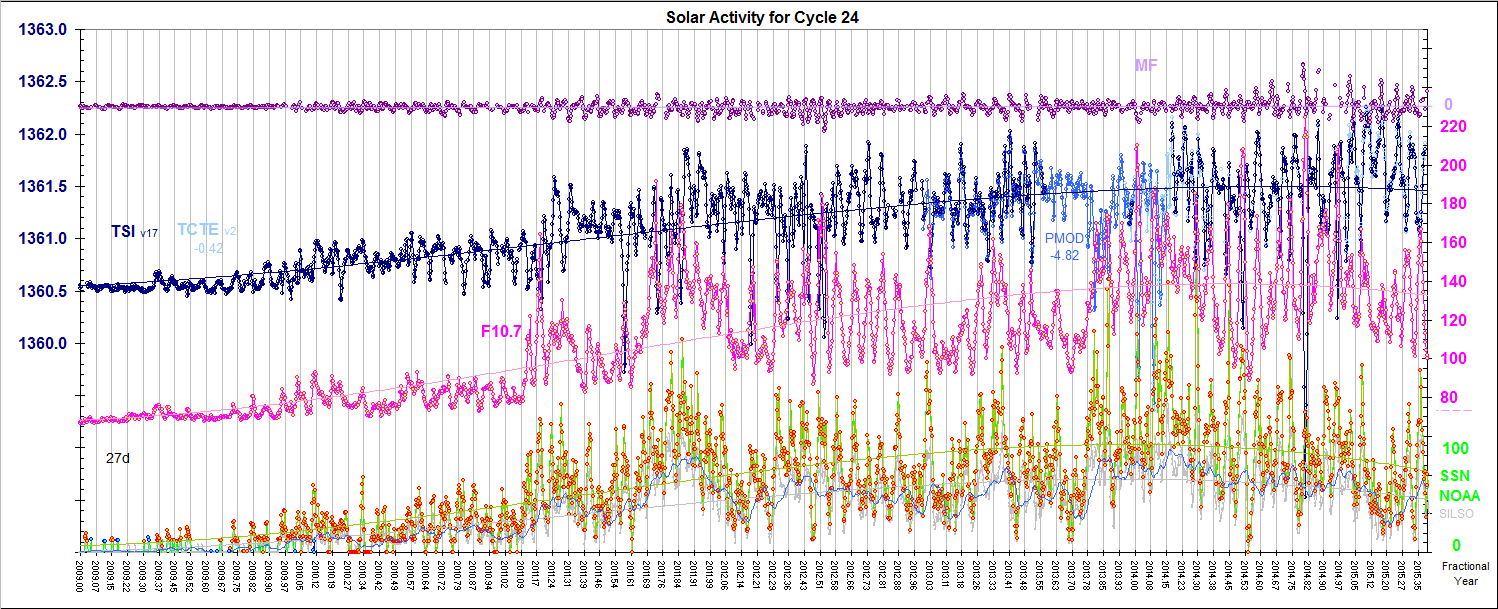
The NOAA Space Weather Prediction Center (SWPC) has released their latest charts on solar activity and the news is not encouraging for solar watchers. Today, the sun has but a couple of anemic “sunspecks”.

Last month I wrote about how May had not continued the advances seen in March and April. Now according the the latest SWPC graphs of the three major metrics of solar activity, June appears to have slipped even further.


I see NASA’s Hathaway making another adjustment to his forecast soon. He wrote on July 1st:
The current prediction for Sunspot Cycle 24 gives a smoothed sunspot number maximum of about 69 in June of 2013. We are currently over two and a half years into Cycle 24. Three consecutive months with average daily sunspot numbers above 40 has raised the predicted maximum above the 64.2 for the Cycle 14 maximum in 1907. The predicted size would make this the smallest sunspot cycle in over 100 years.
More near real-time information on the state of the sun is available on our WUWT solar reference page
UPDATE: My friend in Perth, David Archibald, sends along this information.
Solar Update July 2011
Now that the UK Met Office is half way to admitting that solar activity is the main driver in climate, it is appropriate to check up on how the Sun is going.

Two and a half years after solar minimum, the Ap Index remains below the minima of previous solar cycles.

Dr Svalgaard provides a useful daily update on the F 10.7 flux at http://www.leif.org/research/TSI-SORCE-2008-now.png What the above graph shows is the ramp up of Solar Cycle 24 F 10.7 flux relative to the previous five solar cycles, aligned on the month of minimum. The current cycle has a very flat trajectory.
 Similar to the Ap Index, the Interplanetary Magnetic Field is now up to the levels of previous solar minima.
This chart compares the development of Solar Cycle 24 with the last de Vries cycle event – the Dalton Minimum. The Solar Cycle 24 ramp up in terms of sunspot number is tracking much the same as that of Solar Cycle 5 but about a year ahead of it. All solar activity indications are for a Dalton Minimum repeat. There has been no development that precludes that outcome.

This graph shows the sum of the north and south polar magnetic fields on the Sun. It has yet to get down to the levels of previous maxima, and solar maximum may be still two to three years off.

David Archibald
July 2011
R. Gates says:
July 9, 2011 at 7:00 pm
=======
OK, i’m cherry-picking but you say:
“…I suggest you really get familiar with the complexity of global climate models. Sure they aren’t perfect….”
So, I’m too stupid to understand the complexities of the climate models, which are too stupid to model the climate.
Now what ?
Steven Mosher,
While you’re at the forcings, responses and gains, how do you explain the following:
Global temperature affects atmospheric CO2 (warming causes CO2 to rise and cooling to drop). What is it in the climate system that makes it stable, if CO2 has a warming effect? What are the limiting factors (negative feedbacks)? What shifts the climate from warming to cooling at the maximum CO2 forcing for that previous period of warming? What shifts the climate from cooling to warming at the minimum CO2 forcing for that previous period of cooling? Remember, this happens all the time (probably on all time scales) and it never fails.
The ap index is increasing.
DanDaly said:
“I’m not at all convinced that the Arctic is warmer and the ice there is less than frozen. Winds and currents appear to have moved the Arctic around a bit, but it still appears to be frozen.”
____
Ah, the old, “it’s all the wind and currents moving the ice around.” answer eh? If you really believe this, I mean really believe it, then you are beyond educating as there is plenty of evidence and massive data to completely refute this simple-minded explanation, but you would probably reject it all as you don’t want to consider them. There is no need for us to have any more dialog.
R Gates writes “what excuses will the AGW skeptics have if we don’t get their much talked about and anticipated new “LIttle Ice Age”, ”
Excuses? Frankly if AGW is correct and it keeps us out of another “Little Ice Age” then that will be reason enough to rejoice. The LIA lasted for quite a long time. Plenty of time for us to develop alternative energy sources and begin to pull CO2 from the atmosphere if deemed necessary.
R. Gates,
You seem to believe that we have reached a perfect understanding of the types of climate change that are produced by natural causes. You use this mistaken belief to then assume that all of the remaining excess warming we have observed must be due to human emitted CO2 and atmospheric feed backs.
You appear to an intelligent man who is open to reason so I will put forward the following argument. What if you are wrong and we really don’t have a perfect understanding of a rather complex climate system. All it takes is one mistake, one forcing factor that is overlooked or an underestimation of the long term effects of one driving mechanism in order for the AGW house-of-cards to come tumbling down.
As far as I can see, yoru faith in AGW is based on a premise that our “brightest” scientists have got it just right.
My skeptical beliefs are based on a track record that humans often get the science wrong and what they know about nature is more often than not dwarfed by what they don’t know.
And this statement regarding your perception of how you perceive climate scientists think::
““We do not know what is causing the warming, so it must be CO2.”
Display incredible ignorance on how this process works. Really.
————————————————————————————–
Go read the principle of exclusion again. They narrowed out every possible result that WE KNOW of and since CO2 is all that is left, assumed the rest of the warming is CO2. You see, if you knew what I was talking about there and had read about this logical fallacy which was features here on WUWT, you would realize that this mistake happened once before and it happens in science when you assume that we know everything there is to know about say the climate. That is just arrogant beyond extreme to assume like that and likewise: WRONG.
This is a cardinal mistake, and by defending it and futher insulting me for calling climate scientists to task on this is rather put: (Self-censored) –
What I can’t believe is how many parameters they assume are just correct in GCM’s. If Steven Mosher’s description is correct and I was mistaken, just wow. I thought it was common sense to fine-tune parameters based on actual data, not on laboratory physics that have nothing to do with real life. To explain it further, the climate is a chaotic system. This is a given. In a chaotic system, every variable has an effect on every other variable, so changing one variable at one point means you have to fine-tune every other variable over-time, otherwise the chaotic and correct GCM is then nothing more then a linear model approximation of that which you are modeling. In order to predict “tipping points” and other such points in a chaotic system, this absolutly requires changing variables, and not just cloud cover…
I thought the problem with hind-casting was simple incompetentence or bad modeling practices, boy if this is correct, it means the problem is more deep-seated and originates from a lack of understanding of even the fundamental facts of the climate and weather systems. Shame on them for even pretending to be experts…..and for pretending to be chaos scientists working on the frontier. If this is the case, GCM’s are not chaotic models, they are linear models and are no better then weather models…in fact I would say worse since they tell us they can predict the future.
However, I appreciate you explanation S. Mosher, and I give you props. I do think you might be somewhat mistaken on the interaction of variables or maybe factors in a chaotic system. Even if climate sensitivity is higher (which can not even be proven assuming a MWP) then we think, this just means that the variables are more dynamic so to speak. This means that it doesn’t take as large of changes obviously to change the basic premises we think are true..and as such it leads to large changes which in the end are unpredictable. This means we have no clue to what the actual effect of CO2 increasing has on our planet. ZILCH, no idea whatsoever. My guess, your guess, everyone’s guess is just the roll of the die..maybe somewhat educated or maybe not, but its still just a guess since the higher the sensitivity of the climate system, the more likely we can not even begin to model it correctly.
What can we do with what we know: we can predict something large might happen, but then again, another negative feedback could come up, swallow up that effect and leave us with no change too. We could also have a point where a positive feedback (increased CO2) results in temperatures driving downward due to tipping another variable (which we do not understand) and making us colder. This is just a likely as assuming CO2 has a certain forcing based on conditions in a greenhouse…and that this value is stagnant if not larger at all times. Its all a guess like I said…and I think you were making a similar point to me, but I still do not quite understand how they could model this in this method, it just does not make sense for a chaotic system……
To condense somewhat: Most feedbacks in a chaotic system tend to drive the system towards a new stability point. After a series of bad (read maybe extreme) events, the system evens out and a new equilibrium is reached. I know this is important because in the end even if sensitivity is increased, it just means we can not predict the future climate as well as we think we can.
Or maybe our assumptions are wrong in the input parameters and the said interactions. That is a serious problem with GCM’s, and I am sure I am not the first to talk about this, but since cloud cover is still not fixed as an issue, I still wonder why we still talk about GCM’s in any regard?
That small blunder alone sets them out as wrong, and I think real modeling would prove them wrong on just about every variable. At some point, yes they are probably correct given a temperature of 20.1322 C and Rel Hum = 34.213%, but as you vary from that the forcing will change in small steps.
I know this is long, but RGates, no insults. That gets you no where, and by the way, your link was worthless. It told me nothing of value about GCM’s.
If you have more relevant information on how they make GCM’s, feel free to share it, just don’t call me wrong and link me to some site that tells me nothing on how I am wrong.
I am from the State of Missouri, SHOW IT TO ME or stand down soldier. That is all.
RGates says:
Before making such an outrageously wrong statement, I suggest you really get familiar with the complexity of global climate models. Sure they aren’t perfect, but their ability to predict Arctic warming and decreased year-to-year sea ice is hardly a coincidence
———————————
So tell me, since they are so perfect on that score, why is it that they predict a warming arctic? Since you are the resident expert on GCM’s after calling me wrong, why not tell me why it is that GCM’s predict a warming arctic? (lets not even worry about year to year sea ice for now…but if you get part 1 correct, you can answer that as well.)
-Hint I read the literature on this score so to speak. So lets hear it. And remember, there is a reason they predict this. I have never refuted that they do not, but most of the GCM’s do indeed predict this.
I still can’t believe what Steven told me. I just assumed they would model in a logical fashion…that just boggled my mind and puts things into true perspective. I thought all the talks of hind-casting were just poking fun at the parametrization they were using or their incompetence (like we already knew that right?)
well, NASA seems to give credit to unusual wind patterns, re arctic ice – although quietly.
but then, R Gates simply won’t let current climate science get in the way of his bulldozer.
steptoe fan says:
July 9, 2011 at 10:48 pm
well, NASA seems to give credit to unusual wind patterns, re arctic ice – although quietly.
but then, R Gates simply won’t let current climate science get in the way of his bulldozer
_____
There is no doubt that the wind moves ice around the Arctic, and wind and current can cause the export of sea ice from the Arctic into the N. Atlantic, mainly through the Fram strait. But “unusual” wind patterns are in no way is the only or even main cause of the real multi-decadal decline in sea ice as we’ve seen warmer temps in the Arctic in both ocean and air. A thinning and fractured ice is far more easy to be pushed around by wind and currents than solid, thick multi-year ice. And two other things to consider:
1) Wind and currents are forms of energy. If CO2 is related to the energy balance of the earth, it would stand to reason we’d see changes in wind and currents in the region supposedly on the leading edge of global warming as CO2 increases. These changes may come about through warming of the ocean and changes in the thermohaline structure as well as changes in the atmospheric temperature gradient from the equator to the the pole which might alter wind patterns.
2) Wind and currents also do not explain the reduction in permafrost across the arctic and sub-arctic regions. I’ve not seen wind being able to blow underground to melt the permafrost nor ocean currents flow into the solid frozen earth and melt the permafrost! This goes back to my main point that higher temps in the region are involved in the reduction of sea ice.
BenfromMO says:
July 9, 2011 at 10:36 pm
RGates says:
Before making such an outrageously wrong statement, I suggest you really get familiar with the complexity of global climate models. Sure they aren’t perfect, but their ability to predict Arctic warming and decreased year-to-year sea ice is hardly a coincidence
———————————
So tell me, since they are so perfect on that score, why is it that they predict a warming arctic? Since you are the resident expert on GCM’s after calling me wrong, why not tell me why it is that GCM’s predict a warming arctic? (lets not even worry about year to year sea ice for now…but if you get part 1 correct, you can answer that as well.
______
I am not the resident expert on GCM’s, but thanks for that. I do understand them well enough though to know that their simulations are far from “dumb luck” when showing certain scenarios. They involve the extremely complicated formulas and some of the most complex models ever created– they are after all, modeling solar, ocean, ice, atmosphere, etc.interactions for an entire planet at increasingly higher and higher resolutions. The super-computers used for running the earth climate simulations (and I’ve seen some of them at NCAR in Boulder, CO) take up entire large rooms. Yes, it is a nice past-time for skeptics to bash these models and claim that the climate is all either a random walk or simply, “the sun did it all” but neither of these explanations has any scientific basis. To your question though, the reason that the Arctic is the area where global warming has been modeled to, and in fact is, warming first and most dramatically with increases in CO2 has to with many factors, including polar amplification, the nature of heating in the tropics versus the polar regions, the difference between the 2 mile thick land based ice at the south pole and the few meter thick sea ice at the north pole, etc. A rather nice, easy to understand summary of all these dynamics can be found here:
http://www.digitaluniverse.net/Arctic/articles/view/131804/?topic=8709
Ninderthana says:
July 9, 2011 at 10:21 pm
R. Gates,
You appear to an intelligent man who is open to reason so I will put forward the following argument. What if you are wrong and we really don’t have a perfect understanding of a rather complex climate system.
_______
Our knowledge of the climate system is far from perfect, and I’ve never said in was. In fact, global climate models are constantly being updated and evolving as our knowledge evolves as well. Yes, the climate is complex, but not so complex that we can’t grasp the basics dynamics of it. Do I think we have it exactly perfect? Hardly, otherwise, there’d be no need to research to be on-going. We in fact don’t even know what the majority of the universe is made of. This remarkable fact, related to dark matter and dark energy, and which most people don’t realize makes me a skeptic on many things. There is certainly lots to explore and lots we don’t know about, and hence the reason I love science so much.
But in terms of the basic dynamics of increases in CO2 at the levels we’ve seen over the past few hundred years and it’s relationship to global warming…yes, I think we’ve got most of this modeled pretty well. (at least the linear part, for we may never model the non-linear “tipping points” very well as these are chaotic by nature. Is there still more to learn about solar influences, cosmic rays, high energy UV’s, etc. Certainly, and when we do have these quantified in the same way we can quantify the effects of CO2, then they too will be part of the next generation of climate models.
R. Gates says:
July 9, 2011 at 1:49 pm
“…….I’m still a “skeptic”, but CO2 remains the best explanation for a large part of the warming……
Really don’t mean to “taunt” anyone, BTW.”
R. Gates says:
“July 9, 2011 at 9:31 pm
Ah, the old, “it’s all the wind and currents moving the ice around.” answer eh? If you really believe this, I mean really believe it, then you are beyond educating as there is plenty of evidence and massive data to completely refute this simple-minded explanation, but you would probably reject it all as you don’t want to consider them. There is no need for us to have any more dialog.”
Response – If you really believe, I mean really believe that your 9:31pm arrogant, derisive, dismissively taunting response does not conflict with your 1:49pm statement that you “really don’t mean to taunt anyone”, then you are fundamentally dishonest, as your direct duplicity demonstrates. You. deserve no further respect or tolerance. You are not “25% skeptic”. You are 100% TROLL. Your dismissive statement “There is no need for us to have any more dialog.” is self prophetic. Please stand by that statement. There is no need for anyone to have any more dialog with you.
The above CO2 experts have not demonstrated much knowledge how the real Earth works.
1. TSI output (in W/m2) is relatively constant and makes only tiny difference at the peak of a cycle which is reversed at the next minimum.
2. CO2 contribution is also minimal and its concentration follows the major temperature changes, rather than the other way around.
3. Temperature change is the function of the global oceanic heat content distribution, which is regulated by the ocean currents circulation.
4. It is essential to understand how, why and where the energy is transported and released around the globe; specifically the current warming of the Nordic seas and the Arctic is nothing to do with the current levels of CO2 or TSI; it is to do with energy absorbed in the equatorial regions decades and possibly centuries ago, and the currents’ strength and distribution in the North Atlantic is somewhat different to that of the 1960/70s.
I personally would not trust a doctor who knows nothing about functioning of my cardiovascular system.
low sun spot activity? that may explain why we are freezing out little fingers and toes off here down at the very bottom of Australia currently with snow down to 200M. But don’t worry it will warm up again soon because Julia has advised us the climate is changing!
@Mosh
I was gonna post a reply in response to your post earlier, but it was 1am here and I left it for the morning!
I see a couple of guys have pointed out the error of your simplistic analysis! But for the record, I’ll add my twopenneth…
Firstly – on the reasonable assumption that there was actually an MWP – at that time, major deforestation would hardly have been a problem and neither would have massive anthropogenic CO2 emissions! So, whatever caused the ‘warming’ is highly unlikely to have been CO2 based. I suppose you could argue that it’s possible that the ocean had a ‘hissy fit’ and gave up loads of its stored CO2 or something, if you are desperate to link the event to CO2, but in that case I would argue that how do you know the oceans aren’t doing that today?
Secondly, I don’t believe in the term ‘climate sensitivity’ being solely linked to CO2, which appears to be the general form of presentation, what about all the other ‘links’?. Climate sensitivity is due to the SUM of many many different effects, both positive and negative feedbacks and so on. Nobody knows what, how or why or when all these effects work together or counter each other and our current simple model is clearly inadequate! For a simple ‘proof’, I’ll ask for an explanation of why, allegedly, only 50% of mans current emissions are actually building up in the atmosphere? We don’t actually know, but it is assumed its because the earth is absorbing the other 50% (into so called ‘sinks’, oceans, biomass, etc). Great says I – that means that the MWP is even less likely to have been CO2 based. Because if there was warming but there was no obvious source of excessive CO2, and we know the earth is capable of absorbing a lot of CO2 (it was probably CO2 ‘hungry’, if you like, given all the forests that were around then!) – you cannot thus make a link of CO2 to climate sensitivity at THAT time and ergo, it must far more likely have been something else!
In my opinion, this is one of the prime arguments why the MWP is ‘required’ to be dismissed by the warmista – it kinda kills a ‘highly CO2 sensitive’ climate link, stone dead! As of course, does the 800 year time lag in ice cores, etc, etc.
I defy anyone to show that we know even all the primary climate variables, and then what drives them, the interaction of each of them and moreover, which of them is particularly more important in the overall ‘climate sensitivity’ picture. The whole CO2 issue seems to put CO2 at the top of the list of all the climate ‘drivers’ – but it is manifestly difficult to demonstrate and certainly highly unlikely to be at the very top of the list. Heck, even radiative physics shows that CO2 is only a timy part of the absorptive/reflective radiation spectrum, say compared to water vapour! But yet, water vapour doesn’t seem to be put at the top of the list, and is certainly not advertised by the warmistas as a primary driver!
Personally, I don’t think this scam was set up as a scam, and certainly not on the scale it has become – I think the politicos took it over as an easy way to obtain control and taxes from ordinary folk for their own political agendas. As for the Club of Rome type bulldust, my comment would be – if the governments who want to reduce/control popluation were to introduce a tax for having children, I would find that far more acceptable than taxing carbon/CO2 !!
(I’m not saying this would be acceptable to folk, just that it is more UNDERSTANDABLE and certainly more VERIFIABLE as a realistic ‘plan’ than a tax on CO2/energy!)
Just FYI, Willis Eschenbach has done a “black box” analysis of a couple climate models, e.g. here:
http://wattsupwiththat.com/2011/05/14/life-is-like-a-black-box-of-chocolates/
The discussion was quite lively.
If the Sun has something like a Global Climate, it is most definately disrupted.
Just have a quick look at the STEREO AHEAD & BEHIND. One side looks like half of Venus and the other side looks like it has Tiger stripes. It has all the uniformity of a paint ball that ricocheted twice.
From David Archibald’s Update, I’ve been struck by the similarity between Solar Cycles 22,23,24 and Cycles 3,4,5. It occurs to that if the sun was the main driver then the temperatures over the 2 periods should be pretty similar. I checked the last 15 years (1996-2010) of the CET record with the corresponding solar cycle period (1786-1800) in the late 18th/early 19th century. However there seems to be quite a difference.
Mean temp 1786-1800: 9.06 deg
Mean temp 1786-1800: 10.21 deg
The most recent 15 year period (covering SC23 and the start of SC24) is more than 1 deg C warmer than the last 15 years (covering SC4 and the start of SC5) of the 18th century. Remember this is comparing exactly like with like, so lags are not an issue. Also both periods follow strong solar cycles (i.e. SC3 and SC22 respectively).
Actually the mean temperature for the 15 year period following 1786-1800 (i.e. 1801-1815) was 8.97 so the deepening minimum didn’t have that much of an effect anyway. But the real “dagger to the heart” of the solar case is that the mean temperature for the 1771-1785 period (i.e. covering the strong SC3 cycle) is 9.12 deg C – hardly any different at all. It looks like Lockwood and posters such as Vukcevic may be right. Apart from, perhaps, increasing the likelihood of a cold winter, solar activity has very little influence on average temperature.
The 1781-1820 linear trend is a NON-significant -0.04 deg per decade
I’m pretty sure it’s a similar story if you check out other long term records such as Armagh and Uppsala. It’s not just a CET issue.
Lack of warming, no tropical hot spot, warm causes more snow, Met says sun is 50% to blame, and China stopped it all….
…..yep, the global climate models are constantly being upgraded…..
…and they haven’t gotten it right yet, all they have is lame excuses
CORRECTION
Re: John Finn says:
July 10, 2011 at 3:38 am
This
should say this
John Finn.
The average global temperature doesn’t change much because the system response is always negative for any forcing whether towards warming or cooling.
However, regional effects can be large whilst the negative system response is in progress.
So if the dominant source of changes in the global energy budget is solar variability altering the surface pressure distribution from above we will see more poleward jets for an active sun and more equatorward jets for a less active sun with large regional changes but small global changes.
The lack of a large global change in temperature is therefore not a dagger to the heart of the solar case.
Nor is there any problem by virtue of the slightly higher temperature of the system now as against the temperature of the system 200 years ago. That 200 years was part of a 500 year upswing with energy accumulating slowly in the oceans from a more active sun. If we had the data I think you would find that the jets now are more poleward than they were 200 years ago hence climate differences from the climate back then.
“But here’s the larger point: Global Climate models, while far from perfect, have accurately predicted some of the earliest effects of increased CO2, namely the decline of Arctic sea ice and general warming of the Arctic.”
I have a broken watch that tells the exact time twice a day. 700+ times a year it is correct. I have another watch that is working, but never in an entire year has it had the exact time.
The scientific method does not work by counting the number of times a hypothesis is correct. What counts are the failures – what AGW gets wrong. Climate Scientists know this. That is why they have worked so hard to hide their data and methods.
To declare that a climate change has occurred: Climate change comes from and only comes from a sustained weather pattern variation change great enough to change the extreme envelope of whatever climate is being studied, and can be proofed mechanistically and mathematically.
To declare that an anthropogenic climate change has occurred: Anthropogenic climate change comes from and only must come from a sustained weather pattern variation change great enough to negate or worsen natural forcing, is great enough to change the extreme envelop of whatever climate is being studied, and can be proofed mechanistically and mathemmatically. If a natural pattern exists that can explain the change, the null hypothesis must be kept, irregardless of the presence of any anthropogenic existence.
Neither the Sun nor CO2 changes have been shown to be the agent of climate change. First, climates have not changed. Changes in weather pattern variations have not been sustained. And proofs have not been developed.
RGates, so you have no clue on why the GCM’s predict a warming arctic along with a eroding arctic ice pack? This is at least an honest answer, and I do give you props on being honest.
But I can tell you why its the way it is. When you average out grids over 200KM (which is where most climate models are doing today.) You take a very high average that generally assumes “land” or “ocean” depending on a number of guesses. Of course, this is approrpriate in modeling, you can not get infinite accuracy. I did do a little more research on this problem but still can not get much farther then I am since most posts are aimed at scientifically and computer illiterate persons.
But to be clear, when you average out over any distance…and as time goes by this decreases and theoritically the models should get more accurate, but no matter how small you get, you have assumptions here that may or may not work for the Earth. In the case of GCM’s, they assume a certain albedo for arctic environments…and this is worthless…because the angle of the sun and the amount of solar actually absorbed at these extreme latitudes is not enough to make a difference in temperatures anyway…no matter what the albedo..so they miss the boat for the arctic. In addition, this changes a TON over small changes in latitude in the summer as day length can change over hours of time when you travel 200KM. There are tons of things like this that cause issues in GCM’s in arctic and antarctic environments. They just can not really do well in these environments due the vast differences in the grid cells. Smaller grid cells do not fix this problem, this problem is inherent in the GCM paradigm…that in which differences between blocks are assumed to be the same over the entire globe to a certain extent and they do not even get close to attempting to figure out if this is true or not. So albedo factors as I have noted are just a guess for the arctic, because in the end the averaging and the weather pattern forecasting/modeling which work for the most part on the rest of the globe run into the problem of “changes in latitude at the arctic result in larger differences between cells in the arctic.”
So why would they keep these false albedo and other approximations if they are generally that bad? The assumption I can tell you comes from a fudge factor. (not the famous fudge factor mind you, just another..I found 3 new ones last night just looking at various GCM’s that I would call fudge factors but they call them “inspired” in one case…what a laugh.)
But this fudge factor is based on 2 different trains of thought:
The basic premise of AGW is that the arctic warms fastest and temperate regions warm faster then tropics because the solar insolation and heat (energy) trapping effects of CO2 have basically no impact in the arctic especially. This means there is NO DIRECT EFFECT from CO2. This is not something that is argued. Somehow, the arctic has to originally heat. Where does this original heat come from?
In the theory of AGW, it comes from a hot troposphere hot spot which via hadley/ferral cells moves warm air north. The solar insolation is so vastly superior in tropical and temperate zones that the heat can therefore move north at much larger volumes then the pitiful changes in albedo seen at the poles.
But they can not approximate a large transfer of heat in this fashion easilly with GCM’s, so instead of approximating this (which would make the GCM’s vastly more complicated, and which would not match reality today) they fudge this and simply keep the incorrect albedo readings to an extent and keep the generalized average albedo reading for the rest of the globe which result in arctic values which are just plainly: wrong. So yes, its a simple coincidence that these models match reality at all in the arctic. The fudge factors there would make the arctic warm up no matter what world temperatures did, and this is the key you should be looking for above all else. Without an enhanced arctic warming and sea-ice melting, these models are impossibly incorrect and this fudge factor pops up like the monster it is. This is why so many warmists are so strongly jumping up and down about the arctic. If sea ice started going up and the arctic cooled down “Beyond a reasonable doubt” this throws the monkey into their models and they are proven wrong that way. As I said, their fudge factors assume a warming arctic just about no matter what..and if the arctic is not warming, its COOLING by a ton. Just watch as we start to cool naturally and sea ice picks up…it oughta be fun right?
Can I say that I know the answer to these grids in the arctic which are so vastly different then any other grid that represents the planet? No, and I doubt anyone has a simple model with the GCM paradigm. I would submit that GCM’s will never work for modelling the Earth correctly….and this is largely due to the arctic where you would have to use either smaller grids or different metrics of cell interaction. Becomes very complicated very quickly beyond anything we can imagine…
So in essence, roughly 8% of the globe in arctic (antarctic) environments skews the general models…and this 8% is enough to throw this entire region into question, and when talking about such topics as sea ice and temperatures, I don’t think anyone who takes these predictions to the bank really understands how models work and how the basic curvature of the Earth results in such huge problems for modeling the arctic globally. The simple explanation: Its the curvature and low angles of the sun…….that result in huge differences and problems in modeling the grids in the arctic anyway similar to the rest of the globe.
They might get most physics and reactions on this planet right. I don’t know anyone who has found blatant mistakes yet in GCM’s, but they are riddled with fudge factors, incorrect physics (especially in clouds which they have changed around every year for the last 7 years)…and other factors its a shame to be honest. That anyone takes their results for granted and says they match reality when our elementary method of measuring sea ice (maximum extent at the minimum..seriously thats a good metric?) I tried to explain earlier how small mistakes in the physics can lead to huge erroneous results further down the pipeline, but I was called names for pointing that out….
Arctic temperatures (lets just make the same mistake with the measured data that we did with our models (Dr. Hansen) and use cells in our temperature adjustments so that we make the same mistake with the same methodology in measuring arctic temperatures…GISS) And then what happens in GCM’s if sea ice starts an inevitable upward track?
In that case, the GCM’s start showing enhanced arctic cooling like I mentioned earlier…so basically these models are so sensitive (hyper or too sensitive if you ask me) that they are basically worthless and just guessing.
How much is the arctic warming? Well if you measure it with the same technique you used to model it, I am sure both methods will prove to be correct.
But does that match reality? That is the goal of every model on the planet to match reality. Well we shall see I guess. I give the GCM’s .000001% chance of being right. And that chance I base on the God of Dumb luck, so yes R Gates, I do believe these models are nothing but wastes of space and that they come up with arctic warming and sea ice going downwards due to fudge factors that they never decided to fix correctly. So its dumb luck that it matches reality even close to today despite a couple facts which you really need to consider:
GCM’s never predicted the last 15 years almost not showing very little or no warming. Has the arctic been warming during this time period? Well who knows?
But in essence the questions that should be asked when showing lower sea ice is this: (not the ones that have been asked I remind you by warmists..)
Have temperatures correlated with lower sea ice? Is there lag time between minimum sea ice at minimum and temperature?
Is weather an influence on the yearly minimum?
Is this metric even worth showing?