There’s a saying, “timing is everything”. After reading this, I think it is more true than ever. In other news. Paul Vaughn is giving Bob Tisdale serious competition in the contest over who can fit the most graphs into a single blog post. ☺ There is a helpful glossary of symbols and abbreviation at the end of this post that readers would benefit from reading before the essay. A PDF version is also available via link at the end of the article. – Anthony
Guest post by Paul L. Vaughan, M.Sc.
Lack of widespread awareness of the spatiotemporal nature of interannual terrestrial oscillations is perhaps the most paralyzing bottleneck in the climate discussion.
North Pacific Pivot
Elegant factor analyses by Trenberth, Stepaniak, & Smith (2005) concisely chart the limits of linear climate exploration, providing strong clues that the North Pacific is a globally pivotal intersection.

D – T = -SOI (an index of El Nino / La Nina – details below in “Data & Symbols” section)
WUWT readers are well-acquainted with Tsonis, Swanson, & Kravtsov (2007). Recently Wyatt, Kravtsov, & Tsonis (2011b) shared the following on Dr. Pielke Senior’s blog:
“PNA participates in all synchronizations.”
Orientation for ENSO- & PDO-centric readers:

Complex Correlation
Simple linear correlation can do a part-way decent job of summarizing the preceding intrabasin relations, but properties of interbasin & interhemispheric multiscale spatiotemporal relations clarify the need for complex summaries. For example:

Limitations of linear methods are emphasized by Maraun & Kurths (2005). A mainstream audience might not appreciate their beautifully concise section 3 primer, but there’s a simple way to look at interannual spatiotemporal phasing.

The ~2.37 year signal which is so prominent in the equatorial stratosphere is also easily detected in the troposphere, but there’s clearly “something else” contributing to interannual tropospheric variation.

Note that when iNPI’ doesn’t “go with” iAAM & iLOD, it “goes against” them, much like a switch that is either “off” or “on”. Specialists like Maraun & Kurths might speak of coherence and illustrate the nonrandom distribution of phase differences.
Multiscale complex correlation (for example using adjacent derivative based complex empirical wavelet embeddings) can measure complex nonstationary relations where simple linear correlation fails catastrophically. Naive investigators unknowingly encounter Simpson’s Paradox by falsely assuming independence and blindly running linear factor analyses (such as PCA, EOF, & SSA) without performing the right diagnostics.
Northern Hemisphere Inter-Basin Interannual Coherence
Nonrandom phase relations explored by Schwing, Jiang, & Mendelssohn (2003):


Interannual Solar-Terrestrial Phase-Relations
Terrestrial phase relations with interannual [not to be confused with decadal] rates of change of solar variables, including solar wind speed (iV’), are nonrandom:


Inter-Hemispheric Interannual Phase-Relations
For those wondering how AAO & SAM fit in:


Global Synchronicity
Synchronicity’s the norm. Orientation, configuration, amplitude, & extent of globally constrained & coupled jets & gyres are pressured while network monitoring remains stationary. Regional temporal phase summaries are intermittently flipped by the stationary spatial geometry of monitoring networks in the turbulent global context.

Note particularly (in the last 2 graphs) the strong & stable interannual synchronicity of northern annular, southern annular, & global modes for the decade beginning ~1988. The commencement of the pattern coincides with concurrent abrupt changes in Arctic ice flow (e.g. Rigor & Wallace (2004) Figure 3) and European temperature (e.g. Courtillot (2010)).
Local Connection
Here’s how NPI relates to minimum temperatures at my local weather station:


Concluding Speculation
Terrestrial geostrophic balance is affected by the concert of changes in:
a) interannual (not to be confused with decadal) solar variations.
b) decadal amplitude of semi-annual Earth rotation variations – [see Vaughan (2011) & links therein].
c) solar cycle length – [see links in Vaughan (2011)].
Nipping Potential Misunderstandings in the Bud
“So you’re claiming the North Pacific controls global climate?”
No.
Why do I hear the same places mentioned every rush hour on the traffic report? Bottlenecks are easy places to detect changes in pressure & flow (whether global &/or locally intersecting), even using the simplest methods. Methods such as those suggested by Schwing, Jiang, & Mendelssohn (2003); Maraun & Kurths (2005); and Tsonis, Swanson, & Kravtsov (2007) help expand our vision towards the rest of the network. We have a lot of work to do (both exploratory & methodological).
Further Reading
Everything written by Tomas Milanovic at Dr. Judith Curry’s blog Climate Etc.
Vaughan, P.L. (2011). Solar, terrestrial, & lunisolar components of rate of change of length of day.
Referenced Above
Courtillot, V. (Dec. 2010). YouTube Video (~30min): Berlin Conference Presentation.
http://www.youtube.com/watch?v=IG_7zK8ODGA
Maraun, D.; & Kurths, J. (2005). Epochs of phase coherence between El Nino-Southern Oscillation and Indian monsoon. Geophysical Research Letters 32, L15709. doi10.1029-2005GL023225.
http://www.cru.uea.ac.uk/~douglas/papers/maraun05a.pdf
Rigor, I.; & Wallace, J.M. (2004). Variations in the age of Arctic sea-ice and summer sea-ice extent. Geophysical Research Letters 31. doi: 10.1029/2004GL019492.
http://iabp.apl.washington.edu/research_seaiceageextent.html
Schwing, F.B.; Jiang, J.; & Mendelssohn, R. (2003). Coherency of multi-scale abrupt changes between the NAO, NPI, and PDO. Geophysical Research Letters 30(7), 1406. doi:10.1029/2002GL016535.
Trenberth, K.E.; Stepaniak, D.P.; & Smith, L. (2005). Interannual variability of patterns of atmospheric mass distribution. Journal of Climate 18, 2812-2825.
http://www.cgd.ucar.edu/cas/Trenberth/trenberth.papers/massEteleconnJC.pdf
Tsonis, A.A.; Swanson, K.; & Kravtsov, S. (2007). A new dynamical mechanism for major climate shifts. Geophysical Research Letters 34, L13705.
http://www.nosams.whoi.edu/PDFs/papers/tsonis-grl_newtheoryforclimateshifts.pdf
Wyatt, M.G.; Kravtsov, S.; & Tsonis, A.A. (2011). Atlantic Multidecadal Oscillation and Northern Hemisphere’s climate variability. Climate Dynamics. doi: 10.1007/s00382-011-1071-8.
Since (to my knowledge) there’s not yet a free version, see the conference poster and the guest post at Dr. R.A. Pielke Senior’s blog for the general idea:
a) Wyatt, M.G.; Kravtsov, S.; & Tsonis, A.A. (2011a). Poster: Atlantic Multidecadal Oscillation and Northern Hemisphere’s climate variability.
https://pantherfile.uwm.edu/kravtsov/www/downloads/WKT_poster.pdf
b) Wyatt, M.G.; Kravtsov, S.; & Tsonis, A.A. (2011b). Blog: Atlantic Multidecadal Oscillation and Northern Hemisphere’s climate variability.
Important Note: While Wyatt, Kravtsov, & Tsonis (2011) are likely to stimulate a lot more discussion once a free version of their paper becomes available, it needs to be pointed out assertively & clearly that the cross-correlation approach, while informative, is patently insufficient for determining the full nature of terrestrial spatiotemporal phase relations.
Appendices
In the appendices that follow, attention is concisely drawn to key items that are consistently underappreciated in climate discussions.
Appendix A: Spatial Influence on Phase – Important
Nonrandom phase relations demand careful focus on the spatial dimension. Temporal evolution isn’t the only thing driving apparent phase.
If features grow, shrink, rotate, change shape, reflect, or move relative to the stationary windows in which they are measured, phase is affected.


The effect on summaries is plain & simple. (Anyone previously puzzled by “integration across spatiotemporal harmonics” might now get the general idea.)
Appendix B: Reversals in Temperature-Precipitation Relations
Blink between winter & summer panels of Figure 6:
Trenberth, K.E. (2011). Changes in precipitation with climate change. Climate Research 47, 123-138. doi: 10.3354/cr00953.
http://www.int-res.com/articles/cr_oa/c047p123.pdf
Temperature-precipitation relations are a function of absolutes, not anomalies. This is fundamentally important.
Insight from my local (ABC) example:


Appendix C: Global Distribution of Continental-Maritime Contrast
High-amplitude regional variance leverages global summaries, but multidecadal variations often draw misguidedly narrowed focus to the North Atlantic Ocean when it is the global distribution of continental-maritime contrast (in relation to flow patterns) that should be attracting the attention. Noting the position of the relatively small North Atlantic in this broader context, carefully compare:
1. http://icecap.us/images/uploads/AMOTEMPS.jpg
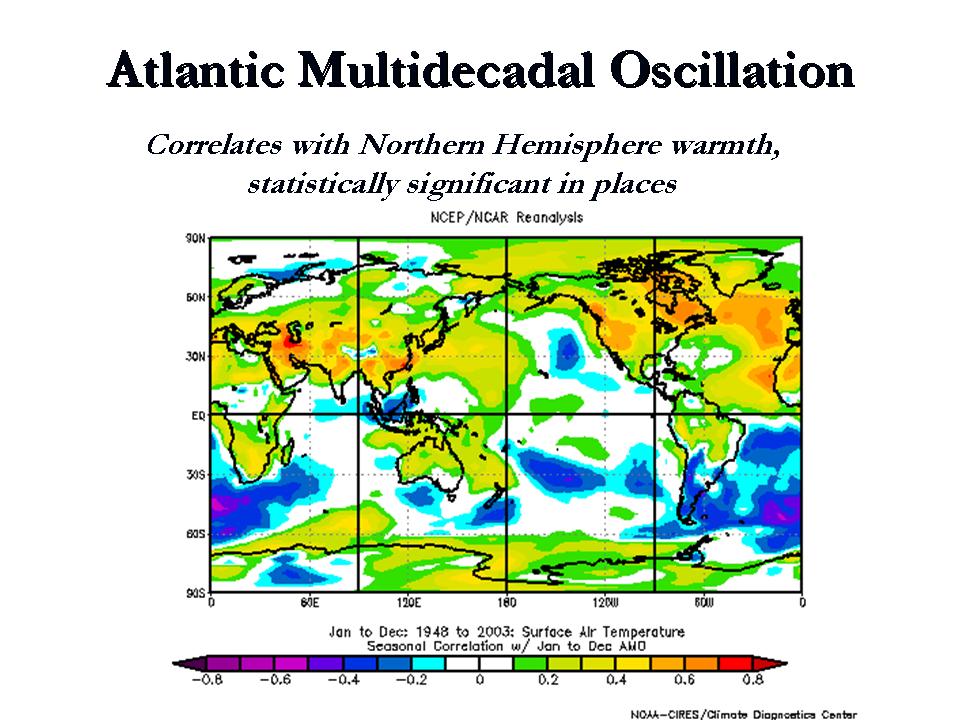
2. Figure 10 here:
Carvalho, L.M.V.; Tsonis, A.A.; Jones, C.; Rocha, H.R.; & Polito, P.S. (2007). Anti-persistence in the global temperature anomaly field. Nonlinear Processes in Geophysics 14, 723-733.
http://www.icess.ucsb.edu/gem/papers/npg-14-723-2007.pdf
Data & Symbols
‘ indicates rate of change
[ ] indicates time-integration
AAM = Atmospheric Angular Momentum
AAO = AntArctic Oscillation
ABC = Agassiz, British Columbia (west coast of Canada near USA border)
AO = Arctic Oscillation
COWL = Cold Ocean, Warm Land index
D-T = -SOI = – Southern Oscillation Index = pressure difference between Darwin & Tahiti (an indicator of El Nino / La Nina cycling)
ENSO = El Nino / Southern Oscillation
i = interannual
LOD = Length Of Day
NAO = North Atlantic Oscillation
NPI = North Pacific Index
PDO = Pacific Decadal Oscillation
PNA = Pacific North America index
PPT = PreciPiTation
QBO = QuasiBiennial Oscillation
SAM = Southern Annular Mode
SOI = Southern Oscillation Index
T = Temperature (°C)
V = solar wind speed
x = extreme
Data links available upon request.
Acknowledgements
Sincere thanks to Anthony Watts, the WUWT Moderation Team, readers, and all those who make valuable contributions towards a deeper understanding of nature.
==========================================================
PDF Version of this essay available here Vaughan, P.L. (2011). Interannual Terrestrial Oscillations (375KB)
Paul Vaughan says:
May 17, 2011 at 7:30 am
Multiscale complex correlation has not been presented in this article, but it has been measured by 2 different methods.
so what is it?
the dependence of your V reconstruction on space and the skewed distribution of your proxy.
Makes no sense [on space] and the distribution is just the way Mother Nature is.
“A statistician concludes that bigger feet helps the child to learn to read.”
Here you’re just having fun playing to the audience.
no, showing that correlation is not causation.
paraphrasing you:
“In your example it would be technically correct to note a relationship between solar wind changes and climate changes” [if indeed the significance is there which it isn’t]
I explained the filtering above (in response to a question from Erl). I can add that the normalization is based on the maximum absolute deviation.
be more specific. I don’t see any explanation. I had precise questions. Provide precise answers, please.
I am staggered by your statement that one can distinguish whether a signal is random or not by a single record, which you imply from this analysis. I have found this entire thesis unconvincing because it does not appear to convey any new ideas (i.e.: phase aggregation in non-linear systems) and it is completely non-rigorous.
A single observation of a time series does not permit one to make judgements about the distribution of ensemble statistics without very specific restraints.
I suggest that you learn some some proper signal processing before you attempt to take this further (Bendat & Piersol, Papoulis).
Paul Vaughan May 17, 2011 at 7:30 am
“Multiscale complex correlation has not been presented in this article, but it has been measured by 2 different methods.”
Leif Svalgaard May 17, 2011 at 2:51 pm
“so what is it?”
“It” is several multidimensional arrays.
Paul Vaughan says:
May 17, 2011 at 9:50 pm
“It” is several multidimensional arrays.
I was asking what the quantification of the correlation was and you give a non-responsive, meaningless reply.
sky wrote (May 17, 2011 at 10:15 am):
“There is nothing in the analytic concept of complex-valued covariance that would produce a spurious signal from pure noise as an artifact, as suggested here in irrelevant comments by Spencer and Saumarez.”
The myth is pathologically widespread, including in academia. Thanks for weighing in with good sense sky.
sky speculated May 17, 2011 at 10:15 am
“Vaughan appears to have worked here entirely in the time domain, rather than the frequency domain.”
No. What’s above is just a minimalist informal laymen’s sketch.
sky wrote May 17, 2011 at 10:47 am
“That said, I’m rather mystified why you don’t use ordinary cross-spectrum analysis. There are no serious nonstationarities evident at the high-frequency end that seems to be the focus of your interests, which are just the opposite of mine frequency-wise. Isn’t it cross-spectral coherence that you’re looking for spatially?
[…] your laboratory-notebook jottings do not constitute a publishable presentation.”
Publishing formally is absolutely not on my current list of aspirations, but informal discussion of climate patterns is worthwhile. There is temporal nonstationarity in some of the series explored (not all appear above) and part (not all) of it is spatially induced. I have conducted multivariate coherence tests and developed alternative methodologies. Proper elaboration would demand far more time than I can spare at present.
sky wrote May 17, 2011 at 10:15 am
“Exploratory analysis of field measurements has a hallowed place in science by providing fodder for explanatory theories. Rather than carping about the fact he doesn’t produce one, it is up to us with training in physics and aspirations of explaining the workings of the climate system to do so.”
Well said. I also appreciated seeing Erl Happ make similar comments above. Plenty of work to share around on these fascinating puzzles. Thanks for contributing positively.
Leif Svalgaard on his V reconstruction – May 17, 2011 at 2:51 pm
“Makes no sense [on space]”
Would the measurements be the same no matter where the stations were located?
Leif Svalgaard May 17, 2011 at 9:58 pm
“I was asking what the quantification of the correlation was and you give a non-responsive, meaningless reply.”
Some misunderstanding here. It’s not a single number, but rather several arrays of numbers.
Leif, as explained to Erl: Contrast years with immediately-adjacent years.
Paul Vaughan says:
May 17, 2011 at 10:47 pm
“Makes no sense [on space]“
Would the measurements be the same no matter where the stations were located?
The solar wind reconstruction is based on geomagnetic activity which is a global phenomenon calibrated with spacecraft data taken just in front of the Earth [seen from the Sun]. There is no ‘spatial’ aspect to this, and your ‘analysis’ does not include any spatial considerations.
Paul Vaughan says:
May 17, 2011 at 10:53 pm
Some misunderstanding here. It’s not a single number, but rather several arrays of numbers.
Statistical significance of a finding is nor several arrays of numbers. In any event you don’t give any numbers.
Paul Vaughan says:
May 17, 2011 at 10:54 pm
Leif, as explained to Erl: Contrast years with immediately-adjacent years.
I asked how the data was filtered and processed and what spatiotemperal procedure was used. You are ducking everything by not being specific. What does ‘contrast’ mean? Is that a standard statistical concept?
Leif, surely you’re not trying to suggest spacecraft were taking the measurements in 1902.
Paul Vaughan says:
May 17, 2011 at 11:33 pm
Leif, surely you’re not trying to suggest spacecraft were taking the measurements in 1902.
The response of the Earth to solar wind speed is calibrated comparing the response 1963-2011 with spacecraft data.
Leif, a contrast is simply a difference. The contrast of b & c is b minus c.
1. Do you have a plot of the residuals from your V reconstruction?
2. Have you run careful diagnostics?
3. Are you suggesting that the reconstruction is not a function of the location of the antipodal stations measuring aa index?
Paul Vaughan says:
May 18, 2011 at 6:42 am
Leif, a contrast is simply a difference. The contrast of b & c is b minus c.
If so, then simply say it, but you are ducking the question, because what you plotted is plainly not just the difference.
1. Do you have a plot of the residuals from your V reconstruction?
Compare observed and reconstructed: http://www.leif.org/research/Solar-Wind-Speed-1965-2011.png
2. Have you run careful diagnostics?
The only one that counts is how well the reconstruction matches observations [see above]
3. Are you suggesting that the reconstruction is not a function of the location of the antipodal stations measuring aa index?
The aa-index is not used for this. But even if it was, the location would not be important: example: assume the response at station A is twice that of station B: resp(A) = 2 resp(B). Solar wind speed is calibrated against A: V(A) = kA resp(A) and against B: V(B) = kB resp(b). You’ll find that kA is 1/2 kB, because V(A) = V(B). Here is how the speed is reconstructed: http://www.leif.org/research/2007JA012437.pdf
See e.g. Figure 19.
The point is that the solar wind speed measured just in front of the Earth [which is that the Earth reacts to] is a point measurement and has no spatial attributes. You simply get a time series.
Leif Svalgaard wrote (May 18, 2011 at 7:32 am) “[…] what you plotted is plainly not just the difference.”
You’re not reading carefully. There are 2 immediately-adjacent years (the one before & the one after).
Leif Svalgaard wrote (May 18, 2011 at 7:32 am):
“The only one that counts is how well the reconstruction matches observations […]”
There are diagnostics that need to be done on residuals. Do you have a plot of the residuals? What diagnostics have you done?
Leif, there are a few misunderstandings at play here.
First of all, I believe you’re assuming that I imagine iV’ to have variability of a similar spatial form to that of the terrestrial indices. Secondly, you seem reluctant to put clear & direct focus on the fact that early measurements weren’t taken from space. I accept responsibility for saying “aa” where I should have referred to IDV & IHV, but the point is that whether we’re talking about aa, IDV, IHV, or whatever, the early measurements were not taken in space. Also, you’re not being explicit that V does have spatial variability, even if you don’t believe it affects Earth (because it’s somewhere else allegedly having no affect on anything else reaching Earth).
Regardless of whether iV’ has spatial variability that affects Earth, there’s structured temporal coherence with terrestrial oscillations. You’re not suggesting that Earth’s spatial variability can’t respond to temporally-varying spatially-uniform external changes are you?
In the past you’ve [at times] been helpful in sorting out physical possibilities. I suggest that you not be so quick to make false assumptions about what you *think people are pushing or claiming. I’m interested only in the truth. If there’s “coincidental” coherence, I can’t accept that as “coincidental” until I fully understand exactly how & why, via separate causation chains, the 2 phenomena appear synchronized. If you &/or others can’t explain sufficiently, the sensible option is to delay judgement and present interim intuition as speculation.
Paul Vaughan says:
May 18, 2011 at 7:43 pm
You’re not reading carefully. There are 2 immediately-adjacent years (the one before & the one after).
One cannot read your utterings carefully [they fall apart then]. What you plot is not what you say. So, again: what PRECISELY are you plotting? And where did you get the data from? My published yearly V-values from Table 4 of http://www.leif.org/research/2007JA012437.pdf do not match what you plot:
http://www.leif.org/research/iV-prime.png
Paul Vaughan says:
May 18, 2011 at 7:51 pm
There are diagnostics that need to be done on residuals. Do you have a plot of the residuals? What diagnostics have you done?
You may safely assume that I always do a satisfactory job on this. Here is a plot of the residuals normalized to the observed values [from a physical point of view we expect the residuals to scale with the value (i.e. relative error to be about the same)]:
http://www.leif.org/research/Solar-Wind-Speed-1965-2011-Residuals.png
The insert is a histogram of the deviations from zero. There are two areas [marked by ovals] where the residuals are too positive [leading to the slight asymmetry of the histogram]. These represent systematic errors that are known. We left the errors in, because it is not clear how to remove them. See paragraph 38 of http://www.leif.org/research/2007JA012437.pdf for discussion of this.
No further diagnostics are needed as any further errors or discrepancies are systematic errors that one just has to live with. The proof of the pudding is simply how well we reproduce the observed values.
Paul Vaughan says:
May 18, 2011 at 8:55 pm
Leif, there are a few misunderstandings at play here.
It is a bit sad that you in almost any comment lament that there are misunderstandings. Misunderstandings can be avoided by being precise [which is not hard – for most people].
First of all, I believe you’re assuming that I imagine iV’ to have variability of a similar spatial form to that of the terrestrial indices.
‘spatial form’ is IMHO just nonsense [but since you have specified what that means, perhaps I should ask (again) what ‘spatial’ aspects you mean].
Secondly, you seem reluctant to put clear & direct focus on the fact that early measurements weren’t taken from space.
The correct way of comparing datasets is to use data from the same source. Splicing space data and inferred data together is a sin [Mann’s Nature trick] if you do not mark them as different. In http://www.leif.org/research/iV-prime.png I, of course do not the space data at all.
Also, you’re not being explicit that V does have spatial variability, even if you don’t believe it affects Earth (because it’s somewhere else allegedly having no affect on anything else reaching Earth).
What V does on the backside of the Sun is of no interest, and in any case, nowhere in your ‘analysis’ do you use of refer to specific spatial variability, so ‘spatial’ is inappropriate.
Regardless of whether iV’ has spatial variability that affects Earth, there’s structured temporal coherence with terrestrial oscillations.
No, sometimes they are in phase and sometimes they are out of phase as any two random datasets will be.
You’re not suggesting that Earth’s spatial variability can’t respond to temporally-varying spatially-uniform external changes are you?
That statement makes no sense at all. Perhaps you simply mean that the effects might be different in different places of the Earth. Sometimes it has this effect, sometimes that effect, sometimes no effect.
I asked you to consider the possibility that the solar wind observed at Earth depends on the time of year [which would then be a confounding factor], but you ducked that one.
In the past you’ve [at times] been helpful in sorting out physical possibilities. I suggest that you not be so quick to make false assumptions about what you *think people are pushing or claiming. I’m interested only in the truth. If there’s “coincidental” coherence, I can’t accept that as “coincidental” until I fully understand exactly how & why, via separate causation chains, the 2 phenomena appear synchronized. If you &/or others can’t explain sufficiently, the sensible option is to delay judgement and present interim intuition as speculation.
Paul Vaughan says:
May 18, 2011 at 8:55 pm
Also, you’re not being explicit that V does have spatial variability, even if you don’t believe it affects Earth (because it’s somewhere else allegedly having no affect on anything else reaching Earth).
The values of V that I give are measured at the Earth, and by the Earth, so no spatial variability somewhere else enters the picture.
In the past you’ve [at times] been helpful in sorting out physical possibilities. I suggest that you not be so quick to make false assumptions about what you *think people are pushing or claiming. I’m interested only in the truth. If there’s “coincidental” coherence
Making a claim removes the ‘false assumption’ bit. ‘The Truth’? Everybody is pushing their truth. The argument is perhaps that you falsely [to use one of your favorite words] claim there is coherence over and above what we would expect by chance or by confounding with a lurking variable. There are standard statistical methods to measure significance of coherence. Use them.
Leif Svalgaard wrote (May 18, 2011 at 10:43 pm):
“There are standard statistical methods to measure significance of coherence. Use them.”
The whole point is that the assumptions underpinning standard statistical inference are untenable given the nature of the variability & relations. Methods that are suitable for the actual nature of the data need to be developed before more meaningful inference can be conducted.
Leif Svalgaard wrote (May 18, 2011 at 10:31 pm)
“[…] sometimes they are in phase and sometimes they are out of phase as any two random datasets will be.”
We’re not dealing with “random datasets”. See sky’s comments above. The temporal evolution of the coherence indicates nonrandom structure, suggesting that a more physical decomposition is needed to conduct meaningful statistical inference. I get the clear impression that you are lax about performing diagnostics to assess “standard” statistical model assumptions.
Leif Svalgaard wrote (May 18, 2011 at 10:31 pm)
“I asked you to consider the possibility that the solar wind observed at Earth depends on the time of year [which would then be a confounding factor], but you ducked that one.”
On the contrary, I commented directly & clearly; perhaps you overlooked the comment.
As you well know from your experience with the V reconstruction 22 year residuals pattern, the structure of the time series makes sensible decomposition tricky, but a better decomposition is needed to get past untenable statistical model assumptions and towards meaningful p-values & confidence intervals. There is no shame in admitting this Leif; quite the contrary.
I imagine you might find Piers Corbyn’s recent comments entertaining:
http://wattsupwiththat.com/2011/05/17/new-study-links-cosmic-rays-to-aerosolscloud-formation-via-solar-magnetic-activity-modulation/#comment-663406
The temporal structure I find in the coherence suggests to me that a decomposition method conditioned on solar cycle (& perhaps also Hale cycle) phase is needed. As it is, the pattern I get is nearly cyclostationary (not to be confused with stationary). V is a very interesting time series.
Paul Vaughan says:
May 19, 2011 at 7:30 am
The whole point is that the assumptions underpinning standard statistical inference are untenable given the nature of the variability & relations. Methods that are suitable for the actual nature of the data need to be developed before more meaningful inference can be conducted.
Yet you declare significance already.
I get the clear impression that you are lax about performing diagnostics to assess “standard” statistical model assumptions.
The reconstruction of V is not a ‘statistical inference’. We know the physics and the cause and effect chain: http://www.leif.org/research/Physics-based%20Long-term%20Geomagnetic%20Indices.pdf . What other diagnostic would you suggest?
“I asked you to consider the possibility that the solar wind observed at Earth depends on the time of year [which would then be a confounding factor], but you ducked that one.”
You are still ducking this one.
get past untenable statistical model assumptions and towards meaningful p-values & confidence intervals.
The reconstruction is not a statistical inference, but a direct measurement using the Earth as the instrument through a well-understood physical cause-effect.
I imagine you might find Piers Corbyn’s recent comments entertaining
No, silly.
The temporal structure I find in the coherence
You have not demonstrated [nor quantified it] any coherence.
V is a very interesting time series
You are not responding to any of my questions as to the provenance and treatment of V. I showed you that you are not plotting my V.
It’s comical that people have a tendency to suspect some nefariously-motivated, complicated filtering method.
No matter how many times I have to explain it, it won’t get any more complicated:
“i” is a SIMPLE contrast of years with immediately-adjacent years.
That’s it.
Leif posted:
http://www.leif.org/research/iV-prime.png
Looks like you’ve finally got it.
You appear to have used a slightly different smoothing strategy on iV’ (perhaps one not based on the dominant temporal modes in the series?…), but I’ve literally no time to squander splitting hairs — let’s instead simply review sky’s comment that trumps the need for time-squandering hair-splitting:
sky wrote (May 17, 2011 at 10:15 am):
“There is nothing in the analytic concept of complex-valued covariance that would produce a spurious signal from pure noise as an artifact, as suggested here in irrelevant comments by Spencer and Saumarez.”
FYI:
I use RAW data in analyses.
What is posted above is not an analysis, but rather a collection of graphs designed to help instigate a review of serious fundamental WUWT audience misconceptions about the nature of interannual terrestrial oscillations. (Like rubbing a kitten’s nose in its piddle or putting a cat in a bath to promote a cleanly home, one expects to get scratched.)
Even leaving aside the whole iV’ thing & the associated exchange on untenable statistical model assumptions that has Leif bristling, we see from his FIRST paragraph in his FIRST post upthread (the 2nd comment in the thread) that Leif agrees FULLY with the thrust about the relations existing among ALL of the other variables:
Leif Svalgaard wrote (May 15, 2011 at 5:41 pm):
“That all the terrestrial relations are correlated in complicated ways simply show that they are not independent, which we would not expect in the first place. Heaping more of these on top of what is already there will make no difference at all because the inter-dependencies are still there.”
Mission accomplished.
Having to post this article was like having to take out the trash. Just something unpleasant that had to be done.
Best Regards to All.