From Spaceweather.com: You know what comes out of the bottom of a thunder storm–lightning. But do you know what comes out of the top? On Sept. 28th at 7:01 am EDT, Joel Gonzalez photographed a gigantic jet shooting up from a storm near NASA’s Kennedy Space Center. Click on the image to watch the action–and turn up the volume for a crackling soundtrack:

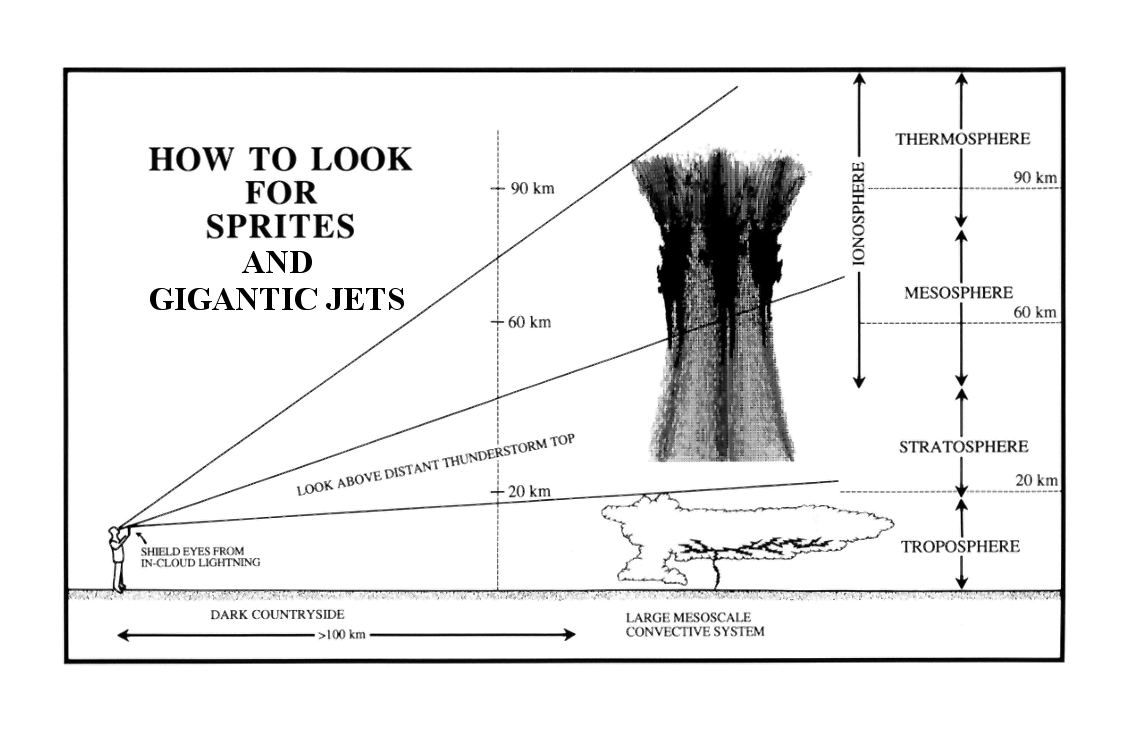
Gigantic jets are lightning-like discharges that spring from the top of thunderstorms, reaching all the way from the thunderhead to the ionosphere 50+ miles overhead. They’re enormous, powerful, and also fairly rare. The first one was discovered in 2001 by Dr. Victor Pasko in Puerto Rico. Since then only a few dozen have been recorded, almost always over open ocean.
“This storm was just north of the Kennedy Space Center over the Atlantic,” notes Gonzalez. “It was daylight already when the jet decided to fire off! Because of this, a lot of detail was lost, but if you watch the movie closely you can see hints of streamers reaching up to the ionosphere.”
Because they connect thunderstorms directly to the ionosphere, gigantic jets play some role in the global flow of electricity around our planet, but how big is that role? No one knows. Investigations of gigantic jets are considered cutting-edge.
Amateur astronomers, you can contribute to this research. Check your local weather radar map for storms just over the horizon, point your meteor cameras in that direction, and click. Gigantic jets may not be as rare as we think.
more images: from Tom King of Watauga, Texas;

========================================================
If you want to be alerted for thunderstorms in your area reaching a certain intensity, see this cool program.
> Anyone ? With jets/sprites/elves, is energy going up or down ?
I’m not a TLE expert, but if it’s like regular lightning, current flows both ways, in a series of strokes, in the plasma channel generated by the leading stroke. Also confusing is the EE convention that current flows from + to – charge, so opposite from flow of electrons. Most of the literature implies that jets emanate from the tops of thunderclouds into the lower ionospher (mesosphere).
> REPLY: Wasn’t me, this is a NASA story – Anthony
Anthony, it’s not a NASA story. The photo was taken in Joel’s backyard, 85 miles SE of the Space Center. (Look at the byline at the bottom of the movie)
REPLY: What part of From Spaceweather.com plus the link, did you miss at the very beginning of the story? It’s on the front page of Spaceweather.com a NASA site, just scroll down – Anthony
Sorry, I thought you meant credit for taking a picture of a blue jet. :-]
I wouldn’t be surprised to find this on a continuum with flares, just as there appears to my eye to be a relationship between ocean currents, jet streams, gas giant cloud belts and a similar pattern on the Sun. One being fluid dynamics, the other being electrodynamics. Beyond that I do not venture.
The lineage is correct. What Joel photographed was a ‘jet’ not a ‘sprite’. Joel is a very accomplished amateur scientist (as you can see for yourself from his website: http://www.backyardastronomy.net
These were first photographed as part of a NASA Phase II SBIR study in the early 1990’s. I know the NASA PI on this (Otha H. Vaughn), and it was taken up by the solar/terrestrial physics branch at Marshall. At least two Shuttle flights had cameras that specifically filmed many of the variances and actually developed the taxonomy for what the different forms of the discharges were.
Here is a link to the research from MSFC.
http://journals.ametsoc.org/doi/abs/10.1175/1520-0493(1992)120%3C1459%3AACTSLA%3E2.0.CO%3B2
Note the date.
Freddy says: Is the net result . . . that energy moves from the top of the thundercloud _up_ to the ionosphere, or from the ionosphere _down_ to the cloud?
I would think that the answer to your question is, “Neither.” All the energy during one of these strikes isn’t really moving anywhere. It is just potential energy being converted into kinetic as a result of the break down of air being exceeded over long great distances.
Energy isn’t moving the way convective transport of energy in warm water vapor transports energy up into a cloud. Instead, think of a cloud system as a very large plate on a huge capacitor that slowly accumulates a build up of charge from either the ground or oppositely charged gases up in the ionosphere. The insulator that separates this charged plate from either “ground” or “opposite charges” is the air that separates that charged plate from either the ionosphere or the ground. As wind moves particles and droplets of water around in the cloud system, electrons are stripped off of their surface just like in a huge VanDeGraff generator. Follow the evidence from what you see. Visible light is given off when the electric potential on the capacitor plate reaches the break-down potential of air, and a conducting path is created by the resulting plasma. As soon as a conducting path is created, a VERY large current of ions are free to move at substantial velocities over very great distances to neutralize the huge potential that has built up. This sudden release of the potential energy that has accumulated in the cloud system results in an explosion of very hot, very kinetic plasma that expands at a velocity exceeding the speed of sound -creating a sonic boom – and a very bright flash of light. Potential energy is rapidly converted to heat energy, light energy, and a very loud sound, and the energy is dissipated into the atmosphere as kinetic energy – resulting LOTS of heat, very bright light, and an explosive release of rapidly expanding gases all along the path of the lightning jet. Energy doesn’t really flow anywhere, it is just dissipated into the atmosphere along the path of the “lightning” as both extreme heat, a very brief burst of radiation, and a sudden clap of thunder. This dissipation of energy radiates out in all directions. If one could tap the current that flows along that plasma channel into say an electrical grid, it would seem that a huge energy source in the cloud transferred a substantial amount of potential energy downward but just as much current of the opposite charge flows upwards during a lighting strike! Net “flow” of energy – not much up, down or sideways.
Don V says:
October 3, 2010 at 1:13 am
———–Reply;
This is the problem with the opinion that there is little net energy involved in plasma/electromagnetic interactions.
The power dissipated by the release of the static voltage potential is released across the full bandwidth from DC,heat, full spectrum radio production to IR through EUV light frequencies, up to and including xrays and gama rays in some events.
Then instead of deriving the total power dissipated across the whole bandwidth, some small sub set is described as being of “little net effect”. Where the whole full spectrum total power dissipated is in the tera watts in hundredths of seconds.
Then the argument given is that “there is not enough power to have an effect”. This straw man argument is very common by a couple of posters on here.
INGSOC says:
October 2, 2010 at 10:56 am
“They’re enormous, powerful, and also fairly rare.”
Sounds like one of my wife’s fleeting good moods.
You need to take her out to the ‘off-the-leash’ park a bit more, and let her run those bad emotions out of her system.
:o)
Just kidding!!!
> These were first photographed as part of a NASA Phase II SBIR study
> in the early 1990′s.
Dennis, yes they’ve been photgraphed before, that wasn’t the point. Jets are seldom seen or photographed. Joel is an accomplished amateur astronomer, who also studies earth science. He set up a camera and waited a year to get this picture. He also captured the extremely-low frequency (ELF,300hz-3khz) and very-low frequency (VLF, 3khz-30khz) signatures of this flash, which you can hear as ‘audio’ in the movie background. Astronomy is still one of the few areas of science where amateurs can make valuble observations and contributions.
Richard Holle says: This is the problem with the opinion that there is little net energy involved in plasma/electromagnetic interactions. . . . . Then the argument given is that “there is not enough power to have an effect”. This straw man argument is very common by a couple of posters on here.
Reply:
In my post, I did not argue that “there was little net energy”, or that “there is not enought power to have an effect”. On the contrary, I made the point that a significant amount of potential energy that is accumulated in the form of electrostatic charge is converted to extremely high kinetic energy during a lightning strike! My post went on to address the question about the “movement” of energy. Where is energy coming from and where is moving to. During one of these lightning strikes, is energy coming from the ionosphere and is it being transmitted to the top of a cloud? Heating it up? or is heat energy that has been brought up from the ocean in the form of hot air and water vapor transmitting a portion of that energy out to the ionosphere during one of these lightning strikes?
I reasoned that, if any “movement” of energy occurs at all, it is from both the ionosphere and the top of the cloud towards the “plasma tube” in which the huge amount of kinetic energy is eventually dissipated in that very brief burst. I would think that the air along the plasma path of the strike is where the energy moves “to”. The resulting extreme heat, and broad spectrum flash of light dissipates away from that plasma “channel” in all directions at both the speed of light (electromagnetic pulse) and the speed of sound (thunder clap). Because the “plasma tube” exists all along the path of dissipation, I reasoned that there is no net “movement” of energy from cloud to ionosphere, or from ionosphere to cloud. Could you please point out where is my reasoning is at fault?
Now that I have had time to think further, I believe that the broad spectrum electromagnetic pulse that radiates out in all directions has a very large portion of its energy pass right through the ionosphere and out into space. The only portion that is retained is that portion of the spectrum that matches the absorbance bands of the gases and ions that make up the ionosphere, that is also actually absorbed by those gas molecules. The portion that radiates down towards the cloud has a small portion of it absorbed by the gases in the cloud (especially water vapor) and whatever passes through the cloud will ultimately get absorbed or reflected off the ocean. The higher albedo from the top surface of the clouds also suggests that a portion of the light that is initally directed towards the cloud will be back scattered. I can’t say what a radiative energy balance from an intense light source between a cloud and the ionosphere dictates, but I imagine it would be similar to the energy balance of radiation coming from the sun.
He also captured the extremely-low frequency (ELF,300hz-3khz) and very-low frequency (VLF, 3khz-30khz) signatures of this flash, which you can hear as ‘audio’ in the movie background. Astronomy is still one of the few areas of science where amateurs can make valuble observations and contributions.
Yep, I know, I built one of these sensors in 1991 for MSFC and for my school the university of Alabama in Huntsville. A version of one of these sensors later flew on the Shuttle. I am not denigrating his contribution, only pointing out that any claim that these were first captured in the year 2001 is not correct.
899 says:
October 3, 2010 at 3:27 am
INGSOC says:
October 2, 2010 at 10:56 am
“They’re enormous, powerful, and also fairly rare.”
Sounds like one of my wife’s fleeting good moods.
You need to take her out to the ‘off-the-leash’ park a bit more, and let her run those bad emotions out of her system.
She needs Mad Money, bro.
> I am not denigrating his contribution, only pointing out that any claim that these were
> first captured in the year 2001 is not correct.
Dennis,
Actually, the jet that Joel photographed was of the “Gigantic” variety (GJ), which _were_ first discovered in Arecibo, Puerto Rico in 2001, a much larger version of the blue jet. I think you were referring to the ‘classic’ sprites and jets.
http://en.wikipedia.org/wiki/Upper-atmospheric_lightning#Gigantic_jets
I’m hearing some feedback that this morning’s photo may be the first ever to capture an entire GJ from cloudtop up in one image. This is being verified by some experts.
Probably too late to be read but never mind.
This taught me a whole lot of new science re. the atmosphere. I finally understand the temperature pattern and the fourfold classification:
* troposphere where higher=cooler therefore unstable, tropos; then
* stable stratosphere where higher=warmer, up from the tropopause boundary where cumulus clouds bang their heads and turn into nimbus clouds; then
* unstable mesosphere where higher=cooler (noctilucent clouds here); then
* stable thermosphere where higher=warmer.
The inversion pattern evident in the stratosphere-mesosphere is ALL caused by the ozone production and absorption of higher frequency rays, clearly a highly dynamic pattern, hence human effects are likely to be very low compared to natural cycles.
From the mesosphere and thermosphere up the atmosphere is ionized plasma due to cosmic ray and solar bombardment, and acts as a mirror to radio waves. The thermosphere is stable, hence the possibility of layering in the ionosphere. The mesopause, the boundary between higher stable and lower unstable atmosphere, is lower during the day because of the solar radiation.
What a magical system for homeostasis and protection of life on earth.
Lucy,
Nice recap. There’s a chart here which illustrates what you said:
http://www.windows2universe.org/earth/Atmosphere/mesosphere_temperature.html
The topmost branches of this GJ reached up to about 90km, which is the top of the mesosphere. And underscores this: The mesosphere is one of the loneliest places in all of the terrestrial spheres, inhabited only rarely by transients (TLE’s, meteors, noctilucent clouds and transient rockets). Too high for aircraft or balloons to fly in; too low for spaceships to orbit in.