NOTE: This has been running two weeks at the top of WUWT, discussion has slowed, so I’m placing it back in regular que. – Anthony
UPDATES:
Statistician William Briggs weighs in here
Eduardo Zorita weighs in here
Anonymous blogger “Deep Climate” weighs in with what he/she calls a “deeply flawed study” here
After a week of being “preoccupied” Real Climate finally breaks radio silence here. It appears to be a prelude to a dismissal with a “wave of the hand”
Supplementary Info now available: All data and code used in this paper are available at the Annals of Applied Statistics supplementary materials website:
http://www.imstat.org/aoas/supplements/default.htm
=========================================
Sticky Wicket – phrase, meaning: “A difficult situation”.
Oh, my. There is a new and important study on temperature proxy reconstructions (McShane and Wyner 2010) submitted into the Annals of Applied Statistics and is listed to be published in the next issue. According to Steve McIntyre, this is one of the “top statistical journals”. This paper is a direct and serious rebuttal to the proxy reconstructions of Mann. It seems watertight on the surface, because instead of trying to attack the proxy data quality issues, they assumed the proxy data was accurate for their purpose, then created a bayesian backcast method. Then, using the proxy data, they demonstrate it fails to reproduce the sharp 20th century uptick.
Now, there’s a new look to the familiar “hockey stick”.
Before:

After:

Not only are the results stunning, but the paper is highly readable, written in a sensible style that most laymen can absorb, even if they don’t understand some of the finer points of bayesian and loess filters, or principal components. Not only that, this paper is a confirmation of McIntyre and McKitrick’s work, with a strong nod to Wegman. I highly recommend reading this and distributing this story widely.
Here’s the submitted paper:
(PDF, 2.5 MB. Backup download available here: McShane and Wyner 2010 )
It states in its abstract:
We find that the proxies do not predict temperature significantly better than random series generated independently of temperature. Furthermore, various model specifications that perform similarly at predicting temperature produce extremely different historical backcasts. Finally, the proxies seem unable to forecast the high levels of and sharp run-up in temperature in the 1990s either in-sample or from contiguous holdout blocks, thus casting doubt on their ability to predict such phenomena if in fact they occurred several hundred years ago.
Here are some excerpts from the paper (emphasis in paragraphs mine):
This one shows that M&M hit the mark, because it is independent validation:
In other words, our model performs better when using highly autocorrelated
noise rather than proxies to ”predict” temperature. The real proxies are less predictive than our ”fake” data. While the Lasso generated reconstructions using the proxies are highly statistically significant compared to simple null models, they do not achieve statistical significance against sophisticated null models.
We are not the first to observe this effect. It was shown, in McIntyre
and McKitrick (2005a,c), that random sequences with complex local dependence
structures can predict temperatures. Their approach has been
roundly dismissed in the climate science literature:
To generate ”random” noise series, MM05c apply the full autoregressive structure of the real world proxy series. In this way, they in fact train their stochastic engine with significant (if not dominant) low frequency climate signal rather than purely non-climatic noise and its persistence. [Emphasis in original]
Ammann and Wahl (2007)
…
On the power of the proxy data to actually detect climate change:
This is disturbing: if a model cannot predict the occurrence of a sharp run-up in an out-of-sample block which is contiguous with the insample training set, then it seems highly unlikely that it has power to detect such levels or run-ups in the more distant past. It is even more discouraging when one recalls Figure 15: the model cannot capture the sharp run-up even in-sample. In sum, these results suggest that the ninety-three sequences that comprise the 1,000 year old proxy record simply lack power to detect a sharp increase in temperature. See Footnote 12
Footnote 12:
On the other hand, perhaps our model is unable to detect the high level of and sharp run-up in recent temperatures because anthropogenic factors have, for example, caused a regime change in the relation between temperatures and proxies. While this is certainly a consistent line of reasoning, it is also fraught with peril for, once one admits the possibility of regime changes in the instrumental period, it raises the question of whether such changes exist elsewhere over the past 1,000 years. Furthermore, it implies that up to half of the already short instrumental record is corrupted by anthropogenic factors, thus undermining paleoclimatology as a statistical enterprise.
…

We plot the in-sample portion of this backcast (1850-1998 AD) in Figure 15. Not surprisingly, the model tracks CRU reasonably well because it is in-sample. However, despite the fact that the backcast is both in-sample and initialized with the high true temperatures from 1999 AD and 2000 AD, it still cannot capture either the high level of or the sharp run-up in temperatures of the 1990s. It is substantially biased low. That the model cannot capture run-up even in-sample does not portend well for its ability
to capture similar levels and run-ups if they exist out-of-sample.
…
Conclusion.
Research on multi-proxy temperature reconstructions of the earth’s temperature is now entering its second decade. While the literature is large, there has been very little collaboration with universitylevel, professional statisticians (Wegman et al., 2006; Wegman, 2006). Our paper is an effort to apply some modern statistical methods to these problems. While our results agree with the climate scientists findings in some
respects, our methods of estimating model uncertainty and accuracy are in sharp disagreement.
On the one hand, we conclude unequivocally that the evidence for a ”long-handled” hockey stick (where the shaft of the hockey stick extends to the year 1000 AD) is lacking in the data. The fundamental problem is that there is a limited amount of proxy data which dates back to 1000 AD; what is available is weakly predictive of global annual temperature. Our backcasting methods, which track quite closely the methods applied most recently in Mann (2008) to the same data, are unable to catch the sharp run up in temperatures recorded in the 1990s, even in-sample.
As can be seen in Figure 15, our estimate of the run up in temperature in the 1990s has
a much smaller slope than the actual temperature series. Furthermore, the lower frame of Figure 18 clearly reveals that the proxy model is not at all able to track the high gradient segment. Consequently, the long flat handle of the hockey stick is best understood to be a feature of regression and less a reflection of our knowledge of the truth. Nevertheless, the temperatures of the last few decades have been relatively warm compared to many of the thousand year temperature curves sampled from the posterior distribution of our model.
Our main contribution is our efforts to seriously grapple with the uncertainty involved in paleoclimatological reconstructions. Regression of high dimensional time series is always a complex problem with many traps. In our case, the particular challenges include (i) a short sequence of training data, (ii) more predictors than observations, (iii) a very weak signal, and (iv) response and predictor variables which are both strongly autocorrelated.
The final point is particularly troublesome: since the data is not easily modeled by a simple autoregressive process it follows that the number of truly independent observations (i.e., the effective sample size) may be just too small for accurate reconstruction.
Climate scientists have greatly underestimated the uncertainty of proxy based reconstructions and hence have been overconfident in their models. We have shown that time dependence in the temperature series is sufficiently strong to permit complex sequences of random numbers to forecast out-of-sample reasonably well fairly frequently (see, for example, Figure 9). Furthermore, even proxy based models with approximately the same amount of reconstructive skill (Figures 11,12, and 13), produce strikingly dissimilar historical backcasts: some of these look like hockey sticks but most do not (Figure 14).
Natural climate variability is not well understood and is probably quite large. It is not clear that the proxies currently used to predict temperature are even predictive of it at the scale of several decades let alone over many centuries. Nonetheless, paleoclimatoligical reconstructions constitute only one source of evidence in the AGW debate. Our work stands entirely on the shoulders of those environmental scientists who labored untold years to assemble the vast network of natural proxies. Although we assume the reliability of their data for our purposes here, there still remains a considerable number of outstanding questions that can only be answered with a free and open inquiry and a great deal of replication.
===============================================================
Commenters on WUWT report that Tamino and Romm are deleting comments even mentioning this paper on their blog comment forum. Their refusal to even acknowledge it tells you it has squarely hit the target, and the fat lady has sung – loudly.
(h/t to WUWT reader “thechuckr”)

This is funny. Romm has posted on this story finally, after two days of ignoring it:
http://climateprogress.org/2010/08/16/hockey-stick-paper-mcshane-and-wyner-statisticians/
He’s grasping at the one paragraph in the paper that he can, no other quotes from it were posted:
Using our model, we calculate that there is a 36% posterior probability that 1998 was the warmest year over the past thousand. If we consider rolling decades, 1997-2006 is the warmest on record; our model gives an 80% chance that it was the warmest in the past thousand years.
Heh, no mention by Romm of the fact that 1998 was caused by El Nino, and not by global warming, that would ruin his rant and yet another chance to plug his failing book.
The counterclockwise spin is creating a whirlwind of denial over there. In the SH, Deltoid is spinning clockwise, making little mini denial vortices.
It is fun to watch.
RC will come out with something tomorrow or Wednesday I’ll bet.
What I’ve gathered about the hockey stick investigations by congress is that the Republicans assigned the job to the Wegman committee (staffed with three statisticans) and the Democrats assigned the job to the NAS group (which had a couple of statisticians and about seven (?) climatologists, including North, the Chairman). These latter were all or mostly members of the climate cabal and were “solid” on Mann’s behalf, as he averred re North in one of his Climategate e-mails. The fix was in to give him a pass. This sort of whitewash by the overseeing bodies of institutionalized science (and institutionalized democracy) is a scandal that vastly eclipses the scandal of climate science. It’s the grossest story every told.
It’s a deliberate mash-up of two phrases (hockey stick / sticky wicket), more formally known as a conflation. There’s a site devoted to collecting humorous instances of such mash-ups: http://www.conflations.com/pages/intro.html
Here’s my favorite example: “When the going gets tough, make lemonade.”
PS: insert “and mainstream journalism” after “institutionalized democracy.”
“For example, 1998 is generally considered to be the warmest year on record in the Northern Hemisphere. Using our model, we calculate that there is a 36% posterior probability that 1998 was the warmest year over the past thousand. If we consider rolling decades, 1997-2006 is the warmest on record; our model gives an 80% chance that it was the warmest in the past thousand years”.
Did I miss something or is that remark based on the flawed statistics that they are criticising ?
How can they make that remark if the whole thrust of their analysis is that the proxies fail to reveal the ups and downs of past temperatures sufficiently well to make a valid comparison with recent thermometer records ?
Wasn’t ‘their’ model itself based on flawed or randomly produced data in order to show that such data with the benefit of a flawed statistical technique can produce a spurious hocky stick shape ?
Perhaps they are just illustrating that their model based on similarly flawed mehodology produces similarly flawed results to those produced by Mann et al.
Damnit! Corrections and clarifications. When I stated, “That’s from Lucy Skywalker. “, read 2 paragraphs above. When I stated, “..and giving literally thousands of interviews..” it was literally closer to a hundred or so. Sentences got caught in transitional thoughts.
ctm & evan.
Maybe Diamonds, but beer doesn’t necessarily make babies
Last month, Montreal University scientists released the results of a recent
analysis that revealed the presence of Phytoestrogens in beer hops.
To test the theory, 100 men each drank 8 schooners of beer within a one (1)
hour period.
It was then observed that 100% of the male subjects,
1) Argued over nothing.
2) Refused to apologize when obviously wrong
3) Gained weight.
4) Talked excessively without making sense.
5) Became overly emotional
6) Couldn’t drive.
7) Failed to think rationally, and
8) Had to sit down while urinating.
Reply: If you only knew about the mystery third roommate. ~ ctm
Henry:
So my original question to Evan, who, as a lukewarmer, seemed sure that CO2 is a greenhouse gas, was : How do you know for sure that CO2 is a greenhouse gas, if nobody has some actual results from experimentations on the cooling and warming?
To be clear: It’s climate. There is no “sure”.
Robert says:
August 16, 2010 at 6:05 pm
“………….
So whats all the fuss about? Everyone is acting as if this is the silver bullet?”
Uhmm, because also from the paper,
“This is disturbing: if a model cannot predict the occurrence of a
sharp run-up in an out-of-sample block which is contiguous with the insample
training set, then it seems highly unlikely that it has power to detect
such levels or run-ups in the more distant past. It is even more discouraging
when one recalls Figure 15: the model cannot capture the sharp run-up
even in-sample. In sum, these results suggest that the ninety-three sequences
that comprise the 1,000 year old proxy record simply lack power to detect a sharp increase in temperature.” and next paragraph,
“As mentioned earlier, scientists have collected a large body of evidence
which suggests that there was a Medieval Warm Period (MWP) at least in
portions of the Northern Hemisphere. The MWP is believed to have occurred
from c. 800-1300 AD (it was followed by the Little Ice Age). It is
widely hoped that multi-proxy models have the power to detect (i) how warm the Medieval Warm Period was, (ii) how sharply temperatures increased
during it, and (iii) to compare these two features to the past decade’s
high temperatures and sharp run-up. Since our model cannot detect the recent
temperature change, detection of dramatic changes hundreds of years
ago seems out of the question.” and from page 41 in the conclusions section,
“On the one hand, we conclude unequivocally that the evidence for a
”long-handled” hockey stick (where the shaft of the hockey stick extends
to the year 1000 AD) is lacking in the data.” later from the conclusions, “Furthermore, the
lower frame of Figure 18 clearly reveals that the proxy model is not at all
able to track the high gradient segment. Consequently, the long flat handle
of the hockey stick is best understood to be a feature of regression and less
a reflection of our knowledge of the truth. Nevertheless, the temperatures
of the last few decades have been relatively warm compared to many of the
thousand year temperature curves sampled from the posterior distribution
of our model.” and finally, “Climate scientists have greatly underestimated the uncertainty of proxybased
reconstructions and hence have been overconfident in their models.
We have shown that time dependence in the temperature series is sufficiently
strong to permit complex sequences of random numbers to forecast
out-of-sample reasonably well fairly frequently (see, for example, Figure
9). Furthermore, even proxy based models with approximately the same
amount of reconstructive skill (Figures 11,12, and 13), produce strikingly
dissimilar historical backcasts: some of these look like hockey sticks but
most do not (Figure 14).”
Robert, I think you missed the point of the statement. Their statement is qualified that they are using the proxy data available. Later, they go on to say the proxy data doesn’t amount to much. Try again.
Reading the paper:
A similar reconstruction but more uncertainty. Ok.
This effort to reconstruct our planet’s climate history has become linked to the topic of Anthropogenic Global Warming (AGW). On the one hand, this is peculiar since paleoclimatological reconstructions can provide evidence only for the detection of AGW and even then they constitute only one such source of evidence. The principal sources of evidence for the detection of global warming and in particular the attribution of it to anthropogenic factors come from basic science as well as General Circulation Models (GCMs) that have been fit to data accumulated during the instrumental period (IPCC, 2007). These models show that carbon dioxide, when released into the atmosphere in sufficient concentration, can force temperature
increases.
Paleoclimate reconstructions are not primary to the theory of AGW. So what motivates this paper?
The paper is motivated by policy implications. This should be ringing alarm bells for both sides of the debate. I think we can all agree that policy considerations should be separate from scientific analysis. Roger Pielke Jnr made this point just recently.
However, that does not necessarily mean the work is biased or second-rate, but it gives me pause, and should do for anyone who holds that policy implications should not form any part of scientific analysis.
The conclusion that the error bars have been underestimated in paleoclimatology, is clear enough. As they produce their own reconstruction, it is interesting to note what their results were.
What I get from the paper is that the story is pretty much the same as in the IPCC, but that the confidence attached to it has previously been too high. This is a qualified vindication of M&M, where their criticisms are somewhat corroborated, but that the essential conclusions of Mann et al are not significantly impacted. There is no impact on the greater body of AGW theory and projections.
Let’s keep up to date with this paper, and see how it endures post-review scrutiny.
Anthony Watts says:
August 16, 2010 at 7:27 pm
“This is funny. Romm has posted on this story finally, after two days of ignoring it:
“Using our model, we calculate that there is a 36% posterior probability that 1998 was the warmest year over the past thousand. If we consider rolling decades, 1997-2006 is the warmest on record; our model gives an 80% chance that it was the warmest in the past thousand years.”
The counterclockwise spin is creating a whirlwind of denial over there. In the SH, Deltoid is spinning clockwise, making little mini denial vortices.
It is fun to watch.
RC will come out with something tomorrow or Wednesday I’ll bet.”
lol, A made a funny!!! And, yes it is fun. Is it wrong to lulz these days? Seriously, apparently that is the talking points marching orders. Funny.
De-italicising the blockquotes proved more problematic than assumed. Sorry, once again, for the formatting. The indents are the paper, the rest is me.
(The mods are no doubt sick of hearing it, but – oh, for a preview button)
Richard S Courtney says:
August 16, 2010 at 4:49 am
Sorry, but that is an Orwellian rewriting of history.
———-
Richard’s comment referred to rewriting of the history around Mann et al 98. My contribution to this most excellent thread is the one liner:
Mann-98 accomplished the Orwellian goal of disappearing the Medieval Warm period.
As several poster have eloquently noted, the issue was never really the blade- it was the disappearance of a similarly warm period in geologically recent history with no know forcing. An earlier even warmer period since the last ice age, the Holocene Optimum, is attributed to the Milankovitch cycle. Not much is written about the Roman Warm Period.
The other comment is that wine is now and has always been grown in England. The current northern extant is of viticulture similar to that during the MWP.
http://www.winelandsofbritain.co.uk/lecture.htm
Finally, the Holocene Climate Optimum seems alluring:
http://en.wikipedia.org/wiki/Holocene_climatic_optimum
p.s. To those who say that the MWP is not “global” I would respond that the current warming trend is not global in a similar manner.
James Allison says:
August 16, 2010 at 7:52 pm
8) Had to sit down while urinating.
Not a chance!!!! Mind you I’m testing the theory now, but my experience is, no matter how hard(did I mean difficult?) or messy things get, we still stand. While anecdotal, witness your local tavern’s men’s latrine. I’m just guessing, but I don’t think there is a lot of setting going on there.
[REPLY – We aim to please, so please aim. ~ Evan]
Further, I think that beer causes diamonds that cause babies, but that just a theory I’m working on. I did the test myself once, but I’m too scared to attempt to replicate the experiment. (On several different levels.)
[REPLY – No percentage in it. Besides, you’ll just get accused of being a control group. ~ Evan]
Well, we understand that without preview and correction abilities that errors will inevitably occur.
We ask our readership to remember this and entertain the noblesse oblige appropriate under the circumstances.
(P.S., Well, okay, half the fun of being a mod consists of the ability to edit one’s posts. Please don’t hate me!)
Alarmist Roundup:
Climate Progress: The Curious Case of the Hockey Stick that Didn’t Disappear. Part 1: The Police Lineup
Deltoid: A new Hockey Stick: McShane and Wyner 2010
Rabett Run: A Flat New Puzzler
Team Science is being mobilized to “correct” two Ph.D. Statisticians on statistical methods. This should be interesting.
Anthony Watts says:
August 16, 2010 at 7:27 pm
“Heh, no mention by Romm of the fact that 1998 was caused by El Nino, and not by global warming, that would ruin his rant and yet another chance to plug his failing book.”
How do you know that “global warming” wasn’t the cause of the 1998 mother of all El Ninos?
Isn’t it possible that so-called AGW ramped up what might have been an average El Nino in 1998?
Oops…
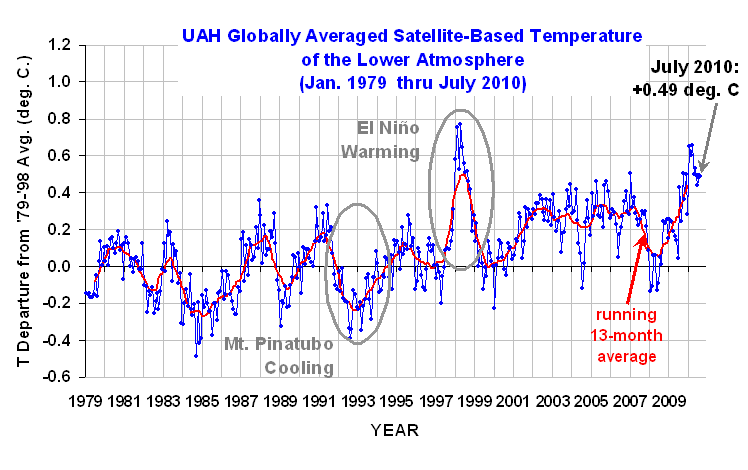
REPLY: No oops there. Well one would think it would “hold” since it is based on CO2 concentration…look at the sharp turndown afterwards. Explain that in terms of CO2 induced global warming. Note also 2008, when CO2 concentration actually fell as temperatures dropped and the ocean absorbing more CO2. Which came first?
http://www.esrl.noaa.gov/gmd/webdata/ccgg/trends/co2_trend_mlo.png
– Anthony
Anthony, I’ll take that bet and raise that it will not happen until Thursday or Friday. I’m thinking he will wind up the entrenched closer to the weekend as any good propagandist would. Timing is everything. By the way, what is with the very teeny smiley at the bottom of the page?

REPLY: you mean this?
Explanation here: http://en.support.wordpress.com/smiley-on-your-blog/
It also describes how I feel about WUWT and readers, so it is a good fit. – Anthony
Barry, I agree, a preview would be handy. Although, I’d probably screw that up too. However, what I think you are stating, and you’re right, your formatting makes it a bit difficult to see what is coming from where, is that you believe several things that I believe are incorrect. Please correct me if I’m wrong about the assertions.
Your saying? “The principal sources of evidence for the detection of global warming and in particular the attribution of it to anthropogenic factors come from basic science as well as General Circulation Models (GCMs) that have been fit to data accumulated during the instrumental period (IPCC, 2007).”
Uhmm, I’m not sure how familiar you are with computers, so I’ll be base, if I may. COMPUTER MODELS DO NOTHING OTHER THAN WHAT THEY ARE TOLD TO DO!!!! If you are unclear about that statement, please ask. I would be more than happy to elucidate. Further, in my view, detection of GW would come from basic READING OF THERMOMETERS. With the caveat of not mucking with the reading after the read. At least not without a published (for public dissemination and discernment.) and accepted reasoning.
“Paleoclimate reconstructions are not primary to the theory of AGW. So what motivates this paper?”
Wrong, they absolutely are. How do you know this temperature swing is “unprecedented”? Hottest ever. Does that ring a bell? How do we believe it is “hottest evuh”? Because of the hockey stick and the rest of the tripe people are made to believe. Its really not that scary to say hottest ever since 1979!!!!
“The paper is motivated by policy implications. This should be ringing alarm bells for both sides of the debate. I think we can all agree that policy considerations should be separate from scientific analysis….”
Uhmm, mirror check!!! Himalayas or Amazon? Or any other of the half-baked tripe loaded studies of political expedience thrown at us on a almost daily fashion. Fact is, I believe this paper was motivated by statisticians tired of the statistical malpractice of climatologists. For evidence, I’d offer the OTHER PAPERS WRITTEN BY STATISTICIANS STATING MANN WAS WRONG!
“Nevertheless, the temperatures of the last few decades have been relatively warm compared to many of the thousand year temperature curves sampled from the posterior distribution of our model.”
No, Barry, that statement is greatly distinguished from statements such as “hottest ever” and “unprecedented”. Neither does it infer the ‘OMG!!! We need to pass industry crippling laws now!!!’ generalized statement and occurrence.
“….but that the essential conclusions of Mann et al are not significantly impacted. There is no impact on the greater body of AGW theory and projections.”
Well, you certainly are entitled, but given that your beloved GCMs in part are generated by accepting historical data created by paleo-climatology, I beg to differ. Further, given that the study was based on the proxies in the Mann studies, how do you go from “Climate scientists have greatly underestimated the uncertainty of proxybased reconstructions and hence have been overconfident in their models.” to your statement above?
Barry if I’ve mischaracterized your assertions, first, I apologize, secondly, please let me know how and where I did such. Thanks for playing.
James
[REPLY – We aim to please, so please aim. ~ Evan]
We aim to please, so you aim too please.
Fixed that for ya!
It appears it did “hold” and you can certainly see its effects ringing to this day in the arctic sea ice. The average global temperature hasn’t declined in the decade since. It held steady. This is the CO2 signature. We have from 1880 to 2000 two obvious complete 60 year cycles (H/T to Tom Vock for pointing it out) where there is a warming trend for 30 years and a “cooling” trend for 30 years. The fact of the matter is the cooling trends don’t go down as much as the warming trends go up. The result is we have a net increase in temperature of O.4c from 1880-1940 and another net increase of 0.4c from 1940-2000. During the same 60 year periods CO2 increased by 25ppm in the first and 50ppm in the second. This is consistent with the physics behind CO2 surface warming – additional insulation has diminishing effectiveness. Furthermore, this agrees nicely with IPCC calculation of each CO2 doubling raising surface temp by 1.1C.
Where the IPCC loses the plot is the silliness about a positive feedback associated with CO2 driven warming. There is not a shred of evidence of any positive feedback and a ton of evidence that there’s no feedback at all. CO2 doublings raise the avg. surface temp 1.1C (close enough for government work but endlessly debatable in the exact number by pedants) and that’s the extent of what CO2 does other than fertilize the atmosphere and ramp up biological productivity of the planet (which is a good thing).
REPLY: Here’s the graph I was thinking of, I was remiss for not providing it for you to look at:
Note the return to the zero anomaly line after the 1998 El Nino event. It was zero before also. If it were CO2 it would have returned to a null + value. Point is you can’t link CO2 to specific events. “weather is not climate” and all that. – Anthony
Anthony Watts says:
August 16, 2010 at 7:27 pm
“It is fun to watch.”
Indeed it is.
The new “McShane-Wyner Hockeystick”:
http://a.imageshack.us/img844/7051/mcshanewynerhockey.png
At first glance, it appears that the graph has been intentionally altered, (presumably by Lambert at Deltoid) but comparing it to the unaltered version shows that they are identical. If one looks closely, the blade doesn’t encompass the first 30 odd years starting at 1850. Also, the shaft/blade combination tends to de-emphasize the uncertainty bars. Carnival sideshow trickery at it’s best.
@Anthony
I will agree with you on one thing. The McShane paper highlighted in the OP clearly demonstrates that the Mann hockey stick is a piece of dishonest rubbish. Of course we knew that already and it was confirmed for us in the Climategate emails.
The MWP, according to the paper quoted in the top post here:
Mann 98 [PDF] reconstruction began in 1400.
You’re thinking of the 99 paper, and the MWP wasn’t ‘disappeared’. It was qualified.
[side note on Orwell…]
Orwell’s book highlights the jargon-ization of language for propagandistic purposes. Using the word ‘disappearing’ as a transitive verb, in this context, is a good example.
One hopes that truth will finally be heard but still they give a backcast which shows that the temperature a thousand years ago could have been much warmer or much cooler than the present day. This is perfectly consistent with their deep reservations about the predictive ability of the proxy data.
—————————-
Joseph
@Anthony
I think perhaps further explanation of the connection between 1998 El Nino and melting Arctic sea ice is in order. You implied that because the global temperature quickly declined after the event that the energy involved didn’t stick around.
Actually it did stick around as latent heat of melting.
http://www.engineeringtoolbox.com/water-thermal-properties-d_162.html
It takes 337 kilojoules per kilogram to turn ice at 32F into water at 32F. This latent heat is called insensible heat because it doesn’t register on a thermometer. That is why the thermometer record didn’t show the energy from that El Nino sticking around. The energy went into non-sensible heat of fusion. It stuck. It just didn’t stick in a form that a thermometer can measure.