Guest post by David Archibald

We return to Dr Svalgaard’s plot of four solar parameters, updated daily at: http://www.leif.org/research/TSI-SORCE-2008-now.png
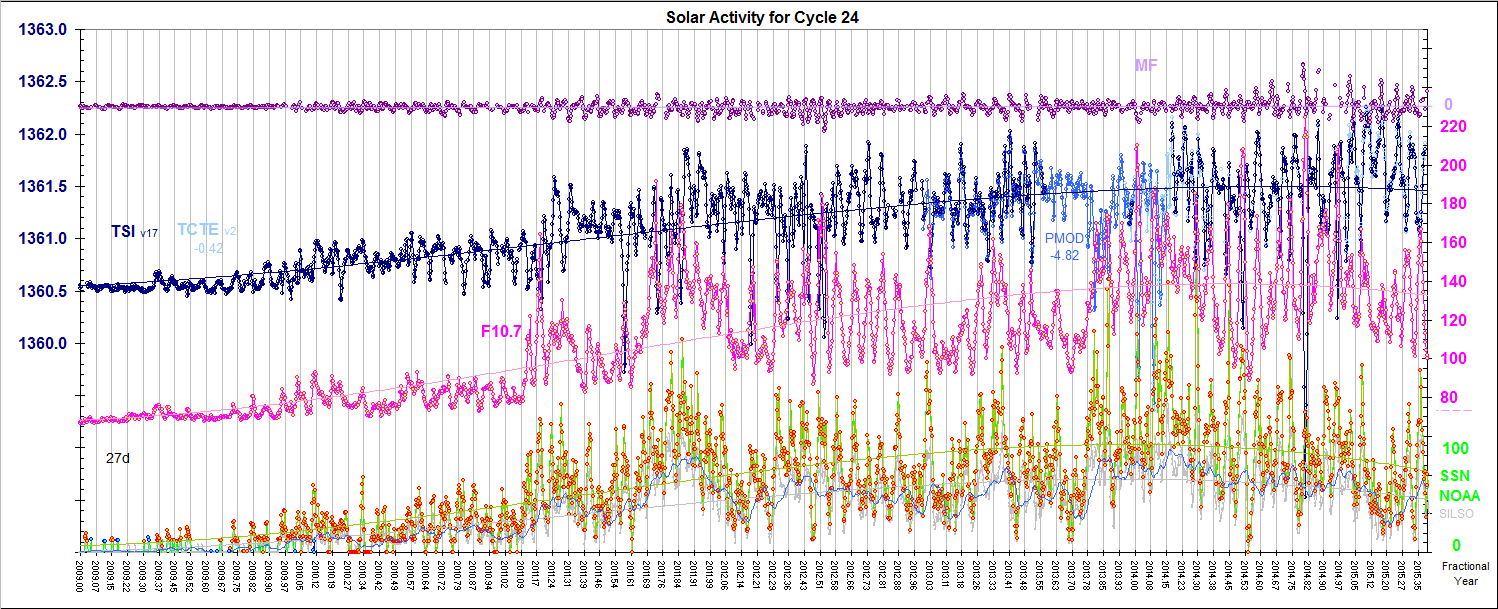
There are a couple of things to note. Firstly, the solar Mean Field, which is the top line, went into the Solar Cycle 23/24 transition being neat and regular like a heartbeat, and has come out choppy and arrhythmic. Secondly, the F10.7 ramp up continues to be very flat indeed. The line of best fit of the F10.7 flux, currently at 82, equates to a sunspot number of 24. In terms of sunspot number, the rate of ramp up over the last year is 11 per annum. At two years into the cycle, this will be the maximum rate of increase we will get.
One of the accepted solar cycle prediction methodologies is a curve fitting exercise two years after the month of solar minimum, which was December 2008. Inspired by the fact that NOAA et al called 2010 the hottest year ever when it was only half over, we have decided to go early and curve fit now. The green corona brightness tells us that solar maximum will be in 2015. Combined with that constraint, the graphic below is the result:

F10.7 flux at solar maximum will be 105, equating to a sunspot number of 50. It will be the weakest solar cycle since Solar Cycle 6, the second half of the Dalton Minimum (1810 to 1823). Solar Cycle 5 had a maximum amplitude of 49.2 and Solar Cycle 6 of 48.7.
The evidence for a Dalton Minimum repeat continues to build. As a 210 year de Vries cycle event, it has come along right on schedule.
Smokey says:
August 29, 2010 at 6:26 pm
John Finn,
I haven’t read your entire post above, but as I scrolled thru I noticed your complaint about comparing you & Michael Mann. So state your position: Do you support Mann’s version of reality, or not? It seems you must, since both you & Mann argue against climate fluctuations such as the Dalton and the MWP. In which case, you’re both wrong.
No I’m not wrong. You now don’t appear to understand the argument. I asked you, or anyone else, for that matter to provide evidence that the Dalton Minimum was significantly colder that other similar periods in the CET (or any other) record.
Note: I did not ask for evidence that the climate fluctuates.
I am not questioning the fact that climate, on a local level at least, fluctuates. I am questioniong the assumption that the Dalton Minimum ‘fluctuated’ more than it did over other similar 30 year periods. I have seen lots of evidence which suggests that the Dalton Minimum was not a particularly warm period (in europe) but nothing which suggests that it was “unusually cold”. You provided a link which showed that CET December temperatures were a bit below par. This leaves us with the possibility that solar activity, while having very little influence on direct heating, may cause shifts in weather patterns. This might mean that some northern latitude regions may get colder – in winter.
However it also means other regions may get warmer
This actually supports the Michael Mann viewpoint that there are regional fluctuations but the “global temperature” is relatively stable.
But of course, if you — or Mann — admitted that the MWP, the LIA, the Dalton Minimum, the Minoan Optimum, the Roman Warm Period, etc. occurred, then all your wild-eyed alarmism gets flushed,
Of course, the Dalton Minimum occurred because it refers to a period of low solar activity – not the climate. The other periods are plagued by a lack of definiton with respect to the timeframes and are not relevant to my original point anyway.
because if the climate naturally warmed and cooled so much prior to the industrial revolution, then it’s pretty much impossible to hang your hat on CO2 as the driver of the climate. And CO2 is the reason for all the shouting.
CO2 could be, and probably is, a driver of climate regardless of climate fluctuation in the pre-industrial period.
So you have to pretend that the planet’s temperature has always been just like it is now: the straight handle of the Hokey Stick
I haven’t pretended anything. But since you insist on continually referring to Mann and/or his hockey stick reconstruction perhaps you should take a look at this WUWT post from last year.
http://wattsupwiththat.com/2009/11/20/mikes-nature-trick/
Scroll down to where it says “Back in December 2004” and note who is challenging Mike Mann about the Hockey stick reconstruction. There is a full version of the exchange at the Myth vs. Fact Regarding the “Hockey Stick” link.
You need to understand that there are many separate issues in the climate change debate. Disagreement with a “sceptic” viewpoint doesn’t necessarily imply full ageement with the AGW viewpoint. Could you, therefore, stop this childish “us and them” line of argument
John Finn says:
August 30, 2010 at 2:45 am
Its early days John, but I have provided one train of thought. We will learn much during the next few years. But there are other factors to consider, the same UV induced weather pattern changes may also be found to influence albedo and ocean heat uptake. Also there looks to be a trend where the PDO and other influences might be aligned with the rhythm of solar slowdowns.
I dont think the changes overall will be big, if this possible grand minimum follows prediction it will be a minor turndown like the Dalton, but the temperature trend should be in a downward direction. But expect some surprises.
Leif Svalgaard says:
August 29, 2010 at 2:25 pm
“Gary, what have temps to do with the Maunder Minimum?”
Leif Svalgaard says:
August 27, 2010 at 8:17 am
“If Livingston and Penn are correct, the sunspot number is no longer a meaningful measure of solar activity”
Consequence.
gary gulrud says:
August 30, 2010 at 6:26 am
“If Livingston and Penn are correct, the sunspot number is no longer a meaningful measure of solar activity”
Consequence.
You are saying that the lower temps cause sunspot numbers to be no longer a good measure? That is a new one.
John Finn:
Bob from the UK
The Wiki entry (which, according to Smokey, we shouldn’t use, by the way) describes a 2 deg decline at one station, i.e. Oberlach in Germany. The source for this information appears to rely on David Archibald (I see what smokety means) who has never cited the source for his data. Does anyone have a link to the Oberlach record? I also seem to recall that the temperature decline at Oberlach began before the weak Dalton cycles started. Another location, it seems, which is able to anticipate the sun’s activity.
In any case, stations in the UK , Sweden and Holland show nothing remarkable about the Dalton Minimum. Yes it was on the cold side but no more so than other periods in the records.
Check out Professor Easterbrook’s web page.
http://myweb.wwu.edu/dbunny/research/global/glopubs.htm
His latest paper is extremely informative, and documents the evidence that links historic measurements to solar variations.
There is a significant drop during the various solar minimums as he outlines.
John Finn:
In any case, stations in the UK , Sweden and Holland show nothing remarkable about the Dalton Minimum
You can see here in the following analysis how the temperature in Sweden drops rapidly during the Dalton minimum. 0.34 per decade.
http://www.kolumbus.fi/tilmari/gwuppsala.htm
In the link above Professor Easterbrook presents additional evidence from other places including glacial variations during that time such as Mt Baker in the US, demonstrating a global phenomenon.
Professor Easterbrook predicts a 1.5 degree cooling in the event of a minimum comparable to the Dalton minimum.
Bob from the UK says:
August 30, 2010 at 10:04 am
You can see here in the following analysis how the temperature in Sweden drops rapidly during the Dalton minimum. 0.34 per decade.
It was even colder during the high solar cycle before the Dalton Minimum. The text does not say ‘during’, but ‘into’. Overall during the ‘standard’ Dalton Minimum 1790-1830, temps were not much different from before and after that period. This looks like a severe case of cherry picking.
Here is seasonal CET anomaly update (for each individual year) for 1659-2010, with some of the major volcano eruptions noted.
http://www.vukcevic.talktalk.net/CET-D.htm
“You are saying that the lower temps cause sunspot numbers to be no longer a good measure?”
Not quite. If solar activity, whose received input is integrated by the oceans, has entered a prolonged minimum and the putative direct relation between integrated solar input and global averaged temperatures is spurious, then global temperatures will fail to trend downward-as measured by satellite after a suitable period.
Inotherwords, the proposition A implies B is invalidated if not B obtains.
If, on the otherhand, not A obtains, and we emerge from the current local minimum-or the depression in solar activity proves illusory, we do not have an exhaustive test of the predicate, nonetheless the hypothesis fails. The coincidence of recurrent solar minima and global cooling are not, in fact, related as a result of evidence gleaned from this trial.
vukcevic says:
August 30, 2010 at 10:33 am
Here is seasonal CET anomaly update (for each individual year) for 1659-2010, with some of the major volcano eruptions noted.
There was a significant eruption in ~1809, depressing temps further:
Title: Ice core evidence for an explosive tropical volcanic eruption 6
years preceding Tambora
Authors: Dai, Jihong; Mosley-Thompson, Ellen; Thompson, Lonnie G.
Publication: Journal of Geophysical Research (ISSN 0148-0227), vol.
96, Sept. 20, 1991, p. 17,361-17,366. (JGR Homepage)
Abstract
High-resolution analyses of ice cores from Antarctica and Greenland
reveal an explosive volcanic eruption in the tropics in A.D. 1809
which is not reflected in the historical record. A comparison in the
same ice cores of the sulfate flux from the A.D. 1809 eruption to that
from the Tambora eruption (A.D. 1815) indicates a near-equatorial
location and a magnitude roughly half that of Tambora. Thus this event
should be considered comparable to other eruptions producing large
volumes of sulfur-rich gases such as Coseguina, Krakatau, Agung, and
El Chichon. The increase in the atmospheric concentration of sulfuric
acid may have contributed to the Northern Hemisphere cooling observed
in the early nineteenth century and may account partially for the
decline in surface temperatures which preceded the eruption of Tambora
in A.D. 1815.
Title: Two major volcanic cooling episodes derived from global marine
air temperature, AD 1807-1827
Authors: Chenoweth, Michael
Publication: Geophysical Research Letters, Volume 28, Issue 15, p.
2963-2966 (GeoRL Homepage), 2001
DOI: 10.1029/2000GL012648
Abstract
A new data set of global marine air temperature data for the years
1807-1827 is used to show the impact of volcanic eruptions in ~1809
(unlocated) and 1815 (Tambora, Indonesia). Both eruptions produced
cooling exceeding that after Krakatoa, Indonesia (1883) and Pinatubo,
Philippines (1991). The ~1809 eruption is dated to March-June 1808
based on a sudden cooling in Malaysian temperature data and maximum
cooling of marine air temperature in 1809. Two large-scale calibrated
proxy temperature records, one from tree-ring-density data, the other
using multi-proxy sources are compared to the marine air temperature
data. Correlation is highest with maximum latewood density data and
lowest with the multi-proxy data.
——-
It would seem that the [actually not so] cold Dalton Minimum temp was mostly due to volcanism and not low solar activity.
gary gulrud says:
August 30, 2010 at 10:40 am
If solar activity, whose received input is integrated by the oceans, has entered a prolonged minimum and the putative direct relation between integrated solar input and global averaged temperatures is spurious, then global temperatures will fail to trend downward-as measured by satellite after a suitable period.
Agree, but we don’t know how long a ‘suitable period’ is, specifically, it is not clear that 2016 is a good point. No matter what happens, enthusiasts [on either side of the fence] will ignore it, claiming all kinds of spurious circumstances, ‘delays’, AGW, volcanoes, bad temperature measurements, UHI, ‘phase catastrophes’, etc.
gary gulrud says:
August 30, 2010 at 10:40 am
In other words, the proposition A implies B is invalidated if not B obtains.
Remember that A=;gt;B is only false [invalidated?] if A is true and B is false. B false says nothing about A.
Remember that A=>B is only false [invalidated?] if A is true and B is false. B false says nothing about A.
Leif Svalgaard says: August 30, 2010 at 10:50 am
It would seem that the [actually not so] cold Dalton Minimum temp was mostly due to volcanism and not low solar activity.
Not entirely according to my early calculations of a ‘N. Atlantic precursor’.
http://www.vukcevic.talktalk.net/CETnd.htm
p.s. significant cooling on the way, prepare to move ‘down Mexico way’.
vukcevic says:
August 30, 2010 at 11:41 am
Not entirely according to my early calculations of a ‘N. Atlantic precursor’.
You fail to make a distinction between a WAG [which has already failed after 1975] and a [at least, somewhat] reliable historical record.
Leif Svalgaard says: August 30, 2010 at 11:51 am
…..has already failed after 1975
You couldn’t be more wrong ! !; you don’t know (but I do) the nature of precursor. Delay after 1975 is gradual and it is well within parameters of the precursor.
http://www.vukcevic.talktalk.net/CETnd.htm
” we don’t know how long a ‘suitable period’ is, specifically, it is not clear that 2016 is a good point.”
Obviously whether we’ve a recurrent solar minimum will not be established in that time, however waiting much longer on the oceans to evolve at a reduced rate will incorporate the secular solar max. Preciosity must give way to practicability. Solar activity fell off the table October 2005(Anthonys’ ap) and a decade is within the range of most estimates for the bulk solar input to bulk ocean output lag.
My resort to truth tables acknowledged the impediment to understanding of my ellipitic manner of expression; was not an attempt at pedantry. If that impulse was unhelpful, I regret the effort.
gary gulrud says:
August 30, 2010 at 12:14 pm
Solar activity fell off the table October 2005(Anthonys’ ap)
No, nothing special happened then. The seemingly sharp change was just the coincidence of the usual decent from the equinoctial high and a the effect of a single geomagnetic storm on Sept. 11, 2005: http://hirweb.nict.go.jp/sedoss/solact3/do?d=2005,09,11
my ellipitic manner of expression
straight talk is always better.
vukcevic says:
August 30, 2010 at 12:07 pm
you don’t know (but I do)
doesn’t carry much weight with me…
“No, nothing special happened then.”
Then you have no pertinent objection to our looking for a departure from the unprecedented warming at the close of the millenium in the satellite record a half-decade hence.
gary gulrud says:
August 30, 2010 at 2:34 pm
Then you have no pertinent objection to our looking for a departure from the unprecedented warming
No, everyone is welcome to go looking. Just be a bit less dogmatic about it.
Leif Svalgaard says: August 30, 2010 at 2:25 pm
doesn’t carry much weight with me
I don’t solicit anyone’s approval.
Drive: personal curiosity.
Reward: keeping the neuron structure active.
Basically, I am self-financing non-profitable benevolent entity working for the benefit of mankind !
vukcevic says:
August 30, 2010 at 3:01 pm
Basically, I am self-financing non-profitable benevolent entity working for the benefit of mankind !
self-promoting pseudo-science does not benefit anybody.
Leif Svalgaard:
The cooling during the Dalton Minimum lasted 20-30 years. I can’t imagine that a volcano would have such an effect. Erruptions typically cause a sudden cooling not a decadal trend. In 1816 there was an erruption which caused the year without a summer. The other fact is that the Greenland and Antarctic temps (as well as other regions) were down not only during the Dalton minimum but during the other minimums as well. I suggest you check out Prof. Easterbrook’s paper. He presents the evidence that links solar activity to temps.
http://myweb.wwu.edu/dbunny/research/global/glopubs.htm
Bob from the UK says:
August 30, 2010 at 10:04 am
John Finn:
You can see here in the following analysis how the temperature in Sweden drops rapidly during the Dalton minimum. 0.34 per decade.
http://www.kolumbus.fi/tilmari/gwuppsala.htm
Bob from the UK
As leif (above) implies I think you may have been ‘conned’ by the careful selection of the 5 periods used to illustrate the Dalton cooling.
Firstly, note in the graph for the first period (1739-1801) cooling starts in the late 1770s when solar activity was high.This is almost 2 decades before the onset of the weak Dalton cycles. How did this happen, Bob? Solar theorists have enough trouble trying to explain the mechanism when cause and effect are the right was round, this ought to have them scratching their heads a bit.
Secondly, note the scales on the vertical (temperature) axes. On the 1739-1801 plot , the vertical axis starts at 2.5 deg and uses 0.5 deg increments. On the 1801-1816 the vertical axis starts at 3.6 deg and uses 0.2 deg increments. I’ll leave you to decide whether this was deliberate or not. But, if we note the temperature readings at the lowest points in the 1739-1801 plot it shows a mean temp of ~3.0 deg in 1784 and 3 other years in the 1780s when the mean temp is just above 3.5 deg. In the 1801-1816 plot the low points (1805 and 1812) are both ~3.7 deg, i.e. higher than the 1780s values.
Finally, check out the the third plot (1816-1867). This is particularly interesting since it completley reinfoces my point about the not-so unusually cold Dalton Minimum. The temperature trend continues downwards from the cherry-picked 1816 start point. The 1860s are around half a degree colder than the second (or third depending on it’s definition) decade of the Dalton minimum. There are 3 years in this period when the mean temperature dipped to 3 deg or below. These dips do not look too dramatic because the vertical axis in the case starts at 2.0 deg and uses 1 deg intervals .
This is an “incredible” piece of analysis – and I don’t necessarily mean that in a good way. However, on close inspection, it does show my statement about there being nothing remarkable about the Dalton minimum was correct. So thanks for that.