Guest post by David Archibald

We return to Dr Svalgaard’s plot of four solar parameters, updated daily at: http://www.leif.org/research/TSI-SORCE-2008-now.png
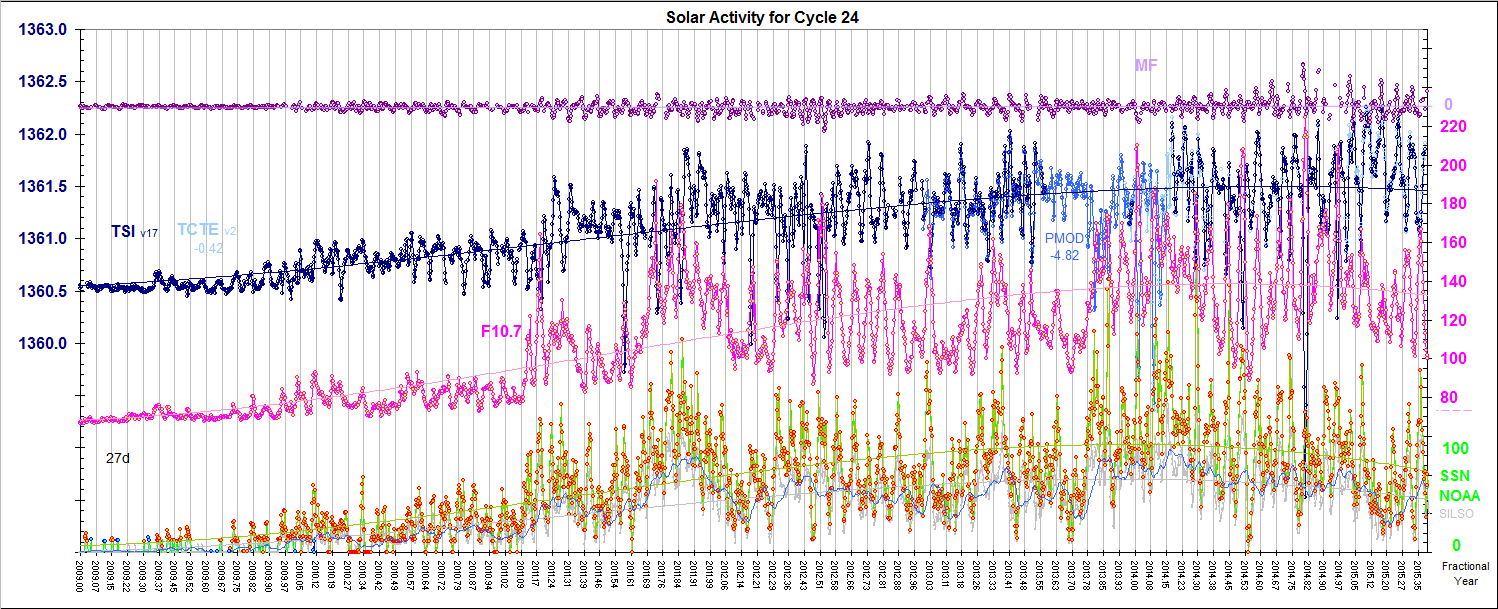
There are a couple of things to note. Firstly, the solar Mean Field, which is the top line, went into the Solar Cycle 23/24 transition being neat and regular like a heartbeat, and has come out choppy and arrhythmic. Secondly, the F10.7 ramp up continues to be very flat indeed. The line of best fit of the F10.7 flux, currently at 82, equates to a sunspot number of 24. In terms of sunspot number, the rate of ramp up over the last year is 11 per annum. At two years into the cycle, this will be the maximum rate of increase we will get.
One of the accepted solar cycle prediction methodologies is a curve fitting exercise two years after the month of solar minimum, which was December 2008. Inspired by the fact that NOAA et al called 2010 the hottest year ever when it was only half over, we have decided to go early and curve fit now. The green corona brightness tells us that solar maximum will be in 2015. Combined with that constraint, the graphic below is the result:

F10.7 flux at solar maximum will be 105, equating to a sunspot number of 50. It will be the weakest solar cycle since Solar Cycle 6, the second half of the Dalton Minimum (1810 to 1823). Solar Cycle 5 had a maximum amplitude of 49.2 and Solar Cycle 6 of 48.7.
The evidence for a Dalton Minimum repeat continues to build. As a 210 year de Vries cycle event, it has come along right on schedule.
Discover more from Watts Up With That?
Subscribe to get the latest posts sent to your email.
John Finn says:
August 28, 2010 at 3:10 am
A zero-sum game involving transposing the cold of the Arctic/Antarctic to the Temperate Zones is a bad deal for civilization in general, most notably in the N. Hemisphere. The Arctic has 6 months in which to re-stock the freezer. The Temperate Zones must support life 365 days out of the year, water and feed them.
Any cooling over a longer time period (ENSO, PDO, AMO, etc.) would be salt rubbed in the wounds should the cycles coincide with the jet stream migration. Toss in the potential for increased cosmic ray induced albedo change plus small TSI effect and you now have enough variables to break a sweat. Last, but not least, there is Murphy, who, as of late, has been demoted to insignificant outlier status, for there is high confidence that all is known about the climate doings that matters.
vukcevic says:
August 28, 2010 at 5:37 am
I personally think that Dr.S. graphs are not presenting true pictures.
http://www.leif.org/research/Livingston%20and%20Penn.png
Up to 2005 there is a downward trend, but for the period 2005-2010 there is no statistically significant trend either in the contrast or magnetic field. It may be an interesting exercise, but for time being it does not appear to solve anything, let alone the great puzzle of the Maunder minimum.
The whole exercise is dodgy Vuk.
Read my rebuttal here.
http://www.landscheidt.info/?q=node/65
John Finn says: August 28, 2010 at 3:10 am
…………..
The UK temperatures on a year to year basis show very wide oscillations, this is usually due to either very cold winter or cool summer and vice versa, but often they move in the opposite direction.
http://www.vukcevic.talktalk.net/CETsw.htm
Of course, all the available energy comes from the sun. For the CETs, it is a matter of how much of that energy is absorbed in the Equatorial regions and to which extent it is transferred to the Arctic. Important factor too is how much of the available storage capacity (in a way of the cold currents) is returned back from the Arctic to the Equator.
The auxiliary events, clouds, wind, precipitation, jet stream etc, have in short term important ‘excursion from the mean’ effect, but in the longer term (decadal bases) they are all, one way or the other, related to the Atlantic Ocean circulation and it is it (Atlantic Ocean circulation) the controlling factor.
Volcanoes have some effect, but they are short term factors, lasting one or two years, then the ‘circulation factor’ re-establishes its predominance.
Here, I show a CET’s precursor which needs a further study, and I hope may point to a fundamental reason for the North Atlantic’s area temperature oscillations.
http://www.vukcevic.talktalk.net/CETnd.htm
Pre-empting on the solar curve fit?
A season by season profile is useful for precipitation but not too clever for temperatures.
Interesting forecast from the Propagation Service Centre, of a maximum in Apr/May 2011, with a SSN of c40.
Link here:-
http://psc.suijs.info/sc24predict1.htm
Thinking:
1) Ice Ages are linked to changes in the parameters of earth’s orbit and axis of rotation. Milankovitch Theory.
2) Delta TSI during solar cycles has been shown to be ~0.1% of TSI. It appears to be too small an amount of energy account for Maunder Min, Dalton Min, LIA and MWP, Roman warm period and CWP (current warm period).
3) Changes in UV, visible light and NIR content of TSI/SSI measured during about second half of SC 23 have some interesting potential aspects wrt climate. SSI change during ~ second half of SC 23 is shown on Page 4 of the presentation of the paper by Harder et al http://lasp.colorado.edu/sorce/news/2010ScienceMeeting/doc/Session3/3.02_Harder_SSI.pdf . This, to me, warrants more study to see if there is plausible way it can account for some historic temp patterns on the scale of the Dalton min, Maunder min, MWP, CWP, etc.
3) Interaction of the earth’s varying magnetic field and the sun’s varying magnetic field causes some effects on the ionosphere. Appears to me to be small in magnitude, however, the mass of the ionosphere is relatively small so relatively little energy input can possibly have a relatively significant effect. I don’t have knowledge of a mechanism.
4) Interaction of the earth’s varying magnetic field and the solar wind causes some effects on the ionosphere. Appears to me to be small in magnitude, however, the mass of the ionosphere is very small so relatively little energy input can possibly have a relatively significant effect. I don’t have knowledge of a mechanism.
5) Current CERN experiment on possible galactic cosmic ray effect on cloud cover may show variation impact on climate via the solar wind/cycle.
That leaves me with knowledge. That is knowledge of the uncertainty about the sun being the cause of CWP, MWP, RWP, LIA, etc. I think it is not looking good so far for solar being the cause, but my mind open to more evidence/mechanisms.
John
John Whitman says: August 28, 2010 at 7:52 am
Thinking:………….
Absolutely agree with all five points you make. For short periods of time (in respect of M. Milankovic’s cycle) measured in hundreds of years; one could assume a constant solar input. There is no need to look for any extra’s input from any other source . The Earth’s hydrosphere (~1.4 × 10^18 tonnes) is a huge storage tank of the sun’s energy, but the energy is not distributed evenly; here the oceans’ currents come into play.
For the rest of my ‘thinking’ see my post above:
http://wattsupwiththat.com/2010/08/27/pre-empting-on-the-solar-curve-fit/#comment-468709
Geoff Sharp says: August 28, 2010 at 6:06 am
I don’t think anything ‘dodgy’ with L&P’s experiment as per say. I think they are doing good and, from science point of view, useful work. What I think is ‘dodgy’ is on one hand is ‘sensational’ interpretations attached to these very short preliminary results, and on the other Dr. S. is sensing that his hypothesis Rmax =0.6 PMFmax is in danger, hence an exit is being prepared.
rbateman says:
August 28, 2010 at 5:59 am
John Finn says:
August 28, 2010 at 3:10 am
A zero-sum game involving transposing the cold of the Arctic/Antarctic to the……
If it’s a zero-sum game then there was no Dalton Minimum cooling – not globally at any rate.
vukcevic says:
August 28, 2010 at 9:49 am
Rmax =0.6 PMFmax is in danger, hence an exit is being prepared.
You are misinterpreting the nature of the prediction. What we predict is the toroidal field. If the sunspot number is no longer a good measure of that, but e.g. F10.7 is, then the prediction should be framed in terms of F10.7, which is what my colleague Ken Schatten is doing. You would benefit from careful reading of: http://www.leif.org/research/Predicting%20the%20Solar%20Cycle%20(SORCE%202010).pdf
vukcevic says:
August 28, 2010 at 9:49 am
I don’t think anything ‘dodgy’ with L&P’s experiment as per say. I think they are doing good and, from science point of view, useful work. What I think is ‘dodgy’ is on one hand is ‘sensational’ interpretations attached to these very short preliminary results, and on the other Dr. S. is sensing that his hypothesis Rmax =0.6 PMFmax is in danger, hence an exit is being prepared.
Yes the exit strategy is again displayed in Leif’s last response to you. But the ad hoc nature of data collection, plus Leif’s use of poor records based on a different collection methods before SC23 cycle max is not good science.
The L&P data is non existent for the last few months, just as the darkness ratio is improving, do we have some recent data we can plot Leif?
Geoff Sharp says:
August 28, 2010 at 10:46 am
Yes the exit strategy is again displayed in Leif’s last response to you. But the ad hoc nature of data collection, plus Leif’s use of poor records based on a different collection methods before SC23 cycle max is not good science.
The L&P data is non existent for the last few months, just as the darkness ratio is improving, do we have some recent data we can plot Leif?
As Vuk you [deliberately?] misunderstand the issue. The data collection is not ad-hoc [look up what ad hoc means] but is statistically unbiased. If you don’t like the few data points before SC23, just ignore them, they make no difference.
My plot is up-to-date through August 1st, 2010. For the past three months the histogram [bin width 200 G] of measured magnetic fields is
bin count
1600 G 1
1800 G 9
2000 G 19
2200 G 15
2400 G 8
2600 G 3
2800 G 4
3000 G 5
For 1998-2002 it was [bin limits rounded]:
1800 G 5
2000 G 26
2200 G 46
2500 G 57
2700 G 39
2900 G 30
3100 G 11
3300 G 11
If L&P are correct we should lose all the little spots and the only ones still visible will be the really dark large spots [just like during the Maunder Minimum]. Keep looking for them for a nice confirmation of L&P.
Geoff Sharp says:
August 28, 2010 at 10:46 am
The L&P data is non existent for the last few months
Matt Penn has been looking at this using the ordinary synoptic data. At a recent [last Tuesday] IAU symposium #273 he reported:
Matthew Penn, William Livingston
National Solar Observatory, Tucson, AZ, United States
“Independent of the normal solar cycle, a linear decrease in the sunspot magnetic field strength has been observed in synoptic infrared observations taken by Livingston at the NSO Kitt Peak McMath Pierce telescope. This trend was seen to continue in observations of the first sunspots of the new solar cycle 24, and extrapolating this pattern would lead to only half the number of spots in Cycle 24 compared to Cycle 23, and to virtually no sunspots in Cycle 25.
We examined synoptic observations from the NSO Kitt Peak Vacuum Telescope and found a change in sunspot intensity and magnetic flux which roughly agreed with the infrared observations. A more detailed examination of both data sets reveals that the relationship of the sunspot magnetic fields with intensities, or with sunspot size, remain constant during the period of observation. While the observations show a lot of scatter, at a barely significant level we see that smaller, brighter and magnetically weaker spots have appeared more frequently as time passes.”
Leif Svalgaard says: August 28, 2010 at 10:06 am
… the prediction should be framed in terms of F10.7, which is what my colleague Ken Schatten is doing. You would benefit from careful reading of: http://www.leif.org/research/Predicting%20the%20Solar%20Cycle%20(SORCE%202010).pdf
I agree with lots of your work, but not always, I have no quarrel with your way of thinking (which is not case the other way), and especially not with Dr. Schatten’s, but it was said :
Schatten’s work on percolation theory and the dynamo is not worth following up, since it has many faults and is not accepted .
Everyone unto his hypothesis. Mine is simple and straightforward, likely to be wrong, as many others, but for time being is as good as any:
http://www.vukcevic.talktalk.net/LFC2.htm
I didn’t know I’d been demoted to insignificant outlier… I’m just busy! Don’t have time to read up a lot here now, bits and spurts, rarely an entire thread & comments. I actually have a productive job to do in this society.
If the stratosphere reaching eruptions come, we cool, if not we roast. Simple as that. Its looking like some large ones will eventually plume at this time but thats subject to change. C-ya Master Bateman. Its cool at night in Maine, but ol sol still puts on a powerful influence during the day.
John Finn said:
“If it’s a zero-sum game then there was no Dalton Minimum cooling – not globally at any rate.”
Depends on your definition of ‘zero sum’.
For the oceans it means ocean heat content.
For the troposphere it means as measured by thermometers or satellites.
For the stratosphere upwards it means as measured by satellites.
Or permutate any combination.
I can envisage a long slow decline or increase in ocean heat content warming or cooling the troposphere correspondingly on a global basis.
I can envisage a long slow decline or increase in the temperature of the stratosphere cooling or warming the troposphere correspondingly on a global basis.
Most likely an interplay between variations in both ocean heat content and stratospheric temperatures being brought back towards equilibrium by constant air circulation adjustments in the troposphere.
And whatever happens it has to be global because the means of adjustment is the latitudinal positioning of the air circulation systems.
John Finn says: August 28, 2010 at 10:00 am
If it’s a zero-sum game then there was no Dalton Minimum cooling – not globally at any rate.
In UK Dalton minimum cooling lasted only 10 years.
http://www.vukcevic.talktalk.net/CETsw.htm
1800-1810 the winters were cooler than average, but the summers were warmer than average: zero sum.
1810-1820 both the summers and winters were lower than average, even so the summer of 1817 was one of the hottest on the record, also high were 1811 and 1821. It was two winters which were exceptionally cold 1795 and 1814.
For the record the coldest winters trio: 1684, 1740 and 1963, none in the Dalton period.
I think the Dalton solar minimum was two cycles 1800-1830.
David Archibald says:
August 27, 2010 at 7:01 pm
“Thus, the two methods using the coronal “rush to the poles” result in
predictions for solar maximum at 2013.3 ± 0.5 and 2014.8 ± 0.5, or 2013-2014.”
I rather doubt the author would want the former prediction reported at this late date, it is no longer a possibility.
Nothing like being out there observing Maine. The water is quite warm too, just like it was in 2000, I’ve been swimming in it. Déjà vu
Smokey says:
August 27, 2010 at 6:01 pm (Edit)
John Finn,
No fair, TonyB was just giving contemporary accounts of an unusually cold period. And it was world-wide, just like the MWP.
Pick your proxy. I pick this.
******************************
Interesting proxy.A painting that is wrong in many details,
http://www.ushistory.org/washingtoncrossing/history/whatswrong.htm
Rain, sleet on a christmas night in NJ. go figure. People re enact the crossing now adays, unless the weather is too severe on the river. So, what was Tmax and Tmin on that day? and how accurately do we know it? I find it interesting that people who do not trust 1000’s of thermometers around the world would trust the tales of tall tale telling americans. wanna discuss the cherry tree?
How cold was it that dec .. hmm I dunno. this is pretty close..
http://books.google.com/books?id=STcoJP7esp4C&pg=PA399&lpg=PA399&dq=weather+records+1776&source=bl&ots=T4DGW3gzi0&sig=ixgu8YFqMXqUfysWXhmHZTp9tmo&hl=en&ei=zWR5TJunLoqstAO3ttjBAQ&sa=X&oi=book_result&ct=result&resnum=8&ved=0CEIQ6AEwBw#v=onepage&q=weather%20records%201776&f=false
Around the same conditions as in 1960
http://www.almanac.com/weather/history/NJ/Trenton/1960-12-25
Started out raining turned to sleet and then snowed, nothing out of the ordinary. Why do people who dont trust the instruments of today, trust the diaries and scriblings of a few random dudes. and then call themselves skeptics
vukcevic says:
August 28, 2010 at 11:43 am
Schatten’s work on percolation theory and the dynamo is not worth following up, since it has many faults and is not accepted.
As usual you attack strawmen and spread doubt wherever possible. First: who said that? and second, the percolation theory has nothing to do with the Schatten prediction which is based on the B-L model.
i>Mine is simple and straightforward, likely to be wrong
Indeed, and is not as good as any, because it is not based on anything viable, and is already wrong back in time.
Ed Murphy says:
August 28, 2010 at 11:44 am
I didn’t know I’d been demoted to insignificant outlier…
No, not you, the other Murphy.
John Finn says:
August 28, 2010 at 10:00 am
The whole point was that even a zero-sum redistribution of climate from poles to Termperate zones is a raw deal.
That the Grand Minimums were nothing more than zero-sum games is your conclusion.
I say Dalton departed the least, the Maunder and Sporer the most, towards the colder side of zero-sum.
Leif Svalgaard says: August 28, 2010 at 1:00 pm
……………..
Author of those words is well known in the field of the solar science, one of only 22 recipients of the Hale Prize of the American Astronomical Society, along with such names as Eugene N. Parker and Horace W. Babcock.
You can’t win ’em all, good night.
John Finn says:
August 28, 2010 at 3:10 am [ … ]
John, I was just trying to make it easy for you, nice guy that I am. I could have posted a painting of folks ice skating on the Thames. I posted the American scene to show that the cold wasn’t local, but affected another continent.
Do you think folks back then were fabricating everything? Maybe everyone back then was making up stories about ice festivals on the frozen Thames. Maybe tree lines around the world descended for no good reason as the planet warmed following the LIA. Is that what you think?
You’re flogging a dead horse trying to convince people here that the MWP and the LIA never happened. Michael Mann claimed the same thing — and he was thoroughly debunked by people outside his field. No scientist wants the public humiliation of being debunked, especially by amateurs. But in Mann’s case that’s the lesser of two evils; the greater evil for Mann is opening the books to skeptical scientists.
Why don’t you ask Michael Mann to produce all of his data, metadata and methodologies, so they can be tested according to the scientific method? Last I heard, Dr Mann is still hiding his methods after twelve years of stonewalling. That’s what a scientific charlatan would do, no?
Smokey says:
August 28, 2010 at 2:42 pm
John Finn says:
August 28, 2010 at 3:10 am [ … ]
John, I was just trying to make it easy for you, nice guy that I am. I could have posted a painting of folks ice skating on the Thames. I posted the American scene to show that the cold wasn’t local, but affected another continent.
But skating on the Thames was not confined to the Dalton Minimum. The Thames froze over many times in the past 1000 years. It even froze during the MWP. Your link to the painting is meaningless. Steven Mosher (August 28, 2010 at 12:56 pm) makes this point perfectly well.
Do you think folks back then were fabricating everything? Maybe everyone back then was making up stories about ice festivals on the frozen Thames
No – they weren’t making things up but there was nothing special about the Dalton Minimium period in this respect. You seem to have trouble grasping this point. There are also good reasons why the Thames tended to freeze motre before the mid 19th century which are related to faster river flow and more shelter.
You’re flogging a dead horse trying to convince people here that the MWP and the LIA never happened.
I’m not trying to convince anyone that the LIA never happened. However, the LIA was not confined to the the Dalton Minimum period – or was it? What period does the LIA cover? When did this “global” event start/finish? I keep reading that it lasted for several hundred years. The Dalton Minimum only ran for ~30 years . What caused the cool climate the rest of the time?