Guest post by David Archibald

We return to Dr Svalgaard’s plot of four solar parameters, updated daily at: http://www.leif.org/research/TSI-SORCE-2008-now.png
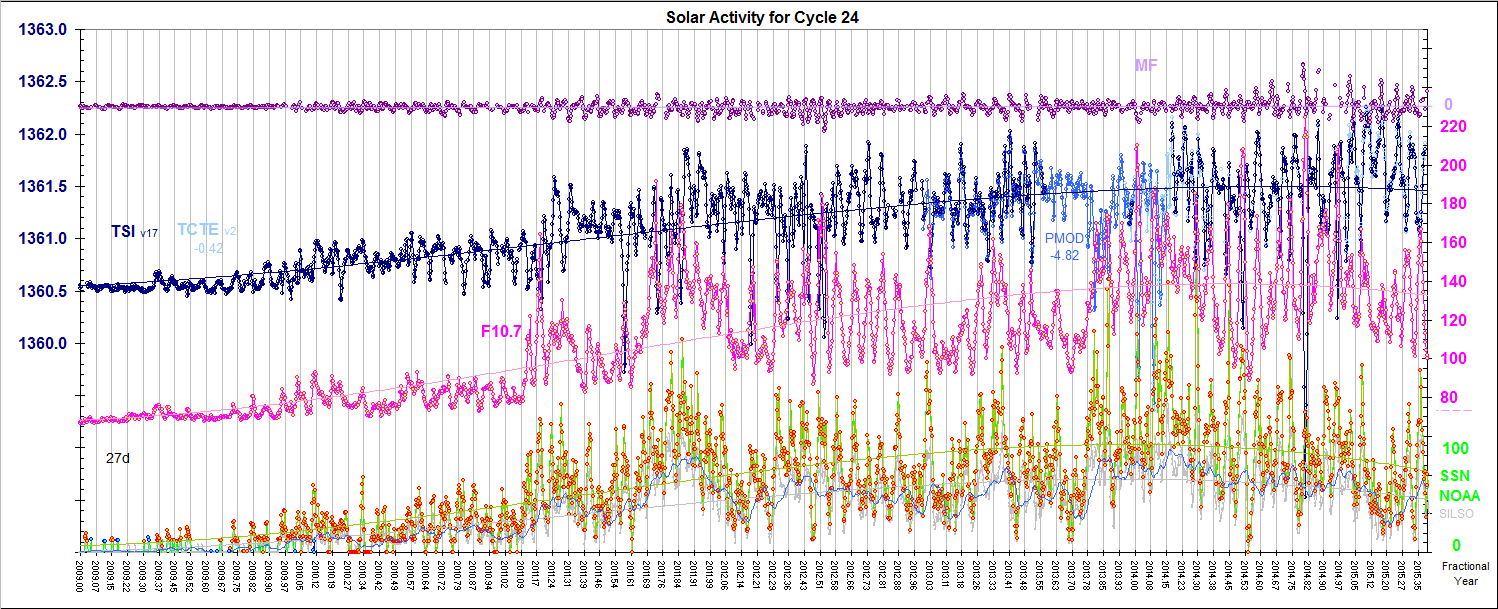
There are a couple of things to note. Firstly, the solar Mean Field, which is the top line, went into the Solar Cycle 23/24 transition being neat and regular like a heartbeat, and has come out choppy and arrhythmic. Secondly, the F10.7 ramp up continues to be very flat indeed. The line of best fit of the F10.7 flux, currently at 82, equates to a sunspot number of 24. In terms of sunspot number, the rate of ramp up over the last year is 11 per annum. At two years into the cycle, this will be the maximum rate of increase we will get.
One of the accepted solar cycle prediction methodologies is a curve fitting exercise two years after the month of solar minimum, which was December 2008. Inspired by the fact that NOAA et al called 2010 the hottest year ever when it was only half over, we have decided to go early and curve fit now. The green corona brightness tells us that solar maximum will be in 2015. Combined with that constraint, the graphic below is the result:

F10.7 flux at solar maximum will be 105, equating to a sunspot number of 50. It will be the weakest solar cycle since Solar Cycle 6, the second half of the Dalton Minimum (1810 to 1823). Solar Cycle 5 had a maximum amplitude of 49.2 and Solar Cycle 6 of 48.7.
The evidence for a Dalton Minimum repeat continues to build. As a 210 year de Vries cycle event, it has come along right on schedule.
peterhodges says:
August 27, 2010 at 11:58 am
this petition in an effort to clearly indicate that this petition is not an attempt to regulate ammunition or firearms.
Sincerely,
Michael Fry, PhD
unfortunately, the petitioners intentions and those of the EPA are not the same thing. if they act you can bet whatever they come up with will regulate ammunition and do nothing for the birds.
and overall very cool blogpost and thread!
This is getting a bit ot, but the petition itself does mention some of the alternatives to lead; notably the solid copper “Barnes” bullet, which is a good round but approx. 3x the cost of traditional bullets, copper jacketed steel core bullets, which are illegal for hunting since they are classed as armor piercing by the govt, and various alloy mixes (bismuth, tin, etc. ) which are all in the experimental phase and have a number of reliability issues. That said, I’ve been hunting and fishing with lead for 60 years, and eating game shot with lead for the same period, with zero ill effects.
The (not so ) hidden agenda of the CBD is obvious of course – eliminate hunting and fishing to “save the critters”, for the good of humanity of course. Same goes for the CO2/AGW, etc. will kill us crowd.
I get very weary of these types who preach endlessly about their high mindedness, and their evangelical zeal to “save humanity from itself”, ad nauseum.
I wrote about the climate during the Dalton minimum through the prism of the life of Charles Dickens who, fortunately, was conveniently born in 1812.
http://noconsensus.wordpress.com/2010/01/06/bah-humbug/
Buy coats. Thick ones
Tonyb
Hi Tony
Great article and a good source of info.
http://noconsensus.wordpress.com/2010/01/06/bah-humbug/
Went back to check on the ‘CET driver’, and indeed 1805-20 it is there on a par with 1690-1700 and 1740-50.
Yeah, I guessed so. But that is not a force. I don’t mind bying such ideas if a mechanism can be shown to exist. But noone has done that yet. Quite the opposite.
Pamela Gray says:
August 27, 2010 at 6:36 am
If the unspoken “read between the lines” subscript here is to Earth’s temperature prediction, and the unspoken “read between the lines” prediction, based on the Sun’s current measurement, is for cold, I still don’t see a mechanism. You might as well say that my slightly graying temples, which appeared almost at the same time we began to slip into minimum, predict cold for the next 30 years as long as my temples continue to gray.
This may well be true if the grayness is due to snow…
Without mechanism, comments related to temperature or “warmists” sound silly and early caveman era to me.
I shall defer to another’s words:
Leif Svalgaard says:
August 27, 2010 at 8:17 am
3) The solar flux wil max at 125 sfu. If Livingston and Penn are correct, the sunspot number is no longer a meaningful measure of solar activity: http://www.leif.org/research/SHINE-2010-Microwave-Flux.pdf
Livingstone and Penn have offered no mechanism to their extrapolation/prediction. Does this mean we should disregard it as caveman era? It is after all, (to use the words of another contributer) pure numerology.
Correlation is not causation. But sometimes correlation *is* prediction – and that can be enough to be getting on with.
Curiousgeorge says:
August 27, 2010 at 12:57 pm
The (not so ) hidden agenda of the CBD is obvious of course – eliminate hunting and fishing to “save the critters”, for the good of humanity of course. Same goes for the CO2/AGW, etc. will kill us crowd.
I get very weary of these types who preach endlessly about their high mindedness, and their evangelical zeal to “save humanity from itself”, ad nauseum.
During winter time, the carrying capacity of a given area is reduced. Any population over this carrying capacity will starve to death. They may as well spend the winter in your freezer, than starving to death outdoors.
Don B says:
August 27, 2010 at 7:41 am
“Pamela, CERN is researching a possible mechanism, the Svensmark hypothesis. Seventeen collaborating research organizations from 9 nations. None of them do cavemen drawings.
http://cdsweb.cern.ch/record/1257940/files/SPSC-SR-061.pdf”
I find it hard to believe that some like Pamela with an interest in this subject would have been unaware of this. Makes me ponder your motives Pamela, as a logical follow on during your post would have been to mention the currently research going on this field.
Unless of course you were trying to create the impression that there is no research into a causal link between solar activity and global temps. This is something I might expect from someone with a warmist view.
Sorry if I’m being cynical but this is the impression your post conveyed (Pamela).
“possible mechanism”: If the TSI is fairly constant, and the UV content goes up and down, some other part of the spectrum must go the opposite direction. This could certainly have an effect on our little biosphere, magnitude unknown.
Everything is connected to everything else, at some level. I doubt the butterflies in China do much for hurricanes in the Atlantic, but a large change in UV? That might be interesting.
Alan the Brit says:
August 27, 2010 at 3:43 am
The Seuss cycle and the de Vries cycle are the same thing, with a period of 210 years.
meemoe_uk says:
August 27, 2010 at 5:10 am
Yes, someone will get the WSO data and plot up those previous cycles.
Tom Rowan says:
August 27, 2010 at 6:55 am
If solar maximum is in 2013 or 2014, then it will be lower than a sunspot number of 50. Short solar cycles are strong and long cycles are weak. As we are having a weak cycle, it will be long. My estimate is 12 years. Long cycles tend to have equal periods of rise and decline. 2015 is in the middle, with that estimate backed up by the green corona brightness.
TonyB says:
August 27, 2010 at 1:03 pm
I wrote about the climate during the Dalton minimum through the prism of the life of Charles Dickens who, fortunately, was conveniently born in 1812.
http://noconsensus.wordpress.com/2010/01/06/bah-humbug/
Buy coats. Thick ones
Tonyb
I’m not sure how you reached your conclusions. From your linked article it says
Decadal CET average 1810-1819 8.798C. The coldest decade since 1690-1699.
which sounds significant until you realise the Decadal CET average for 1780-1789 was 8.86 deg, i.e. just 0.06 deg difference between the depths of the Dalton Minimum and the 1780s when solar activity was relatively high.
There are loads of other ‘facts’ in your article which appear to support an anomalously cold Dalton Minimum but on close analysis show very little.
John Finn,
No fair, TonyB was just giving contemporary accounts of an unusually cold period. And it was world-wide, just like the MWP.
Pick your proxy. I pick this.
Z says:
August 27, 2010 at 3:11 pm
Livingstone and Penn have offered no mechanism to their extrapolation/prediction.
It has been known for ~150 years that sunspots form by the coalescence of small pores and ‘specks’. Ken Schatten has a mechanism for this: http://www.leif.org/research/Percolation%20and%20the%20Solar%20Dynamo.pdf The efficiency of that process could be variable with time [granted that we don’t know why, but it would be strange if that were absolutely constant all the time as any complex system has internal fluctuations] so the L&P effect could have a physical basis.
David Archibald says:
August 27, 2010 at 4:54 pm
If solar maximum is in 2013 or 2014, then it will be lower than a sunspot number of 50. Short solar cycles are strong and long cycles are weak.
If the maximum is is 2013-2014 the cycle will be stronger than if the maximum were to come in 2015.
My estimate is 12 years.
Based on what?
2015 is in the middle, with that estimate backed up by the green corona brightness
One more time: according to green corona man, Dick Altrock, maximum will be 2013-2014, not 2015.
From SOHO-23, ASP conf. Series, vol 428, p 147 (2010): “The properties of the current “rush to the poles” yields an estimate of 2013 or 2014 for solar maximum”.
Dear oh dear, Dr Svalgaard. You have selectively quoted Altrock. What he said was: “Thus, the two methods using the coronal “rush to the poles” result in
predictions for solar maximum at 2013.3 ± 0.5 and 2014.8 ± 0.5, or 2013-2014.” Rounding up 2014.8 makes it 2015.
He also said, and I quote: “Altrock concluded that
(i) the maximum of solar activity, as defined by the smoothed sunspot number,
occurred 1.5 ± 0.2 yr before the extrapolated linear fit to the RttP reached the
poles, and (ii) the RttP could be used to predict the date of solar-cycle maximum up to three years prior to its occurrence.”
Thus, if his own methodology is correct and solar maximum is in 2015, he is calling it two years too early to be accurate.
Speaking of going early, the whole basis of curve fitting at two years post the month of minimum is that the shape of the curve is constrained. Therefore, if the maximum is in 2013, the sunspot number will be lower than if it is in 2015. We can’t wish a higher rate of ramp up into existance.
David Archibald says:
August 27, 2010 at 7:01 pm
Dear oh dear, Dr Svalgaard. You have selectively quoted Altrock.
No, I have quoted his own assessment from the conclusion of his talk. And I know Dick and what he conservatively thinks about this.
Thus, if his own methodology is correct and solar maximum is in 2015, he is calling it two years too early to be accurate.
If he is calling it to be accurate, then 2015 would be inaccurate.
Therefore, if the maximum is in 2013, the sunspot number will be lower than if it is in 2015.
No, as the rise time would be shorter and the maximum thus higher.
And don’t ‘dear oh dear’ me again.
well is the max on 2001? or 2003?
2003
+ 13
______
2016
will be a long time out
there is a date coming 2017 for tagging everyone with a readable chip.
6-7 years? very interesting !
gary gulrud says:
August 27, 2010 at 10:14 am
Under present management, the last thing I would expect to see is America preparing as a nation.
At this point, it’s up to individuals and small communities to prepare….if they are so inclined, and to the extent that they are able.
One common thread in agriculture: In a Grand Minimum, the wheat always gets it first.
It matters not how this is accomplished (mechanism), it does matter whether this is occuring once again.
Leif Svalgaard says:
August 27, 2010 at 6:11 pm
that process could be variable with time [granted that we don’t know why, but it would be strange if that were absolutely constant all the time as any complex system has internal fluctuations] so the L&P effect could have a physical basis.
Weasel words everywhere….time to give L&P away Leif, its not happening. The gauss and contrast readings continue to get higher towards cycle max, spots won’t disappear near 2015 (it will be near cycle max) but if you hang around to the next minimum eventually it will happen.
Current spot 1101 (which will get darker) is measuring 82%, even with the reduced frequency the regions are increasing in magnetic strength.
Not sure how relevant this is to the Svensmark hypothesis and his cloud experiment, but the standard operating procedure for detecting cosmic rays at home appears to require the construction of a cloud chamber:
=====
After about 15 minutes, you should start to notice the tracks of particles passing through. The tracks look a little like spider’s threads going along the chamber floor. It may help to turn off any room lights. As the electrically charged cosmic rays come along, they ionize the vapor (i.e., tear away the electrons in some of the gas atoms along its path). This leaves these atoms positively charged, which attracts nearby atoms. This is enough to start the condensation process and so you see the little droplets forming along the path the particle took through the chamber.
http://www.amnh.org/education/resources/rfl/web/einsteinguide/activities/cloud.html
======
Is that not a mechanism, Pamela Gray?
Geoff Sharp says:
August 27, 2010 at 9:49 pm
spots won’t disappear near 2015 (it will be near cycle max)
Cheap shot. Nobody is saying that now. It is clear that the L&P will be drawn out further.
Weasel words are appropriate when uncertainties are involved. We can’t all be ‘in the know’ as you.
“wayne Job says:
My question to this information would be, what is the best investment for the cool to come, coal, oil or gas, perhaps uranium? Maybe EM Smith could help put me right.”
Fine Scotch and deep red Bordeaux Wines…
Shortage of Barley and lack of a ‘good vintage’ in coming years would make them stellar and made of unobtanium…. That is, should we actually cool.
And if we don’t, you can still drink them and they will still increase in value.
Pamela Gray,
“The extreme ultraviolet photons that are most intense during the peak of the solar cycle aren’t the same as the UV rays that give you sunburns,” notes Dr. Judith Lean, a physicist at the US Naval Research Laboratory. “Sunburns come from the UV-A and UV-B bands around 300 nanometers. Extreme ultraviolet photons from the Sun are at least 10 times more energetic than UV-A and UV-B and they vary 100 times more [between solar minimum and solar maximum]. It’s a good thing they’re all absorbed by nitrogen and oxygen at high altitudes — otherwise a day at the beach would be no fun.”
And these EUV rays warm the Stratosphere on absorption, which coupled with the alteration in the polar jet streams as described by Stephen Wilde would provide a reasonable mechanism, no?
Follow your posts with interest, keep them up!
It certainly does look like L&P is happening
http://www.leif.org/research/Livingston%20and%20Penn.png
Reflecting on my last post, is there any need to find greater variations in Solar TSI output to account for cool climate periods? If a decrease of Extreme UV can force polar jet streams equatorwards the considerable cold sinks of Greenland and Antarctica would be able to sustain temperature dips for many years in temperate regions, mainly in the winters.
This may explain why the average temperature records do not show much of a dip for these periods, insolation is only a little below average, but a locked polar jetstream can be a disaster for crops and animals.
i> Smokey says:
August 27, 2010 at 6:01 pm
John Finn,
No fair, TonyB was just giving contemporary accounts of an unusually cold period. And it was world-wide, just like the MWP.
TonyB has written a post which constantly refers to the CET record. I have used the same temperature record show that his cherry-picked statistics are misleading. There were decades throughout the 18th and 19th centuries which were just as cold as the 1810-1819 decade. I showed an example of one (1780-1789) in a previous post, another example is the 1880-1889 decade which had mean temperature of 8.87 deg – again within a few hundredths of the 1810-1819 mean temperature. In fact, the mean temperatures for most decades in the 19th century were within 0.2-0.3 deg of the 1810-1819 mean temperature.
So, according to TonyB’s sources (and several others), it was not an “unusually cold period”.
Pick your proxy. I pick this.
A Painting?? You’ve provided a link to a painting as support for your assertion that the LIA was both unusually cold and widespread. This should be easy. I’ll start by picking a proxy from our very own TonyB who posted his little gem just over 12 months ago
http://wattsupwiththat.com/2009/06/20/historic-variation-in-arctic-ice/
In his post, TonyB cites the address given by the President of the Royal Society in November 1817 . Tony B writes:
So, in 1817, slap bang in the middle of TonyB’s coldest decade of the “unusually cold” Dalton Minimum the Royal Navy are investigating warming in the arctic. This, incidentally, was prompted by reports from seasoned arctic explorers such as William Scoresby.
I personally think that Dr.S. graphs are not presenting true pictures.
http://www.leif.org/research/Livingston%20and%20Penn.png
Up to 2005 there is a downward trend, but for the period 2005-2010 there is no statistically significant trend either in the contrast or magnetic field. It may be an interesting exercise, but for time being it does not appear to solve anything, let alone the great puzzle of the Maunder minimum.