Guest post by David Archibald

We return to Dr Svalgaard’s plot of four solar parameters, updated daily at: http://www.leif.org/research/TSI-SORCE-2008-now.png
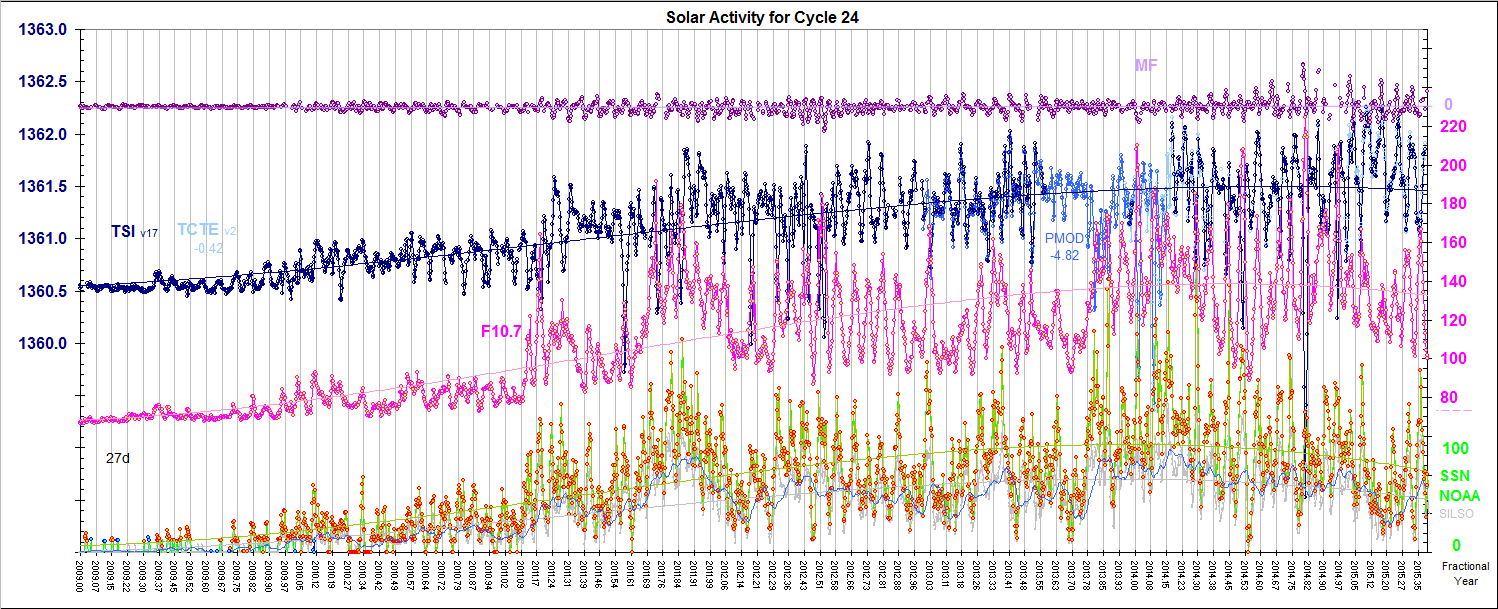
There are a couple of things to note. Firstly, the solar Mean Field, which is the top line, went into the Solar Cycle 23/24 transition being neat and regular like a heartbeat, and has come out choppy and arrhythmic. Secondly, the F10.7 ramp up continues to be very flat indeed. The line of best fit of the F10.7 flux, currently at 82, equates to a sunspot number of 24. In terms of sunspot number, the rate of ramp up over the last year is 11 per annum. At two years into the cycle, this will be the maximum rate of increase we will get.
One of the accepted solar cycle prediction methodologies is a curve fitting exercise two years after the month of solar minimum, which was December 2008. Inspired by the fact that NOAA et al called 2010 the hottest year ever when it was only half over, we have decided to go early and curve fit now. The green corona brightness tells us that solar maximum will be in 2015. Combined with that constraint, the graphic below is the result:

F10.7 flux at solar maximum will be 105, equating to a sunspot number of 50. It will be the weakest solar cycle since Solar Cycle 6, the second half of the Dalton Minimum (1810 to 1823). Solar Cycle 5 had a maximum amplitude of 49.2 and Solar Cycle 6 of 48.7.
The evidence for a Dalton Minimum repeat continues to build. As a 210 year de Vries cycle event, it has come along right on schedule.
Discover more from Watts Up With That?
Subscribe to get the latest posts sent to your email.
——————-
Henry Pool,
CME = Coronal Mass Ejections, see http://helios.gsfc.nasa.gov/cme.html
John
The global implications of Dalton Minimum tempertures are very alarming.
Geoff Sharp says:
August 27, 2010 at 3:52 am
Which force is that (you didn’t mention it)?
If the unspoken “read between the lines” subscript here is to Earth’s temperature prediction, and the unspoken “read between the lines” prediction, based on the Sun’s current measurement, is for cold, I still don’t see a mechanism. You might as well say that my slightly graying temples, which appeared almost at the same time we began to slip into minimum, predict cold for the next 30 years as long as my temples continue to gray. Without mechanism, comments related to temperature or “warmists” sound silly and early caveman era to me.
The maximum for solar cycle 23 started in 1999. If my math is correct, this is eleven years later.
Being that the sunspot solar cycle is eleven years, could it be possible that we have started the maximum for solar cycle 24?
I know these 11 year cycles are an average length.
The above prognostication relies on a 16 year gap between cycle 23 max and cycle 24 max.
I think cycle 24 is a dude firecracker. Lots of anticipation, a fizzle, and into the dust bin.
I think we have entered our maximum period now.
Do the prediction methods used here work well for the 3 previous cycles when satellite data was available and modern telescopes allowed accurate measurements also??
Will Antony host a bookies forum where he allows readers to choose a solar maximum sunspot number and month/year to see how well the readership does, just as he did for Arctic Sea Ice Minimum last winter prior to this September’s event??
Might be fun, eh?? Particularly if the cumulative data isn’t made available to avoid the ‘sheep herd’ effect……….allowing him to make an announcement as to what all readers thought……….
Quote>There are a couple of things to note. Firstly, the solar Mean Field, which is the top line, went into the Solar Cycle 23/24 transition being neat and regular like a heartbeat, and has come out choppy and arrhythmic. F10.7 flux at solar maximum will be 105, equating to a sunspot number of 50. It will be the weakest solar cycle since Solar Cycle 6, the second half of the Dalton Minimum (1810 to 1823). Solar Cycle 5 had a maximum amplitude of 49.2 and Solar Cycle 6 of 48.7.<
Hey, that's my "under the influence" prediction. lol
Joe Lalonde,
Sunspots are actually exit ports for the Sun People’s spaceships 😉
Quote>There are a couple of things to note. Firstly, the solar Mean Field, which is the top line, went into the Solar Cycle 23/24 transition being neat and regular like a heartbeat, and has come out choppy and arrhythmic.F10.7 flux at solar maximum will be 105, equating to a sunspot number of 50. It will be the weakest solar cycle since Solar Cycle 6, the second half of the Dalton Minimum (1810 to 1823). Solar Cycle 5 had a maximum amplitude of 49.2 and Solar Cycle 6 of 48.7.<
Hey, that's my "under the influence" prediction! lol
I don't know what happened to the last post but should have..
>There are a couple of things to note. Firstly, the solar Mean Field, which is the top line, went into the Solar Cycle 23/24 transition being neat and regular like a heartbeat, and has come out choppy and arrhythmic.<
Didn't Leif tell us that herky jerky starts are not that unusual. Then sited another cycle to demonstrate the poin?
Everything OK Leif.
Had this copy and pasted twice and this is now the third attempt.
>F10.7 flux at solar maximum will be 105, equating to a sunspot number of 50. It will be the weakest solar cycle since Solar Cycle 6, the second half of the Dalton Minimum (1810 to 1823). Solar Cycle 5 had a maximum amplitude of 49.2 and Solar Cycle 6 of 48.7.<
Hey, that's my "under the influence" prediction! lol
I don't know what happened to the last posts but should have..
David’s projection is neither too optomistic nor pessimistic.
There are 3 possibilites:
1.) Solar Activity will turn up late, but still turn up. Max ~ 70.
2.) Solar Activity will follow the 2 year rule. Max ~ 50.
3.) Solar Activity will suffer a ‘double dip’ recession and crash. Max ~ 20-30.
A very strange occurence appears in the literature prior to Solar Activity downturns: People get wary and start hoarding/taking less risk which turns the bow planes of the Markets down. I’ll take the Human animal sense about this, project that Society itself senses the inpending 2nd downturn, to which the Sun will have already been on it’s way to.
As Pamela points out there is no proven mechanism between sunspots and temperature, however from what I understand there are one or two mechanisms, which have been proposed. The most popular one and the most plausible as far as I can see is the cosmic radiation causing cloud cover to change. When the electromagnetic field is low there are more clouds due to increased cosmic radiation, and conversely if the EM field is high. Another mechanism I’ve heard about would be the interaction
of the Electromagnetic field of the Sun on the Earth’s EM field which causes the Oceans to warm or cool slightly, i.e. the globe warms up from inside.
Like other “cosmic” phenomena like black holes, dark matter I think this mechanism will be very difficult to prove and so we can only look at the correlation between sun activity and temperature.
Something Anthony noted was the seeming step function change in the rate of decline as solar flux as it plummeted below 70. Change of state. Ominous words when you are talking about the sun.
Kinda like the Milankovitch cycles. We know we are on the ice cliff staring into an ice age, according to Milutin. We know the sun regularly shuts down for maintenence. And we know we are in for some nasty weather. When the sun don’t shine the weather is cold, rainy, snowy, and ice-agey.
The weather today is ice-agey with a chance of warming by 2050. Isn’t that what the experts are telling us? The southern half of our planet is in the ice-box. It snowed in Austrailia years in a row…..in summer.
Our future is staring us in the face. And know one seriously studying climate change can scientifically deny that all the indicators are there, we see them, and we know what they indicate.
You want a prediction about the weather, you’re asking the wrong Phil.
I’ll give you a winter prediction.
It’s gonna be cold…
it’s gonna be gray…
and it’s gonna last you
for the rest of your life.
Phil Connor, Meteorologist WPBH-TV9
Pamela, CERN is researching a possible mechanism, the Svensmark hypothesis. Seventeen collaborating research organizations from 9 nations. None of them do cavemen drawings.
http://cdsweb.cern.ch/record/1257940/files/SPSC-SR-061.pdf
I am contemptuous of anyone having even a tiny sense of alarmism resulting from Mr. Archibald hypothesizing a near term (now) Dalton Minimum.
Adapting is why our species is in the successful position we are now. Our civilizations actually accelerated through the early 1800s (Dalton Minimum) and we arrived at today with no lingering effects from it, quite the contrary. Indeed adapting in the modern world means development of new technologies that have benefit beyond the temporary climate change that motivated creating them in the first place.
Even a Maunder Minimum would just be merely be a temporary adapting, as we have done since the very first human appeared.
The difficulty lies in our governments impeding adaptation . . . . there is no problem with a free society easily adapting rapidly.
John
Sunspot-
Agree, the implications of a global decrease in temperatures are much more alarming. Nothing like a crop failure on the order of 1816 to get the whole global warming mess put to bed, for good. A volcanic eruption, added to a nice minimum, WOW!
http://en.wikipedia.org/wiki/Year_Without_a_Summer
johnnythelowery says:
August 27, 2010 at 5:22 am
Besides which you are all wrong because there is no coupling with the sun because the TSI variance is only .1 of W/m2.
Lots of people mention this, but why do we dismiss this? Sounds like the case of ‘the debate is over’. Perhaps, and I am no expert here, but maybe there is some affect that we just don’t know about, so ‘perhaps’ it does not have a direct affect, but I would not dismiss even this small amount of change.
Of most interest in the solar activity sphere is the temperature profile in the years to come. The prognosis has been for a 2C* global temperature drop, enough to demolish the CAGW concept. I have hand-plotted such a profile, but it would better if those familiar with the ups and downs of the expected drop to plot such an expectation with time and the solar activity.
We lambast the IPCC for foolish or misguided projections (not “predictions”, right?). If this is to be the demise of CAGW, it would be wonderful to have something to paste on the cubicle wall and watch its progression (or not). Anyone help here? I’m old-school and have no 12-year-old to help me.
But we are all gonna die in 2012 from a massive solar storm!!
http://www.news.com.au/technology/sun-storm-to-hit-with-force-of-100-bombs/story-e6frfro0-1225909999465
“johnnythelowery says:
August 27, 2010 at 5:22 am
Besides which you are all wrong because there is no coupling with the sun because the TSI variance is only .1 of W/m2.”
In my judgement based on observations a lengthy downturn in solar activity causes a warming stratosphere, an enhanced polar oscillation and the jets to sink equatorward cooling the mid latitudes and by sending the cloud banks nearer the equator increases albedo and reduces energy entering the oceans.
The issue to resolve is how exactly does a quiet sun warm the stratosphere when all current theories expect a cooling stratosphere when the sun is less active.
I’m safe following Bateman and Archibald in saying Rmax <50 in mid-2015- although Badalyan predicted this half a decade ago(coronal green line).
1) The solar mean field has a steady, strong rhythm now. Here are the last ten rotations superposed: http://www.leif.org/research/Solar-MF-Superposed.png You can see the sharp polarity change at day 18.
2) The green corona points to a maximum in 2013-2014, not 2015, according to Dick Altrock who is the person measuring the green corona at NSO.
3) The solar flux wil max at 125 sfu. If Livingston and Penn are correct, the sunspot number is no longer a meaningful measure of solar activity: http://www.leif.org/research/SHINE-2010-Microwave-Flux.pdf
Henry@John&Mark
Thanks for the explanation.
Henry Pool says: “Sorry could not find CME in the glossary. What does it mean?”
Google [CME + solar] and you rapidly get a link to Wankapedia showing that CME = Coronal mass ejection. This is a general method and can be used to decipher other abbreviations without adding fluff to the thread.