The Heliospheric Current Sheet Tilt Angle and Implications for Friis-Christensen and Lassen Theory

Guest post by David Archibald
The Chairman of NOAA’s Solar Cycle 24 review panel, Douglas Biesecker, said back in March 2007 that the flattening of the heliospheric current sheet was one of the expected signatures of solar minimum (the Solar Cycle 23/24 transition). At times of weak solar activity, the month of transition can be relatively hard to pick, except for the flattening of the heliospheric current sheet, shown following:

This graph of the heliospheric current sheet tilt angle from 1976 shows sharp transitions from one solar cycle to the next. The data is from www.wso.stanford.edu
By comparison, Dr Svalgaard’s plot of four solar parameters from 2008, available at http://www.leif.org/research/TSI-SORCE-2008-now.png , shows a lot of latitude in picking the month of transition:
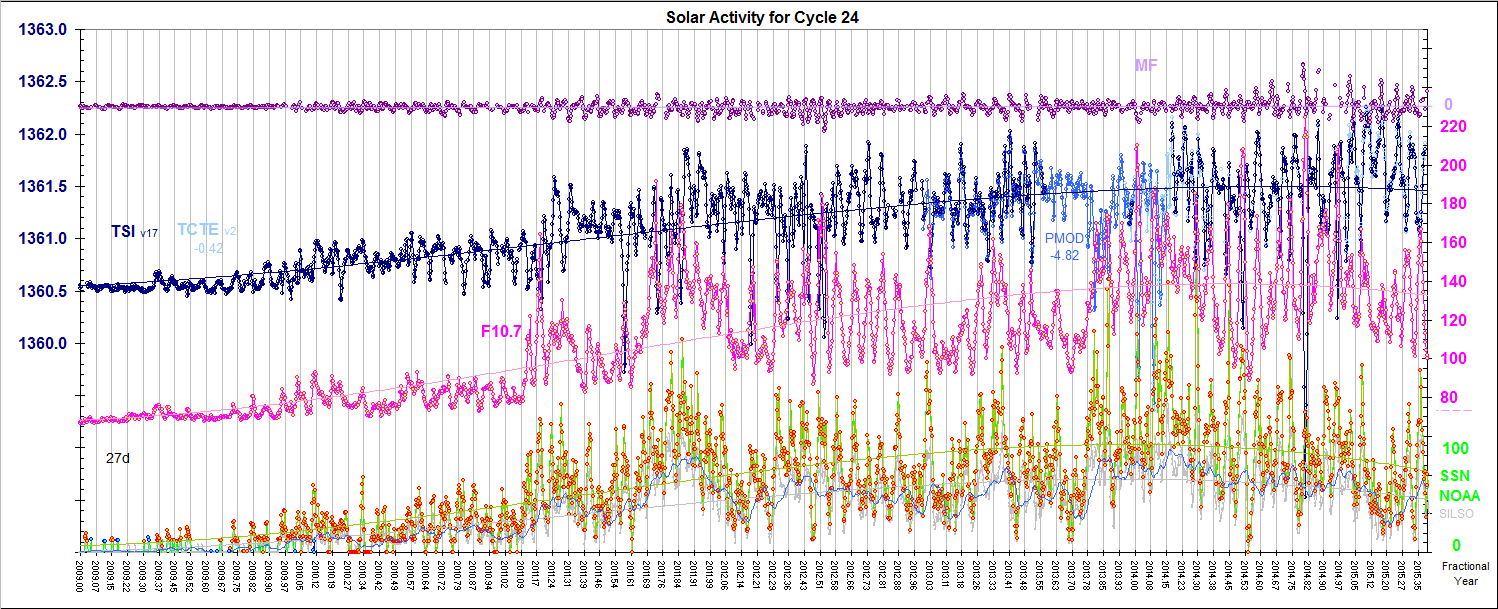

On top of his graphic I have plotted December 2008 which is commonly accepted as the month of the Solar Cycle 23/24 transition and October 2009, which was Carrington rotation 2089 and the month of transition based on flattening of the heliospheric current sheet. The MF doesn’t change character until this later date.
The big question is,”What are the implications for Friis-Christensen and Lassen theory?” Friis-Christensen and Lassen based their theory on a couple of hundred years of sunspot data, but what if the true relationship between solar cycle length and the Earth’s temperature over the following solar cycle is based on solar cycle length as measured from the flattening of the heliospheric current sheet rather than the rather subjective choice of minimum sunspot number? We will need possibly another hundred years of tilt angle data to get a definitive result, but in the meantime we can calculate the consequences.

Plotting the heliospheric current sheet-based data onto Butler and Johnson’s 1996 graphic for Armagh, Northern Ireland results in having to plot outside their graphic. These solar cycle length conditions are unprecedented in recorded Armagh history. They result in the predicted temperature decline over Solar Cycle 24 at Armagh to be 2.4°C, a full one degree cooler than the result based on commonly accepted solar cycle length data.
Applying heliospheric current sheet-based data to the plot for Hanover, New Hampshire derives a 3.1°C temperature decline, about one degree more than previously calculated. This is more than four times the purported 0.7°C temperature rise of the 20th century.

There is one way to determine whether or not Friis-Christensen and Lassen theory should be based on solar cycle length based on flattening of the heliospheric current sheet. If the average temperature decline at Hanover, New Hampshire over Solar Cycle 24 is 3.1°C rather than the previously predicted 2.2°C, then that will be early confirmation that flattening of the heliospheric current sheet should be used. We will only have to wait until early next decade for that data.
David Archibald
August, 2010
Leif Svalgaard says:
August 12, 2010 at 10:34 pm
Leif Svalgaard says:
August 12, 2010 at 10:32 pm
I’m using the same temperature as F-C&L
Do you have a link to the paper from which you took the temperature values? What I find on the web looks different.
Leif,
Nice to see you around these parts : )
OK, I see based on your analysis referenced in your above comment that the correlations of Friis-C and Lassen mentioned by David Archibald in the lead post have met some fundamental hurdles that they (F-C & L) do not overcome.
As a strictly personal comment I say that, still, I am struggling for the far view picture that all these solar/galactic/universe pieces (thank you for the pieces) should add up to. Integrating them into some summary of order-of-magnitude influence on earth system is both intriguing and difficult. Having fun though. But I would love to cheat and see some summary that someone else has done. [? recommendations ?]
Leif, I hope you were notified in advance of this post which featured your name in the Full Tilt 2 Pinball Icon.
– Thanks WUWT for setting up these solar journeys.
– David Archibald, thanks for posts that seem to always spark a lively (to say the least) comment stream during which I always learn things solar.
– Thanks Leif for volunteering as a mentor to some of us solar neophytes. You do it with good humor and extraordinary patience.
John
So Leif,
It looks like some of the SC 24 sunspots we are getting are already showing at a low latitude. Why is that?
John Whitman says:
August 13, 2010 at 5:53 am
..As a strictly personal comment I say that, still, I am struggling for the far view picture that all these solar/galactic/universe pieces (thank you for the pieces) should add up to. Integrating them into some summary of order-of-magnitude influence on earth system is both intriguing and difficult. Having fun though.
.. Thanks Leif for volunteering as a mentor ..You do it with good humor and extraordinary patience.
Aye, aye
And a happy Friday. Watch out for dragons though. haha
anna v says:
August 13, 2010 at 5:21 am
Do you have a link to the paper from which you took the temperature values? What I find on the web looks different.
They are just the standard HADCRU values. There is a little subtlety: You’ll note that there are two blue curves [cycle lengths] and two pink curves [dT]. You can define the cycle length is two ways: from minimum to minimum and from maximum to maximum. I plot both at the midpoint in time between the defining epochs. For dT, I compute the average over the cycle and plot that at the same midpoint. As there is no trend in the cycle lengths, I also show a detrended dT [the green curves] for the reason given.
tallbloke says:
August 12, 2010 at 11:57 pm
We don’t even understand the circulations and interactions of the sodium ions and chlorine radicals of dissolved salts in the oceans on our own planet yet,[…]
I don’t think that the sodiums ions in our oceans play any role in creating sunspots…
vukcevic says:
August 13, 2010 at 1:15 am
If you accusing someone of dishonesty (which is becoming a habit of yours, which I shall ignore) you should provide proof, not rattle off nonsense in an attempt to run away from what data is showing.
Too many instances to recount, so let me just do one to begin with. On your graphs at http://www.vukcevic.talktalk.net/LFC-B.htm the first graph has a value of 63.5 uT for the Z-component for the year 1000 AD. On the second graph the year 1000 AD shows 69 uT. Now, you do have a cryptic comment about ‘time scales displacement 900-1100 AD’. Perhaps you mean that if you plot Z upside-down and shifted 200 years you get some correlation. In earlier versions of the plot, you used a longitude of 30W, now you use 27W, but the values [as far as I can see] have not changed. In earlier discussion you claimed CALS7K was rubbish, now you claim it is golden, etc, etc. Blaming the data for any deficiency in the correlation is another example. To gain some credibility, plot the temperate and Z on the same plot, to the same scale, and no fiddling around with displacements or upside-down data. Your reluctance to do so is proof enough.
Ninderthana says:
August 13, 2010 at 2:58 am
Leif is only a pancea for those who are weak of mind.
Not only an attack on me, but on all other feeble-minded. Go wash your mouth out with soap.
What about the flattening, or rather less height of the earth’s atmosphere?
Tilo Reber says:
August 13, 2010 at 7:01 am
It looks like some of the SC 24 sunspots we are getting are already showing at a low latitude. Why is that?
This is quite normal when you are more than 1.5 years into a cycle as there is a large spread in latitudes. See e.g. http://solarscience.msfc.nasa.gov/images/bfly.gif and compare the current cycle with previous ones.
Ninderthana,
Leif can defend himself : )
So, we who openly show sincere respect for Dr. Svalgaard based on our own independent voluntary judgments of his professional life, are what by your implications? Weak? Minions under the thrall of a dark lord of “anti-natural philosophy”? Shall us minions start calling Leif “he who must not be named” out of fear his displeasure with our scientific statements? Shall the Muses save us? Shall you save us Ninderthana?
This minion of “he who shall not be named” will now butcher a great line from Star Trek, “These Droids, Ninderthana, aren’t the ones you are looking for, please move on.”
John
Carla,
Do you remember the “turtles all the way down” comment stream earlier this year (or late last year) in a WUWT solar post that featured many of the players commenting on this solar post?
Well, maybe this time it is “Dragons all the way down”.
John
vukcevic says:
August 13, 2010 at 1:15 am
If you accusing someone of dishonesty (which is becoming a habit of yours, which I shall ignore)
On another blog you hide under the name ‘radun’ http://solarcycle24com.proboards.com/index.cgi?board=general&action=display&thread=622&page=29
And praise your own graphs as ‘Vuk’s superior analysis’ and similar hyperbole throughout. Honesty? Perhaps we have different ideas about what it means.
Leif,
If we speak of interactions the planets have with the sun, you say, aside from tidal, what other forces could their be?
I associate the word tidal, hopefully correctly, with gravity.
Therefore at least electrical and magnetic forces remain for action-at-a-distance by which the planets could interact with the sun.
Considering the presense of a large sun magnetosphere (what we’re talking of in the original post, isn’t it?) which couples (in a physical sense) to the smaller magnetospheres of at least some planets quite capably, the movement of magnetic fields across each other certainly has both magnetic and electrical connotations, if not from first principles then those only slightly above.
As to how those forces change the sheet exactly, or cause phase disturbances of the solar dynamo, or other such matters, I would be foolish to say I knew, but the answer to the question “What else would you suggest?” is simple: magnetic and eletrical forces, if not tidal or gravitational. My apologies, in advance, for not having read other threads which debunk the leverage of those two.
If I could, probably undeservedly, comment on this silliness which is brewing: Personal perception of Dr. Svaalgard is immaterial to the ability to discuss, argue, refute, disagree or agree with him. His large knowledge of the sun is a reference, not a warrant for correctness. To assume otherwise stifles reasonable discussion, as does personal criticism. So.. Whats up with that, people?
Buffoon says:
August 13, 2010 at 7:54 am
but the answer to the question “What else would you suggest?” is simple: magnetic and eletrical forces, if not tidal or gravitational.
The problems with those are two-fold:
1) they involve even less energy that the tidal forces. The solar wind is exceedingly tenuous.
2) they cannot propagate upstream in the the supersonic solar wind, which expands 11 times faster than magnetic/electric forces can propagate.
You see, it is all a question about energy.
Buffoon says:
August 13, 2010 at 7:54 am
but the answer to the question “What else would you suggest?” is simple: magnetic and eletrical forces
If those forces can create, modulate, regulate, the mighty Sun where a single sunspot can be many times the size of the Earth [and some 3000 active regions are generated each solar cycle], think about the havoc these forces would bring upon the tiny Earth. There issue is energy and how you bring it to bear.
Buffoon says:
August 13, 2010 at 7:54 am
This takes us to:
http://milesmathis.com/tide2.html
What do you think of this proposition?
Sensitive people tend to be very touchy. They take slight at the slightest provocation. Let the commenter who is without comment throw the first stone. Everyone else should stick to the subject being discussed; or not. But, if NOT, should offer something of a related nature and similiar value. It takes old thick skin to be an adult in a world full of children under 50. If you like what someone said put it in your piggy bank; if you don’t then let it be. You don’t have to eat everything you see resting in a puddle on the floor. Hold your nose and walk around such temptations. Appreciate the world for what it truly is, a place to learn and teach. Learn what you do not know from others. Teach what you do know to others.
Re: Leif Svalgaard says:
August 13, 2010 at 7:29 am
[This is quite normal when you are more than 1.5 years into a cycle as there is a large spread in latitudes. See e.g. http://solarscience.msfc.nasa.gov/images/bfly.gif and compare the current cycle with previous ones.]
As long as you’re talking about sunspots, help me out with something.
I learned from this website:
http://spot.colorado.edu/~koppg/TSI/
that the passage of a sunspot (or group) across the sun causes a decline in TSI that can be substantial:
http://spot.colorado.edu/~koppg/TSI/TSI_Oct2003.JPG
My question is, if sunspots cause a transient decline in TSI, why is the TSI greatest when the SSN the highest and average sunspot area the highest? That seems backwards. Or is the decline diagrammed in the above image an unusual event?
Pascvaks,
Perhaps for me a “mea maxima culpa” is sort of in order. OK.
John
Vukcevic:
Yes, modern physics has become a neo-scholasticism. It is the avoidance of real questions in the pursuit of trivial methodology. It is the memorization of an endless list of names and manipulations in lieu of understanding mechanics. It is the knee-jerk invocation of authority and the explicit squelching of dissent. It is the institutionalized acceptance of censorship and the creation of dogma. Grand Masters like Feynman say “shut up and calculate!”
http://milesmathis.com/death.html
Actually, the big planets do have an affect on our planetary tides as well as the continental tug; they just happen to be more affected by the moon/sun. Furthermore, the big gas bag planets have an affect on the sun’s position relative to if the the gas bag planets did not exist, so therefore the sun. The planets are all working within a system of continuous change…e.g. as does our climate change which over millions of years has been dramatic.
Stephan says:
August 12, 2010 at 7:50 pm
So Far re sun activity and outcomes versus climate or weather
DA = 1
Leif = 0
Chapman = -1
you forgot:
Hathaway = not even wrong
for interested folks, some back matter:
the originla f-c and l
http://www.friendsofscience.org/assets/files/documents/Solar%20Cycle%20-%20Friis-Chr_Lassen-.pdf
leifs analysis does apparently use the same temperature record, although f-c&l is from 1991, who knows how much that record has “evolved” since then. there is also a phase shift to obtain the correlation, which i am not sure leif’s analysis takes into account.
here is archibald, with armagh etc actual temp records, which IMHO is much more efficacious than using the dubious crutem etc manufactured records anyway
http://www.warwickhughes.com/agri/Solar_Arch_NY_Mar2_08.pdf
leif has said (paraphrasing) the dubious correlation arises because f-c&l (and by corollary archibald) do not analyze the data correctly.
maybe leif is correct, but i would like to see the faulty temperature record and phase shift issues addressed before i am convinced.
also, i would like to know if leif, archibald, and f-c&l use the same solar cycle length record
just some thoughts 😉
stephen richards says:
August 13, 2010 at 12:53 am
Leif’d lief as not, it were Leif not Lief. (Lief (archaic) Readily, willingly.)
http://en.wikipedia.org/wiki/Katyusha_rocket_launcher
I found this reference :
http://www.tmgnow.com/repository/solar/lassen1.html
Could you please point out to me if the data in the scatter plot in the debunking plot you referenced above is the same as fig 7, bottom ? They do not look the same.
They reference a paper by Jones for the temperatures. Is that the same as HADCRU temperatures?
Sorry, my last is for
Leif Svalgaard says:
August 13, 2010 at 7:23 am