The Heliospheric Current Sheet Tilt Angle and Implications for Friis-Christensen and Lassen Theory

Guest post by David Archibald
The Chairman of NOAA’s Solar Cycle 24 review panel, Douglas Biesecker, said back in March 2007 that the flattening of the heliospheric current sheet was one of the expected signatures of solar minimum (the Solar Cycle 23/24 transition). At times of weak solar activity, the month of transition can be relatively hard to pick, except for the flattening of the heliospheric current sheet, shown following:

This graph of the heliospheric current sheet tilt angle from 1976 shows sharp transitions from one solar cycle to the next. The data is from www.wso.stanford.edu
By comparison, Dr Svalgaard’s plot of four solar parameters from 2008, available at http://www.leif.org/research/TSI-SORCE-2008-now.png , shows a lot of latitude in picking the month of transition:
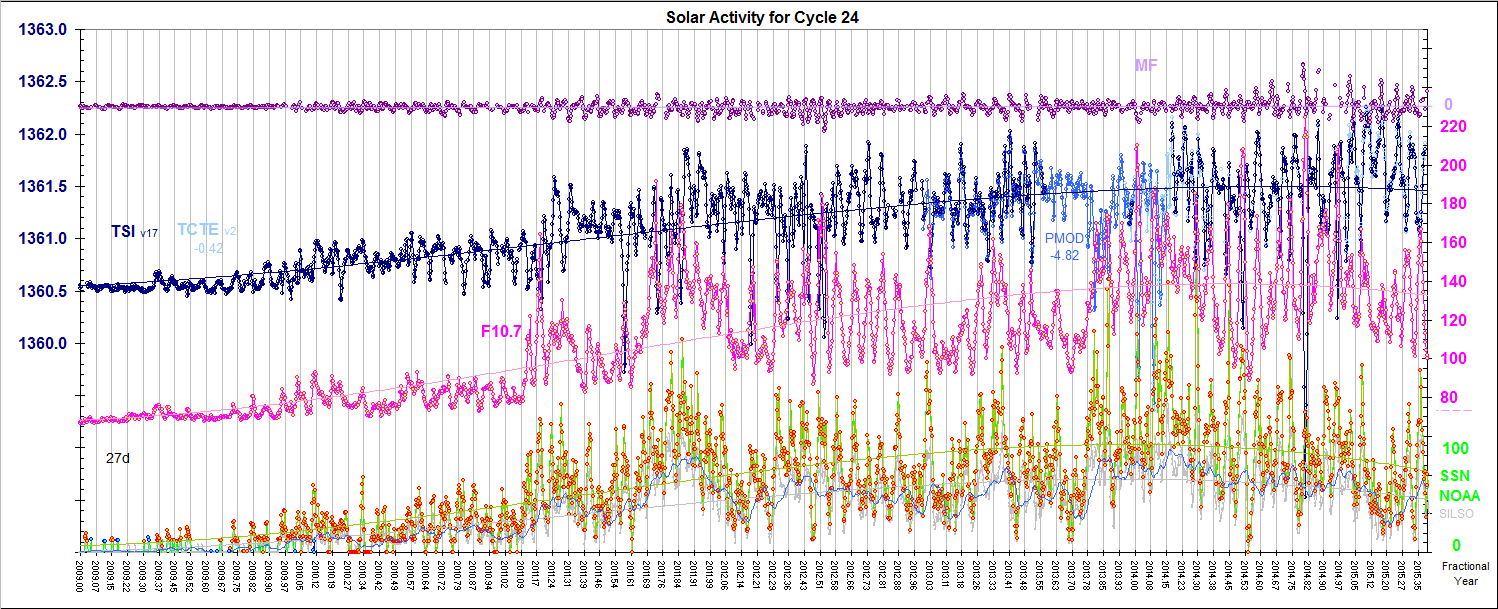

On top of his graphic I have plotted December 2008 which is commonly accepted as the month of the Solar Cycle 23/24 transition and October 2009, which was Carrington rotation 2089 and the month of transition based on flattening of the heliospheric current sheet. The MF doesn’t change character until this later date.
The big question is,”What are the implications for Friis-Christensen and Lassen theory?” Friis-Christensen and Lassen based their theory on a couple of hundred years of sunspot data, but what if the true relationship between solar cycle length and the Earth’s temperature over the following solar cycle is based on solar cycle length as measured from the flattening of the heliospheric current sheet rather than the rather subjective choice of minimum sunspot number? We will need possibly another hundred years of tilt angle data to get a definitive result, but in the meantime we can calculate the consequences.

Plotting the heliospheric current sheet-based data onto Butler and Johnson’s 1996 graphic for Armagh, Northern Ireland results in having to plot outside their graphic. These solar cycle length conditions are unprecedented in recorded Armagh history. They result in the predicted temperature decline over Solar Cycle 24 at Armagh to be 2.4°C, a full one degree cooler than the result based on commonly accepted solar cycle length data.
Applying heliospheric current sheet-based data to the plot for Hanover, New Hampshire derives a 3.1°C temperature decline, about one degree more than previously calculated. This is more than four times the purported 0.7°C temperature rise of the 20th century.

There is one way to determine whether or not Friis-Christensen and Lassen theory should be based on solar cycle length based on flattening of the heliospheric current sheet. If the average temperature decline at Hanover, New Hampshire over Solar Cycle 24 is 3.1°C rather than the previously predicted 2.2°C, then that will be early confirmation that flattening of the heliospheric current sheet should be used. We will only have to wait until early next decade for that data.
David Archibald
August, 2010
OT but this could be quite big (if it is true)
http://www.climatechangefraud.com/climate-reports/7479-us-government-in-massive-new-global-warming-scandal-noaa-disgraced
Not OT re: sun activity so far
DA =1
Leif = 0
but hats off to Leif for having guts to rise to every occasion of dissent and responding artfully.
OT also, but the AGW is about to collapse totally as this is THE AGW jewel in the crown
http://ocean.dmi.dk/arctic/icecover.uk.php
Any idea if magnetism affects wind? That is about the only thing the Sun can do that, to my knowledge has not been studied well.
So Far re sun activity and outcomes versus climate or weather
DA = 1
Leif = 0
Chapman = -1
LOL
Earle Williams says:
August 12, 2010 at 6:15 pm
FYI, linking to a document does not constitute a second debunking.
It does, when the documents shows that the correlation did not hold up. Replication is what it is all about.
James F. Evans says:
August 12, 2010 at 6:58 pm
The underlying magnetic field is called the interplanetary magnetic field, and the resulting electric current forms part of the heliospheric current circuit.
This current was known from the beginning [e.g. http://www.leif.org/EOS/JA083iA02p00717.pdf ] as is a natural consequence of particles drifting along the polarity reversal. This local current is caused by the reversal of the magnetic field.
Our knowledge of the HCS has not changed since the 1970s, all later measurements simply solidly confirm the earlier ideas.
Stephan says:
August 12, 2010 at 7:45 pm
but hats off to Leif for having guts to rise to every occasion of dissent and responding artfully.
No guts required for simply telling it the way it is.
David, I am left with questions after reading. Could you please address for myself, as well as the other readers:
1) How do you have so many points on your cross-plots if we didn’t have the technology to measure the “tilt” beyond the last couple solar cycles (shouldn’t there just be a couple points?)
2) Also, why are New Hampshire & Armagh always used as correlation points with solar data? What about other long lived climatic data sites? Why are they not used?
3) What do you say about Leif’s comments at “August 12, 2010 at 1:41 pm” that this is not a good way to measure cycle length?
Looking forward to the answers
Best Regards
JL
Leif,
I always look forward to your insightful, and evidence based, critiques of the various solar theories espoused on this site.
Your cheerful countenance only serves to add to your credibility, a trait that many climate scientists would do well to emulate.
I don’t know much about these issues but I can recognize an actual evidence based argument when I hear one.
Keep up the good work.
Lance says:
August 12, 2010 at 8:30 pm
Leif,
I always look forward to your insightful, and evidence based, critiques of the various solar theories espoused on this site.
Your cheerful countenance only serves to add to your credibility, a trait that many climate scientists would do well to emulate.
I don’t know much about these issues but I can recognize an actual evidence based argument when I hear one.
Keep up the good work.
—–
I’d like to second that! My formal astronomy dates back to Lief’s excellent paper, published in 1978, regarding solar forces in three dimensions! It boggles my mind how much we’ve learned since then, with better observational tools, computers and knowledge of physics.
Thanks, Lief! I appreciate how you once set me straight on the purported tidal effects of the planets on the sun! Doesn’t make any sense when you look at the masses and distances involved.
Leif Svalgaard says:
August 12, 2010 at 5:26 pm
DA: The big question is,”What are the implications for Friis-Christensen and Lassen theory?”
The Friis-C and Lassen ‘theory’ has been debunked so many times that it is hardly worth the effort to do it again, but here is one more time: http://www.leif.org/research/Cycle%20Length%20Temperature%20Correlation.pdf
My reservation on accepting that your plot has debunked the correlation between prior cycle and temperature is that you are using some kind of global temperature.
Localities have a lot of variations and it is possible that in a global average these are smoothed over into insignificance.
Let me illustrate: when average temperatures change from decade to decade, one can attribute it to motions of air systems,PDO, AO, Jet stream etc. This has the result, as we see graphically with the contrasts this year, to have very contrasting regional temperatures. In averaging over the globe this will be lost. 2010 may come out cold but Russia fried with respect to what it got in other years.
I think that the particular proposition would be laid to rest if there were a study of many more regions the world over. It might be that only temperate regions display this effect and tropical and arctic the opposite ( this would be interesting too) . Debunking needs a more detailed study than using the average temperatures.
“they would exert a strong tidal influence.”
Is that the only influence that they can exert, and the only influence which could create an outcome?
I think debunking is done based on lack of mechanism, not wriggle matching. For Solar influences to heat up or cool down our planet as demonstrated by trends, to the degree that we have found, we need to consider a mechanism that is plausible. And it needs to be somewhat exclusionary. In other words, it needs to be better than internal known drivers at explaining temperature trends. I would even suggest that it has to be strong enough to combat internal drivers.
David Archibald, I hope ‘n pray you are wrong!
Leif, you better be right or else all of us will suffer, well we will suffer, for the lack of common sense!
Thank you guys for the good read.
i’ll put five cents on Archibald. lol
pdo cold ao? too and amo heading there, sounds cold to me! sun we could use some extra heat now TX earthly Tim.
anna v says:
August 12, 2010 at 9:50 pm
My reservation on accepting that your plot has debunked the correlation between prior cycle and temperature is that you are using some kind of global temperature.
I’m using the same temperature as F&C.
Buffoon says:
August 12, 2010 at 10:16 pm
“they would exert a strong tidal influence.”
Is that the only influence that they can exert, and the only influence which could create an outcome?
What else would you suggest? The various suggestions that people have come up with are either unphysical or not operative. We have gone over this many times on this blog. Look back at some of the relevant threads.
But it doesn’t really matter because the correlations are not that good that they cry out for an explanation.
Leif Svalgaard says:
August 12, 2010 at 10:32 pm
I’m using the same temperature as F-C&L
Leif Svalgaard says: August 12, 2010 at 5:02 pm
vukcevic says: August 12, 2010 at 1:26 pm
Rsq = 0.53 is not particularly significant. In this correlation I have Rsq = 0.8933
http://www.vukcevic.talktalk.net/NFC1.htm
Neither one is significant. And yours even breaks down when you include more data back in time.
No it does not, it just gets reversed possibly due to bidirectional flow (excess cold saline reduces temperatures, excess warm saline increases temperatures) at the same coordinates.
http://www.vukcevic.talktalk.net/LFC-B.htm
Perhaps you may whish to reinforce your previous remark as quoted here:
http://wattsupwiththat.com/2010/08/12/target-monckton/#comment-455237
vukcevic says:
August 12, 2010 at 11:07 pm
No it does not, it just gets reversed possibly due to bidirectional flow (excess cold saline reduces temperatures, excess warm saline increases temperatures) at the same coordinates.
Plot the stuff on the same graph and scale and don’t try to plot part of it upside-down.
Perhaps you may wish to reinforce your previous remark as quoted here:
My remark stands.
Paul Vaughan says:
August 12, 2010 at 5:56 pm
I request Dr. Svalgaard’s professional opinion of the following claims:
http://tallbloke.wordpress.com/2010/08/11/roy-martin-venus-earth-jupiter-solar-cycle-analysis/
“[…] amazing new Venus Earth Jupiter – Solar cycle analysis” – (August 11, 2010)
Leif Svalgaard says:
August 12, 2010 at 7:34 pm
In the end, it is a question of energy. If the planets were 100 times more massive and 10 times closer, they would exert a strong tidal influence. We see that for other stars, but for today’s solar system there is not enough energy in the planetary influences to have any effect. To overcome that hurdle the correlation has to be MUCH better.
Leif Svalgaard says:
August 12, 2010 at 10:32 pm
The various suggestions that people have come up with are either unphysical or not operative….
But it doesn’t really matter because the correlations are not that good that they cry out for an explanation.
I don’t want to hijack David Archibalds thread with yet another argument with Leif about this, so I’ll reproduce his opinion on my thread and we can discuss it there in context with the other contributions.
I’ll just point out that Leif’s certainty on the issue is unwarranted. We don’t even understand the circulations and interactions of the sodium ions and chlorine radicals of dissolved salts in the oceans on our own planet yet, let alone the energetic particles whizzing around in the interplanetary electromagnetic soup and the conducive (without a ‘t’) pathways they follow. Hence all the new and conflicting papers in the solar physics journals on flux ropes, reconnection with planetary magnetospheres, etc etc. As to the quality of the correlation, R^2 values aren’t everything, and I recommend people look carefully at the graph, read the discussion and form their own opinions bearing in mind we haven’t finished the work on this yet. A bit like Leif’s response to me when I pushed him on the progress solar physicists have made in understanding why the equatorial region of the sun circulates faster than the polar regions. “We’re working on it :-)” was his reply. Two to keep an eye on in my opinion.
Doug Proctor says:
August 12, 2010 at 4:31 pm (Edit)
Tallbloke says: “We won’t see anything like that fall in temperature, because the oceans are carrying a lot of extra energy accumulated since 1935 and particularly in the 47 years from 1955 to 2002.”
Dr. Archibald’s prediction is based on historical records comparing temperature changes in specific areas with sunspot lengt/TILT issues. The state of the ocean energy is a part of whatever temperature change there was previously – perhaps explaining the spread in the data.
Yes, and carrying that point further, the unusually high state of ocean heat content is probably why the Christiansen-Lassen correlation breaks down in the later C20th while it looked pretty good up until the 1960’s. So in my opinion, their theory is not ‘debunked’ as Leif claims, but needs modifying to take into account the non-linear response of Earth’s climate system to the Solar energy input. Getting the temperature record corrected would help get the correlation between solar cycle length and global temperature back on track too.
look out Lief incoming. That was a Katucha of Liefs.
Thanks for coming Dr S. You are always more than welcome.
Though I struggle with the depth of the science that is used as both the hammer and the anvil of reason used by Doc Leif and the others, the merits of the what truths they convey are unerring.
A inquiry to the minds at large here..When we had the CME last week.. that caused Aurorae futher south than usual.. The distributer on my nephew’s car went kerplunct.. on a hunch I called all the garages.. auto repair shops and parts suupply stores I could in the area to inquire if any increase in electrical related parts or repair were in demand.
Through This I learned that many did report and significant increase in demand for same.
I also by way of sleuthing, found that many major department stores with the Magnetic theft protection devices(you know them as the klaxon that goes off when the cashier has not deactivated) reported many phantom alarms.. of constant failures in the system..during the event.
Any comments?..
Leif Svalgaard says: August 12, 2010 at 11:17 pm
……………………….
Perhaps you should do some secondary school maths:
Even at its simplest functions y1=M-f(t) and y2=M+f (t) are divergent, and have a natural discontinuity at point of change from y1 to y2 at time t=T. If you accusing someone of dishonesty (which is becoming a habit of yours, which I shall ignore) you should provide proof, not rattle off nonsense in an attempt to run away from what data is showing. Your knowledge of solar activity is respected, but this is a different matter, so any baseless remarks will be disregarded.
Following is for more courteous readers of WUWT:
Correlation for period of time is reversed possibly due to bidirectional flow at the same coordinates (the excess cold saline oceanic flow reduces temperatures, the excess of warm saline flow increases temperatures), see the second graph at:
http://www.vukcevic.talktalk.net/LFC-B.htm
Effect of excessive cold flow (into North Atlantic) through the Denmark Strait would result in different proportion of the temperature change to the excess of warm water flow (into Arctic) in the opposite direction .
Here I shall quote the WHOI :
“The Irminger Sea is strategically located to play a critical role in the oceans’ global circulation and the Earth’s climate.”
http://www.whoi.edu/oceanus/viewImage.do?id=100535&aid=66549
Paleomagnetic dating (intensity and actual dates) is just as uncertain as is the temperature reconstruction from proxies, so coincidence between them for the last two millennia is more than remarkable. Only point of contention is a time scale displacement 900-1100AD between two sets of data, but that could be result of inaccurate proxy dating of either or both sets of variables.
Leif is only a pancea for those who are weak of mind.
He claims that he uses evidence to direct his pronouncements on the Sun, however, he only gives credence to the pieces of evidence that back his current view of the Sun. Any piece of evidence that appears to contradict his wonderfully black and white picture of the Sun is summarily dismissed out-of-hand.
All hail Leif – the antithesis of a real natural philospher.
Leif Svalgaard says:
August 12, 2010 at 1:41 pm
“Using a single location in New Hampshire as a proxy for global [or even regional] temperature is just bad science.”
Better warn Hansen/Schmidt/Mann, et al, they seem to be using one station in the Yukon as a proxy for the whole arctic circle.
However, I personally don’t give a fig about measuring the rest of the planet as much as my local climate. Hanover is only about 10 miles northwest of me, so as far as I’m concerned, 3.1C is something to be seriously concerned about.
Update that may contribute to understanding of the process described in my previous post:
See last graph on
http://www.vukcevic.talktalk.net/LFC-B.htm or
http://www.vukcevic.talktalk.net/LFC1.htm
Re: Leif Svalgaard
I submitted the following comment to the thread to which I linked:
“Looks like after a lot of work, Roy arrived where I did when I investigated these claims (using a different approach): Loose synchrony. The loose synchrony extends to J+N (not to be confused with J-N).”
Seeing such a benign comment blocked reminded me of Tamino (who banned me for making benign comments about El Nino).
After 1.5 years of pursuing these planetary synchronies I reached the conclusion that lunisolar tides, earth orientation parameters, stratospheric volcanism, and Southern Ocean & Southeast Pacific sea surface temperatures are far more fruitful territory.
I acknowledge the valuable contributions of Leif Svalgaard, Ian Wilson, anna v, & other physicists.
Realization of the confounding with the lunisolar tides was a sledge-hammer of a game-changer for me.