The Heliospheric Current Sheet Tilt Angle and Implications for Friis-Christensen and Lassen Theory

Guest post by David Archibald
The Chairman of NOAA’s Solar Cycle 24 review panel, Douglas Biesecker, said back in March 2007 that the flattening of the heliospheric current sheet was one of the expected signatures of solar minimum (the Solar Cycle 23/24 transition). At times of weak solar activity, the month of transition can be relatively hard to pick, except for the flattening of the heliospheric current sheet, shown following:

This graph of the heliospheric current sheet tilt angle from 1976 shows sharp transitions from one solar cycle to the next. The data is from www.wso.stanford.edu
By comparison, Dr Svalgaard’s plot of four solar parameters from 2008, available at http://www.leif.org/research/TSI-SORCE-2008-now.png , shows a lot of latitude in picking the month of transition:
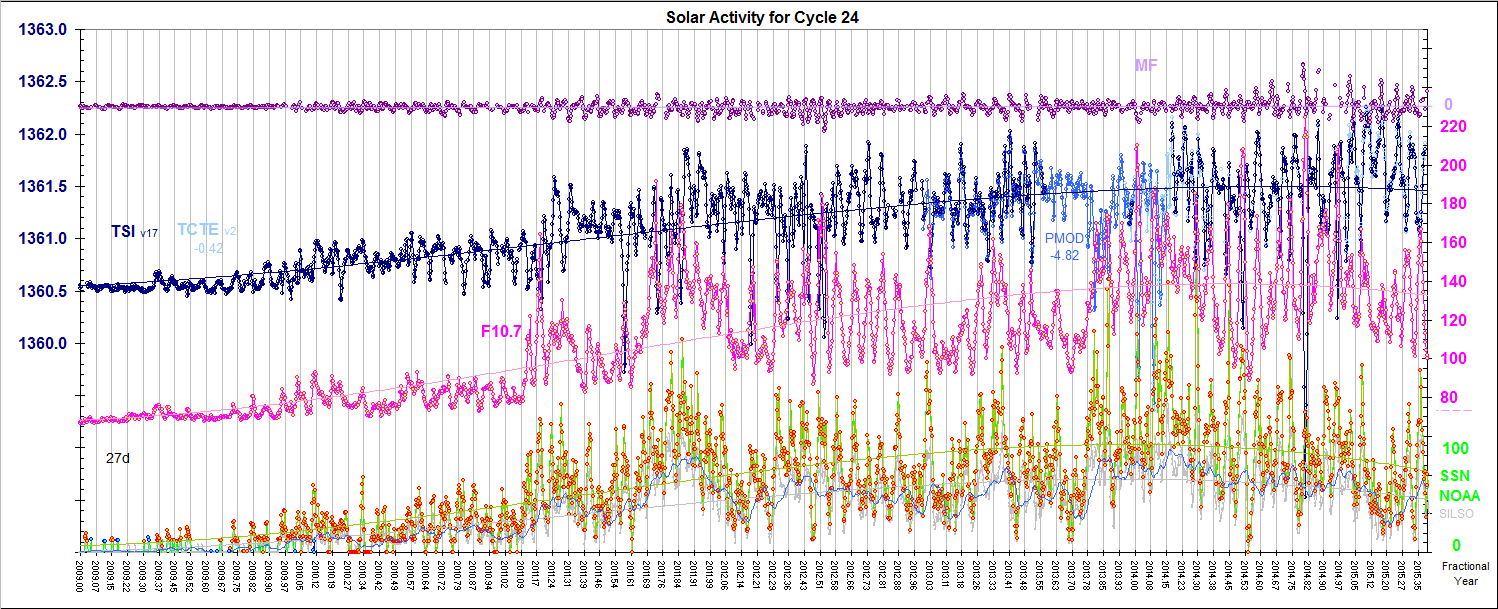

On top of his graphic I have plotted December 2008 which is commonly accepted as the month of the Solar Cycle 23/24 transition and October 2009, which was Carrington rotation 2089 and the month of transition based on flattening of the heliospheric current sheet. The MF doesn’t change character until this later date.
The big question is,”What are the implications for Friis-Christensen and Lassen theory?” Friis-Christensen and Lassen based their theory on a couple of hundred years of sunspot data, but what if the true relationship between solar cycle length and the Earth’s temperature over the following solar cycle is based on solar cycle length as measured from the flattening of the heliospheric current sheet rather than the rather subjective choice of minimum sunspot number? We will need possibly another hundred years of tilt angle data to get a definitive result, but in the meantime we can calculate the consequences.

Plotting the heliospheric current sheet-based data onto Butler and Johnson’s 1996 graphic for Armagh, Northern Ireland results in having to plot outside their graphic. These solar cycle length conditions are unprecedented in recorded Armagh history. They result in the predicted temperature decline over Solar Cycle 24 at Armagh to be 2.4°C, a full one degree cooler than the result based on commonly accepted solar cycle length data.
Applying heliospheric current sheet-based data to the plot for Hanover, New Hampshire derives a 3.1°C temperature decline, about one degree more than previously calculated. This is more than four times the purported 0.7°C temperature rise of the 20th century.

There is one way to determine whether or not Friis-Christensen and Lassen theory should be based on solar cycle length based on flattening of the heliospheric current sheet. If the average temperature decline at Hanover, New Hampshire over Solar Cycle 24 is 3.1°C rather than the previously predicted 2.2°C, then that will be early confirmation that flattening of the heliospheric current sheet should be used. We will only have to wait until early next decade for that data.
David Archibald
August, 2010
Tallblike says: “We won’t see anything like that fall in temperature, because the oceans are carrying a lot of extra energy accumulated since 1935 and particularly in the 47 years from 1955 to 2002.”
Dr. Archibald’s prediction is based on historical records comparing temperature changes in specific areas with sunspot lengt/TILT issues. The state of the ocean energy is a part of whatever temperature change there was previously – perhaps explaining the spread in the data. The -3.1C* (or whatever) is the prediction based on a linear regression. The -0.65C* may be the actual number for Cycle 24, based on the actual conditions of this time. Like the candymint/breathmint, you could be both right.
Initial discussion of global cooling had 2008 as the start of the cooling. Clearly this is not the case. I plotted up a graph of what the temperature drop must look like to cover only -1.6C* drop from 2011 to 2021, plotted on a Cycle 23/24 Effective Sunspot Number (http:/www.nwra.com/spawx/ssno-cyc e23.gif). It is quite a ride if you expect temperature drops to have the same rates (with up-cycles) as regular cycles we experience. Of interest, however, is that a 0.5C* increase coincided with the rise from the beginning of Cycle 24, as if there were a two-variable input phase issue going on. If so, then a sudden drop from this point on might suggest that an in-phase situation is going to kick in (the out-of-phase part preventing both cooling and warming since 2008).
The melding of the temperature anomaly record (UAH rather than GISS) to the last few cycles is very interesting, but the requirement for the Archibald prediction is even more so. (I’m old school, using paper and pencil, so cannot attach a graph. I need an 11-year-old to help me here!)
http://www.wso.stanford is an improper link, try
http://wso.stanford.edu/
http://wso.stanford.edu/gifs/HCS.html
HCS indicates Heliospheric Current Sheet
What is “the heliospheric current sheet”?
And how is it measured?
Full tilt 2 pinball, Leif-Archibald edition.
LOL!
That is truly funny. I laughed. Thank you Anthony Watts! 🙂
vukcevic says:
August 12, 2010 at 1:26 pm
Rsq = 0.53 is not particularly significant. In this correlation I have Rsq = 0.8933
http://www.vukcevic.talktalk.net/NFC1.htm
Neither one is significant. And yours even breaks down when you include more data back in time.
Schrodinger’s Cat says:
Apart from Svensmark’s idea that the solar wind (active sun) prevents neutrons from deep space from seeding cloud formation, are there any other explanations as to why cycle length could affect climate?
———-
I thought Svensmark’s idea was based on muons—Nigel Calder has an on-going debate with Prof Terry Sloan about that:
http://calderup.wordpress.com/2010/08/09/do-clouds-disappear-3/
I would have made the periods on the tilt graph at 9.6yrs and 12.8yrs, we could then see how the two cycles relate directly to the 3.2yr `bashful ballerina`.
Within your article it mentions “graphic for Armagh, Northern Ireland” and “plot for Hanover, New Hampshire” along with temperature decreases. What are these references to specific locations and temperatures and how do they relate to the solar wind, i.e. assumed interrelation to the heliospheric current sheet tilt angle. I just don’t understand why these local geo references.
DA: The big question is,”What are the implications for Friis-Christensen and Lassen theory?”
The Friis-C and Lassen ‘theory’ has been debunked so many times that it is hardly worth the effort to do it again, but here is one more time: http://www.leif.org/research/Cycle%20Length%20Temperature%20Correlation.pdf
Ulric Lyons says:
August 12, 2010 at 5:09 pm
I would have made the periods on the tilt graph at 9.6yrs and 12.8yrs, we could then see how the two cycles relate directly to the 3.2yr `bashful ballerina`.
The bashful ballerina is spurious. There is no such phenomenon, even if you bend the ‘data’.
Archibald;
” but what if the true relationship between solar cycle length and the Earth’s temperature over the following solar cycle is based on solar cycle length as measured from the flattening of the heliospheric current sheet rather than the rather subjective choice of minimum sunspot number? ”
Yes, long spotless day periods can be rather warm often, then there is the matter of all those cold winters cropping up at solar maximum, especially big cycles.
Gary Pearse says:
August 12, 2010 at 2:48 pm
Don’t expect too many comments if one doesn’t give a brief “heliospheric current sheet tilt angle for dummies” paragraph.
Here is an account of its discovery and effects:
http://www.leif.org/research/A%20View%20of%20Solar%20Magnetic%20Fields,%20the%20Solar%20Corona,%20and%20the%20Solar%20Wind%20in%20Three%20Dimensions.pdf
Here’s how I (crudely) try to describe it to friends and colleagues….
Just think of it as an electric hot plate heating a large pot of soup. Gradually turn the hot plate down, but then crank it to full for a bit, then bring back the temperature down etc etc. and the overall temperature of the soup will be relatively constant – also allowing for lag time due to the latent heat storage of the soup (ie. earth).
But if you delay the return of the hot plate to ‘full’ for a bit longer and the soup will start to cool and it will alow cooler air to fall onto the soup as well (ie. cosmic radiation producing clouds)
This is why the proponents of the solar>global temp have merit, because the past century (barring the 1960s) the Sun has been as active as it has been for the past 1000 years with high sunspot numbers (amplititude) and short cycle durations (frequency), which in turn doesnt allow for the ‘turning down’ of the hot plate as it were.
Since cooling is also a possibility; that’s why they now allow for it with the term “Climate Change”.
Temps go up, temps go down. It just doesn’t matter.
It’s change we can believe in.
David A. implies that the “Friis-Christensen and Lassen theory” is a major pillar of climate science and goes on to suggest more cooling than previously thought if the HCS concept is used. Apparently, though, the “F-C & L” theory is not all that well thought of as indicated here:
http://www.skepticalscience.com/solar-cycle-length.htm
Dr. Leif says the HCS idea won’t float and others say the F-C&L proposal is likewise of dubious value.
So now what?
I request Dr. Svalgaard’s professional opinion of the following claims:
“This is really exciting. […] improved the correlation in a big way […] has come up with this stunning result […] shows the planetary alignments relating to small changes such as secondary peaks on the downslope of the solar cycles put the link between the production of sunspots and the motion of the planets beyond doubt”
http://tallbloke.wordpress.com/2010/08/11/roy-martin-venus-earth-jupiter-solar-cycle-analysis/
“[…] amazing new Venus Earth Jupiter – Solar cycle analysis” – (August 11, 2010)
Most enjoyable discussion, but I think the reputation for science goes to Leif.
I don’t know about sorting according to the HCS periods, but using the SIDC accounts of solar cycle lengths and years, my precipitation data back to 1870 sorts fairly well:
http://www.robertb.darkhorizons.org/TempGr/WvPrecipSC.GIF
Perhaps I will find the times of the HCS periods and try another sort.
Leif Svalgaard,
FYI, linking to a document does not constitute a second debunking. It constitutes linking to a document. I know it is a lot of work to copy and paste a URL and I appreciate your noble efforts. But do please keep a sense of perspective.
The results of the 2009 CLOUD run is to be announced at the end of this month:
http://cdsweb.cern.ch/record/1257940/files/SPSC-SR-061.pdf
“@ur momisugly Rhoda R says August 12, 2010 at 1:23 pm:
Science: States the theory, describes what is expected, and sets the requirements for support of that theory. Refreshing.”
Rhoda, about 20 years ago I read a sourced statement about C14 testing. I have long since lost trak of what book it was in, but I will never forget what it said:
85% of all C14 test results are discarded when the results fall outside of expected values. The rejected results – without specific basis – are said to have been contaminated.
This put a huge ? in my head about any published C14 dates. I have no idea whether those published dates are correct or if they were pre-selected from cherry picked C14 tests.
I DO recall writing down the source, but lost track of it before I ever had a reason to refer to it.
I can tell the magnetic field strength must be picking up around the Pacific Ocean. Certain individuals seem high on something!
Dr. Svalgaard presented this explanation of the helio current sheet:
Here is an account of its discovery and effects:
http://www.leif.org/research/A%20View%20of%20Solar%20Magnetic%20Fields,%20the%20Solar%20Corona,%20and%20the%20Solar%20Wind%20in%20Three%20Dimensions.pdf
This is an excellent account of the solar magnetic fields.
In 1978, this was state of the art.
And, it is still very good in terms of presenting solar magnetic fields.
But today, 2010, Science can also observe & measure, in addition to magnetic fields, the flow of electrified particles, plasma, free electrons & ions, their configuration & structure, and any attendant electric fields and resultant electric currents:
The Wikipedia entry for Helio current sheet:
“The heliospheric current sheet (HCS) is the surface within the Solar System where the polarity of the Sun’s magnetic field changes from north to south. This field extends throughout the Sun’s equatorial plane in the heliosphere. The shape of the current sheet results from the influence of the Sun’s rotating magnetic field on the plasma in the interplanetary medium (Solar Wind). A small electrical current flows within the sheet, about 10−10 A/m². The thickness of the current sheet is about 10,000 km.
The underlying magnetic field is called the interplanetary magnetic field, and the resulting electric current forms part of the heliospheric current circuit. The heliospheric current sheet is also sometimes called the interplanetary current sheet.”
http://en.wikipedia.org/wiki/Heliospheric_current_sheet
Paul Vaughan says:
August 12, 2010 at 5:56 pm
production of sunspots and the motion of the planets beyond doubt
“[…] amazing new Venus Earth Jupiter – Solar cycle analysis”
I’m in principle suspicious of claims that are ‘beyond doubt’. The phase differences shoots down the idea. since we have sunspot data back to ~1700 and planetary data much further back, one wonders why the analysis begins in the 1840s. The ‘analysis’ seems to be standard fare, nothing new there, move on 🙂 Introducing ever more planets and tweaking ever more knobs can help any purported correlation. One can even introduce an ‘anomaly’ formula that will take care of any differences and try to find some correlation with something to explain the errors. In the end, it is a question of energy. If the planets were 100 times more massive and 10 times closer, they would exert a strong tidal influence. We see that for other stars, but for today’s solar system there is not enough energy in the planetary influences to have any effect. To overcome that hurdle the correlation has to be MUCH better. Another stumbling block is that the Sun rotates and any planetary influence ‘sweeps’ over the surface [and interior] every 27 days.