Radiative Physics Simplified II
A guest post by Jeff Id
Radiative physics of CO2 is a contentious issue at WUWT’s crowd but to someone like myself, this is not where the argument against AGW exists. I’m going to take a crack at making the issue so simple, that I can actually convince someone in blogland. This post is in reply to Tom Vonk’s recent post at WUWT which concluded that the radiative warming effect of CO2, doesn’t exist. We already know that I won’t succeed with everyone but when skeptics of extremist warming get this wrong, it undermines the credibility of their otherwise good arguments.
My statement is – CO2 does create a warming effect in the lower atmosphere.
Before that makes you scream at the monitor, I’ve not said anything about the magnitude or danger or even measurability of the effect. I only assert that the effect is real, is provable, it’s basic physics and it does exist.
From Tom Vonk’s recent post, we have this image:
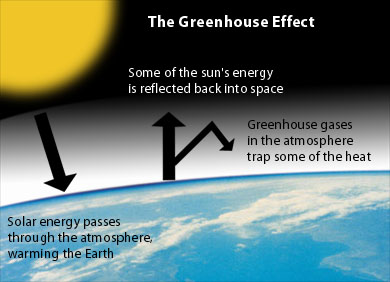 Figure 1
Short wavelength light energy from the sun comes in, is absorbed, and is re-emitted at far longer wavelengths. Basic physics as determined by Planck, a very long time ago. No argument here right!
Figure 2 below has several absorption curves. On the vertical axis, 100 is high absorption. The gas curves are verified from dozens of other links and the Planck curves are verified by my calcs here. There shouldn’t be any disagreement here either – I hope.
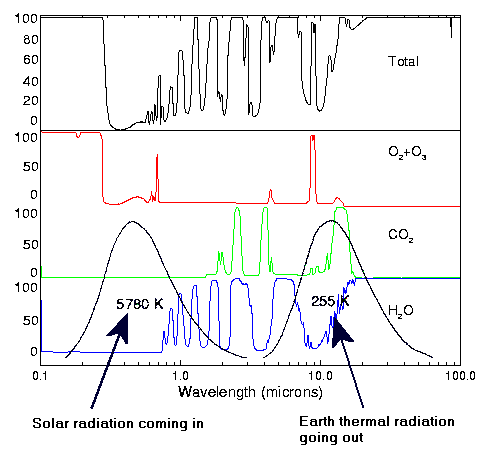 Figure 2 – Absorption curves of various molecules in the atmosphere and Planck curve overlay.
What is nice about this plot though is that the unknown author has overlaid the Planck spectrums of both incoming and outgoing radiation on top of the absorption curves. You can see by looking at the graph (or the sun) that most of the incoming curve passes through the atmosphere with little impediment. The outgoing curve however is blocked – mostly by moisture in the air – with a little tiny sliver of CO2 (green curve) effective at absorption at about 15 micrometers wavelength (the black arrow tip on the right side is at about 15um wavelength). From this figure we can see that CO2 has almost no absorption for incoming radiation (left curve), yet absorbs some outgoing radiation (right curve). No disagreement with that either – I hope. Tom Vonk’s recent post agrees with what I’ve written here.
Energy in from the Sun equals energy out from the Earth’s perspective — at least over extended time periods and without considering the relatively small amount of energy projecting from the earth’s core. If you add CO2 to our air, this simple fact of equilibrium over extended time periods does not change.
So what causes the atmospheric warming?
Air temperature is a measure of the energy stored as kinetic velocity in the atoms and molecules of the atmosphere. It’s the movement of the air! Nothing fancy, just a lot of little tiny electrically charged balls bouncing off each other and against the various forces which hold them together.
Air temperature is an expression of the kinetic energy stored in the air. Wiki has a couple of good videos at this link.
“Warming” is an increase in that kinetic energy.
So, to prove that CO2 causes warming for those who are unconvinced so far, I attempted a thought experiment yesterday morning on Tom Vonk’s thread. Unfortunately, it didn’t gain much attention. DeWitt Payne came up with a better example anyway which he left at tAV in the comments. I’ve modified it for this post.
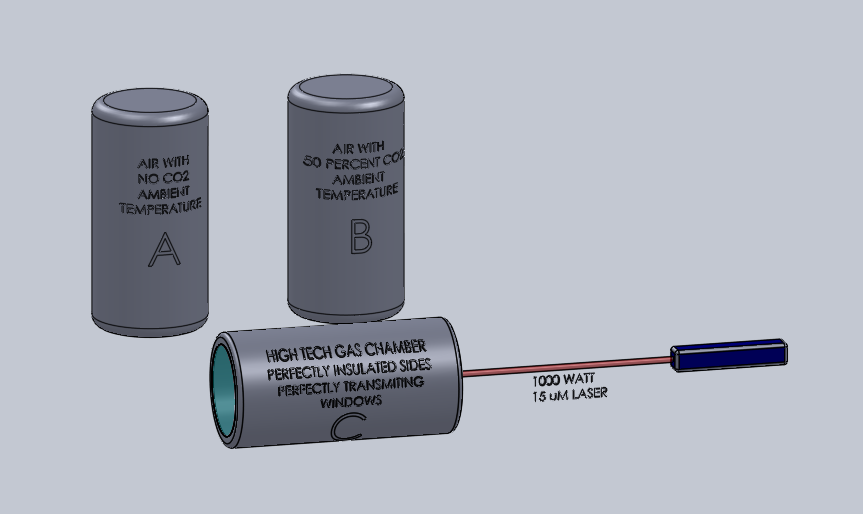 Figure 3- Experimental setup. A – gas can of air with all CO2 removed at ambient temp and standard pressure. B – gas can of air diluted by 50 percent CO2, also at ambient temp and standard pressure. C ultra insulated laser chamber with perfectly transparent end window and a tiny input window on the back to allow light in from the laser. Heat exit’s the single large window and cannot exit the sides of the chamber.
Figure 4 is a depiction of what happens when C contains a vacuum.
 Figure 4 – Laser passes straight through the chamber unimpeded and a full 1000 Watt beam exits our perfect window.
The example in Figure 5 is filling tank C with air from tank A air (zero CO2) at the equilibrium state.
 Figure 5 – Equilibrium of hypothetical system filled with zero CO2 air from canister A.
Minor absorption of the main beam causes infrared absorption and re-emission from the gas reducing the main beam from the laser. This small amount of energy is re-emitted from the gas through the end window and scattered over a full 180 degree hemisphere.
What happens when we instantly replace the no-CO2 air in chamber C with the 50% CO2 air mixture in B?
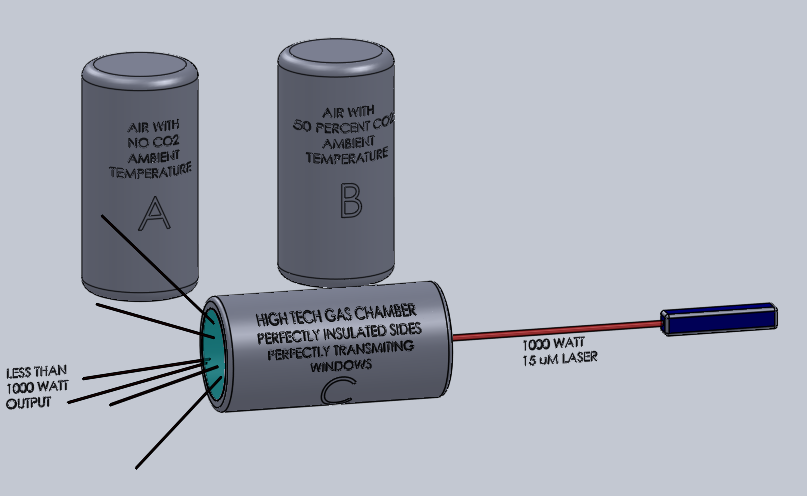 Figure 6 – Air in C is replaced instantly with gas from reservoir B
From the perspective of 15 micrometer wavelength infrared laser, the CO2 filled air is black stuff. The laser cannot penetrate it. At the moment the gas is switched, the laser beam stops penetrating and the 1000 watts (or energy per time) is added to the gas. At the moment of the switch, the gas still emits the same random energy as is shown in Figure 5 based on its ambient temperature, but the gas is now absorbing 1000 watts of laser light.
Since the beam cannot pass through, the CO2 gains vibrational energy which is then turned into translational energy and is passed back and forth between the other air molecules building greater and greater translational and vibrational velocities. —- It heats up.
As it heats, emissions from the window increase in energy according to Planck’s blackbody equation. Eventually the system reaches a new equilibrium temperature where the output from our window is exactly equal to the input from our laser – 1000 watts. Equilibrium! – (Figure 7)
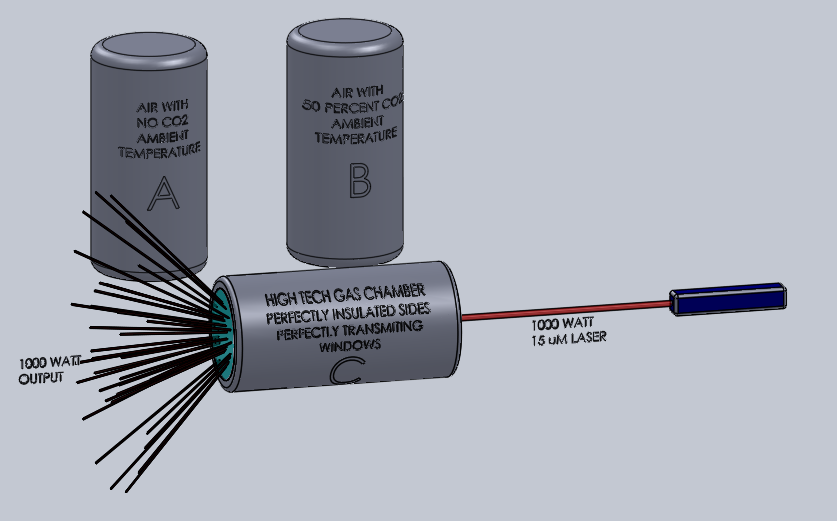 Figure 7 – Equilibrium reached when gas inside chamber C heats up to a temperature sufficient to balance incoming light energy..
The delay time between the instant the air in C is switched from A type air to B air to the time when C warms to equilibrium temperature is sometimes stated as a trapping of energy in the atmosphere.
“CO2 traps part of the infrared radiation between ground and the upper part of the atmosphere”
So from a few simple concepts, two gasses at the same temp, one transparent the other black (at infrared wavelengths), we’ve demonstrated that different absorption gasses heat differently when exposed to an energy source.
How does that apply to AGW?
The difference between this result and Tom Vonk’s recent post, is that he confuses equilibrium with zero energy flow. In his examples and equations, he has a net energy flow through the system of zero, which is fine. Where he goes wrong is equating that assumption to AGW.
What we have on Earth, is a source of 15micrometer radiation (the ground) projecting energy upward through the atmosphere, exiting through a perfect window (space) – sound familiar? Incoming solar energy passes through the atmosphere so we can ignore it when considering the most basic concepts of CO2 based warming (this post), but it is also an energy flow. In our planet, the upwelling light at IR wavelengths is a unidirectional net IR energy flow (figure 2 – outgoing radiation), like the laser in the example here.
Of course adding CO2 to our atmosphere causes some of the outgoing energy to be absorbed rather than transmitted uninterrupted to space (as shown in the example), this absorption is converted into vibrational and translational modes (heating). Yes, Tom is right, these conversions go in both directions. The energy moves in and out of CO2 and other molecules, but as shown in cavity C above, the gas takes finite measurable time to warm up and reach equilibrium with space (the window), creating a warming effect in the atmosphere.
None of the statements in this post violate any of Tom’s equations; the difference between this post and his, is only in the assumption of energy flow from the Sun to Earth and from Earth back to space. His post confused equilibrium with zero flow and his conclusions were based on the assumed zero energy flow. The math and physics were fine, but his conclusion that insulating an energy flow doesn’t cause warming is non-physical and absolutely incorrect.
Oddly enough, if you’ve ever seen an infrared CO2 laser cut steel, you have seen the same effect on an extreme scale.
————-
So finally, as a formal skeptic of AGW extremism, NONE of this should create any alarm. Sure CO2 can cause warming (a little) but warmer air holds more moisture, which changes clouds, which will cause feedbacks to the temperature. If the feedback is low or negative (as Roy Spencer recently demonstrated), none of the IPCC predictions come true, and none of the certainly exaggerated damage occurs. The CO2 then, can be considered nothing but plant food, and we can keep our tax money and take our good sweet time building the currently non-existent cleaner energy sources the enviro’s will demand anyway. If feedback is high and positive as the models predict, then the temperature measurements have some catching up to do.
Even a slight change in the amount of measured warming would send the IPCC back to the drawing board, which is what makes true and high quality results from Anthony’s surfacestations project so critically important.
This is where the AGW discussion is unsettled.
====================================
My thanks to Jeff for offering this guest post – Anthony
Discover more from Watts Up With That?
Subscribe to get the latest posts sent to your email.
We are given that the concentration of gaseous water or free H2O molecules (I am avoiding the standard term ‘water vapor’ because in common usage a vapor is a fog) in the atmosphere ranges, according to the EPA, from 30,000 ppm to 40,000 ppm and the concentration of CO2 is about 390 ppm. Thus it seems reasonable to assume that for every single CO2 radiation photon that escapes to outer space or is received from the surrounding atmosphere in a given volume of atmosphere per unit time, there may be roughly 77 to 103 equivalent H2O radiation photon events.
Even considering the fact that the lower concentration of CO2 may allow CO2 photons to escape the atmosphere at lower altitudes, I would still think that H2O must be by far the most dominant greenhouse gas in the atmosphere and must play a primary role in determining the altitude and temperature of the tropopause.
Thanks for your answer Kevin Kilty. You gave a detailed explanation, but I’d like to follow with some questions and clarifications.
The two tubes may be akin to blackbody cavities, where one is filled with CO2 (to some pressure) and the other with a transparent gas (or we can say it is empty). We can say that equilibrium can is achieved in each tube when the OLR at each window matches the incoming solar radiation.
Staying at the windows for a second, I assume that the tube full of CO2 has an emitting surface at the window, whereas the empty tube does not. I’m not sure whether that has any bearing on the matter.
So what do we expect to happen at the other end of the tubes according to GHG theories?
OLR emitted from the deep end of the empty tube gets free passage straight through the cavity and out the window. It can equilibriate in much the same way as the moon. Perhaps reaching a similar temperature to the surface of the moon in daylight.
This thread discusses CO2 as a resistive medium to OLR. The GHE effect appears to demand that equilibrium can only be achieved at the window of the tube full of CO2, if the temperature at its closed end is much higher. (We could almost decide what temperature we want by design of length of tube and maybe CO2 pressure?).
The argument of “OLR resistance” seems to suggest that the closed end of the tube full of CO2 could be sustained at higher temperature compared to temperature at its window. Certainly by radiative arguments – I’m not sure whether conduction will/could alter this.
Could we stick with a scenario where the sides are well insulated and conduction loss is negligible (incoming solar is quite powerful so we need not get too concerned if there is some leakage through the sides).
That leaves the question: when pointed into the sun, what are the temperatures at the closed ends of the tubes to radiate identical amounts of OLR at the windows?
If there is a significant temperature difference at the closed end of the tubes, we have potential to drive an engine and do work. Flow of heat through the engine helps the OLR to bypass the resistive medium in the tube full of CO2.
Why am I sceptical about this?
Yes, at 15um the detector sees “black”. This is because the optical depth of the atmosphere at 15um is far less than the actual depth of the atmosphere.
Astronomy 101: Composition of cold clouds of gas backlit by continuous spectrum have an absorption line (a gap where energy goes to zero) at the characteristic absorption frequency of the gas.
Derek B says: August 6, 2010 at 5:07 pm: “If the alarmists are even half right, that’s time we don’t have. So, much as we distrust them, we are reduced to depending on models and basing policy on risk minimisation. Meanwhile, we do know that there was significant surface warming over the 20th century as a whole. Yes, there are several candidate explanations, but none of them can claim to be more convincing than the known rise in CO2.”
I smell a troll! Still pushing the precautionary principle, Derek? We are only “reduced to depending on models” because the models have been so elevated to a level of respect that far exceeds their validity. Too many assumptions, too many unknowns, too many “what ifs,” too many ultra-wide error bars, too much cherry-picking. Just because the alarmists have been “reduced to depending on models” doesn’t mean the rest of us have to be.
Dang, why can’t this site have a “preview” button so we can check when the HTML hasn’t worked? Sorry.
[Fixed. Sorry, WordPress doesn’t support a preview function. ~dbs, mod.]
Barry Moore on line broadening:
Barry, I haven’t read the IPCC report and doubt I’ll have time to do that soon. You seem to quote the IPCC report as claiming that the increased concentration of CO2 will result in line broadening. If so, the IPCC is incorrect and I hope you’ll look more closely at the actual science.
Many factors contribute to line broadening. Two of the most important effewcts are temperature (via Doppler) and *pressure* broadening. Not cencentration, but pressure. If a sealed vessel has it’s concentration of a gas increased so that the pressure also increases then you will see the effect. For non-polar molecules this is a pretty rigorous rule. In the same sealed vessel, if you added more N2 instead of CO2 to your original CO2 you’d still observe pressure broadening. It’s definitely not a concentration based effect
Since, even with increased CO2 in the atmosphere we are predicting no change in atmospheric pressure, the IPCC is simoly wrong if it in fact states this. Can you please point me to the section and page where this is discussed?
Mike Haseler says:
August 7, 2010 at 3:43 am
The question is:
When IR is absorbed by CO2, what percentage of that IR is re-emitted as IR, what percentage is converted to vibrational & motion modes, and what percentage to other “pathways”.
At tAV, (comment 47) Pat Frank calculated the decay half life for radiative emission as 30 milliseconds, and the collision time between molecules at 10^-8 seconds – so almost none of the gas decays and re-emits (sorry to those who don’t like the word).
I didn’t know it was that much difference myself.
Liam – that is correct – all of the outgoing ~15um radiation that can be absorbed is. It’s the re-radiation by the warmed gas that matters. If there were 100 ppm less CO2 it would pretty much all still be absorbed by the atmosphere, but the altitude at which, say 90%, of the CO2 had been absorbed would be higher than at current concentrations. And if the concentration were 100 ppm higher than today that altitude would be lower. Does that make sense?
Now, go back to the point of this post: that warmed CO2 re-emits and *some* of it re-emits toward earth. Remember the inverse square law and that CO2 will be re-absorbing some of the re-emitted light on the way down and it’s easy to see that if on average the ~15 um radiation is absorbed higher in the atmosphere (low concentration case) then less of that reradiated energy makes it back to the ground and if on average the ~15 um radiation is absorbed lower in the atmosphere (high concentration case) then more of that reradiated energy makes it back to the ground.the difference might be small, but there clearly is a difference.
That part of the physics can be summarized just that simply. If people are going to argue over the finer details of how that reradiation happens I wish they’d be more careful about those details, but the conclusion of this very small part of the much more complicated picture can really be summed up that simply.
Many are going to immediately respond back regarding LTEs and forcings and negative feedbacks. Yes – of course they are all very important points to take into consideration. But this small portion of the topic seems still to be poorly understood by most of the folks here and it sure would be nice if we could get a significant plurality up to speed on at least this part.
A boy can dream, can’t he!
John Marshall asks ‘has he actually done the experiment?’ The answer is NO!
IR exert R.W. Wood did something similar 100 years ago and showed that CO2 does not trap heat.
Philosophical magazine , 1909, vol 17, p319-320
A bottle of monatomic argon reacts to IR radiation the same as a bottle of CO2.
“As it heats, emissions from the window increase in energy according to Planck’s blackbody equation. Eventually the system reaches a new equilibrium temperature where the output from our window is exactly equal to the input from our laser – 1000 watts. Equilibrium! – (Figure 7)”
questions, questions, always more questions:
What happens when the diameter of the chamber is increased ( keeping the 50% CO air mixture)? At what diameter will the laser beam “seen” on the out put side of the chamber? Or does (figure 7) the diameter of the chamber mater?
If you had “heat” sensor on the walls of the chamber would they always detect the same amount of “heat” on the walls as the diameter increased?
If the “heat” on the wall goes from X degrees to same degrees of “room” temperature on the outside of the walls wouldn’t indicate the 50% CO2 air mixture close to the walls not doing a lot of re radiation of “heat”?
This post is more acceptable to me then Tom’s and the experiment at least proves that there is a warming effect.
On the other hand, if it were not for the ozone and the water vapor and the CO2 and the oxygen in the air then we would all fry….the extra 30% radiation or so would make us toast….
The paper that confirmed to me that CO2 is (also) cooling the atmosphere by re-radiating sunshine is this one:
http://www.iop.org/EJ/article/0004-637X/644/1/551/64090.web.pdf?request-id=76e1a830-4451-4c80-aa58-4728c1d646ec
they measured this radiation as it bounced back to earth from the moon. So the direction of the radiation was:sun-earth-moon-earth. Follow info in fig. 6, bottom. Note that it already starts at 1.2 um, then one peak at 1.4 um, then various peaks at 1.6 um and 3 big peaks at 2 um.
So all gases other than nitrogen also cause a cooling effect!!My question was en is: what is the net effect of the cooling and warming of each the gases in the atmosphere other than nitrogen?
Where is the research on that? If you don’t have anything on that, then what is the use discussing any of these so-called theories?
Mr Id’s thought experiment is an assertion in drag. A bit like computer climate models.
Very perceptive question. Alarmingly few people know enough to ask it.
The troposphere is opaque to 15um radiation upwelling from the earth’s surface in tens of meters. That is indeed vitally important. Adding more CO2 would have the effect of bringing total absorption closer to the surface – more kinetic energy in a smaller air mass makes the sensible temperature higher. The nub is that convection keeps the air near the surface well mixed at distances greater than tens of meters so at this point decreasing the optical depth of the atmosphere at 15um won’t have any effect – total radiated energy from the surface at 15um will be evenly distributed in the first few hundred meters of atmosphere regardless of how much more CO2 gets added.
The most fundamental underpinning of modern science is observation.
When there is uncertainty about the existance or non-existance of a phenomenon, scientists usually try to perform an experiment (i.e. fair test) or make an observation that will either refute or verify the existance of a phenomenon.
In the journal Energy and Environment Volume 21, Number 4 / August 2010
Dr. Ferenc M. Miskolczi has published an article:
“The stable stationary value of the earth’s global average atmospheric Planck-weighted greenhouse-gas optical thickness ”
http://multi-science.metapress.com/content/nm45w65nvnj3/?p=a52f8c4dc8a1411392c30af7d57b34f2&pi=1
which conclusively shows from observation that the mean infra-red opacity of the atmosphere has NOT SIGNIFICANTLY CHANGED over the last 61 years.
Hence, while it may be true that increasing levels of CO2 have increased the mean infra-red opacity of the atmosphere – it also true that some other infra-red absorber (most likley water vapor) has effectively counter-balanced the increase in opacity caused by CO2.
Any reasonable scientist who has read Dr. Ferenc M. Miskolczi’s paper would have no trouble dismissing CAGW on scientific grounds.
Jeff, you can put what you want in your post but it still does not address the basic problem in physics that makes the alleged back radiation greenhouse effect impossible. A colder object (lower atmosphere) CANNOT heat a hotter object. Heat always moves from hotter to colder, this is like claiming you can make a river flow uphill. Not without a pump (i.e. WORK input you cannot).
Eventually sceptics/skeptics/realists, including Lindzen and Spencer are going to HAVE to accept that the greenhouse effect from back radiation is impossible.
This is the important question:-
”
The question is:
When IR is absorbed by CO2, what percentage of that IR is re-emitted as IR, what percentage is converted to vibrational & motion modes, and what percentage to other “pathways”.
”
I read on another site that it has been calculated that it takes only about 0.4 second for an IR photon to leave the atmosphere from the surface. It is all the absorptions and re-emmissions by IRIG’s (Infra Red Interacting Gasses) that slow the IR photon down. At the speed of light, if you assume the atmosphere is 100miles thick, it should take only approx 0.0005376 of a second to leave the atmosphere.
All the IRIG’s do is scatter IR and warm the atmosphere a little. This scattered IR cannot warm the ground. See 2nd law.
The real greenhouse effect is due to the slowness of convection which is the main cooling mechanism.
A lot of people are fixated on the idea of photons coming in and going out of CO2 molecules, re-emission, etc. I am going to suggest a paradigm shift that leads to a more accurate way of thinking. CO2 intrinsically emits around 15 microns with a strength that depends on its temperature and concentration. The emission intensity only depends on these things, and is equal in all directions obviously.
Of course it absorbs too at those wavelengths, so you may ask what is the net effect. This depends on the background radiation. When you look up at CO2 against a cold sky, it is emitting more than absorbing, because it is warmer than the background. When you look down with the earth as a warm background, it is a net absorber. Either way it is absorbing and emitting at those wavelengths.
The important part is that from the ground perspective it is a net emitter, making for a warming effect.
From the space perspective it is a net absorber making for a reduction of outgoing radiation that also has consequences for the net earth energy budget.
Very few skeptics doubt that atmospheric CO2 is a source of warming. What they suggest is that, compared to other sources, its effect on Earth’s temperature is so minuscule as to be background noise. The insulating atmospheric effect (the term “greenhouse effect” is incorrect and misleading) created by water vapor is much more pronounced.
By the way, as Dr. Ference Miskolczi’s findings (which are routinely ignored) have shown, the total infrared optical thickness of the atmosphere, and its theoretical value is 1.87, has not changed, despite a 30 per cent increase in CO2 over the last 61 years.
(Says Miskolczi: “I performed these computations using observations from two large, publicly available datasets known as the TIGR2 and NOAA. The computations involved the processing of 300 radiosonde observations, using a state-of-the-art, line-by-line radiative transfer code. In both datasets, the global average infrared optical thickness turned out to be 1.87, agreeing with theoretical expectations.”)
His results “show an apparent warming associated with no apparent change in the absorption properties. Change in absorption properties cannot have been the cause of the warming.”
Please see:
http://www.examiner.com/x-32936-Seminole-County-Environmental-News-Examiner~y2010m2d12-Former-NASA-scientist-defends-theory-refuting-global-warming-doctrine
http://www.friendsofscience.org/assets/documents/E&E_21_4_2010_08-miskolczi.pdf
Jeff Id, in your lead off post you say;
“None of the statements in this post violate any of Tom’s equations; the difference between this post and his, is only in the assumption of energy flow from the Sun to Earth and from Earth back to space. His post confused equilibrium with zero flow and his conclusions were based on the assumed zero energy flow. The math and physics were fine, but his conclusion that insulating an energy flow doesn’t cause warming is non-physical and absolutely incorrect.”
————————–
Jeff Id,
I did my homework and read both your post and Tom Vonk’s post one more time (3rd time).
Thank you for your excellent and educational post.
I find that your above paragraph from your post is not an accurate re-statement of what Tom Vonk said.
I liked your post immensely, except for it stating to be a reply to Vonk. Yours is a good educational tool for understanding our atmosphere by itself when all references to Vonk are removed.
I found that Tom Vonk explicitly addressed a specific narrow aspect concerning the interaction of gases in the atmosphere among themselves and also with IR radiation. His study did not pretend to address anything more widely of the whole earth system. His caveats explicitly stated processes and conditions in the whole earth system he did not address.
John
Radiation is not only governed by Plank theory, and it is very much dependent on View Factor, any body with radiative heat transfer course training, knows why the sun feels hot to earth at noon time than sunset time, the angle of sun radiation, or technically – View factor, is a key factor of radiative heat transfer
CO2, a 400 ppm quantity in the air – which means out of 100 gas molecule in the air, there is less than 0.04 molecule are CO2, so the effective radiation heat transfer due to such small View factor is questionable, need to be carefully calculated, no mention the physical parameter of absorptivity, emissivity of CO2 gas is highly temperature dependent, common knowledge is that it is significant of absoption at combustion temperature level, which is 3000 F range. atmosphere is far low temperature than combustion
by the way, the experiment of 50% CO2 in the can does not reflect the real air composition which only has 0.04% CO2 in volume. You have to compare apple to apple, right?
Merrick’s last post is correct but I think his description is looking at the effect from the wrong perspective if one wants to be quantitative. I am sorry if I am boring anyone by repeating the same point I have made several times before but the key issue is not where the 15 micron photons are first absorbed (which is only a few feet off the ground) but where they are last absorbed before being radiated into space. If say the concentration of CO2 doubles the point where this final radiation takes place has to move upwards until the partial pressure of CO2 is half that at the original level so that the photon mean free path is the same.
This view is more informative because it is not possible to discuss the energy balance of the earth from bottom up. It is too complex. For this reason I did not find either Tom’s or Jeff’s papers very convincing. The only reasonable approach is to view the world (with its atmosphere) as a whole. It is then quite simple.
All the energy aborbed by the earth has to be radiated into space.
The earth’s albedo will change due to clouds and the disribution of land and water and as the earth rotates but if we neglect these (or averaged them over time) the energy absorbed and that radiated is constant, equal and opposite.
The absorbtion is mainly by land and sea because the atmosphere is a poor absorber of sunlight.
The radiation out is from three main agents. The earth’s surface, CO2 molecules in the atmosphere and H2O molecules in the atmosphere. These three account for 99% of the energy radiated into space.
The energy radiated will depend on the temperature of these radiating elements, and their concentrations in the case of CO2 and H2O.
The earth’s surface radiates directly into space at wavelengths around 10 micron where the atmosphere is nearly transparent. The temperature is therefore around 288K for these wavelengths. Photons between 13 and 18 micron are radiated by CO2 molecules from at or just below the tropopause (altitude 16km over the tropics and 8km over the poles). The tropopause is at 220K. Most of the remaining energy is radiated by H20 from various altitudes and temperatures depending on wavelength.
Thus is should be clear that photons emitted by CO2 and H20 are being radiated from molecules at a lower temperature than the surface temperature of the earth. If the atmosphere did not contain these molecules that energy would indeed be radiated from the surface. In this scenario the earths temperature would not have to be so high in order to radiate the same total energy. This is the unambiguous argument to show that the (badly named) greenhouse effect really does exsist.
However it does not follow that increasing CO2 will automatically increase surface temperature. The argument made by the Hadley centre is that an increase in CO2 increases the effective radiating altitude (as discussed above) and this implies a drop in temperature. A lower temperature means less radiation and therefore the surface has to warm in order to restore the energy balance. However all the satellite data I have seen suggests that the radiating temperature is 220K which is the lowest temperature found in the atmosphere. Unless the tropopause is cooling ( it may be but I have seen no evidence) it could easily be argued that an increase in CO2 will lead to increased radiation due the higher CO2 concentrations and therefore the surface has to cool to compensate.
When it is not clear whether an effect is positive or negative it is hard to say that the science is settled!
Jeff Id says:
At tAV, (comment 47) Pat Frank calculated the decay half life for radiative emission as 30 milliseconds, and the collision time between molecules at 10^-8 seconds – so almost none of the gas decays and re-emits (sorry to those who don’t like the word).
So basically, the IR given off by the warm earth is absorbed in around 10m (at peak absorption) and then the molecule doesn’t re-emit for around 30msecs, during which time it’s get banged 3million times which is far more than is necessary to convert the energy held by the excited electron into motion/heat energy.
Another interesting facet is that if the mean path of the IR is around 10m, then that IR energy takes around 30seconds to go through 10km of atmosphere. Or if we were to decide the really “thick” bit of the atmosphere was 30km, then within 100secs the IR will at a layer which has a relative “open window” into space.
Now, what is the effect of CO2 high in the atmosphere? It collides roughly every 10^-8 seconds, and in any one of those collisions, it can act as a vector to enable that heat energy to be lost via IR.
CO2 is a bit like sticking holes in a bag of dry, fine sand. The hole itself can be very small, but eventually (like a sand hour-glass), the conduit will allow the heat to escape.
So, one CO2 molecule in a vast array of gas can be like one small hole in a sand-bag, two – like two holes. Put enough CO2 in the atmosphere and you get a dramatic cooling effect.
PAUSE FOR REFLECTION
This is precisely the argument of the global warmers, but turned upside down. CO2 is a cooling gas, too much CO2 in the atmosphere will lead to catastrophic cooling of the atmosphere and “unless we all stop burning so much fossil fuel – it will inevitably lead to global cooling and we could see up to 6C warming, the sea level may fall making many ports unnavigable. The cooling temperatures would certainly lead to a rise of winter illnesses like flu (23,000 die in the UK each winter).
Global cooling by excessive CO2 is a real and imminent threat to national security and those who do not accept the simple truth of basic science that CO2 cools the atmosphere are clearly are in the pay of fossil fuel companies.
Moreover, the recent 21st century cooling clearly shows the CO2 induced global cooling effect is happening “faster than we had imagined” and …. etc.
Cal said:
“Unless the tropopause is cooling ( it may be but I have seen no evidence) it could easily be argued that an increase in CO2 will lead to increased radiation due the higher CO2 concentrations and therefore the surface has to cool to compensate.”
The tropopause doesn’t appear to cool . Instead it’s height changes. It moves up when the troposphere is warming and down when the troposphere is cooling.
Contemporaneously the air circulation systems move poleward when the tropopause is rising and the troposphere warming.
Similarly the air circulation systems move equatorward when the tropopause is falling and the troposphere is cooling.
Both the changes in the height of the tropopause and the changes in the latitudinal positions of the air circulation systems are direct evidence of a change in the speed of the hydrological cycle as I have said boringly often before.
Thus a bit more energy in the atmosphere from more CO2 or any other GHG just provokes more ocean surface evaporation and a miniscule compensating increase in the speed of the hydro cycle for probably no change in surface temperature.
If a significant change in radiative balance could be caused then a higher equilibrium temperature would be achieved but if that happened there would also have to be a change in the optical depth of the atmosphere and Miskolczi seems to have shown as best we can discern from the available date that the optical depth has not changed for over 60 years despite more CO2 in the air.
AGW theory now has a serious case to answer.
It got too late to comment last night, but thank you everyone! There is a lot of great science in the comments above, too many names to mention. This is what makes WUWT the best site on the net.
People get caught up in the absorption and emission bands of CO2 and H20 and do not understand there is radiation ocurring all over the spectrum. CO2 has specific frequencies where it strongly interacts with EM radiation but there is also base black-body radiation (that is not as strong or intense sometimes) but there is two kinds of radiation to be concerned about – the strong Absorption and Emission bands and the more general black-body radiation.
Let’s take the Modtran results for the sensor at 50 metres high, the height we are concerned about since we live on the surface (no one lives at 20 kms high).
Here is the chart of the radiation “looking down” at 50M (for the tropics).
http://geodoc.uchicago.edu/tmp/rad.07105553.gif
It is nearly a perfect black-body curve at 20C, the average surface temperature in the topics. There are no bands, everything is radiating as if it were 20C.
The chart “looking up”. Now we see the same black-body curve again – no CO2 Absorption bands are evident here – except in the Atmospheric Windows, the intensity of the emissions has fallen (still “back-radiating” as some like to call it) but the intensity in the windows has now dropped to something like -20C.
http://geodoc.uchicago.edu/tmp/rad.07105841.gif
Let’s move the sensor altitude to 20 kms high where the temperature is -60C.
Looking up, we see that CO2 is still quite active here. There is some activity in the H20 and methane bands but nothing is going on in the window regions, The radiation at these spectra is already on its way to space.
http://geodoc.uchicago.edu/tmp/rad.07105142.gif
Looking down, we see the windows are emitting like the blackbody curve of 20C, CO2 is emitting as if it were -60C, and H20 is emitting as if it were -18C and so on.
http://geodoc.uchicago.edu/tmp/rad.07110031.gif
So one needs to consider there are a number of things going on here.