By Steven Goddard,

http://ocean.dmi.dk/arctic/meant80n.uk.php
Summer is rapidly winding down in the Arctic, and (based on DMI graphs) the region north of 80N appears set to finish the summer as the coldest on record. So far, there have only been a small handful of days which made it up to normal temperatures. The Arctic is one of many places described by climate scientists as “the fastest warming place on earth.”
Ice melt during July was the slowest in the JAXA record.

NCEP is forecasting below freezing temperatures for the next two weeks across much of the Arctic.

http://wxmaps.org/pix/temp2.html
Solar energy received in the Arctic is in rapid decline, as the sun drops towards the horizon.

http://earthobservatory.nasa.gov/Features/EnergyBalance/page3.php
As we forecast two weeks ago, PIPS average ice thickness has bottomed out between 2006 and 2009.

Ice thickness has increased by 25% since 2008, indicating that PIOMAS claims of record low volume are probably incorrect. PIOMAS models are often used as a “data” source by global warming activists as evidence that the Arctic is in a “death spiral.”

Below are the PIOMAS forecasts for the rest of summer. PIOMAS is expecting a big melt in August, because they believe that the ice is very thin.

Next week we will start visual comparisons of actual extent vs. PIOMAS forecasts.
Ice extent is tracking below 2006 and above 2009, just as the PIPS thickness data has indicated all summer. Evidence so far points towards PIPS being a very reliable data source.

http://ocean.dmi.dk/arctic/icecover.uk.php
The modified NSIDC image below shows how 2010 has diverged from 2007. Green areas have more ice than 2007, and red shows the opposite.

The modified NSIDC image below shows ice loss over the last week in red. As predicted in last week’s Sea Ice News #15, there has been substantial loss in the East Siberian and Chukchi Seas. Based on NCEP weather forecasts, this will continue for at least one more week.

The next modified NSIDC image below shows the differences between current Arctic ice and September, 2006. Areas in green indicate how far the ice will have to melt back to exceed the 2006 minimum. Areas in red show where ice loss has already exceeded the 2006 minimum.

Our PIPS based forecast of 5.5 million km² continues to be right on track.
Meanwhile down south, Antarctic ice continues near record highs.

http://nsidc.org/data/seaice_index/images/daily_images/S_stddev_timeseries.png
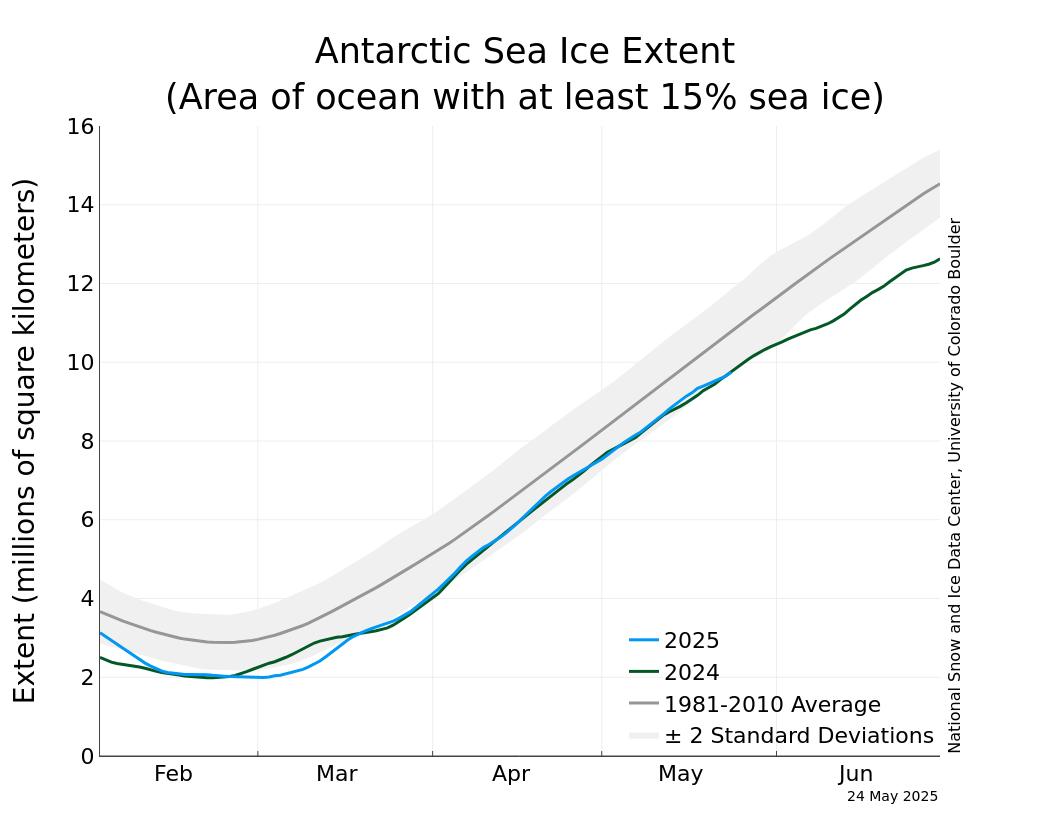
There has been much press this year about a “record polar melt” in the works. This information is incorrect, but it is seems extremely unlikely that the scientists behind those reports will make much of an effort to set the record straight.
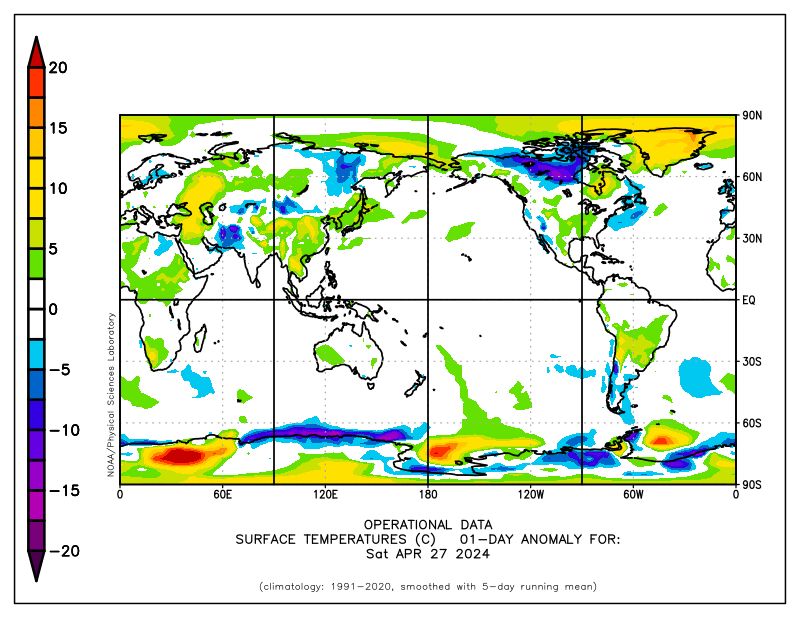
The Arctic Oscillation is forecast to turn negative again, hinting at cooler weather in the Northern Hemisphere starting in about a week.

Much of Russia, Siberia and the former Soviet Republics are already seeing well below normal temperatures, but this is (of course) not being reported by the press.

http://www.esrl.noaa.gov/psd/map/ANIM/sfctmpmer_01a.fnl.30.gif
Jimmy Haigh
That pond has been frozen for several weeks.
“Stevengoddard says:
August 2, 2010 at 3:57 am
Julienne says “I’m more interested in getting to the underlying physics, and you miss that with statistics.”
I completely agree with that philosophy.”
I disagree. When you have a great number of things, you need statistics (see the discussion about the ideal gas). The problem starts when you have to decide whether
the results make sense (are “significant”). That is where the hockeystickians fail utterly.
Julienne,
You talk about “ice survivability” as if something fundamental has changed.
Yet I see cold temperatures and favorable winds. I don’t see any reason to believe the ice is more vulnerable in August this year than 10 years ago.
Fuzzylogic19,
Not only is your logic fuzzy, but your information is incorrect.
Please cite your sources showing that global ice volume has decreased for glaciers and both poles. Once you give us your sources we can at least evaluate them. Until then, you are just making an uneducated guess.
savethesharks says:
August 1, 2010 at 10:48 pm
R. Gates says:
August 1, 2010 at 9:43 pm
***
Current conditions in the “warm” Antarctic. Vostok: Temperature -113F.
http://www.wunderground.com/global/stations/89606.html
Get your head out of your model cloud (or model a*s*)…and come join the real world.
Chris
Norfolk, VA, USA
***
What’s your idea of a ‘warm’ Antarctic? Is it winter in the southern hemisphere or am I mistaken?
Julienne Stroeve says:
August 2, 2010 at 12:27 am
Typically, I’m more interested in getting to the underlying physics, and you miss that with statistics.
I’m not much for statistics either. That’s why I noted your “Average ice loss from August 1 to August 31st is 1.5 million sq-km (based on an average from 1979-2000).”
……neutral AO state since that time period. According to previous links between the winter AO and summer Arctic sea ice, there should have been some recovery after those positive AO….
So you are attributing Arctic melt to AO and not co2? I ask only to clarify.
blackswhitewash.com says:
August 2, 2010 at 3:03 am
And what was there 40 years ago? 100? 200? 1000?
….30 years data…no idea if the baseline is average or high, or low.
This is the point I’m trying to make.
Just “eyeballing” the ice extent graph for the arctic, it appears that at least for 8/1 the years 2008,2009, and 2010 are pretty much a statistical tie. It will be interesting to see where it goes in the next 6 weeks or so.
Sea ice area in the Arctic Basin continues to decline at an anomalous rate.
http://arctic.atmos.uiuc.edu/cryosphere/IMAGES/recent365.anom.region.1.jpg
Maybe it is a little early to declare a climate “recovery”.
[maybe it is a little too early to declare anomalous rate from one graph without comparing it to other years. look at how fast the increase i ice happened ~mod]
GeoFlynx
Meltponds confusing the satellite data.
Alexej Buergin says:
August 2, 2010 at 5:49 am
“Stevengoddard says:
August 2, 2010 at 3:57 am
Julienne says “I’m more interested in getting to the underlying physics, and you miss that with statistics.”
I completely agree with that philosophy.”
I disagree. When you have a great number of things, you need statistics (see the discussion about the ideal gas). The problem starts when you have to decide whether
the results make sense (are “significant”). That is where the hockeystickians fail utterly.
_______________
Both points of view are correct, only one of them will tell you what, and the other aims toward finding out why. As a scientist, of course Julienne would be interested in the physics behind the phenomenon.
In terms of the Arctic Sea ice, GCM’s have long projected the slow decline in overall summer extent, though as we all know, it appears currently (the past 5 years) to be happening even faster than predicted. There is real physics behind why the general decline has long been forecast, but the GCM’s have not been accurate in predicting the faster decline, which is probably due to unpredictable feedbacks. Why the melt is happening faster than any of the GCM’s forecast is certainly the topic of much research and speculation, and finding out why will push the science and knowledge forward. The graph (a point of statistics) that Julienne produced is very helpful in seeing what is happening over the longer term:
http://2.bp.blogspot.com/_KfE5s-4q1s4/TAUmb9TrqoI/AAAAAAAAAEk/XQ4BhJEOC-U/s1600/stroeve.png
Though I am not a career scientist, I am one who is far more interested in why this decline in Arctic Sea ice is happening faster than the GCM’s predicted just a few years back. So statistics tell us what, but the gold (for me) lies in the why…and the longer term trend is climate, and knowing why is climate science– not climate or weather statistics.
stevengoddard says:
August 2, 2010 at 5:54 am
Julienne,
You talk about “ice survivability” as if something fundamental has changed.
Yet I see cold temperatures and favorable winds. I don’t see any reason to believe the ice is more vulnerable in August this year than 10 years ago.
___________
Steve,
That’s because you’ve discounted David Barber and his “rotten ice” entirely. A great In addition to ice extent, and ice volume, is of course ice density. Lower density ice=greater vulnerability to melt. Simple thermodynamics.
blackswhitewash.com says:
August 2, 2010 at 3:03 am
Fuzzylogic19 says:
August 2, 2010 at 12:00 am
Amino Acids in Meteorites says:
August 1, 2010 at 10:27 pm
Fuzzylogic19 says:
August 1, 2010 at 10:16 pm
Decreasing, both Arctic, Antarctica and glaciers show ice volume losses.
In comparison to what?
***
Simple, compared to what was there before.
***********************
And what was there 40 years ago? 100? 200? 1000?
claiming we are all doomed based on 30 years data is insane. Especially when we have no idea if the baseline is average or high, or low.
Also at a time of very high solar irradiance, at a time with very strong El Nino’s and positive AO.
And when there is plenty of historical evidence that there was less ice in the 1930′s, and even less when the Vikings were rowing their little boats around the globe.
***
So what’s the problem, it is sea ice and more than half melts in summer. We have about 30 years of satellite data and the baseline is determined by that. Do you have some magic means to determine how much ice there was up to 1000 years ago? Did the Vikings have GPS devices locked onto a satelite? Historical evidence, like stories?
This ice is not like the stuff on land, most of what freezes in winter melts in summer. For the last 30 years the former is losing the latter winning.
tty says:
August 2, 2010 at 12:47 am
R Gates writes:
“The lower concentation ice that doesn’t end up melting, but has a lot of open water around it, will of course go on to become that infamous “rotten ice” this winter.”
It is obvious that you do not live anywhere where you have practical experience of sea-ice. “Rotten ice” is ice in the last stage of melting. However unlike rotten meat, rotten ice does not stay rotten. If temperature sinks below zero it refreezes and is as good as new. As a matter of fact better than new if it is in salt water, since the partial melting flushes the salt out. So, there is positively no rotten ice in winter.
___________
It is obvious that you don’t understand what David Barber et. al. mean by “rotten ice” as pertaining to the Arctic Ice pack. I think a simple google on this topic will help you understand. Rotten ice (in David Barber’s use of the word) is far less dense and continuous than solid ice pack and there are very good reasons for that. But again, google it, read a bit, and then we can discuss it without you attacking my knowledge base.
“Julienne Stroeve says:
August 2, 2010 at 12:27 am
Amino Acids and Thrasher, I’m always reluctant to put too much emphasis on statistical linkages with climate indicies, but I understand there are many who want/like to make these links. Typically, I’m more interested in getting to the underlying physics, and you miss that with statistics.”
——————
It is not hard to work out the physics behind how a cyclically warm and cold northern Atlantic ocean and a cyclically warm and cold north Pacific ocean (or a cyclic Arctic Oscillation) affects the sea ice. Pretty straight-forward.
There are numerous papers which link the AMO and/or the AO to the Arctic sea ice using climate model simulations. Relatively recent one which uses both here (these are not sceptical researchers).
http://www.lanl.gov/source/orgs/ees/ees14/pdfs/09Chlylek.pdf
The past two days have had close to 100,000 melt each day. I refer to look at the numbers rather than the charts.
An average around 40, 000 for the rest of the melt season will approach 2007 lows.
Like I said , it will take an average under 30,000 per day to set a low of Steve’s predicted 5.5 million. Unless it slows quickly it should end up less than that.
Cassandra King says:
August 1, 2010 at 11:30 pm
R Gates confidently asserted that 2010 would be “one heck of a melt season” and he also predicted the sea ice minimum of 4 million sq KM or less.
_________
Cassandra, I never projected 4 million sq. km. or less. Please retract your assertion or back it up with a post of mine. I’ve consisently put my projection for extent at 4.5 million sq. km. and everyone who’s been reading this blog since March knows that.
We’ve got a solid month of melt left at least and currently the sea ice extent is higher than 2007, but lower than 2008 or 2009, which is exactly where I said we would end up this year. Right now, the low concentration ice is melting fast. I would hold your bashing of my forecast for a few weeks…
Julienne,
Your understanding of arctic sea ice creation and melting correlates with the period of satellite observation from 1978 to now. This period is associated with an anomalously positive NAO index and sea ice volume decline similar to that which likely occcured during the 1930’s. Much progress has been made to hindcast sea ice volume to the pre satellite era. The retro page of the Polar Ice center website illustrates how rapidly ice can build up under negative NAO indices as happened from 1955 to 1969.
http://psc.apl.washington.edu/zhang/IDAO/retro.html#Satellite_ice
NAO historic graph
http://en.wikipedia.org/wiki/File:Winter-NAO-Index.svg
Gerdes’s JGR paper published in 2007 looked at hindcasts for the twentieth century and found no long term change in sea ice volume.
http://www.agu.org/journals/ABS/2007/2006JC003616.shtml
Using the post satellite period as a basis for prediction of sea ice volume decline is cherry picking the longer trend.
Save the Sharks said:
Earth is not “in the balance” as Gore has said.
Earth balances herself out….every time. We are witnessing that at both poles.
Mother Earth does not give a fat flying **** what we think one way or the other.
She will keep on going on as she has done for billions of years…and if our drop-in-the-bucket species is a casualty of her wrath, then so be it.
I hope not, though.
Current conditions in the “warm” Antarctic. Vostok: Temperature -113F.
http://www.wunderground.com/global/stations/89606.html
Get your head out of your model cloud (or model a*s*)…and come join the real world.
Chris
Norfolk, VA, USA
___________
Chris,
I disagree with you about CO2. The 40% increase in the past few hundred years I think are having an effect on climate (though I’m only 75% certain of this). It’s a big change, and the real question will be how sensitive will the climate be to this increase. How much warming will we see by 2100? 3 degrees C, 4 degrees?
The earth does have a natural way of balancing things out when CO2 gets too far out of whack, but it takes millions of years in the geological cycle, as increased CO2 means greater weathering rock as the hyrdrological cycle intensifies. The weathering rock removes CO2 from the atmosphere, thereby decreasing the global temps. This a fascinating long term feedback loop and worth a google, trust me.
The rapid anthropogenic CO2 is more like a volcanic episode (without the accompanying sulfur for cooling). The earth’s ability to react to this rapid event through natural feedback processes might be overwhelmed (hence why the issue of sensitivity is so important). In addition to the decline in Arctic Sea ice, the acididification of the oceans(and apparently the decline of planckton) are good indications that the earth’s systems cannot respond fast enough to the changes that rapid CO2 increases may be causing.
I have no doubt that the earth will survive this episode of rapid CO2 increase, though perhaps there will be adjustments to the biosphere.
R. Gates wrote: The graph (a point of statistics) that Julienne produced is very helpful in seeing what is happening over the longer term:
http://2.bp.blogspot.com/_KfE5s-4q1s4/TAUmb9TrqoI/AAAAAAAAAEk/XQ4BhJEOC-U/s1600/stroeve.png
Though I am not a career scientist, I am one who is far more interested in why this decline in Arctic Sea ice is happening faster than the GCM’s predicted just a few years back. (end of quote)
Robert, I looked at the graph above, a compendium of global warming models that you seem to be so curious about, and have a question. Based on others’ comments in here, it would seem that the 1930’s saw as much, or more, melting in the arctic as we are seeing now (or at least close, and I really have learned not to trust the historical data in this field by the way, so perhaps they really weren’t close?)
Assuming the 1930’s was a time of relatively low summer arctic ice extent, what’s with the backcasting of the models on the graph you presented? They show a more or less continuously high ice extent for the entire century until about 1970. No variation for the 1930’s is evident, except in the one outlier at the bottom of the graph. (And that one becomes lost in the confusion around the year 2000 or so.) Furthermore, the “observed extent” shows a huge drop from 1950’s (when we had lousy data) to the 1980’s (when presumably the data was better), so I’m not even sure that drop actually occurred. (It wouldn’t surprise me if it didn’t, given the way records seem to be made up in this field.)
Anyway, my point is that the models didn’t even backcast properly, and as all of them are apparently structured to have increasing CO2 drive higher temperatures, why would you pay any attention to them at all? They are models that don’t predict the past, apparently, so why would anyone put any trust at all in their ability to forecast the future? Just curious.
(I can understand, given the reliance on these models, why various parties are so desperate to make sure the current temperature record shows a continuing increase, even if it means employing the sort of “tricks” revealed here on an almost daily basis.)
” R. Gates says:
August 2, 2010 at 7:46 am
Julienne says “I’m more interested in getting to the underlying physics, and you miss that with statistics.”
Both points of view are correct, only one of them will tell you what, and the other aims toward finding out why. As a scientist, of course Julienne would be interested in the physics behind the phenomenon. ”
It is not about “physics or statistics”, it must be “physics AND statistics”. That is why tome 5 of the great book of theoretical physics by Landau and Lifshitz, the one about thermodynamics, has the title “Statistical Physics”. Chapter 1 starts with statistical distributions, chapter 2 with temperature, chapter 4 is about the ideal gas.
This is one of the good things of the Soviet Union, R.I.P.
R. Gates
Within two days, 30% concentration ice will be the highest since 2006.
But I appreciate your determination to melt the ice. Keep cranking that CO2 out of your computer!
It looks like we will see a pretty steep halt in the ice melt later this week into next week. The sea ice “area” has been a decent precursor to that. We saw it flatten big time before the halt in early July, and now we are seeing it again the past several days. The ice that is left is going to be tougher and tougher to melt as it tries to penetrate some of that multi-year ice that the -AO left in the Beaufort Gyre from this past winter that hasn’t been present the past several years.
stevengoddard says:
Meltponds confusing the satellite data.
So the abnormally low concentration data is due to an abnormally high degree of melt ponding? Are these the same melt ponds you keep telling us are frozen over? Just for the record…
Like I said , it will take an average under 30,000 per day to set a low of Steve’s predicted 5.5 million. Unless it slows quickly it should end up less than that.
And this after 4 weeks of very adverse to melting weather conditions in the period it matters most. Low pressure areas dominated the Arctic, making it colder, cloudier – less insolation with the Sun high in the sky – and preventing the ice from being transported out of Fram Strait. In short, the exact opposite of the weather conditions that made 2007, with its thicker ice, the record holder for minimum extent.
That there’s still a chance of minimum extent going below 5 million square km is quite amazing in itself. the end result depends on ice thickness, of course, but even more on atmospheric conditions. This much is clear.
Had the thicker ice of 2007 experienced the weather conditions the Arctic has witnessed in this July, there is no chance the minimum would have ended up below 5 million square km.