By Steven Goddard,

http://ocean.dmi.dk/arctic/meant80n.uk.php
Summer is rapidly winding down in the Arctic, and (based on DMI graphs) the region north of 80N appears set to finish the summer as the coldest on record. So far, there have only been a small handful of days which made it up to normal temperatures. The Arctic is one of many places described by climate scientists as “the fastest warming place on earth.”
Ice melt during July was the slowest in the JAXA record.

NCEP is forecasting below freezing temperatures for the next two weeks across much of the Arctic.

http://wxmaps.org/pix/temp2.html
Solar energy received in the Arctic is in rapid decline, as the sun drops towards the horizon.

http://earthobservatory.nasa.gov/Features/EnergyBalance/page3.php
As we forecast two weeks ago, PIPS average ice thickness has bottomed out between 2006 and 2009.

Ice thickness has increased by 25% since 2008, indicating that PIOMAS claims of record low volume are probably incorrect. PIOMAS models are often used as a “data” source by global warming activists as evidence that the Arctic is in a “death spiral.”

Below are the PIOMAS forecasts for the rest of summer. PIOMAS is expecting a big melt in August, because they believe that the ice is very thin.

Next week we will start visual comparisons of actual extent vs. PIOMAS forecasts.
Ice extent is tracking below 2006 and above 2009, just as the PIPS thickness data has indicated all summer. Evidence so far points towards PIPS being a very reliable data source.

http://ocean.dmi.dk/arctic/icecover.uk.php
The modified NSIDC image below shows how 2010 has diverged from 2007. Green areas have more ice than 2007, and red shows the opposite.

The modified NSIDC image below shows ice loss over the last week in red. As predicted in last week’s Sea Ice News #15, there has been substantial loss in the East Siberian and Chukchi Seas. Based on NCEP weather forecasts, this will continue for at least one more week.

The next modified NSIDC image below shows the differences between current Arctic ice and September, 2006. Areas in green indicate how far the ice will have to melt back to exceed the 2006 minimum. Areas in red show where ice loss has already exceeded the 2006 minimum.

Our PIPS based forecast of 5.5 million km² continues to be right on track.
Meanwhile down south, Antarctic ice continues near record highs.

http://nsidc.org/data/seaice_index/images/daily_images/S_stddev_timeseries.png
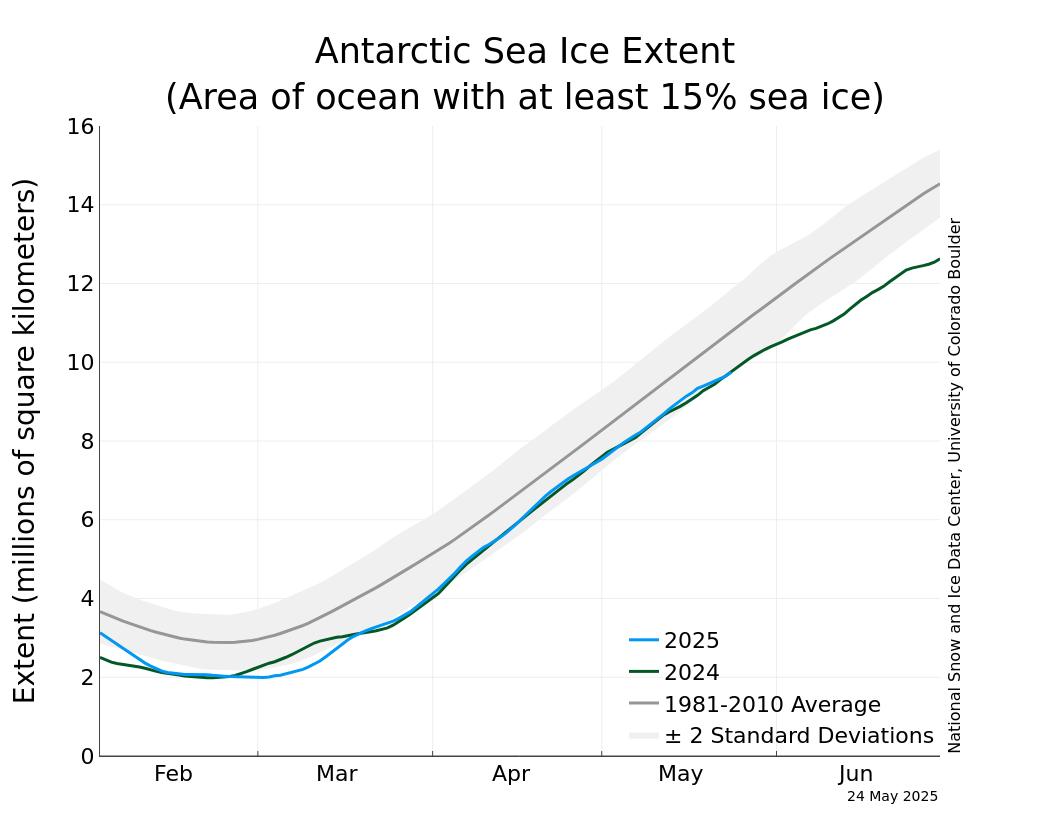
There has been much press this year about a “record polar melt” in the works. This information is incorrect, but it is seems extremely unlikely that the scientists behind those reports will make much of an effort to set the record straight.
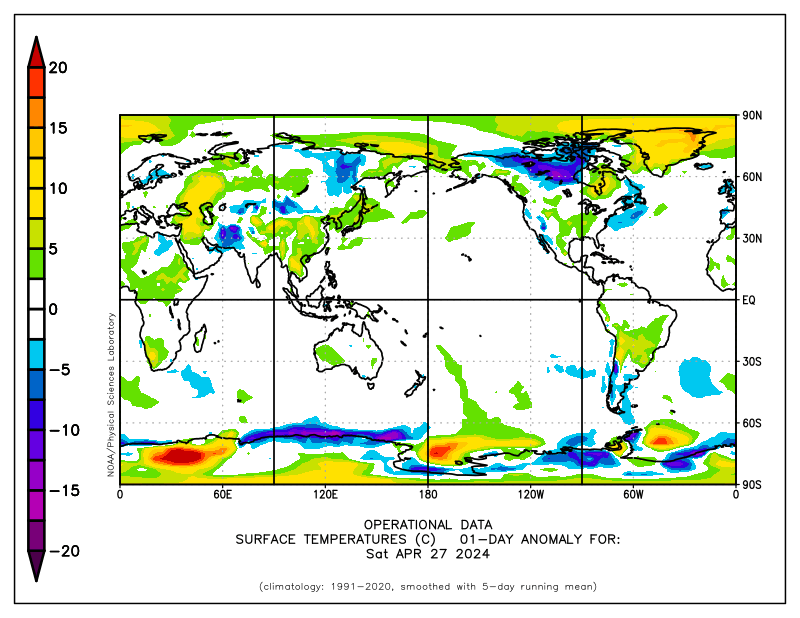
The Arctic Oscillation is forecast to turn negative again, hinting at cooler weather in the Northern Hemisphere starting in about a week.

Much of Russia, Siberia and the former Soviet Republics are already seeing well below normal temperatures, but this is (of course) not being reported by the press.

http://www.esrl.noaa.gov/psd/map/ANIM/sfctmpmer_01a.fnl.30.gif
R. Gates says:
August 1, 2010 at 9:43 pm
In sum, 2010 will show no improvement or marked reversal in the longer term decline of Arctic Sea ice…but with increasing solar irradiance, and the high probability of a decent El Nino in the next few years leading up to Solar Max in 2013, there is also a high probability of 2007′s record low extent and volume being surpassed by an even lower 2.5 million sq. km. (and this is conservative) summer low extent before 2015.
=======================
You are hopelessly biased and predisposed on your “data” and beliefs.
There is almost no point in discussing or trying to have an honest debate with you…because, specifically, your deductivenes…overrides any attempt at being inductive.
That is completely contrary to any semblance of the Scientific Method.
And there is really NO cause for alarm whatsoever in relation to your enemy, the demon, CO2.
There IS cause for alarm in the fact that we are polluting, overfishing , and generally screwing up the planet with genetically modified crops and disrupting natural biological cycles.
But all of this really has nothing to do with CO2.
It is a shame though, as all of these worthy causes get thrown under the rickety, belching, tie-dyed volkswagen CO2 bus.
The good thing is….Mother Nature does not lie. She never does.
Earth is not “in the balance” as Gore has said.
Earth balances herself out….every time. We are witnessing that at both poles.
Mother Earth does not give a fat flying **** what we think one way or the other.
She will keep on going on as she has done for billions of years…and if our drop-in-the-bucket species is a casualty of her wrath, then so be it.
I hope not, though.
Current conditions in the “warm” Antarctic. Vostok: Temperature -113F.
http://www.wunderground.com/global/stations/89606.html
Get your head out of your model cloud (or model a*s*)…and come join the real world.
Chris
Norfolk, VA, USA
Steve, how come you get 2010 so low in your graph
http://climateinsiders.files.wordpress.com/2010/08/jaxa_july_ice_melt.png?w=541&h=284#
From Jaxa I work it out as 1.986×10^6 km-2 but you seem to have it around 1.875 ??? I’m summing the values from the JAXA spreadsheet that is linked from the graph page.
Meanwhile, in the Antarctic, the positiv ice anomaly is decreasing now :-
http://arctic.atmos.uiuc.edu/cryosphere/IMAGES/seaice.recent.antarctic.png
meaning the global anomaly is well below zero as well. I’d be interested to see R.Batemans black and white graph now, or Just the Facts thoughts on this.
Andy
What fuzzylogic19 and RGates and many others can not seem to comprehend…(or don’t want to comprehend)….in regards to 30 years of satellite measurement of ice:
How many 30 year periods does it take to get 4.6 billion?
4.6 Billion / 30 = 153,000,000
AndyW
8806563 – 6922031 = 1884532
http://www.ijis.iarc.uaf.edu/seaice/extent/plot.csv
Amino Acids in Meteorites said:
August 1, 2010 at 9:50 pm
“The only way to not see a rapid growing trend in Arctic ice is to compare it to a data set that is too short.”
I don’t agree with that sentence, the shorter the data set the more likely you are to see, or what appears to be, a rapid growing trend. For instance if you take Jaxa, which is a lot shorter, it would appear that there is now a growing trend in Arctic ice from 2007, but is it? Or is it just walking back to the longer term trend?
Andy
153,000,000
Striling English
Rooney stunk in the World Cup and Ronaldo is gone. Man U lost to Kansas City last week! Write them off. I’d go with Chelsea.
Champions, gotta go with Real Madrid.
FA and Division 1, who cares?
If Everton pays 11 million for Donovan, they are idiots. He can’t make or receive a pass and looks totally spaced out most of the time. Without Altidore his WC would have stunk.
R Gates confidently asserted that 2010 would be “one heck of a melt season” and he also predicted the sea ice minimum of 4 million sq KM or less.
I cannot help but wonder if R Gates stands by his assertions in view of the evidence thus far? I note that he seems to be pushing back his predictions of doom a couple of years and I also note that he now seems to be convinced of the effect of solar cycles on global temperatures when the AGW orthodoxy denied any such link for years.
The goal posts they are a changin? As a great poet once said(apologies to Bob Dylan). I see as reality confronts the beliefs of the AGW advocates they change the rules of the game and the parameters of indicative effects and we get flip flops and evasions like extent Vs area and Jerry built lash ups like the “dipole anomaly”
To coin a phrase, our esteemed contributor Mr Gates shot his bolt way too early and bet the farm on an anomalous indicator and making the error of viewing the evidence through the lens of his emotional beliefs. It will be 30 days or so before we know what the actual reality will be and even then one swallow a summer does not make, I fear we have been trapped into short termism to prove or disprove a theory when the climate opperates in cycles of hundreds and thousand years.
I hereby challenge Mr Gates to stand by his earlier assertion regarding this years melt season he confidently made at the start of the summer.
BTW – Real Madrid is playing in LA next Sunday against Donovan. I’m tempted to fly out there for that.
This is a great service in giving clear and authoritive information in a way even non scientists like myself can grasp. I have been blogging on hostile green site, mostly Monbiot, where I find your name (Steve Goddard) is being trashed (maybe orchestrated). They are trying to laugh your work off, I think using your Spring forecast which appeared to go astray for a few weeks as an example. (They never notice how bad their models have been to predict anything).
I think this simple demonstation of the data is really getting to them and they really do not like what you are doing.
Well done, you are a star!
savethesharks says:
August 1, 2010 at 10:59 pm
What fuzzylogic19 and RGates and many others can not seem to comprehend…(or don’t want to comprehend)….in regards to 30 years of satellite measurement of ice:
How many 30 year periods does it take to get 4.6 billion?
4.6 Billion / 30 = 153,000,000
***
And the relevance?
Amino Acids in Meteorites says:
August 1, 2010 at 10:27 pm
Fuzzylogic19 says:
August 1, 2010 at 10:16 pm
Decreasing, both Arctic, Antarctica and glaciers show ice volume losses.
In comparison to what?
***
Simple, compared to what was there before.
Julian in Wales
Thanks. The only thing that anyone will remember is the end result.
They can have their fun now – as they sink into oblivion.
Thanks for taking the time to produce another good update of what’s going on in the far north.
I think we are going to have an early start to the NH winter, as the first batch of swallows have already congregated on the telegraph poles and departed for warmer climes. This is 5 weeks earlier than normal here on the south coast of the UK and is not a good sign.
The good news is that I am now feeling more confident of my guess that Arctic sea ice will end up around the 5.9m km^2 level. The continuing quiet sun and cooler oceans will mean more ice than many of the ‘experts’ predict.
Amino Acids and Thrasher, I’m always reluctant to put too much emphasis on statistical linkages with climate indicies, but I understand there are many who want/like to make these links. Typically, I’m more interested in getting to the underlying physics, and you miss that with statistics.
However, my view on the current situation of Arctic sea ice does depend in part to a link with an atmospheric index. In the late 1980s/early 1990s there was large export of the older, thicker ice out of the Arctic basin through Fram Strait under the persistence of the positive winter AO phase. This left behind a rather thin ice pack that is more vulnerable to further atmospheric and oceanic forcing. While the statistics made sense then, you would have to further note that the ice has continued to thin (and more of the old ice has continued to disappear) under a more neutral AO state since that time period. According to previous links between the winter AO and summer Arctic sea ice, there should have been some recovery after those positive AO years and yet this didn’t happen. But statistical linkages do not always work in the same way each time, and perhaps those linkages start to break down as the energy/mass balance of the system changes. We constantly need to revise our thinking as we accumulate more data and gain better understanding of how all the components of the climate system interact.
Einar Midtskogen writes:
“It’s currently possible to circumnavigate all of Svalbard without meeting ice, which is unusual.”
According to Norsk Polarinstitutt it was possible in 7 out of 10 years in the thirties (1930-31, 1933, 1936-39). See ice-maps at:
http://acsys.npolar.no/ahica/quicklooks/looks.htm
stevengoddard says:
August 1, 2010 at 10:25 pm
Fuzzylogic19
I bet you miss those days when all of Canada and much of Northern Europe were buried under miles of ice.
***
Can’t say much about Canada, but as for Northern Europe, yes I saw the paper headlines, “Europe freezing” with photo’s of snow. However, snow in quantity doesn’t fall with extreme cold (it tends to be dry, low humidity and powdery snow at best) but at temperatures around freezing point (makes for big flakes). I was there in 1966/67 and that was a bad winter, -27C in some places; hasn’t happened since though. Yes, last winter there was snow in Holland, but not all that much and they didn’t even get a white X-mas. Mind you, to achieve that there has to be a snow cover on both X-mas days of X-mas; because snow melts so quickly over there that it only happens about once every 17 years. Dutch winters tend to start 3 weeks later and a end 3 weeks early. Not much skating though because snow on ice acts as a blanket, not much thickening. Just wondering, how did Northern Europe get burried under miles of ice? Does it fall in blocks from the sky? Big blocks? Is there much of a population left? Sorry, couldn’t resist.
rbateman says:
August 1, 2010 at 10:43 pm
Fuzzylogic19 says:
August 1, 2010 at 10:16 pm
Only in places not easily accessible.
Mt. Shasta is a freakin snow-cone this summer. The Warmists claim it is a rare exception, but then everybody & his brother can see it. It’s the places you can’t get to that the Warmists claim are cooking faster than ever.
***
Are you referring to weather or climate?
R Gates writes:
“The lower concentation ice that doesn’t end up melting, but has a lot of open water around it, will of course go on to become that infamous “rotten ice” this winter.”
It is obvious that you do not live anywhere where you have practical experience of sea-ice. “Rotten ice” is ice in the last stage of melting. However unlike rotten meat, rotten ice does not stay rotten. If temperature sinks below zero it refreezes and is as good as new. As a matter of fact better than new if it is in salt water, since the partial melting flushes the salt out. So, there is positively no rotten ice in winter.
So, it’s *not* looking good for a water-ski circumnavigation of the Pole.
Again…
Here is the prognosis of the man with the highest IQ in climatology for 2009 (on Aug 7, 2009):
Steve McIntyre
Posted Aug 7, 2009 at 9:47 PM | Permalink | Reply
2009 is now slightly behind 2008. My prediction is that 2009 will end up over 500,000 sq km behind 2008.
BarryW
Posted Aug 8, 2009 at 6:57 AM | Permalink | Reply
Re: Steve McIntyre (#28),
That puts it at about 5.2 Mkmsq.
(Translation: In Canada “behind” means “above”).
For comparison Serreze at al: 4.7 Mkmsq, released Aug 19, 2009
(To be honest: It was called Meier et at, but since Meier seems to be a decent chap, let us blame Serreze).
How about asking SMcI for this year’s outlook?
Fuzzylogic19 says:
August 2, 2010 at 12:00 am
Amino Acids in Meteorites says:
August 1, 2010 at 10:27 pm
Fuzzylogic19 says:
August 1, 2010 at 10:16 pm
Decreasing, both Arctic, Antarctica and glaciers show ice volume losses.
In comparison to what?
***
Simple, compared to what was there before.
***********************
And what was there 40 years ago? 100? 200? 1000?
claiming we are all doomed based on 30 years data is insane. Especially when we have no idea if the baseline is average or high, or low.
Also at a time of very high solar irradiance, at a time with very strong El Nino’s and positive AO.
And when there is plenty of historical evidence that there was less ice in the 1930’s, and even less when the Vikings were rowing their little boats around the globe.
Looks like that meltwater pond in front of the camera at the north pole is now starting to freeze over…
Tenuc says, August 2, 2010 at 12:10 am:
“I think we are going to have an early start to the NH winter, as the first batch of swallows have already congregated on the telegraph poles and departed for warmer climes. This is 5 weeks earlier than normal here on the south coast of the UK and is not a good sign.”
Is it possible that you have been seeing swifts, rather than swallows?
Swifts migrate back around the middle of August, swallos and house martins stay until September.
But even if you saw swifts rather than swallows – it is indeed a bit early for them to start leaving.
Julienne says “I’m more interested in getting to the underlying physics, and you miss that with statistics.”
I completely agree with that philosophy.