By Steven Goddard,

http://ocean.dmi.dk/arctic/meant80n.uk.php
Summer is rapidly winding down in the Arctic, and (based on DMI graphs) the region north of 80N appears set to finish the summer as the coldest on record. So far, there have only been a small handful of days which made it up to normal temperatures. The Arctic is one of many places described by climate scientists as “the fastest warming place on earth.”
Ice melt during July was the slowest in the JAXA record.

NCEP is forecasting below freezing temperatures for the next two weeks across much of the Arctic.

http://wxmaps.org/pix/temp2.html
Solar energy received in the Arctic is in rapid decline, as the sun drops towards the horizon.

http://earthobservatory.nasa.gov/Features/EnergyBalance/page3.php
As we forecast two weeks ago, PIPS average ice thickness has bottomed out between 2006 and 2009.

Ice thickness has increased by 25% since 2008, indicating that PIOMAS claims of record low volume are probably incorrect. PIOMAS models are often used as a “data” source by global warming activists as evidence that the Arctic is in a “death spiral.”

Below are the PIOMAS forecasts for the rest of summer. PIOMAS is expecting a big melt in August, because they believe that the ice is very thin.

Next week we will start visual comparisons of actual extent vs. PIOMAS forecasts.
Ice extent is tracking below 2006 and above 2009, just as the PIPS thickness data has indicated all summer. Evidence so far points towards PIPS being a very reliable data source.

http://ocean.dmi.dk/arctic/icecover.uk.php
The modified NSIDC image below shows how 2010 has diverged from 2007. Green areas have more ice than 2007, and red shows the opposite.

The modified NSIDC image below shows ice loss over the last week in red. As predicted in last week’s Sea Ice News #15, there has been substantial loss in the East Siberian and Chukchi Seas. Based on NCEP weather forecasts, this will continue for at least one more week.

The next modified NSIDC image below shows the differences between current Arctic ice and September, 2006. Areas in green indicate how far the ice will have to melt back to exceed the 2006 minimum. Areas in red show where ice loss has already exceeded the 2006 minimum.

Our PIPS based forecast of 5.5 million km² continues to be right on track.
Meanwhile down south, Antarctic ice continues near record highs.

http://nsidc.org/data/seaice_index/images/daily_images/S_stddev_timeseries.png
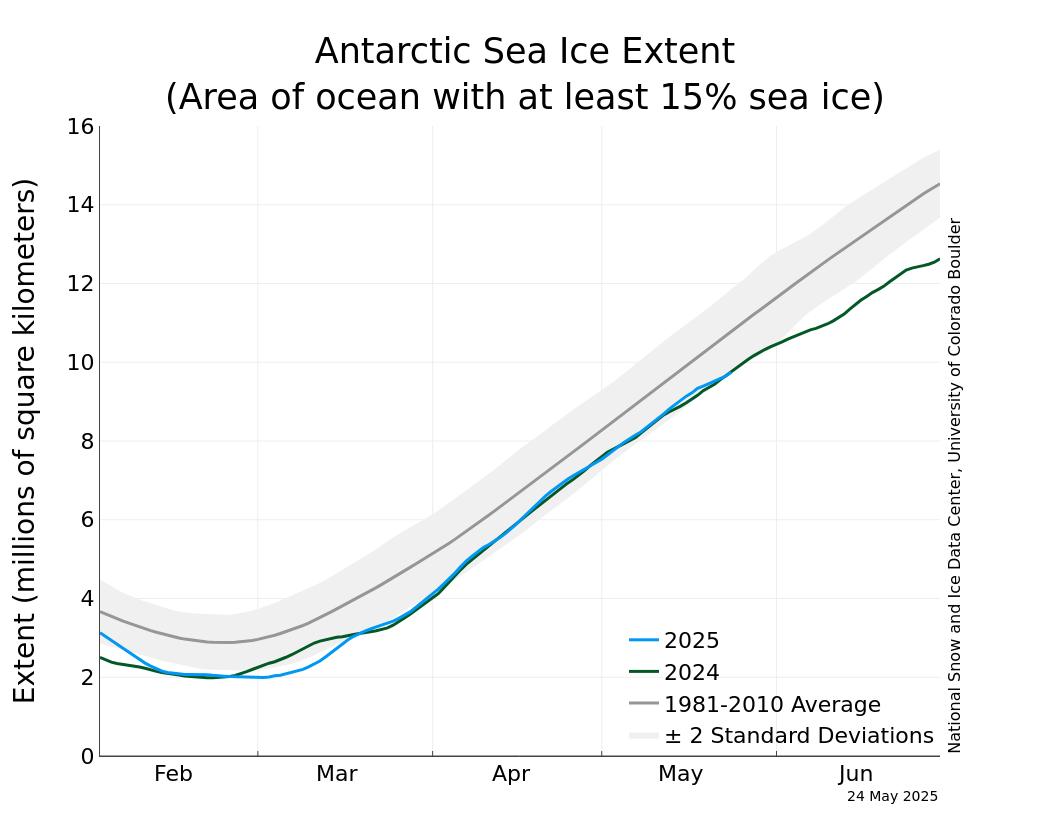
There has been much press this year about a “record polar melt” in the works. This information is incorrect, but it is seems extremely unlikely that the scientists behind those reports will make much of an effort to set the record straight.
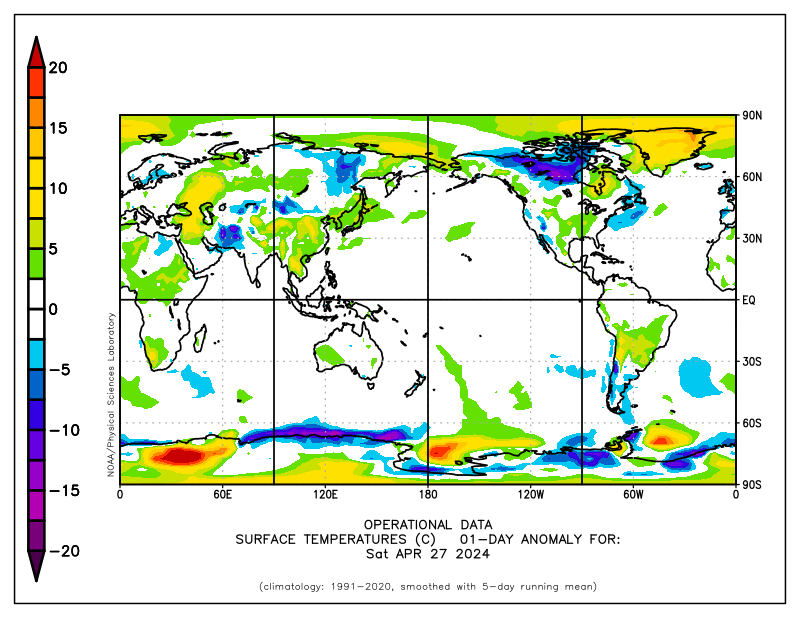
The Arctic Oscillation is forecast to turn negative again, hinting at cooler weather in the Northern Hemisphere starting in about a week.

Much of Russia, Siberia and the former Soviet Republics are already seeing well below normal temperatures, but this is (of course) not being reported by the press.

http://www.esrl.noaa.gov/psd/map/ANIM/sfctmpmer_01a.fnl.30.gif
Thrasher, you’re right one day does not matter. More telling would be the fact that 2010 has tracked low throughout the summer, which is continuing the trend towards lower summer ice conditions this past decade compared to what was seen in the 1950s-1990s (that’s about as far back as we can go with a high degree of confidence on conditions arctic-wide). I do find discussions of recovery very misleading when the data do not support it.
NSIDC has not discussed the AMO or the PDO in their blogs. The arctic sea ice news and analysis blog did not start until 2006, and the site focuses on atmospheric and oceanic conditions that have influenced each summer’s ice loss for those years. Neither the PDO or the AMO appear to be explaining the changes we’ve seen from 2006-2010.
Ed Caryl says:
August 1, 2010 at 6:49 pm
“Why do the Warmistas (Calamitologists) never look south? Maybe they don’t want to see what’s sneaking up behind them? Boo!”
Reply: my dad always warned us to beware the enema attacking from the rear!
Steve, NSIDC does not just rely on just AMSR-E data. Thus for NSIDC to show all the years used in analysis would make for a graph that would be impossible to distinguish individual years from. But the data is easily downloaded from NSIDC’s web site for anyone to do their own analysis with, allowing anyone to track how 2010 compares to prior years.
Even though I did a September prediction based on March ice age distribution and typical survivability of ice of different age classes, I think it is highly likely that 2010 will drop below 5.5 million sq-km. It is clear that the rates of survivability have been changing (i.e. less ice survives the transit through the Gyre in summer), so making estimates based on how the ice used to behave are likely to be conservative. MODIS imagery still shows a lot of openings in the ice pack so I expect ice loss to continue at a decent pace through August. Average ice loss from August 1 to August 31st is 1.5 million sq-km (based on an average from 1979-2000).
Thanks for the response Julienne. I do not think the 2006-2010 period is long enough to “explain” any climate cycle. Its a 5 year sample size. The PDO/AMO would not be felt on a long term basis for another 5-10 years at the earliest (assuming we are truly entering that negative phase). I’m just surprised that its never mentioned and its always “death spiral” talk. We are coming out of a +PDO/+AMO peak which would favor lower ice coverage anyway, but that is never mentioned either. While we cannot exactly explain how much this affects the ice in absolute terms, why do we keep seeing references to AGW for the 2007-2010 ice coverage? Surely the AGW argument would mean we keep decreasing from 2007, right? Or even 2008? The AGW theory cannot explain the upward tick since that time either. Why has is it not continued downward in the past 3 years? We heard the “death spiral” talk back then, and its been pretty much regressing back to the 2002-2005 mean each year since then.
I’ll make a disclaimer that I am in no way saying we aren’t warming from AGW…just questioning the validity of its actual significance on our much larger climate. So while the PDO/AMO do not explain the changes from 2006-2010 as you say, what explains the the changes between 2007-2010?
Julienne,
OK, your new prediction is noted.
Fuzzylogic19 says:
August 1, 2010 at 6:13 pm
Extent, extent,extent…..ice volume anyone?
It was covered. You may have overlooked that. Just read the post again.
CRS, Dr.P.H. says:
August 1, 2010 at 4:11 pm
… but not Mann’s!
(sorry, couldn’t resist)
The next few weeks are going to be darn interesting, but based on the current trajectory of the decline, it looks like 2010 will end below 2009 and 2008 in sea ice extent and volume, but not below 2007, just as I forecast in March. Notice how rapidly we are diverging from 2006 (the year that Steve was saying this year was most like). In fact, 2010 was only similar to 2006 for a very short period of time (a few weeks) due to ice spreading as the general melt dynamics were really never similar. 2010 saw a lot more open water early in the season in key areas such as the Beufort, Kara, and Barants Seas. The low concentration ice is now spreading out and melting in some of those same waters that have been warmed this summer. If you look at the sea ice area anomaly time series over the past few years:
http://arctic.atmos.uiuc.edu/cryosphere/IMAGES/sea.ice.anomaly.timeseries.jpg
You can see that 2010 and 2006 really are quite different in their dynamics, and 2010 is actually more like a hybrid between 2008 and 2007. (and not coincidentally, that’s where it appears we’ll end up). We’re primed for a rapid decline in extent over the next few weeks as the ice that has spread out over open water begins to melt and fall below that 15% concentration threshold for JAXA extent. The lower concentation ice that doesn’t end up melting, but has a lot of open water around it, will of course go on to become that infamous “rotten ice” this winter.
In sum, 2010 will show no improvement or marked reversal in the longer term decline of Arctic Sea ice…but with increasing solar irradiance, and the high probability of a decent El Nino in the next few years leading up to Solar Max in 2013, there is also a high probability of 2007’s record low extent and volume being surpassed by an even lower 2.5 million sq. km. (and this is conservative) summer low extent before 2015.
Julienne Stroeve says:
August 1, 2010 at 7:36 pm
Some ice extent numbers from the last 4 years from NSIDC’s daily extent fields:
July 31st 2010: 6.88 million sq-km
July 31st 2009: 7.12
July 31st 2008: 7.56
July 31st 2007: 6.69
average for 1979-2000: 8.61
not sure how that makes 2010 a recovery in some folks eyes, to me it looks like ice melt in 2010 is like it has been the last few years.
======================================================
I’ll ask again if 1979-2000 is a fair baseline? 21 years of data is a short period to base any conclusions on, especially since the early part of that data set was affected by the cooling of 1945 to 1975. The only way to not see a rapid growing trend in Arctic ice is to compare it to a data set that is too short. What would be fairer is a data set that goes back to 800 A.D. But we don’t have that. So we cannot conclude anything alarming about Arctic ice. And really, we cannot conclude anything.
Thrasher says:
August 1, 2010 at 8:47 pm
“Surely the AGW argument would mean we keep decreasing from 2007, right? Or even 2008? The AGW theory cannot explain the upward tick since that time either. Why has is it not continued downward in the past 3 years?”
Reply: I believe you’ve just hit the nail on the head, but you’ve got to be more careful with your terminology. It is not an AGW “theory”. It is simply a conjecture. And you’ve just proven it as such!
The 2010 Arctic sea ice extent minimum will be below that of 2009.
“Recovery” has been cancelled due to global warming.
But all skeptical amateurs are free to revise their predictions upwards to 2006, 2003, or above. It’s the summer – shoes, shirts, and prediction rules are casual.
R. Gates
I admire your persistence – for two more weeks.
Julienne Stroeve says:
August 1, 2010 at 8:38 pm
Neither the PDO or the AMO appear to be explaining ……(based on an average from 1979-2000).
Apparently the alarming thinning ice hypothesis is based on currents from the oceans. So I cannot see how PDO (+) and PDO (-) aren’t affecting Arctic ice.
Most of the years from 1979-2000 were PDO (+) years.So average melt was higher than it would be in mostly PDO (-) years. The earth has entered PDO (-) for a few years now—and it shows in the Arctic ice totals since 2007. The average ice loss during 1979-2000 may not play out this August.
Arctic ice is an immense mass. To think that PDO (+) or PDO (-) would track along in step with what Arctic ice does couldn’t be true. They would be a lag.
Ralph Dwyer says:
August 1, 2010 at 9:51 pm
Thrasher says:
August 1, 2010 at 8:47 pm
“Surely the AGW argument would mean we keep decreasing from 2007, right? Or even 2008? The AGW theory cannot explain the upward tick since that time either. Why has is it not continued downward in the past 3 years?”
Reply: I believe you’ve just hit the nail on the head, but you’ve got to be more careful with your terminology. It is not an AGW “theory”. It is simply a conjecture. And you’ve just proven it as such!
____________________
This is completely erroneous. The long and deep solar minimum we’ve just passed through in 2008-2009 and it’s subsequent low total solar irradiance is a known and accounted for “reason” why the summer ice minumum didn’t continue strait down from 2007. 2007’s low summer extent was a shocker to many sea ice experts, just as the lowest in a century solar minimum as a shocker to many solar experts, but a simple glance at total solar irradiance when charted against global temps shows why the slow down in the decline of summer sea ice in 2008-2009 was hardly unexplainable. Go here and look at the graphs by clicking on “sun” in the left hand column:
http://www.climate4you.com/
Probably more remarkable is that the summer sea ice did not mount an even bigger recovery during this longest and deepest solar minimum in a century.
Charles S. Opalek, PE says:
August 1, 2010 at 3:08 pm
With all these anecdotal stories of ice melting, can someone answer a simple question?
Is the world inventory of ice increasing, or decreasing?
Anyone?
***
Decreasing, both Arctic, Antarctica and glaciers show ice volume losses.
Fuzzylogic19
I bet you miss those days when all of Canada and much of Northern Europe were buried under miles of ice.
Fuzzylogic19 says:
August 1, 2010 at 10:16 pm
Decreasing, both Arctic, Antarctica and glaciers show ice volume losses.
In comparison to what?
Maybe some comments about the Northwest Passage next week for us with less time to look around.
When glaciers retreat and reveal tree stumps and remains of villages we cannot conclude that the loss of ice is alarming but only that it has happened before, and that it has been warmer in the past than it is now.
Robert,
Note NCEP is forecasting freezing temperatures in portions of the NWP next week.
http://climateinsiders.files.wordpress.com/2010/08/ncepaug1.jpg
Fuzzylogic19 says:
August 1, 2010 at 10:16 pm
Only in places not easily accessible.
Mt. Shasta is a freakin snow-cone this summer. The Warmists claim it is a rare exception, but then everybody & his brother can see it. It’s the places you can’t get to that the Warmists claim are cooking faster than ever.
The UK soccer season is soon to start.
As everyone here seems to be so fascinated with making forecasts rather than seeing what actually happens..- much like the criticism rightly made of those who mistake climate model output for experiments – can anyone help me with my wee little flutters for the footie?
I need outright winners for the Premiership, Championship, Division1 and the FA Cup.
Thanks in advance.
Amino Acids in Meteorites says:
August 1, 2010 at 10:29 pm
Tree stumps where glaciers previously existed?
I’ve been brushfired, I’ve been treeringed, and now I’m stumped.
JER0ME says:
August 1, 2010 at 9:37 pm
CRS, Dr.P.H. says:
August 1, 2010 at 4:11 pm
Glaciers come and go, wax and wane, and man’s influence is uncertain.
… but not Mann’s!
(sorry, couldn’t resist)
—–
REPLY: LOL!!