By Steven Goddard,

http://ocean.dmi.dk/arctic/meant80n.uk.php
Summer is rapidly winding down in the Arctic, and (based on DMI graphs) the region north of 80N appears set to finish the summer as the coldest on record. So far, there have only been a small handful of days which made it up to normal temperatures. The Arctic is one of many places described by climate scientists as “the fastest warming place on earth.”
Ice melt during July was the slowest in the JAXA record.

NCEP is forecasting below freezing temperatures for the next two weeks across much of the Arctic.

http://wxmaps.org/pix/temp2.html
Solar energy received in the Arctic is in rapid decline, as the sun drops towards the horizon.

http://earthobservatory.nasa.gov/Features/EnergyBalance/page3.php
As we forecast two weeks ago, PIPS average ice thickness has bottomed out between 2006 and 2009.

Ice thickness has increased by 25% since 2008, indicating that PIOMAS claims of record low volume are probably incorrect. PIOMAS models are often used as a “data” source by global warming activists as evidence that the Arctic is in a “death spiral.”

Below are the PIOMAS forecasts for the rest of summer. PIOMAS is expecting a big melt in August, because they believe that the ice is very thin.

Next week we will start visual comparisons of actual extent vs. PIOMAS forecasts.
Ice extent is tracking below 2006 and above 2009, just as the PIPS thickness data has indicated all summer. Evidence so far points towards PIPS being a very reliable data source.

http://ocean.dmi.dk/arctic/icecover.uk.php
The modified NSIDC image below shows how 2010 has diverged from 2007. Green areas have more ice than 2007, and red shows the opposite.

The modified NSIDC image below shows ice loss over the last week in red. As predicted in last week’s Sea Ice News #15, there has been substantial loss in the East Siberian and Chukchi Seas. Based on NCEP weather forecasts, this will continue for at least one more week.

The next modified NSIDC image below shows the differences between current Arctic ice and September, 2006. Areas in green indicate how far the ice will have to melt back to exceed the 2006 minimum. Areas in red show where ice loss has already exceeded the 2006 minimum.

Our PIPS based forecast of 5.5 million km² continues to be right on track.
Meanwhile down south, Antarctic ice continues near record highs.

http://nsidc.org/data/seaice_index/images/daily_images/S_stddev_timeseries.png
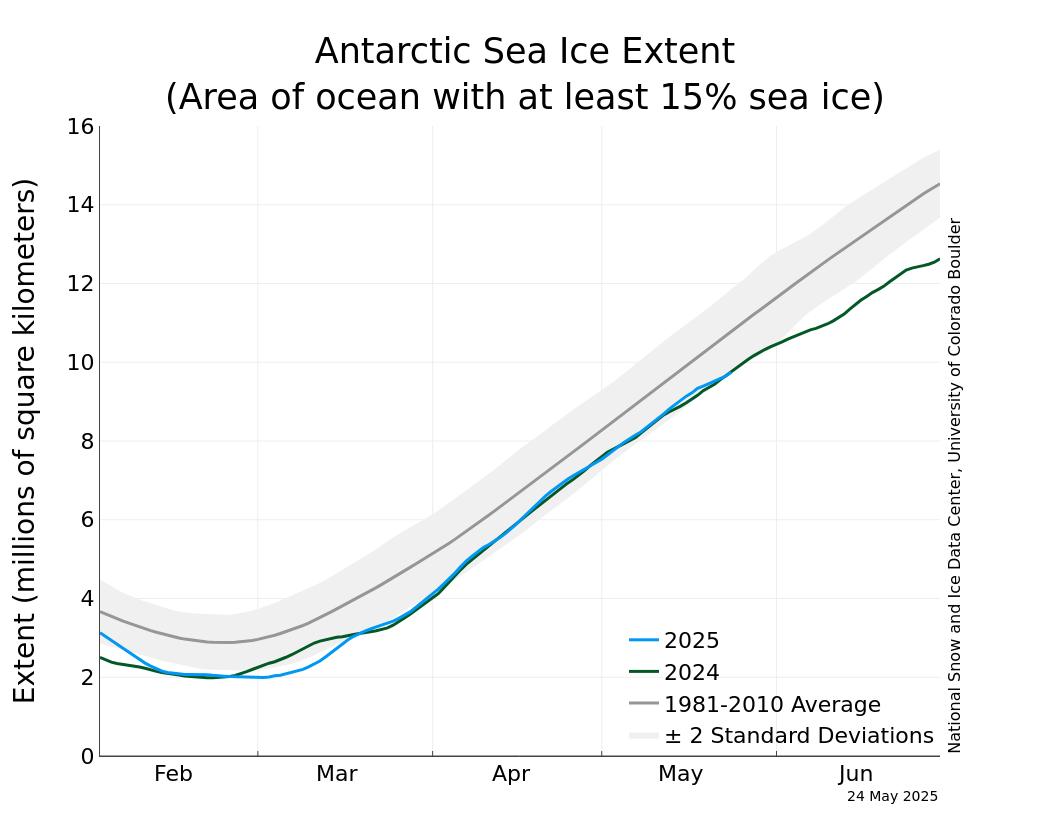
There has been much press this year about a “record polar melt” in the works. This information is incorrect, but it is seems extremely unlikely that the scientists behind those reports will make much of an effort to set the record straight.
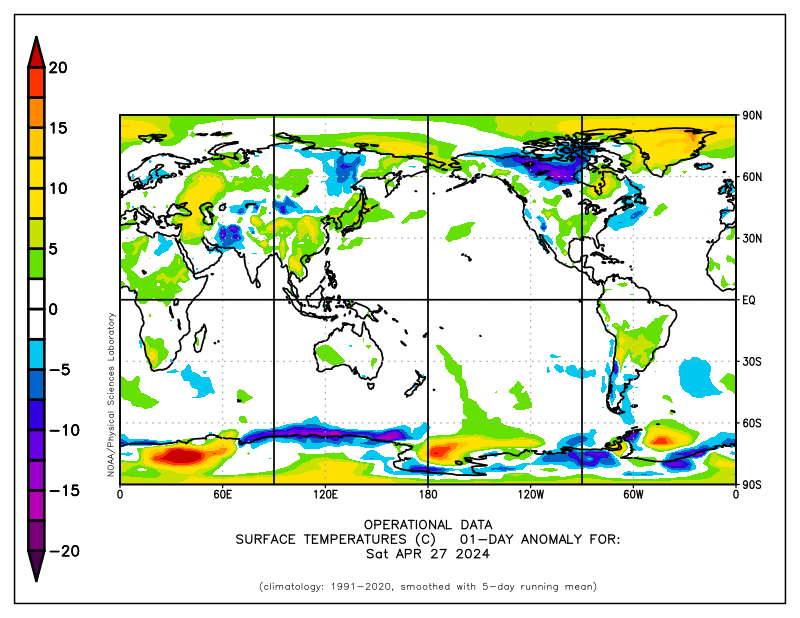
The Arctic Oscillation is forecast to turn negative again, hinting at cooler weather in the Northern Hemisphere starting in about a week.

Much of Russia, Siberia and the former Soviet Republics are already seeing well below normal temperatures, but this is (of course) not being reported by the press.

http://www.esrl.noaa.gov/psd/map/ANIM/sfctmpmer_01a.fnl.30.gif
With all these anecdotal stories of ice melting, can someone answer a simple question?
Is the world inventory of ice increasing, or decreasing?
Anyone?
“The Arctic Oscillation is forecast to turn negative again, hinting at cooler weather in the Northern Hemisphere starting in about a week.” Last week 3 flocks of geese, in their typical V formations, took off from the pond and grainfields behind our house, and then settled back down. This is the earliest (in southeastern Washington Sate) I have seen them exercising for their fall migration.
dp says:
August 1, 2010 at 1:43 pm
When does enough weather become climate?
———————————————————–
Easy!
cold is weather
Hot is climate!
@Steinar Midtskogen
Which has been the case since 90s… The current anomaly at svalbard is infact lower than it has been in ages at this time of year. It is about to dip below normal as well:
http://fil.nrk.no/yr/grafikk/klima/mnd/mnd_099840_nob.png
The average temp for last 30 days will soon be BELOW normal if weather forecast is anywhere near correct: http://www.yr.no/sted/Norge/Svalbard/Longyearbyen/sannsynlighetsvarsel.png
@Steinar Midtskogen
And i forgot to mention the fact that they are using 61-90 as so called normal, which was a rather cold period in that area.
You all do not understand how Climate Science works. You create model than change the KM’s to be the one that best agrees with what you think it should be.
To beat 2009, assuming another 44 days of melt, the average daily melt needs to stay under 30,000 sk a day. It better slow fast.
Hoskald says:
August 1, 2010 at 1:14 pm
“I hope you’re right, I could use some cooler weather down here in Oklahoma! Not looking forward to this winter though.”
I’m looking forward to this winter…
I’m not sure about “ice” but here is sea ice.
http://arctic.atmos.uiuc.edu/cryosphere/IMAGES/global.daily.ice.area.withtrend.jpg
Some people argue that we have turned a corner. We shall have to wait and see.
More ice below:
http://wattsupwiththat.com/sea-ice-page/
I wonder if the next winter will be “the hottest” on record. Is it possible the same situation like “snow Armageddon” last winter? Let’s collect some firewood before it!
And yet…
* Arctic ice extent is the second lowest on record for this time of year
* Arctic ice area is the second lowest on record for this time of year
* Arctic ice average concentration (= area / extent) is the lowest on record for this time of year
* The rate of ice extent loss was slowed in early July by cloudy conditions, and winds tending to spread out the ice pack. It has since accelerated again. The current rate of ice extent loss is considerably faster than 2009, and running parallel to 2008
There is no way to spin this as “continued recovery” as things stand, we all have to wait for the final factor: the length of the melt season. 2008 showed rapid continuing ice loss through to the start of September and beyond, whereas 2009 showed a sharp decline in ice loss around the start of August. Whether 2010 follows the former pattern or the latter determines whether this year’s ice loss will be disastrous, or merely extremely bad. If there’s any kind of acceleration, e.g. due to the Dipole Anomaly returning and compressing the low-concentration ice, we’re into the realms of catastrophic. The state of the central pack is not good, looking at the MODIS images. I don’t have the background to tell how much worse it is than 2007/8/9, but it’s certainly no better.
Pretty much neck and neck with 2009 right now. If it finishes higher than 2009, I’m sure we’ll hear the “4th lowest extent on record” thing…eventually we might get to a 2013 ice free arctic. It better get melting quick though!!
Charles S. Opalek, PE says:
August 1, 2010 at 3:08 pm
With all these anecdotal stories of ice melting, can someone answer a simple question?
Is the world inventory of ice increasing, or decreasing?
Anyone?
——–
REPLY: Chas, thanks for asking! It depends on who you talk to, and if they have a dog in the AGW fight.
Much attention in the media is paid to Arctic/Antarctic ice extent, but not as much to actual mass of the ice. WUWT posters often postulate that, although some of the thin ice close to shores has melted, the overall area (extent) is doing well, and the lack of melting of Arctic ice & movement out of the Arctic basin this summer due to wind patterns will lead towards increasing thickness of ice. In other words, we see the glass half-full, and recovery of the Arctic mass. Similarly, the Antarctic seems to be faring well.
I cannot speak for land mass ice (glaciers and ice fields), but media reports of massive & rapid depletion seem to be rather, well, premature. Glaciers come and go, wax and wane, and man’s influence is uncertain. Deposition of soot from combustion of fossil fuels and biomass might be a greater factor than the media tends to report.
Mine through this blog for past threads, you’ll find a wealth of information. Fascinating reading! Cheers, Chuck the DrPH, Univ of Illinois
It makes a difference whether the ice is at your house or below. Believe me.
Bill Illis says:
August 1, 2010 at 2:26 pm
This is the hi-res Modis temperature map for July 29th (lots of missing pixels but you should be able to see it).
That is quite a hot spot from Russia to Europe. Is that that blob from last year? 😉
noaaprogrammer says:
August 1, 2010 at 3:09 pm
“The Arctic Oscillation is forecast to turn negative again, hinting at cooler weather in the Northern Hemisphere starting in about a week.”
Am I remembering right—the AO (-) pushes cold air from the Arctic down toward Russia and the US?
Completely ignoring the Antarctic and the global sea ice extent by the mainstream media borders on incompetence.
Gail Combs says:
August 1, 2010 at 3:01 pm
So where did the super cold in South America go???
Apparently, according to the Short Term Climate at NCEP:
http://wxmaps.org/pix/temp8.html
It’s still there, and it’s predicted to hang around.
If it is a preview of the N. Hemispere’s winter, it’s going to get ugly.
I dont understand : thickness and area are approximately at 2006 level, but volume is much much lower (according to PIOMAS model), how can this be possible ?
It looks like PIOMAS shows the M’Clure Strait (or McClure) as open. But Cryosphere Today does not show that it’s open.
M’Clure Strait
http://img829.imageshack.us/img829/7357/arctic.gif
Cryosphere Today, 7/31/10
http://img713.imageshack.us/img713/9458/arcticseaicecolor000d.png
Looking at the 1st graph, I don’t see how the atmosphere / greenhouse / co2 can melt much ice.
Peter Ellis says:
August 1, 2010 at 3:53 pm
“Whether 2010 follows the former pattern or the latter determines whether this year’s ice loss will be disastrous, or merely extremely bad. If there’s any kind of acceleration, e.g. due to the Dipole Anomaly returning and compressing the low-concentration ice, we’re into the realms of catastrophic.”
Reply: Your comment appears a bit hyperbolic. Can you please describe the extremely bad disasters and catastrophes we face? We can start from there. Thanks.
Benjamin says:
August 1, 2010 at 4:53 pm
I dont understand : thickness and area are approximately at 2006 level, but volume is much much lower (according to PIOMAS model), how can this be possible ?
It’s evidence that PIOMAS is wrong. That will make it easier to understand. 😉
Whether 2010 follows the former pattern or the latter determines whether this year’s ice loss will be disastrous, or merely extremely bad.
Compared to What, PE? We only have 30 years of ice record. Can you say for certain that the north polar ice has NEVER disappeared entirely in the past half billion years of climate change?
The world inventory of ice has been decreasing since the end of the last ice age, when glaciers covered Chicago and New York a mile deep.