By Steve Goddard
The Arctic is proud to have been listed as one of many “fastest warming places on earth.”
The GISS 250km Arctic image below shows temperature trends from 1880-2009. Areas in black represent regions with no data.

In most fields of science, data is considered an essential element of historical analysis. But climate science gets a pass, because it involves “saving the planet.” Antarctic coverage is equally as impressive. The image below looks right through the earth to the Arctic hole.

Temperatures in the high Arctic have been running well below normal and have started their annual decline. There are only about 30 days left of possible melt above 80N.

http://ocean.dmi.dk/arctic/meant80n.uk.php
This can be seen in North Pole webcams which show the ice frozen solid.

http://psc.apl.washington.edu/northpole/webphotos/noaa2.jpg

As forecast in last week’s sea ice news, ice loss accelerated during the past week over the East Siberian Sea due to above normal temperatures.

http://ocean.dmi.dk/arctic/icecover.uk.php
The modified NSIDC map below shows (in red) regions of the Arctic that have lost ice over the past week.

The modified NSIDC map below shows (in red) ice loss since early April.

The modified NSIDC map below shows (in red) ice loss since July 1. The Beaufort Sea has actually gained ice (green.) Looks like a Northwest Passage traverse is quite possible (by helicopter.)

Ice loss from July 1 through July 23 has been the slowest on record in the JAXA database. Ice loss during July has been about one half that of 2007.

The graph below shows the difference between 2010 and 2007 melt. 2010 started the month half a million km² behind 2007, and is now half a million km² ahead of 2007.

The modified NSIDC image below shows the difference between 2007 ice and 2010 ice. Green indicates more ice in 2010, red indicates less.

“Climate expert” Joe Romm reported in May
Arctic sea ice shrinks faster than 2007, NSIDC director Serreze says, “I think it’s quite possible” we could “break another record this year.” Watts and Goddard seem in denial
Average ice thickness continues to follow a track below 2006 and above 2009, hinting that my prediction of a 5.5 million km² minimum continues to be correct.

During July, ice movement has been quite different from 2007 – which had strong winds compressing the ice towards the pole. By contrast, July 2010 has seen winds generally pushing away from the pole. Thus the ice edge on the Pacific side is further from the pole. No rocket science there, and a pretty strong indication that the alleged 2007 record summer melt was primarily due to wind.
Cryosphere Today showed two days ago that Arctic Basin ice is nearly identical to 20 years ago, but unfortunately their web site is down and I can’t generate any images.
NCEP forecasts warm temperatures in the East Siberian, Chukchi and Beaufort Seas for the next week, so I expect that melt will continue around the edges of the Arctic Basin.
Meanwhile, Antarctic ice continues well above normal. Antarctica is also the fastest warming place on the planet.
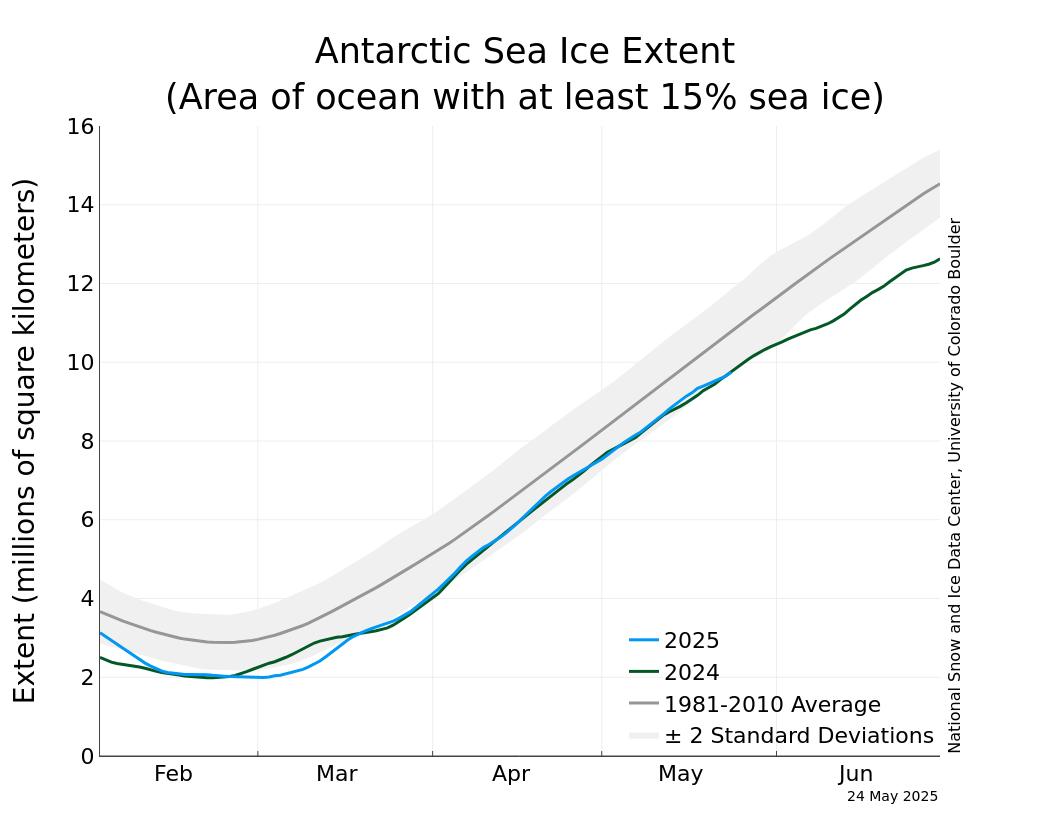

Conclusion: There is no polar meltdown at either pole.
Next week we start comparing PIOMASS forecasts vs. reality. PIOMASS claims that Arctic ice is the thinnest on record.

============================================
Don’t forget to bookmark WUWT’s new Sea Ice Page
Sponsored IT training links:
Subscribe for 350-030 training and get up to date 70-649 materials with 100% success guarantee plus get free demos for 220-701 exam.
Caleb says:
July 25, 2010 at 8:42 pm
=========================
Caleb, you are an extremely smart, evolved individual.
Always appreciate your posts…and your words here…are definitely no exception.
I repeat these words…all worth repeating:
=======================
Caleb’s words:
“Fortunately, it won’t be teenagers who risk death. Instead it will be a bunch of old men of my age who wish they were teenagers. Unlike me, and teenagers, they have millions of dollars and can afford pleasure craft. However their lives are so empty and devoid of meaning, despite all their hard-earned wealth, that they attempt an absurd stunt and mouth inane platitudes about Global Warming, seeking the meaning they remember they had as teenagers, but have lost.”
“After all, if you had several million dollars, and really did care for “humanity,” would you spend your millions on a “pleasure craft” and sail the Northwest Passage? Or would you spend it on people with very real needs, in your own home town?”
In 2008 a kayaker tried to get to the North Pole. He got “stuck”.
http://wattsupwiththat.com/2008/09/03/adventures-in-arctic-kayaking/
R. Gates says:
July 25, 2010 at 8:20 pm
“You would do well to pick up a book on chaos theory.”
=========================================
And you would do most well to just pick up a few books of meteorology and physics, not to mention a book or two on logical fallacies, and just basically NOT set forth your opinion….for a very VERY long while.
Sort of like a monk taking a vow of silence.
Chris
Norfolk, VA, USA
tty says:
July 25, 2010 at 3:17 pm
Phil:
“According to CT on that date this year the ice area was 5.1075397Mm^2 whereas on the same date in 1990 it was 6.1955042Mm^2, that isn’t nearly identical!”
I would be very chary about comparing those two figures. In the 80′s and 90′s SSM/I saw a lot of ice in places where there wasn’t any. Just have a look at the Baltic, the White Sea and the Pechora coast (where there is positively never any ice in July, the Baltic is even bathable then).
To tty: I’m curious about the point you make above. Are you saying that the satellite interpretations of ice extent were biased upward in the 80’s and 90’s? And if so, you’re basing this on your knowledge of certain areas being ice-free that are shown to be counted as part of the calculated ice extent at the time?
The reason I’m asking is that I asked a while back if the AMSRE data could have been biased downward compared to pre-2002 ice extent figures. Yours is the first comment I’ve seen that implies that might be the case (at least in the one instance you discussed above.)
Arctic ice is not supposed to be an important topic. Sooooo, why do these Arctic ice posts get so much attention?
Just askin……
R. Gates:
You always leave out the rest of the story.
Having passed through Deep Solar Minimum, the rest of it, so far, is the Solar Doldrums. No breakout ramps, if you are going to pin the blame on Solar Activity, which according to SIDC, is low to very low.
The Arctic is only 1/2 the poles on the Earth. The Antarctic tells the rest of the Global Sea Ice story. No cherry picking one pole to support unprecedented warming.
And as for your tipping points: where’s the physics that have pinpointed these hystereses?
Simulations run on computers are not physics, and neither are extrapolated homogenizations.
As Steve has laid out, the ‘warming faster than anyplace else’ flag waving has worn out. It’s tired.
David W says: …7.23 and 7.18
That is REALLY: 7.323 and 7.318.
Yet JAXA still shows 2009 passing 2010 (but by a tenth as much)
Comparing _______2007___ to___ 2010_______&______2009
Ahead June 28______ no________ 679,531 Sq.Km______ no
Ahead July 25____542,500_________no______________5,312
Daily: ___________2007_________2010__
July23-24 ______ – 115,906 _____- 93,906
July24-25 ______ – 76,875 _____ – 56,875preliminary
Remaining Melts (K= 1,000km2) ___2 Days @ur momisugly 93 K __3d@ur momisugly 87 K __ 5d@ur momisugly 55
__4d@ur momisugly 107__4d@ur momisugly 80__12d@ur momisugly 50__ 4d@ur momisugly 33__ 5d@ur momisugly 55__24Days @ur momisugly 14.5 K
However, The La Nina High Pressure Systems are Creeping Closer: now moving North a bit Out of the Pacific near Juneau Alaska: http://www.esrl.noaa.gov/psd/map/images/fnl/mslp_01.fnl.html
… We could start quarter-million Melts in a week … or a Month.
I think Wayne Davidson’s “Big Blue” is coming … Blue Skies, anyway.
Tell you what Steve: I’ll cut my estimate for a Melt severe enough to cause Ocean Current Shutdown … by 0.1 percent per day, if
Under 150K, .2 if under 100K and .4 if under 50K … but above 150 K each 50K Doubles also e.g 500K/day = 2E7 = + 12.8%. Well, actually, I’ve BEEN doing that, and what I once said was a Likelihood of 1/4 to 1/8th, is now about 1/10 th..
Call it 10%, less 0.2 for today = 9.8 %.
Amino Acids in Meteorites says:
July 25, 2010 at 9:57 pm
Sooooo, why do these Arctic ice posts get so much attention?
Because you can’t get up there on a dime.
Not like the sea level, where one can see it’s not going anywhere.
Phil. says:
July 25, 2010 at 5:20 pm
Air in the close vicinity of melting sea ice would be expected to stay close to 0ºC.
Regarding temperature, according to Spencer’s AQUA Ch 5 every day in July as been as hot or hotter than any other days since 1979 (to within the width of the line). So it would be surprising if July 2010 doesn’t turn out to be the hottest month of the satellite record.
What about the difference between DMI and GISS? Why is one well below normal, and the other the ‘hottest (insert) in (insert)’? Why is there such a profound difference in the Arctic? One is ~1C below normal (the color blue on a map)! Yet, I get the big red splotch treatment from GISS-filled maps. WUWT?
“Qualitative support for the greater Arctic anomaly of the GISS analysis is provided by Arctic temperature anomaly patterns in the GISS analysis: regions warmer or cooler than average when the mean anomaly is adjusted to zero are realistic-looking meteorological patterns.”
Oh, because it looks real! How scientific.
http://data.giss.nasa.gov/gistemp/paper/gistemp2010_draft0601.pdf
” Amino Acids in Meteorites says:
July 25, 2010 at 9:57 pm
Arctic ice is not supposed to be an important topic. Sooooo, why do these Arctic ice posts get so much attention?
Just askin……”
1) Winter ice is a baby to the GW group. If it stops showing any trend upwards (along with temps…), the entire GCM modeling philosophy has to be reworked. They worked themselves into a corner with this one because other ideas did not pan out.
2) Along with the amazon, winter ice is something tangible to sell to the “unwashed masses”. If this goes, they are left with the amazon which would not bear scrutiny.
3) This particular en nino is the last chance to show warming and have it believable on the short-term. Long-term, yes, we might be warming, but over next 10+ years they know what the PDO will do to global temperatures, and especially the solar cycle whose effect takes up to 10 years to show.
Once again, climate science became about politics unfortunately, so trends of this year versus last year do matter, because in public policy people just do not have that long of an attention span… Its all about the agenda and making sure the right news hits at the right time. You have to keep the public entertained, or they get bored and move onto topics that actually might be pressing.
Here’s the link to it: https://www.intrade.com
WUWT had a thread on that story last year, here: http://wattsupwiththat.com/2009/10/07/the-surprising-real-story-about-this-years-northeast-passage-transit/
There were also comments on that story in other Arctic ice-related threads. I made the following comment, approximately, in one of them:
RE: Amino Acids in Meteorites: (July 25, 2010 at 2:04 pm) “Skeptics? Who’s a skeptic?”
In my view, you accept the term ‘Catastrophic AGW Alarm Skeptic’ (perhaps shortened to ‘CAGW Skeptic’) for yourself if you feel that this danger is unlikely, but still allow that those warning of catastrophic AGW might eventually prove to have been correct. If you feel quite sure that there is no danger of this ever happening, then perhaps you are better described as a ‘Catastrophic AGW Alarm Antagonist’ or ‘Catastrophic AGW Alarm Rejector.’
R. Gates says:
July 25, 2010 at 4:35 pm
phlogiston says:
July 25, 2010 at 3:20 pm
So much has been staked by both sides on the Arctic ice melt that September could be the STALINGRAD of the AGW controversy. Defeat for the warmists – in the form of continued year-on-year recovery 2007-2008-2009-2010, would establish a firm trend and culminate a long series of failed AGW predictions of Arctic ice death spiral. It will not be the end of the conflict – far from it – the Kursks, Prokhorovkas and Berlins will still lie ahead. But the tide will have turned…
_________
This is very funny
Sounding confident as usual. So you think it will all be over by Christmas? (Where did I hear that before?)
R. Gates says:
July 25, 2010 at 8:20 pm
latitude says:
July 25, 2010 at 7:44 pm
You would do well to pick up a book on chaos theory.
What is really funny is AGW proponents such as yourself jumping onto the chaos theory bandwagon. “Chaos theory”, or more precisely, non-linear and non-equilibrium spontaneous pattern formation at the boundary of linearity and chaos, is indeed an important aspect of climate and undermines the simplistic arithmetic basis of AGW based on radiative forcing. It also changes the effect of feedbacks in such a way as to undermine the feedback arguments of CAGW. Tsonis employed non-linear system analysis to propose a natural cyclical basis for the temperature oscillations of the past century which correctly predicted the current reversal of warming to cooling.
https://pantherfile.uwm.edu/kravtsov/www/downloads/GRL-Tsonis.pdf
“Chaos theory” is not a friend of AGW.
Phil, [snip]
[reply] Attack the ideas, not the man. RT-mod
Rod Everson:
I know that for about a decade from the early 80’s to the early 90’s the maps at Cryosphere systematically shows spurious ice in coastal areas in summer (I can’t check the exact dates since that part of Cryosphere is down). I know the ice is non-existent in the cases of the Baltic and the White Sea, and by comparing with maps before and after the critical period it is clear that the problem extends to most coastal areas around the Arctic.
Whether this ice is counted or not I do not know. The Baltic for some reason is not included in the counted area but other affected areas like the White Sea, the Bering Saa, the Gulf of St Lawrence and the Sea of Okhotsk is. It is possible that they somehow correct for the error, but I doubt it. It would be very difficult to do without an independent data source.
Re: Discrepancy between DMI and GISS Arctic temperature anomalies.
Earlier in this thread, both Dave F and Caleb asked a very reasonable question “how can GISS be claiming a positive anomaly, whilst the DMI data simultaneously implied that this year’s figures were below average?”
It is possible that the answer could be simply due to the differing baselines employed. My understanding (always suspect, even on a good day) is that GISS uses 1951 – 1980 as their base. However, it looks like DMI calculates their mean temperature on the entirety of the figures available on their website, i.e. 1958 – present.
By definition, the mean GISS global temperature anomaly for 1951-1980 comes out as 0 degrees C. However, the GISS global mean anomaly for 1958-2009 is +0.19 C. (Based on the numbers given in http://data.giss.nasa.gov/gistemp/graphs/Fig.A2.txt)
As reported temperatures have been ramping up from the ’80s onwards, any “mean” incorporating more recent years would be expected to be higher than the fixed 1951-80 reference used by GISS.
As an analogy, whilst living in Scotland, I was considered taller than average. However, whilst working in the Netherlands, I developed in crick in the neck looking up at people. In other words, using one mean, I was a positive anomaly, but was simultaneously a negative anomaly using the other, equally valid, mean. Any time one uses different baselines, then considerable care is required when talking about divergences from their respective means.
The above suggestion might be an over-simplification, as, instead of a single global mean, there may be specific latitudinal means are employed in the calculation of these zonal anomalies. Nonetheless, the differing baselines should account for a major portion of the apparent discrepancy between what GISS and DMI are reporting. Differences in algorithms (Al Gore Rhythms?????) and collection methods should account for the remainder.
Obviously, if there is still a significant unexplained discrepancy once the baselines are normalised, then, to borrow a line from Hamlet “Something is rotten in the state of Denmark – or the other place”.
If someone (perhaps Mr Goddard??) has the inclination to perform a normalisation on the baselines, it would be very illuminating to see the outcome.
Those first two images look exactly like some shots I once took of disco balls…
Phil and EFS_Junior,
I was showing the ice chart for the route that Bear Grylls plans to take which goes via Cambridge Bay. The ‘classical’ route.
PS I see lots of clouds in the MODIS pictures you linked – not sure I would rely on those particular photographs. I believe the Canadian Met Office uses Radarsat to compile their ice reports.
For fun let’s check out the temperature in Vostok, Antacrica this morning…
Vostok, Antarctica (Airport)
Clear
-105 °F
—
Sure looks toasty down there…
R. Gates says:
July 25, 2010 at 8:09 pm
… The formation of any single bubble is chaotic yet deterministic (as all chaotic but non-random systems are) and this is akin to predicting the weather. The knowledge that the pot will eventually boil is akin to knowing the climate. We still don’t know all the variables and feedbacks that would be similar to the thermodynamic properties of the pot or the purity of the water, but I think the GCM’s have enough in them to know enough to know the general direction, if not the exact point where the water starts to boil. But indeed, there may be chaotic “bubbles” that form in unpredictable places along the way
———-
The physicist Joseph Ford had a phrase “A chaotic system is its own fastest computer”. You cannot make any predictions about a real chaotic system if you don’t know absolutely everything about it to an infinite degree of precision. The Earth’s climate is not merely chaotic, but chaotic with random time-varying inputs!! Chaotic system variables exhibit sensitive dependence on initial conditions, as do the statistical properties of chaotic systems. Your analogy of boiling water is false because a key definition of chaos is that the system variables remain bounded. If you just turn up the notch until the oceans boil away, that is not chaos. All chaos theory does is draw a line in the sand which kinda says “You Shall Not Pass” (like when Gandalf meets the Balrog, but I digress 🙂 )
Bill the Frog
The difference in baseline is much too small to account for the differences between GISS and DMI.
A much simpler explanation is that GISS does not have any data points above 80N, and that they generate imaginary temperatures there.
The GISS 250 km Arctic image shows temperature trends from 1880 to 2008. Is it possible that the Artic was not monitored in 1880 with the same density of measurement that it is today? Perhaps a more modern map would show a greater density of polar coverage and reassure your readers of the current trend.
R. Gates says:
July 25, 2010 at 8:20 pm
Tipping points are real events and among the most important in nature. You would do well to pick up a book on chaos theory. Human life, and all life only exists because of tipping points during our development.
=============================================================
So you agree the computer games are completely worthless.
GCMs can not model tipping points or chaos.
Why do you have so much faith in the GCMs then?
Charles Wilson says:
July 25, 2010 at 10:35 pm
“David W says: …7.23 and 7.18
That is REALLY: 7.323 and 7.318.
Yet JAXA still shows 2009 passing 2010 (but by a tenth as much)”
Oops sorry, missed a digit. Thanks for the correction. Yepo its only a small difference but the gap may widen a little further tomorrow if we get another daily loss under 60,000 sq km.
samll boats have been doing the NW Passage with regularity