By Steve Goddard
The Arctic is proud to have been listed as one of many “fastest warming places on earth.”
The GISS 250km Arctic image below shows temperature trends from 1880-2009. Areas in black represent regions with no data.

In most fields of science, data is considered an essential element of historical analysis. But climate science gets a pass, because it involves “saving the planet.” Antarctic coverage is equally as impressive. The image below looks right through the earth to the Arctic hole.

Temperatures in the high Arctic have been running well below normal and have started their annual decline. There are only about 30 days left of possible melt above 80N.

http://ocean.dmi.dk/arctic/meant80n.uk.php
This can be seen in North Pole webcams which show the ice frozen solid.

http://psc.apl.washington.edu/northpole/webphotos/noaa2.jpg

As forecast in last week’s sea ice news, ice loss accelerated during the past week over the East Siberian Sea due to above normal temperatures.

http://ocean.dmi.dk/arctic/icecover.uk.php
The modified NSIDC map below shows (in red) regions of the Arctic that have lost ice over the past week.

The modified NSIDC map below shows (in red) ice loss since early April.

The modified NSIDC map below shows (in red) ice loss since July 1. The Beaufort Sea has actually gained ice (green.) Looks like a Northwest Passage traverse is quite possible (by helicopter.)

Ice loss from July 1 through July 23 has been the slowest on record in the JAXA database. Ice loss during July has been about one half that of 2007.

The graph below shows the difference between 2010 and 2007 melt. 2010 started the month half a million km² behind 2007, and is now half a million km² ahead of 2007.

The modified NSIDC image below shows the difference between 2007 ice and 2010 ice. Green indicates more ice in 2010, red indicates less.

“Climate expert” Joe Romm reported in May
Arctic sea ice shrinks faster than 2007, NSIDC director Serreze says, “I think it’s quite possible” we could “break another record this year.” Watts and Goddard seem in denial
Average ice thickness continues to follow a track below 2006 and above 2009, hinting that my prediction of a 5.5 million km² minimum continues to be correct.

During July, ice movement has been quite different from 2007 – which had strong winds compressing the ice towards the pole. By contrast, July 2010 has seen winds generally pushing away from the pole. Thus the ice edge on the Pacific side is further from the pole. No rocket science there, and a pretty strong indication that the alleged 2007 record summer melt was primarily due to wind.
Cryosphere Today showed two days ago that Arctic Basin ice is nearly identical to 20 years ago, but unfortunately their web site is down and I can’t generate any images.
NCEP forecasts warm temperatures in the East Siberian, Chukchi and Beaufort Seas for the next week, so I expect that melt will continue around the edges of the Arctic Basin.
Meanwhile, Antarctic ice continues well above normal. Antarctica is also the fastest warming place on the planet.
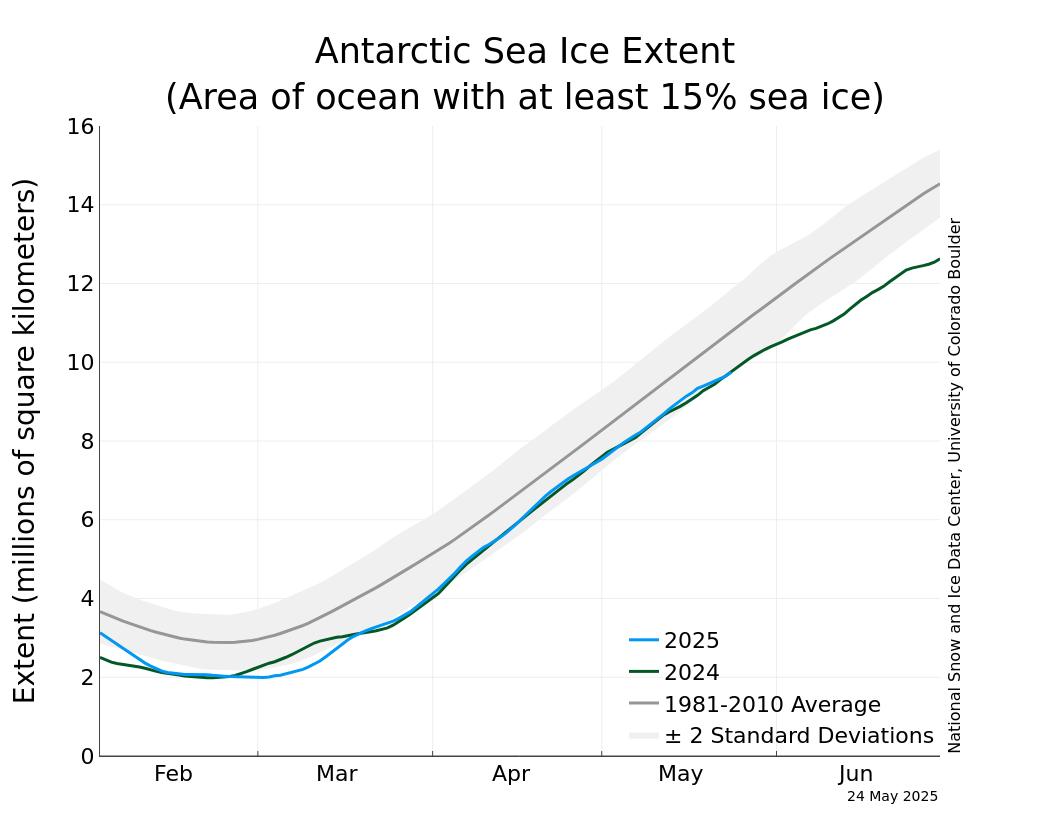

Conclusion: There is no polar meltdown at either pole.
Next week we start comparing PIOMASS forecasts vs. reality. PIOMASS claims that Arctic ice is the thinnest on record.

============================================
Don’t forget to bookmark WUWT’s new Sea Ice Page
Sponsored IT training links:
Subscribe for 350-030 training and get up to date 70-649 materials with 100% success guarantee plus get free demos for 220-701 exam.
savethesharks says:
July 25, 2010 at 9:46 pm
R. Gates says:
July 25, 2010 at 8:20 pm
“You would do well to pick up a book on chaos theory.”
=========================================
And you would do most well to just pick up a few books of meteorology and physics, not to mention a book or two on logical fallacies, and just basically NOT set forth your opinion….for a very VERY long while.
Sort of like a monk taking a vow of silence.
Chris
Norfolk, VA, USA
____________
I’m no Ph.D., but I can hold my own, thank you very much. I’ll express my viewpoints when I feel the urge as I never thought being a monk would be too interesting a life.
tty says:
July 26, 2010 at 4:20 am
Rod Everson:
I know that for about a decade from the early 80′s to the early 90′s the maps at Cryosphere systematically shows spurious ice in coastal areas in summer (I can’t check the exact dates since that part of Cryosphere is down). I know the ice is non-existent in the cases of the Baltic and the White Sea, and by comparing with maps before and after the critical period it is clear that the problem extends to most coastal areas around the Arctic.
Whether this ice is counted or not I do not know. The Baltic for some reason is not included in the counted area but other affected areas like the White Sea, the Bering Saa, the Gulf of St Lawrence and the Sea of Okhotsk is. It is possible that they somehow correct for the error, but I doubt it. It would be very difficult to do without an independent data source.
Here’s what NSIDC, have to say about that:
“Please note that our daily sea ice images, derived from microwave measurements, may show spurious pixels in areas where sea ice may not be present. These artifacts are generally caused by coastline effects, or less commonly by severe weather. Scientists use masks to minimize the number of “noise” pixels, based on long-term extent patterns. Noise is largely eliminated in the process of generating monthly averages, our standard measurement for analyzing interannual trends.”
In any case the difference in the two figures I quoted was over 1Mm^2, orders of magnitude different.
JJB, thanks. Nice thing is we’ll know in two months.
Dr Chaos says:
July 26, 2010 at 6:03 am
R. Gates says:
July 25, 2010 at 8:09 pm
… The formation of any single bubble is chaotic yet deterministic (as all chaotic but non-random systems are) and this is akin to predicting the weather. The knowledge that the pot will eventually boil is akin to knowing the climate. We still don’t know all the variables and feedbacks that would be similar to the thermodynamic properties of the pot or the purity of the water, but I think the GCM’s have enough in them to know enough to know the general direction, if not the exact point where the water starts to boil. But indeed, there may be chaotic “bubbles” that form in unpredictable places along the way
———-
The physicist Joseph Ford had a phrase “A chaotic system is its own fastest computer”. You cannot make any predictions about a real chaotic system if you don’t know absolutely everything about it to an infinite degree of precision. The Earth’s climate is not merely chaotic, but chaotic with random time-varying inputs!! Chaotic system variables exhibit sensitive dependence on initial conditions, as do the statistical properties of chaotic systems. Your analogy of boiling water is false because a key definition of chaos is that the system variables remain bounded. If you just turn up the notch until the oceans boil away, that is not chaos. All chaos theory does is draw a line in the sand which kinda says “You Shall Not Pass” (like when Gandalf meets the Balrog, but I digress 🙂 )
________________
I think that the Milankovitch cycles would indicate that we do know the pot will boil (or freeze) in fairly predictable ways…i.e. we know the final destination, but we just don’t know the path to get there because it is a chaotic path, but the general direction is not chaotic. What we currently don’t know (and is the essential issue of AGW) is how sensitive the climate truly is to a 40% increase (and rising) of CO2 over a geologically short time period. Using the sandpile model, at what point does a slight change in CO2 represent that additional grain of sand added to the top of a sandpile to cause the pile to collapse? We know (based on Milankovitch) that we are headed to another ice age in 30,000 years or so…but what will be the nature of the little chaotic bubble that will be created by the additional quick anthropogenic rise in CO2?
GeoFlynx
Perhaps not ….
[youtube=http://www.youtube.com/watch?v=NDm4_NwRzVU]
Billy Liar says:
July 26, 2010 at 5:31 am
Phil and EFS_Junior,
I was showing the ice chart for the route that Bear Grylls plans to take which goes via Cambridge Bay. The ‘classical’ route.
PS I see lots of clouds in the MODIS pictures you linked – not sure I would rely on those particular photographs. I believe the Canadian Met Office uses Radarsat to compile their ice reports.
Clouds move, using AQUA and TERRA images you can see the same area several times a day. Last summer I found the MODIS images gave a better fit to what was being reported ‘on the water’ than the Ice Canada Radarsat (which were more conservative, not a bad thing given their mission).
Also I’m not sure about that ‘fast ice’ shown on the map you cited, it hasn’t been shown as such before, for example: http://ice-glaces.ec.gc.ca/prods/WIS56SD/20100719180000_WIS56SD_0005094543.gif
stevengoddard says:
July 26, 2010 at 6:18 am
Bill the Frog
The difference in baseline is much too small to account for the differences between GISS and DMI.
A much simpler explanation is that GISS does not have any data points above 80N, and that they generate imaginary temperatures there.
Which begs the question: how many data points above 80ºN do DMI use in their computer model, how much of their temperature is imaginary? Unless you treat both sources similarly you haven’t dealt with the problem, both use very sparse data and interpolate.
R. Gates says:
July 26, 2010 at 7:02 am
I’m no Ph.D., but I can hold my own, thank you very much. I’ll express my viewpoints when I feel the urge as I never thought being a monk would be too interesting a life.
===================================
Might be a good discipline for you.
And help you ponder more…and talk less…out of your austral end. 😉
I like your resolve, R.
Its just that when your agenda, overwhelms your science, the agenda kills the science.
Chris
Norfolk, VA, USA
Good Science, and the Scientific Method that supports it, is a strong, but fragile ecosystem.
Agenda-driven politics, of any kind, are the unwanted weeds, poison ivy, and nasty, worthless opportunistic species..that threaten to cause the ecosystem to fail.
Right now, the multi-billion dollar pseudo-scientific International Church of the CAGW…is the Round-up-worthy, “carpet-bagger” invasion of the Science Ecosystem.
OK….not Round-up. Some other herbicide not made by Monsanto (don’t give them a dime of your money!), but you get my point…
Chris
Norfolk, VA, USA
I’m aware most people here are discussing the North West passage; however this article, from 1915 on the North East passage is definitely apropos:
http://query.nytimes.com/mem/archive-free/pdf?_r=1&res=9902E7DF103FE233A25750C2A9649D946496D6CF
Oops, it looks like JAXA changed their minds, like they always do 1-2 times per day, and 2010 has not crossed 2009 YET.
2010 is still 7,344 km^2 below 2009.
Mabye after tomorrow’s final, or the next day’s final, or the next day after that, …, you all can crow aboot 2009 vs 2010.
Of course, being below, or above, a given year is no guarantee of the final Arctic sea ice extent, until such time that we can refer to the actual 2010 Arctic sea ice minima in the past tense.
Phil, if you look at the egg code for ice I described as ‘fast ice’ on the chart you linked to you will see that the form of ice (bottom figure in the egg) for area ‘C’ on the chart is ‘8’ – which is fast ice. So it’s fast ice on your chart too.
R. Gates says: “but what will be the nature of the little
chaotic bubble that will be created by the additional quick anthropogenic rise in CO2?”
One possibility is that each additional molecule of CO2 represents a grain of sand taken from the top of the pile and moved to the side. Evidence shows less water vapor in crucial areas like the top of the troposphere and therefore more stability.
Modern temperature data IS being collected in the Arctic using ground, ship, and satellite. The “hole”, being represented in this post as a lack of data, is simply the deliberate exclusion of this data from the GISS analysis by a process called an ice mask. Hansen uses this mask to exclude data unduly influenced by sea ice, where as surface temperatures measured on sea ice contrasts sharply with that over exposed sea.
http://www.columbia.edu/~jeh1/mailings/2010/20100127_TemperatureFinal.pdf
Hansen explains his method and the rational behind it. The omission of this data is fully noted and represented in his papers and is not the result of “no data” condition in this region.
stevengoddard:
I have a query on the webcam images. You say the North Pole image shows the melt pond frozen solid. You may be right, but I can’t see that in the picture myself. It looks dark, like water, or perhaps water with a thin layer of ice on top. Could you perhaps post a tutorial on how to spot the differences, with comparative images from various stages?
@R Gates
I take your point on sandpiles and so on, but you are veering into complexity theory and the work of Per Bak on self-organized criticality, which I don’t know a whole lot about! The way I see it, putting my nonlinear systems hat on, the Earth’s climate is sitting at some point in an n-dimensional space, where each dimension represents some parameter that can be varied, such as CO2 or albedo, or the Sun’s output. A lot of this space represents robust chaos – we know this because the parameters are changing all the time and we are here to tell the tale. No doubt some points in the space represent unstable solutions where the earth boils or freezes. However, if we know that CO2 has been much higher in the past than it is now, then IMHO there is nothing to worry about in increasing CO2 from 280 to 380ppm over a century as this region of the space is historically robust. If the Earth has survived umpteen asteroid strikes and supervolcano eruptions, then I’m sure it’ll survive a gentle ramping in CO2 levels.
Paul,
As pond ice gets thicker, it becomes more opaque and develops a frosted appearance. Thin ice tends to be very transparent.
dr chaos says:
July 26, 2010 at 11:04 am
@R Gates
I take your point on sandpiles and so on, but you are veering into complexity theory and the work of Per Bak on self-organized criticality, which I don’t know a whole lot about! The way I see it, putting my nonlinear systems hat on, the Earth’s climate is sitting at some point in an n-dimensional space, where each dimension represents some parameter that can be varied, such as CO2 or albedo, or the Sun’s output. A lot of this space represents robust chaos – we know this because the parameters are changing all the time and we are here to tell the tale. No doubt some points in the space represent unstable solutions where the earth boils or freezes. However, if we know that CO2 has been much higher in the past than it is now, then IMHO there is nothing to worry about in increasing CO2 from 280 to 380ppm over a century as this region of the space is historically robust. If the Earth has survived umpteen asteroid strikes and supervolcano eruptions, then I’m sure it’ll survive a gentle ramping in CO2 levels.
You’ve a very subtle jump there, the ‘speed of the hand deceives the eye’, you’d need to know that the [CO2], solar irradiance, Earth’s albedo and distribution of the continents and oceans have been the same before without ill effects, not just one of the parameters. If you did show that and at that time there were no polar icecaps would you be so sanguine?
dr chaos says:
July 26, 2010 at 11:04 am
@R Gates
I take your point on sandpiles and so on, but you are veering into complexity theory and the work of Per Bak on self-organized criticality, which I don’t know a whole lot about! The way I see it, putting my nonlinear systems hat on, the Earth’s climate is sitting at some point in an n-dimensional space, where each dimension represents some parameter that can be varied, such as CO2 or albedo, or the Sun’s output. A lot of this space represents robust chaos – we know this because the parameters are changing all the time and we are here to tell the tale. No doubt some points in the space represent unstable solutions where the earth boils or freezes. However, if we know that CO2 has been much higher in the past than it is now, then IMHO there is nothing to worry about in increasing CO2 from 280 to 380ppm over a century as this region of the space is historically robust. If the Earth has survived umpteen asteroid strikes and supervolcano eruptions, then I’m sure it’ll survive a gentle ramping in CO2 levels.
____________
I would argue that from a geological perspective, it has been anything but a “gentle ramping” in CO2. The 40% rise in the past few hundred years is virtually instant from a historical geological perspective…a sharp spike upward as it were. This “spike” is yet another dimension in the phase space of the climate system…in other words, raise CO2 from 280 to 390 ppm over 2 million years and you get one set of attractors, but raise it virtually instantly, and you get an entirely different set or topograph of phase space.
In terms of the earth suriviving…of that I have no doubt. Life is pretty robust and “will find a way” so to speak, but it is interesting to note that we are seeing an increase in the overall species extinction rates around the globe, but beyond that basic fact, I’ve not studied it too much. It may be more related to loss of habitat from other human activities rather than specific to AGW.
JAXA uses a five-day moving average, so each daily figure will be adjusted four times (I think).
stevengoddard says:
July 26, 2010 at 11:18 am
“As pond ice gets thicker, it becomes more opaque and develops a frosted appearance. Thin ice tends to be very transparent.”
Yes, that’s why I didn’t think it looked frozen solid; it doesn’t seem opaque and frosted enough. Which is why I thought presenting a comparative series might be valuable.
Mo/Dy/Hr Latitude Longitude Temp Press
07/26/1600Z 86.422°N 2.625°E -0.4°C 990.3mb
07/26/1500Z 86.424°N 2.567°E -0.4°C 990.0mb
07/26/1400Z 86.426°N 2.517°E -0.4°C 989.8mb
07/26/1300Z 86.428°N 2.476°E -0.4°C 989.8mb
07/26/1200Z 86.431°N 2.444°E -0.3°C 990.0mb
07/26/1100Z 86.434°N 2.414°E -0.3°C 989.6mb
07/26/1000Z 86.437°N 2.380°E -0.4°C 989.2mb
07/26/0900Z 86.441°N 2.338°E -0.4°C 989.3mb
07/26/0800Z 86.444°N 2.288°E -0.3°C 989.9mb
07/26/0700Z 86.448°N 2.223°E -0.3°C 990.5mb
07/26/0600Z 86.451°N 2.146°E -0.3°C 991.6mb
07/26/0400Z 86.456°N 1.934°E -0.4°C 992.6mb
07/26/0300Z 86.457°N 1.810°E -0.4°C 994.0mb
07/26/0200Z 86.458°N 1.684°E -0.4°C 995.8mb
07/26/0100Z 86.459°N 1.559°E -0.5°C 997.3mb
07/26/0000Z 86.460°N 1.443°E -0.4°C 998.8mb
07/25/2300Z 86.462°N 1.322°E -0.5°C 1000.3mb
07/25/2200Z 86.464°N 1.220°E -0.6°C 1001.6mb
07/25/2100Z 86.467°N 1.105°E -0.7°C 1002.6mb
07/25/2000Z 86.470°N 1.008°E -0.6°C 1003.7mb
07/25/1900Z 86.473°N 0.926°E -0.5°C 1004.5mb
07/25/1800Z 86.476°N 0.859°E -0.5°C 1005.2mb
07/25/1700Z 86.479°N 0.795°E -0.6°C 1006.1mb
07/25/1500Z 86.485°N 0.680°E -0.6°C 1007.6mb
07/25/1400Z 86.487°N 0.632°E -0.7°C 1008.3mb
07/25/1300Z 86.490°N 0.586°E -0.6°C 1008.8mb
07/25/1200Z 86.492°N 0.549°E -0.6°C 1009.1mb
07/25/1100Z 86.494°N 0.513°E -0.8°C 1009.4mb
07/25/1000Z 86.495°N 0.485°E -1.0°C 1009.5mb
07/25/0800Z 86.498°N 0.458°E -0.9°C 1010.0mb
07/25/0700Z 86.499°N 0.457°E -1.3°C 1009.7mb
07/25/0600Z 86.500°N 0.462°E -1.0°C 1010.1mb
07/25/0500Z 86.501°N 0.470°E -0.6°C 1010.4mb
07/25/0400Z 86.502°N 0.480°E -0.9°C 1010.6mb
07/25/0300Z 86.503°N 0.493°E -1.0°C 1010.4mb
07/25/0100Z 86.505°N 0.518°E -1.0°C 1010.3mb
07/25/0000Z 86.505°N 0.532°E -1.1°C 1010.4mb
07/24/2300Z 86.506°N 0.548°E -1.2°C 1010.1mb
07/24/2200Z 86.507°N 0.564°E -1.0°C 1010.1mb
07/24/2100Z 86.507°N 0.581°E -0.8°C 1009.8mb
07/24/2000Z 86.508°N 0.598°E -0.9°C 1009.8mb
07/24/1900Z 86.508°N 0.615°E -0.8°C 1009.8mb
07/24/1800Z 86.509°N 0.629°E -0.8°C 1009.7mb
07/24/1700Z 86.509°N 0.641°E -1.5°C 1009.5mb
07/24/1600Z 86.510°N 0.649°E -2.4°C 1009.5mb
07/24/1500Z 86.510°N 0.657°E -1.7°C 1009.8mb
07/24/1400Z 86.511°N 0.661°E -0.6°C 1011.0mb
07/24/1300Z 86.511°N 0.665°E -0.4°C 1010.9mb
07/24/1200Z 86.512°N 0.669°E -0.5°C 1011.4mb
07/24/1100Z 86.513°N 0.670°E -0.8°C 1009.2mb
07/24/1000Z 86.514°N 0.668°E -1.1°C 1008.7mb
07/24/0900Z 86.515°N 0.667°E -1.8°C 1008.8mb
07/24/0800Z 86.515°N 0.666°E -2.1°C 1009.2mb
07/24/0700Z 86.516°N 0.667°E -2.2°C 1009.0mb
07/24/0600Z 86.516°N 0.670°E -2.9°C 1008.8mb
07/24/0500Z 86.517°N 0.674°E -3.2°C 1008.5mb
07/24/0400Z 86.517°N 0.677°E -3.4°C 1008.1mb
07/24/0300Z 86.518°N 0.676°E -3.7°C 1007.8mb
07/24/0200Z 86.519°N 0.668°E -3.5°C 1007.8mb
07/24/0100Z 86.520°N 0.652°E -3.3°C 1007.7mb
07/24/0000Z 86.520°N 0.631°E -3.1°C 1007.4mb
07/23/2300Z 86.521°N 0.605°E -3.0°C 1006.9mb
07/23/2200Z 86.521°N 0.579°E -2.8°C 1006.9mb
07/23/2100Z 86.522°N 0.550°E -2.5°C 1006.8mb
07/23/2000Z 86.522°N 0.524°E -2.3°C 1006.7mb
07/23/1900Z 86.523°N 0.500°E -2.1°C 1006.3mb
07/23/1800Z 86.524°N 0.478°E -2.0°C 1006.4mb
07/23/1700Z 86.525°N 0.457°E -1.9°C 1006.2mb
07/23/1600Z 86.526°N 0.436°E -1.8°C 1006.0mb
07/23/1500Z 86.528°N 0.411°E -1.8°C 1006.2mb
07/23/1400Z 86.529°N 0.388°E -1.8°C 1006.6mb
07/23/1300Z 86.531°N 0.364°E -1.8°C 1006.8mb
07/23/1200Z 86.532°N 0.344°E -1.8°C 1006.9mb
07/23/1100Z 86.534°N 0.326°E -1.8°C 1006.9mb
07/23/1000Z 86.535°N 0.310°E -1.9°C 1007.0mb
07/23/0700Z 86.540°N 0.290°E -2.8°C 1006.8mb
07/23/0600Z 86.542°N 0.292°E -2.8°C 1006.8mb
07/23/0500Z 86.543°N 0.297°E -2.8°C 1007.2mb
07/23/0400Z 86.544°N 0.303°E -3.0°C 1007.6mb
07/23/0300Z 86.545°N 0.307°E -2.9°C 1007.6mb
07/23/0200Z 86.546°N 0.309°E -3.1°C 1007.8mb
07/23/0100Z 86.546°N 0.313°E -3.0°C 1007.3mb
07/22/2300Z 86.547°N 0.328°E -2.3°C 1007.6mb
07/22/2200Z 86.547°N 0.334°E -2.4°C 1007.6mb
07/22/2100Z 86.548°N 0.343°E -2.0°C 1007.6mb
07/22/1900Z 86.549°N 0.357°E -2.0°C 1007.5mb
07/22/1800Z 86.549°N 0.363°E -2.1°C 1007.5mb
07/22/1700Z 86.549°N 0.369°E -2.2°C 1007.7mb
07/22/1500Z 86.549°N 0.383°E -1.9°C 1007.7mb
07/22/1400Z 86.549°N 0.391°E -1.7°C 1009.1mb
07/22/1300Z 86.548°N 0.399°E -1.8°C 1009.4mb
07/22/1200Z 86.548°N 0.405°E -1.8°C 1009.0mb
07/22/1100Z 86.547°N 0.405°E -1.9°C 1008.6mb
07/22/1000Z 86.546°N 0.408°E -2.0°C 1008.2mb
07/22/0900Z 86.545°N 0.410°E -2.1°C 1008.0mb
07/22/0800Z 86.544°N 0.414°E -2.2°C 1008.1mb
07/22/0700Z 86.543°N 0.419°E -2.2°C 1008.1mb
07/22/0600Z 86.542°N 0.425°E -2.3°C 1008.0mb
07/22/0500Z 86.540°N 0.433°E -2.4°C 1008.0mb
07/22/0400Z 86.538°N 0.443°E -2.5°C 1008.1mb
Roger Knights says:
July 26, 2010 at 12:09 pm
EFS_Junior says:
July 26, 2010 at 8:57 am
Oops, it looks like JAXA changed their minds, like they always do 1-2 times per day, and 2010 has not crossed 2009 YET.
JAXA uses a five-day moving average, so each daily figure will be adjusted four times (I think).
____________________________________________________________
I don’t doubt that AFAIK, as that is what their website states, if I’m not mistaken.
However, over these past few months, the final previous day’s estimate has always occured (posted) before the next day’s estimate has been posted (In the CDT timezone shortly after 10:00PM).
So far 2010 has chosen it’s own path, irrespective of previous year’s paths, my expectation, is that it will continue to chose it’s own path (although, if 2010 crosses 2005, 2008, and 2009, then my expectation would be for a greater Arctic sea ice extent than my current expectation, statistically speaking, of course).
From the IJIS web site:
“Averaging period and the update timing of daily data
– In general, sea-ice extent is defined as a temporal average of several days (e.g., five days) in order to eliminate calculation errors due to a lack of data (e.g., for traditional microwave sensors such as SMMR and SSM/I). However, we adopt the average of two days to achieve rapid data release. The wider spatial coverage of AMSR-E enables reducing the data-production period.
– Usually the latest value of daily sea-ice extent is fixed and updated at around 1 p.m. (4 a.m.) JST (UT). Before the value is fixed, we also assign a preliminary value of daily sea-ice extent several times (usually three to four times) as an early report, which is determined without the full two-day observation coverage. (The fixed values of sea-ice extent are determined with the full coverage of observation data.)”
That reads to me as saying JAXA uses a two day moving average.
is this that Gavin?
I see a lot of clear skies over the Arctic in the satellite images (and surface photos linked). All that sun… I really do expect to break 2007′s record this year.
http://wattsupwiththat.com/2010/06/25/ice-dancing/#comment-417353