By Steve Goddard
The Arctic is proud to have been listed as one of many “fastest warming places on earth.”
The GISS 250km Arctic image below shows temperature trends from 1880-2009. Areas in black represent regions with no data.

In most fields of science, data is considered an essential element of historical analysis. But climate science gets a pass, because it involves “saving the planet.” Antarctic coverage is equally as impressive. The image below looks right through the earth to the Arctic hole.

Temperatures in the high Arctic have been running well below normal and have started their annual decline. There are only about 30 days left of possible melt above 80N.

http://ocean.dmi.dk/arctic/meant80n.uk.php
This can be seen in North Pole webcams which show the ice frozen solid.

http://psc.apl.washington.edu/northpole/webphotos/noaa2.jpg

As forecast in last week’s sea ice news, ice loss accelerated during the past week over the East Siberian Sea due to above normal temperatures.

http://ocean.dmi.dk/arctic/icecover.uk.php
The modified NSIDC map below shows (in red) regions of the Arctic that have lost ice over the past week.

The modified NSIDC map below shows (in red) ice loss since early April.

The modified NSIDC map below shows (in red) ice loss since July 1. The Beaufort Sea has actually gained ice (green.) Looks like a Northwest Passage traverse is quite possible (by helicopter.)

Ice loss from July 1 through July 23 has been the slowest on record in the JAXA database. Ice loss during July has been about one half that of 2007.

The graph below shows the difference between 2010 and 2007 melt. 2010 started the month half a million km² behind 2007, and is now half a million km² ahead of 2007.

The modified NSIDC image below shows the difference between 2007 ice and 2010 ice. Green indicates more ice in 2010, red indicates less.

“Climate expert” Joe Romm reported in May
Arctic sea ice shrinks faster than 2007, NSIDC director Serreze says, “I think it’s quite possible” we could “break another record this year.” Watts and Goddard seem in denial
Average ice thickness continues to follow a track below 2006 and above 2009, hinting that my prediction of a 5.5 million km² minimum continues to be correct.

During July, ice movement has been quite different from 2007 – which had strong winds compressing the ice towards the pole. By contrast, July 2010 has seen winds generally pushing away from the pole. Thus the ice edge on the Pacific side is further from the pole. No rocket science there, and a pretty strong indication that the alleged 2007 record summer melt was primarily due to wind.
Cryosphere Today showed two days ago that Arctic Basin ice is nearly identical to 20 years ago, but unfortunately their web site is down and I can’t generate any images.
NCEP forecasts warm temperatures in the East Siberian, Chukchi and Beaufort Seas for the next week, so I expect that melt will continue around the edges of the Arctic Basin.
Meanwhile, Antarctic ice continues well above normal. Antarctica is also the fastest warming place on the planet.
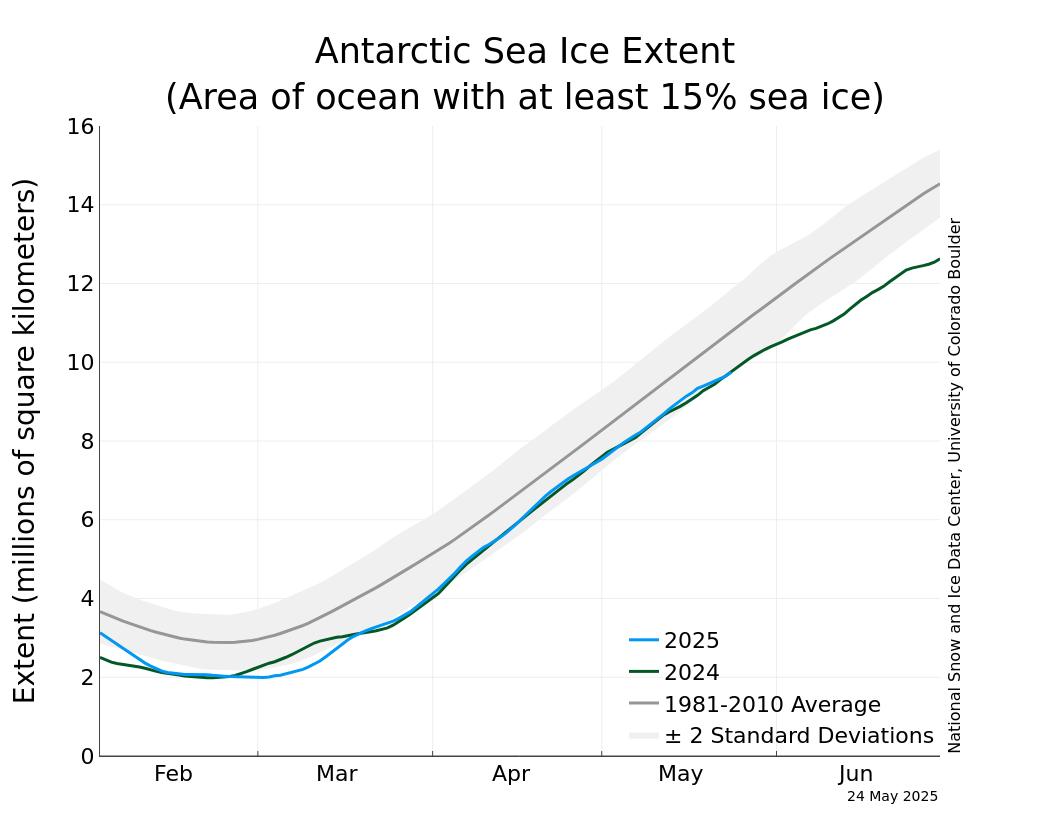

Conclusion: There is no polar meltdown at either pole.
Next week we start comparing PIOMASS forecasts vs. reality. PIOMASS claims that Arctic ice is the thinnest on record.

============================================
Don’t forget to bookmark WUWT’s new Sea Ice Page
Sponsored IT training links:
Subscribe for 350-030 training and get up to date 70-649 materials with 100% success guarantee plus get free demos for 220-701 exam.
“Peru Government Declares Cold Wave Emergency in 16 Regions”
Thanks Arn.
So where is all the noise about this cold like there was noise about heat in the US?
2010 has nearly caught up to 2009 now. Only a measly 40k sq km behind, and 2009 will fall below 2010 by the end of today if today’s melt is below 60k.
JJB,
This one is just for you. It shows every place GISS missed in May, 2010 – in pink.
[youtube=http://www.youtube.com/watch?v=NDm4_NwRzVU]
Those ponds at the North Pole are frozen. But there has been open water there several times. And it is highly likely there was less ice at the Arctic (maybe even none in summers) during the Medieval Warm Period. Have a look at this video:
John from CA says:
July 25, 2010 at 12:51 pm
Thanks Steve,
Assuming the information (following links) are accurate, there appear to be research stations within many of the black out areas you listed. If they’re still active, isn’t their data included in global temp etc.?….
______________________________________________
You forgot about station drop out. The norther stations and the mountain stations (like in my home state) were dropped.
Graph of temp and station drop out: http://diggingintheclay.files.wordpress.com/2010/04/canadadt.png
Dave F says:
July 25, 2010 at 3:50 pm
Phil. says: (all of them)
Phil, isn’t temperature what this is all about? You know, the atmosphere is going to be hotter because of atmospheric CO2? Especially in the (sub-average to this date) Arctic and Antarctic? And how does GISS get a nice big red blob out of those temperatures anyway when DMI shows them come in below average pretty much all summer up until now?
Air in the close vicinity of melting sea ice would be expected to stay close to 0ºC.
Regarding temperature, according to Spencer’s AQUA Ch 5 every day in July as been as hot or hotter than any other days since 1979 (to within the width of the line). So it would be surprising if July 2010 doesn’t turn out to be the hottest month of the satellite record.
Amino Acids in Meteorites says:
July 25, 2010 at 5:15 pm
Those ponds at the North Pole are frozen. But there has been open water there several times.
There’s open water there now look at the polynya in the photo!
R. Gates says:
July 25, 2010 at 4:44 pm
=================
Take a breath, we’re all looking at the same data.
Damn man, you go from Alaska to Florida, and then breathlessly to the Arctic.
All the signs (solar,oceans), point to cooling. The dark side is calling 🙂
R. Gates says:
July 25, 2010 at 4:35 pm
This is very funny. The summer Arctic Sea ice has been melting faster in the past few years then GCM’s projected it would based on AGW
————————————
then this somehow disproves the AGW hypothesis
============================================================
It certainly disproves something.
If the proof of AGW is proved by those computer games, and the computer games don’t get it right, in either direction.
Then the computer games are not accurate and prove nothing.
You would think after 50 years they might be a little closer.
Amino Acids in Meteorites says:
July 25, 2010 at 5:15 pm
Those ponds at the North Pole are frozen. But there has been open water there several times. And it is highly likely there was less ice at the Arctic
======================================================
AAM, I think it’s highly likely that there was a lot less ice when trees were growing there. 😉
PJB says:
July 25, 2010 at 12:54 pm
When I look at http://ocean.dmi.dk/arctic/icecover.uk.php , are there “reliable” (non-model generated) data concerning the range of the cycle over the latest inter-glacial period?
(Say 10,000 years so that we don’t use the Younger Dryas to “inflate” the values.)
I would imagine that this decade’s spread is quite small when compared to millennial results….
_______________________________________________
Here is the stuff I have bookmarked on that subject (no order)
Greenland last 10,000 years
http://jonova.s3.amazonaws.com/graphs/lappi/gisp-last-10000-new.png
Barents sea temperatures 1900-2010
http://wattsupwiththat.files.wordpress.com/2009/10/barents_sea_temp_with_amo.png
http://www.ngu.no/en-gb/Aktuelt/2008/Less-ice-in-the-Arctic-Ocean-6000-7000-years-ago/
The Physical Evidence of Earth’s Unstoppable 1,500-Year Climate Cycle
http://www.ncpa.org/pub/st279/
Possible solar origin of the 1,470-year glacial climate cycle demonstrated in a coupled model
http://www.nature.com/nature/journal/v438/n7065/abs/nature04121.html
http://www2.ucar.edu/news/bering-strait-influenced-ice-age-climate-patterns-worldwide
Temperatures from greenland Ice core
http://i90.photobucket.com/albums/k247/dhm1353/Climate%20Change/alley.png
http://www.globalwarmingskeptics.info/forums/thread-188-post-3123.html#pid3123
Oldest temperature records including St Petersburg Russia
http://i47.tinypic.com/2zgt4ly.jpg
Paleo temp records
http://img196.imageshack.us/img196/8615/allpaleotemp.png
http://www.scotese.com/climate.htm
http://www.whoi.edu/page.do?cid=3842&pid=12455&tid=282
2000 years of proxy temperature data (not trees)
http://www.ossfoundation.us/projects/environment/global-warming/myths/loehle-temperature-reconstruction/image/image_view_fullscreen
1660-2009 Little Ice age thermometers – one is in the Arctic
http://climatereason.com/LittleIceAgeThermometers/
Hope that helps
R. Gates says:
July 25, 2010 at 4:35 pm
This is very funny. The summer Arctic Sea ice has been melting faster in the past few years then GCM’s projected it would based on AGW, and so if, and this is a huge IF, but if it somehow returns to melting as fast as GCM’s said it should based on AGW (i.e. disappearing by 2070 to 2100), then this somehow disproves the AGW hypothesis. Now, that’s funny stuff…
———————————————————————————
The “increased” melting rate does not disprove the AGW theory. But it does point out the unreliability of the results of the GCM’s. It shows that the natural processes are not well modeled.
R. Gates, you are completely right that Steve is focusing on weather rather than climate. I should have caught on sooner that’s what he’s doing here, and trying to pass it off as climate. Looking at the many open water areas that have developed the last couple of weeks under the central Arctic low sea level pressure, and now the upcoming shift back towards a more dipole pattern, I bet the September 2010 ice extent will drop far below his predicted 5.5 million sq-km.
Steve, thanks for the movie. I am curious though why Greenland stations are not included in the GISS fields. I know they are still recording data. Is the reason you use DMI because they use more Arctic stations than GISS?
Billy Liar says:
July 25, 2010 at 5:09 pm
Rob Vermeulen says:
July 25, 2010 at 2:40 pm
‘Yes, the NW passage is almost open and should be within a few weeks. Same for NE passage. See This detailed map
http://arctic.atmos.uiuc.edu/cryosphere/NEWIMAGES/arctic.seaice.color.000.png‘
Not very detailed map! I think you need this one:
http://ice-glaces.ec.gc.ca/prods/WIS38CT/20100725180000_WIS38CT_0005101570.gif
where you will see that the NWP is far from open; there is a large gray area of fast ice.
You need to look a little further north.
http://rapidfire.sci.gsfc.nasa.gov/realtime/single.php?T102060150
#
#
DaveH says:
July 25, 2010 at 2:09 pm
On August 28th, Bear Grylls will set off to navigate the Northwest Passage in an infatable boat to publicise ‘global warming’. Do you think that he’ll make it?
http://www.fcpnorthwestpassage.com/journey/route–timeline
________________________________________________________________
Perhaps he will win the Darwin Award.
Nature usually punishes stupidity with death.
Summer 2030: Artic ice still there, adjust AGW model, predicts summer 2040.
Summer 2040: Artic ice still there, adjust AGW model, predicts summer 2050.
Summer 2050: Artic ice increases! Nuts!
Retired, time to pass to next public grant recipient with instructions to claim all failures are just “weather”.
Robert,
1880 is the year that the data started showing the “global temperature”, according to GISS
Do you think it is unreasonable to examine their entire dataset, or do you prefer to cherry pick starting 60 years later?
JJB, congrats for looking at some weather factors and starting a prediction. Care to give us a guess at a number? R Gates, take note of that analysis. There are both short and long term weather processes at work here, and your linear extrapolation of no ice in 2030 considers none of that, and has no scientific value.
JJB
Someone is deceiving you – but it isn’t me.
DMI uses 30% concentration ice, which is a much better indicator of ice health than the 15% which everyone else uses.
R. Gates says:
July 25, 2010 at 2:33 pm
“It is possible that both the NWP and NEP will open up this year, if even for a week or two. If the trends of the past 10 years continue, there will be plenty of commercial opportunity opening up in the Arctic in the coming years, and this will undoubtedly cause some issues in their own right.”
_______________________________________________________
Good Grief! The Russians have been regularly navigating the North East Passage for close to 100 years. Explorers have been going through for about 450 years. What is new about this? Just Google it, lots of references.
Global ice melt by year, 2002 – present.
Wayne Delbeke says:
July 25, 2010 at 6:54 pm
R. Gates says:
July 25, 2010 at 2:33 pm
“It is possible that both the NWP and NEP will open up this year, if even for a week or two. If the trends of the past 10 years continue, there will be plenty of commercial opportunity opening up in the Arctic in the coming years, and this will undoubtedly cause some issues in their own right.”
_______________________________________________________
Good Grief! The Russians have been regularly navigating the North East Passage for close to 100 years. Explorers have been going through for about 450 years. What is new about this? Just Google it, lots of references.
_______
Having both the NWP and NEP open in the same year is historically quite rare. In fact, I think it happened for the first time only 2 years ago in 2008…this was my point. The fact that the Russians can break through the remaining thin ice in the summer and get passage through isn’t the point. I’m talking about open water.
Brooks says:
July 25, 2010 at 4:42 pm
A quote below from the captain of a boat that had just finished the NW passage in 2009. He states he was one 9 boats completing the passage during the summer season of 2009 out of 10 attempting it. This was also reported in Boat US magazine. In 2007 4 boats made it in a single season. These numbers for passages in a single season are unprecedented. ”
How many attempts were made in 2007. Its unsurprising given the amount of publicity the Arctic is receiving that there are more attempts which are probably better prepared from a navigational viewpoint than in previous years.
Really doesnt prove a thing.
Another thought occurred with regards the rate of ice melt for multi year ice vs 1st year ice. If we are seeing a recovery, logically initially we’ll see more 1st year ice. More first year ice means more ice to lose early in the season as that 1st year ice is always the first to go.
This could be why for the past few years we’ve seen higher levels of melt early in the season but then a slow down as we get into late July/August and the multi-year ice which has increased a little over the previous season.
I got a chuckle out of R Gates stating that the increase was a decrease, because the current increases were only “getting back” to the decrease which models predicted.
I suppose I’m having trouble keeping track of all the Alarmist predictions. I can only deal with them one at a time. The first ones to deal with are the really dire ones, which stated the arctic sea ice may-might-could be gone this summer.
It looks like that one is dealt with.
R Gates is wise to retreat to a safer prediction of an ice-free arctic summer in 2030.
I hope R Gates sticks with us to the bitter end, for I like seeing how his mind justifies evidence that would deeply depress most Alarmists. I can’t help but like a man who remains optimistic and isn’t quick to lose faith, even if he’s wrong.
If you are listening, Mr. Gates, I would be interested in hearing how you justify GISS portraying the arctic as a red blob, even as DMI shows temperatures below normal.
Do you find the GISS maps comforting? Are they a cozy refuge, where Alarmists can retreat and lick their wounds? And do you deem DMI a bunch of Big Oil liars?