By Steve Goddard
The Arctic is proud to have been listed as one of many “fastest warming places on earth.”
The GISS 250km Arctic image below shows temperature trends from 1880-2009. Areas in black represent regions with no data.

In most fields of science, data is considered an essential element of historical analysis. But climate science gets a pass, because it involves “saving the planet.” Antarctic coverage is equally as impressive. The image below looks right through the earth to the Arctic hole.

Temperatures in the high Arctic have been running well below normal and have started their annual decline. There are only about 30 days left of possible melt above 80N.

http://ocean.dmi.dk/arctic/meant80n.uk.php
This can be seen in North Pole webcams which show the ice frozen solid.

http://psc.apl.washington.edu/northpole/webphotos/noaa2.jpg

As forecast in last week’s sea ice news, ice loss accelerated during the past week over the East Siberian Sea due to above normal temperatures.

http://ocean.dmi.dk/arctic/icecover.uk.php
The modified NSIDC map below shows (in red) regions of the Arctic that have lost ice over the past week.

The modified NSIDC map below shows (in red) ice loss since early April.

The modified NSIDC map below shows (in red) ice loss since July 1. The Beaufort Sea has actually gained ice (green.) Looks like a Northwest Passage traverse is quite possible (by helicopter.)

Ice loss from July 1 through July 23 has been the slowest on record in the JAXA database. Ice loss during July has been about one half that of 2007.

The graph below shows the difference between 2010 and 2007 melt. 2010 started the month half a million km² behind 2007, and is now half a million km² ahead of 2007.

The modified NSIDC image below shows the difference between 2007 ice and 2010 ice. Green indicates more ice in 2010, red indicates less.

“Climate expert” Joe Romm reported in May
Arctic sea ice shrinks faster than 2007, NSIDC director Serreze says, “I think it’s quite possible” we could “break another record this year.” Watts and Goddard seem in denial
Average ice thickness continues to follow a track below 2006 and above 2009, hinting that my prediction of a 5.5 million km² minimum continues to be correct.

During July, ice movement has been quite different from 2007 – which had strong winds compressing the ice towards the pole. By contrast, July 2010 has seen winds generally pushing away from the pole. Thus the ice edge on the Pacific side is further from the pole. No rocket science there, and a pretty strong indication that the alleged 2007 record summer melt was primarily due to wind.
Cryosphere Today showed two days ago that Arctic Basin ice is nearly identical to 20 years ago, but unfortunately their web site is down and I can’t generate any images.
NCEP forecasts warm temperatures in the East Siberian, Chukchi and Beaufort Seas for the next week, so I expect that melt will continue around the edges of the Arctic Basin.
Meanwhile, Antarctic ice continues well above normal. Antarctica is also the fastest warming place on the planet.
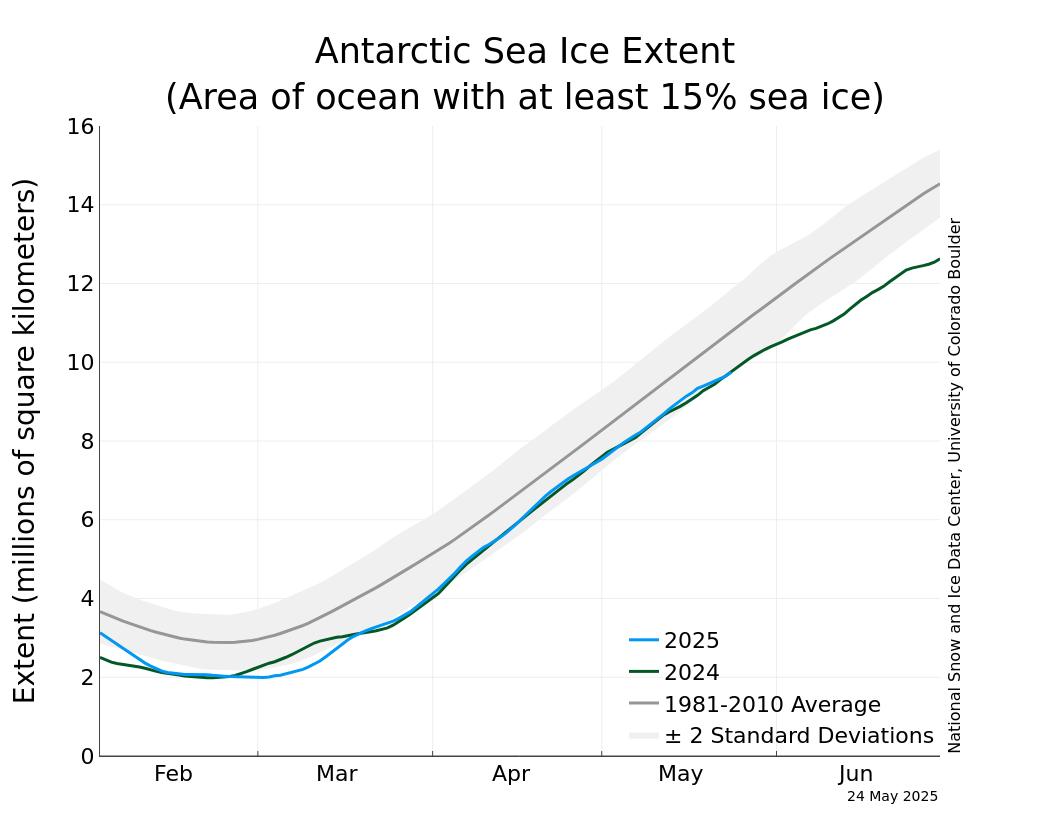

Conclusion: There is no polar meltdown at either pole.
Next week we start comparing PIOMASS forecasts vs. reality. PIOMASS claims that Arctic ice is the thinnest on record.

============================================
Don’t forget to bookmark WUWT’s new Sea Ice Page
Sponsored IT training links:
Subscribe for 350-030 training and get up to date 70-649 materials with 100% success guarantee plus get free demos for 220-701 exam.
Amino Acids in Meteorites says:
July 25, 2010 at 3:15 pm
NW Passage has opened several times in history. It is nothing noteworthy for it to open now. But I suppose if you want to make it look like the NW Passage opening is something alarming you’ll keep history out of the picture.
Prior to this decade you think it’s ‘opened several times’, off hand I can only think of a couple of times. If as I expect the passage opens again this year that will be 4 years in a row, that’s noteworthy!
Phil. says: (all of them)
Phil, isn’t temperature what this is all about? You know, the atmosphere is going to be hotter because of atmospheric CO2? Especially in the (sub-average to this date) Arctic and Antarctic? And how does GISS get a nice big red blob out of those temperatures anyway when DMI shows them come in below average pretty much all summer up until now?
http://data.giss.nasa.gov/cgi-bin/gistemp/do_nmap.py?year_last=2010&month_last=6&sat=4&sst=0&type=trends&mean_gen=0112&year1=1940&year2=2009&base1=1951&base2=1980&radius=250&pol=pol
So if we choose a slightly different change detection time amount then suddenly the arctic has stations again. Most stations in the Arctic have been operating since the mid 1900s with some being early 1900s. So when he asks for from 1880 to 2010 then it will only include the areas with data extending back that far. To give the impression that GISS analysis does not use stations in the Arctic is disingenuous at best. Try showing different time intervals Goddard?
Phil
Will you please give proof that it has never been open 4 times in a row before?
And are you certain it has been open 3 times in a row without icebreaker help?
my favourite BBC man, Paul “whatever happened to global warming” Hudson:
N.B. “as defined” by….
21 July: BBC: Paul Hudson: Global temperatures: Set for a sharp fall?
The El Nino which has helped to cause near record global heat so far this year is now history, as sea temperatures in equatorial regions of the Pacific continue to fall…
Just how fast will be crucial in deciding whether 2010 will be hotter than the hottest year on record, which was set in 1998, as defined by the UK Hadley Centre, The World Meteorological Organisation (WMO) and UAH Satellite data….
If history repeats itself, not only could 2011 be much cooler than 2010, but that cool bias could extend into 2012 too…
http://www.bbc.co.uk/blogs/paulhudson/2010/07/global-temperatures-set-for-a.shtml
BBC: Paul Hudson: First half of 2010: Close to record warmth (UPDATED FRI 7th JULY)
The last paragraph of my latest blog seems to have aroused interest so for clarification this may be of interest.
I spoke to various people in climate science when I put together my article ‘global temperature predictions for 2010’. One prominent climate sceptic told me that there was no chance of 2010 being warmer globally than 1998 because of solar considerations. 1998, from a solar point of view, ‘was a coming together of many things’ he said, that would not be replicated possibly ‘for another 100 years’. He went on to admit that if 2010 was hotter than 1998, he may have to re-examine his theory that it was the sun that was the main driver of global temperatures..
http://www.bbc.co.uk/blogs/paulhudson/2010/07/first-half-of-2010-close-to-re.shtml
WUWT gets plenty of mentions in the comments.
Robert
You must be new to this. The topic has been covered before. Seven Goddard did not bring up something new.
It is possible that we will be hit by an asteroid next year. It is possible that we will enter an ice age next year.
It is even possible that the US could win the World Cup in 2014. (On second thought, some things are too far fetched….)
http://ice-map.appspot.com/?map=Arc&sat=ter&lvl=7&lat=75&lon=-99&yir=2010&day=205
Strangely enough the northern route is close to navigable earlier than the southern and weeks earlier than last year. Time to go short with Panama Canal.
I followed the link to Joe Romm and looked at the comments in May.
I rarely go there and reading the comments I’m reminded why.
What nasty people they are! No style, no grace, accusations without even an attempt at proof.
I can normally have a disagreement with people and part in a friendly manner. That would be impossible with that lot I’m sure.
I would try to be careful about predicting the Northern Sea Route/ NE passage opening … at this point in 2007 it would’ve been just as tempting to say that, but of course you would’ve been wrong!
Phil,
Where is the crack you are talking about that “has started to really open up”?
http://www.arctic.noaa.gov/npole/2010/images/noaa2-2010-0725-130427.jpg
Those little melt ponds do look frozen.
phlogiston says:
July 25, 2010 at 3:20 pm
So much has been staked by both sides on the Arctic ice melt that September could be the STALINGRAD of the AGW controversy.
Well said, sir!
Steve, sometimes it’s hard to follow exactly what you believe contributes to ice loss. In many of your previous postings you don’t believe air temperature has anything to do with ice loss in summer, but then in this posting you say the ice loss in the E. Siberian Sea is a result of warm temperatures, while at the same time continually arguing that air temperatures are colder than normal (with your link to the DMI reanalysis data). You say wind was the major factor in 2007, and yet the air temperatures were warmer in 2007 than this summer, especially in the E. Siberian Sea. Instead of constantly contradicting yourself, why not admit that there are many factors that work together to cause ice loss? You are not being close to comprehensive in any of your sea ice news postings, but selectively focus on items to try to make your point, while selectively ignoring others that would disprove the point you are trying to make (which is that the Arctic sea ice is not at all shrinking). The data do not lie. There has been no recovery to summer conditions seen 20 years ago. Trying to pretend that Arctic sea ice is not showing a strong decline in summer is a waste of everyone’s time.
“On August 28th, Bear Grylls will set off to navigate the Northwest Passage in an infatable boat to publicise ‘global warming’. Do you think that he’ll make it?”
Great Freudian slip there.
He’ll probably need an infatable boat to provide extra insulation from the cold!
Robert thanks for pointing that out! It is too bad that Steve purposefully tries to mislead his readers.
phlogiston says:
July 25, 2010 at 3:20 pm
So much has been staked by both sides on the Arctic ice melt that September could be the STALINGRAD of the AGW controversy. Defeat for the warmists – in the form of continued year-on-year recovery 2007-2008-2009-2010, would establish a firm trend and culminate a long series of failed AGW predictions of Arctic ice death spiral. It will not be the end of the conflict – far from it – the Kursks, Prokhorovkas and Berlins will still lie ahead. But the tide will have turned…
_________
This is very funny. The summer Arctic Sea ice has been melting faster in the past few years then GCM’s projected it would based on AGW, and so if, and this is a huge IF, but if it somehow returns to melting as fast as GCM’s said it should based on AGW (i.e. disappearing by 2070 to 2100), then this somehow disproves the AGW hypothesis. Now, that’s funny stuff…
As it stands, it doesn’t look like it will return to the earlier predicted rate of decline by AGW models, so more likely we’re still looking at an ice free summer Arctic by 2030 at the latest.
A quote below from the captain of a boat that had just finished the NW passage in 2009. He states he was one 9 boats completing the passage during the summer season of 2009 out of 10 attempting it. This was also reported in Boat US magazine. In 2007 4 boats made it in a single season. These numbers for passages in a single season are unprecedented.
“Monday, September 14, 2009
Back from the Ice
Having returned from the “Summer of Cold” on the Northwest Passage, I am in the process of editing my journal, sorting the thousands of photographs and attempting to put the trip into perspective. I will be adding the distillation of all of it to this blog over the next weeks. Stay tuned!
This year all but one of the ten vessels attempting the Passage completed their goal. No vessels were damaged, no crew members injured, no “Mayday” calls were made and no one “found themselves passengers after the coast guard had to pluck them off boats hopelessly stranded in ice” as was recently reported in an article by the Canadian Press.
The crew of the vessel that did not complete the trip this year will return next year to continue the journey. That they are not completing the trip this year is the result of, not drama, but schedule delays.
Much was made in the blogosphere of the ice encountered by the vessels in 2009. “[That several vessels were at times beset by ice] is a sure sign that climate change is not occurring, proving global warming is a hoax” or “several boats were not properly prepared for the ice.” That kind of thing.
What is remarkable is that ordinary ocean going pleasurecraft can now make the Northwest Passage in a single season. Sure it’s a bit dangerous! The ice is still there. To sail the Passage is still a calculated risk. But with planning and care it can now be done.
And that is the point.
It was not too long ago that the only “properly prepared” vessel for the Northwest Passage was an icebreaker! It’s only in the last few years that pleasurecraft, even minimally crewed, fiberglass, unsponsored boats-without-a-cause like Fiona have been able to complete the trip.
I will leave it to scientists to supply the facts, and the debaters to hash out, why that is possible.
[For more news of Fiona’s successful 2009 completion of the Northwest Passage, including the latest position on its continued trip around North America, visit Eric Forsyth’s site at http://www.yachtfiona.com]
Phil. says:
July 25, 2010 at 3:29 pm
Amino Acids in Meteorites says:
July 25, 2010 at 3:15 pm
NW Passage has opened several times in history. It is nothing noteworthy for it to open now. But I suppose if you want to make it look like the NW Passage opening is something alarming you’ll keep history out of the picture.
Prior to this decade you think it’s ‘opened several times’, off hand I can only think of a couple of times. If as I expect the passage opens again this year that will be 4 years in a row, that’s noteworthy!
===========
The thing about the Northwest Passage, is that it can close just as fast as it opened, depending on the wind.
Very few have tried to navigate it, without a sat-phone.
JJB says:
“nstead of constantly contradicting yourself, why not admit that there are many factors that work together to cause ice loss? You are not being close to comprehensive in any of your sea ice news postings, but selectively focus on items to try to make your point, while selectively ignoring others that would disprove the point you are trying to make (which is that the Arctic sea ice is not at all shrinking). The data do not lie. There has been no recovery to summer conditions seen 20 years ago. Trying to pretend that Arctic sea ice is not showing a strong decline in summer is a waste of everyone’s time…”
________
Well said, and it should also be pointed out that Steve is really not talking about climate but weather, and so when he posts temps, and dates for break up of Pt. Barrow shore-fast ice, and pic of melt ponds, etc. this is all an Arctic weather update. No different really than talking about snow if Florida or an east coast heat wave. We all can look at the longer term charts for ourselves and take note of the longer term decline and the fact that the Arctic sea ice has not shown a positive anomaly since 2004.
Steve,
I’d noticed how different the DMI 30% ice extent graph has started to look more and more different from the other 15% graphs. I guess as you have been saying for some time the central arctic ice is looking healthier than in recent years due to this years favourable weather and is withstanding the melt while the pheripery continues to follow the trend seen in recent decades.
Again congrats on getting this years forecasy spot on (so far) and for sticking it up the doom-sayers but I’d still love a convincing argument that says the long term trend isn’t the important thing here.
A quick question on the DMI data. Surely that data set can only use the same (or similar) sparse data records to generate it’s 80N graph? These are the only records humanity has. Why not ctitises DMI for doing pretty much the same as GISS? From my understanding if you we’re to plot DMI data in the form of trends it would show similar to GISS. As you point out the summers are relatively consistent through the arctic, this is because energy is going into melting ice rather than warming the air. The GISS trend is in the non-summer seasons and this would be matched by a similar DMI plot if one existed.
stevengoddard says:
July 25, 2010 at 2:28 pm
DaveH
‘Of course he will make it. With an inflatable raft, he can portage around or over the ice.’
I don’t think the 3 x 300HP Mercury’s are as portable as the ‘inflatable raft’!!
I think they’ll be lucky not to kill themselves. They are planning to go at very high speed – too fast to see ‘growlers’.
Slightly OT but relevant to the SH:
From the weather is not climate department.
Latin American Herald Tribune:
snip…
http://www.laht.com/article.asp?ArticleId=361111&CategoryId=14095
EDIT: Please do not post the entirety of news stories here, they constitute potential copyright violations. Thnx. – the mods
Amino Acids in Meteorites says:
July 25, 2010 at 4:11 pm
Phil,
Where is the crack you are talking about that “has started to really open up”?
About halfway up this image, it goes all the way across, it first became noticeable about May 26th.
http://www.arctic.noaa.gov/npole/2010/images/noaa2-2010-0725-130427.jpg
Here it is about 36 hrs ago:
http://www.arctic.noaa.gov/npole/2010/images/noaa2-2010-0723-010107.jpg
and here about a week before:
http://www.arctic.noaa.gov/npole/2010/images/noaa2-2010-0716-132117.jpg
Rob Vermeulen says:
July 25, 2010 at 2:40 pm
‘Yes, the NW passage is almost open and should be within a few weeks. Same for NE passage. See This detailed map
http://arctic.atmos.uiuc.edu/cryosphere/NEWIMAGES/arctic.seaice.color.000.png‘
Not very detailed map! I think you need this one:
http://ice-glaces.ec.gc.ca/prods/WIS38CT/20100725180000_WIS38CT_0005101570.gif
where you will see that the NWP is far from open; there is a large gray area of fast ice.
Amino Acids in Meteorites says:
July 25, 2010 at 3:58 pm
Phil
Will you please give proof that it has never been open 4 times in a row before?
And are you certain it has been open 3 times in a row without icebreaker help?
Yes 2007, 2008 and 2009.