
Guest post by Dr. Walt Meier
Steve Goddard has written several contributions on sea ice lately, particularly on the PIPS model, and as expected there has been much discussion about sea ice as we’ve entered another summer melt season. I can’t possibly comment on everything, but I will provide some information on a few points. In this post, I’ll tackle the PIPS and PIOMAS model issues.
In a following post, I’ll address the other three issues. I include several peer-reviewed journal references for completeness and to give a sample of the amount of research that has gone into investigating these issues. Note that as usual, I’m speaking only for myself and not as a representative of the National Snow and Ice Data Center or the University of Colorado at Boulder.
PIPS 2.0 and PIOMAS
When I saw PIPS being mentioned, it brought back fond memories for me. I haven’t worked with PIPS recently, but several years ago, I was a visiting scientist at the U.S. National Ice Center (NIC). NIC is a joint Navy, NOAA, and Coast Guard center whose primary duty is to provide operational support for military and civilian ships in and near ice-covered waters.
NIC is the primary customer of the PIPS model outputs, which they’ve used the operational forecasts to help produce their operational ice analyses. As a researcher at NIC, one of the projects I was involved with a project to evaluate the operational forecasts. I was a co-author on a couple peer-reviewed journal articles (Van Woert et al., 2003; Van Woert et al., 2001), where we found that the operational forecasts showed some skill at predicting ice edge conditions over the following 1-5 days, but the forecasts had difficulty during times of rapid ice growth or melt. (Steve referenced one of the papers – thanks Steve!). So I can perhaps clarify and explain some issues about PIPS and its applicability for studying climate and its appropriateness for studying climate compared to PIOMAS. Here are some relevant points:
1. As mentioned above, PIPS is an operational model. It is run to forecast ice conditions over 1-5 day intervals. The basic model physics is the same for any sea ice model – ice grows when it is cold, melts when temperatures are above freezing, and moves around due to winds and other factors. However, model details and how each type of model is implemented and run differ depending on the application. Similarly, climate and weather models include the same basic underlying physics, but you wouldn’t run a climate model to forecast weather or vice versa.
2. Validation of PIPS (see references above) has been done for sea ice extent, concentration, and motion near the ice edge (an important factor in the day-to-day changes in the ice edge). This is because the ice edge is the area of operational interest – i.e., the focus is on providing guidance for ships to avoid getting trapped in the ice. Very little validation was done for ice thickness estimates, particularly in the middle of the ice pack.
PIOMAS has been specifically validated for ice thickness using submarine and satellite data (http://psc.apl.washington.edu/zhang/IDAO/retro.html). Of course, the PIOMAS model estimates are not perfect, but they appear to capture the main features of the ice cover in response to forcings over seasonal and interannual scales.
3. PIPS 2.0 was first implemented in 1996 using model components developed in the 1970s and 1980s. These components capture the general physics of the ice and ocean well, but are basic by today’s standards. This provides suitable simulations of the ice cover, especially for short-term forecasts (which are most sensitive to the quality of the atmospheric forecast that drives the model). There has been a lot of sea ice model development since the 1980s, which according to a recent abstract for a conference presentation at the Joint Canadian Geophysical Union and Canadian Meteorological and Oceanographic Society 2010 Meeting, will be implemented in the next generation PIPS model, PIPS 3.0. However that is not yet being run operationally and thickness fields on the website are from PIPS 2.0. The primary references for PIPS 2.0 are Hibler (1979), Hibler (1980), Thorndike et al. (1980), and Cox (1984).
PIOMAS includes much more up-to-date model components (developed during the late 1990s early 2000s) with significant improvements in how well the model is able to simulate the growth, melt, and motion of the ice cover. In particular, the model do a much better job at realistically moving the ice around the basin and redistributing the thickness (i.e., rafting, ridging) in response to wind forcing. Thus, the thickness fields are likely to be more realistic than PIPS. The primary references for PIOMAS are: Zhang and Rothrock (2003), Zhang and Rothrock (2001), Winton (2000), Zhang and Hibler (1997), Dukowicz and Smith (1994).
4. The PIPS website has very limited information about the model or the model output products; it contains only image files; there are no raw data files, no documentation, no source code, no citation of peer-reviewed journal articles. A few articles can be found online elsewhere, and there are a few journal articles, but overall the information is quite sparse. This isn’t a big issue for PIPS, and I don’t fault those who run the PIPS model, because it has a small, focused user community who are familiar with the model, its characteristics, and its limitations.
The PIOMAS website contains detailed documentation including several peer-reviewed journal articles describing the model; it also contains model outputs, images, animations, and source code. Of course, the amount of documentation doesn’t say anything about the quality of the model outputs. But I think most people today agree that for climate data being widely-distributed and which is being used to make conclusions about climate change, it is a good idea to have data and code freely available.
So, which model results do I trust more? For operational forecasts, I might use PIPS. And PIPS probably does capture some aspects of the longer-term changes. But for the reasons stated above, I would trust the PIOMAS model results more for seasonal and interannual changes in the ice cover. I very much doubt that anyone familiar with the model details would unequivocally trust PIPS over PIOMAS.
But what about the PIOMAS volume anomaly estimates? How can they be showing a record low volume anomaly when there is less of the thinner first-year ice than in previous years as seen in ice age data? Doesn’t this mean that PIOMAS results are way off? Well, first, it is quite possible that the model may currently be underestimating ice thickness. No model is perfect. However, there is a possible explanation for the low volume and the PIOMAS model may largely be correct.
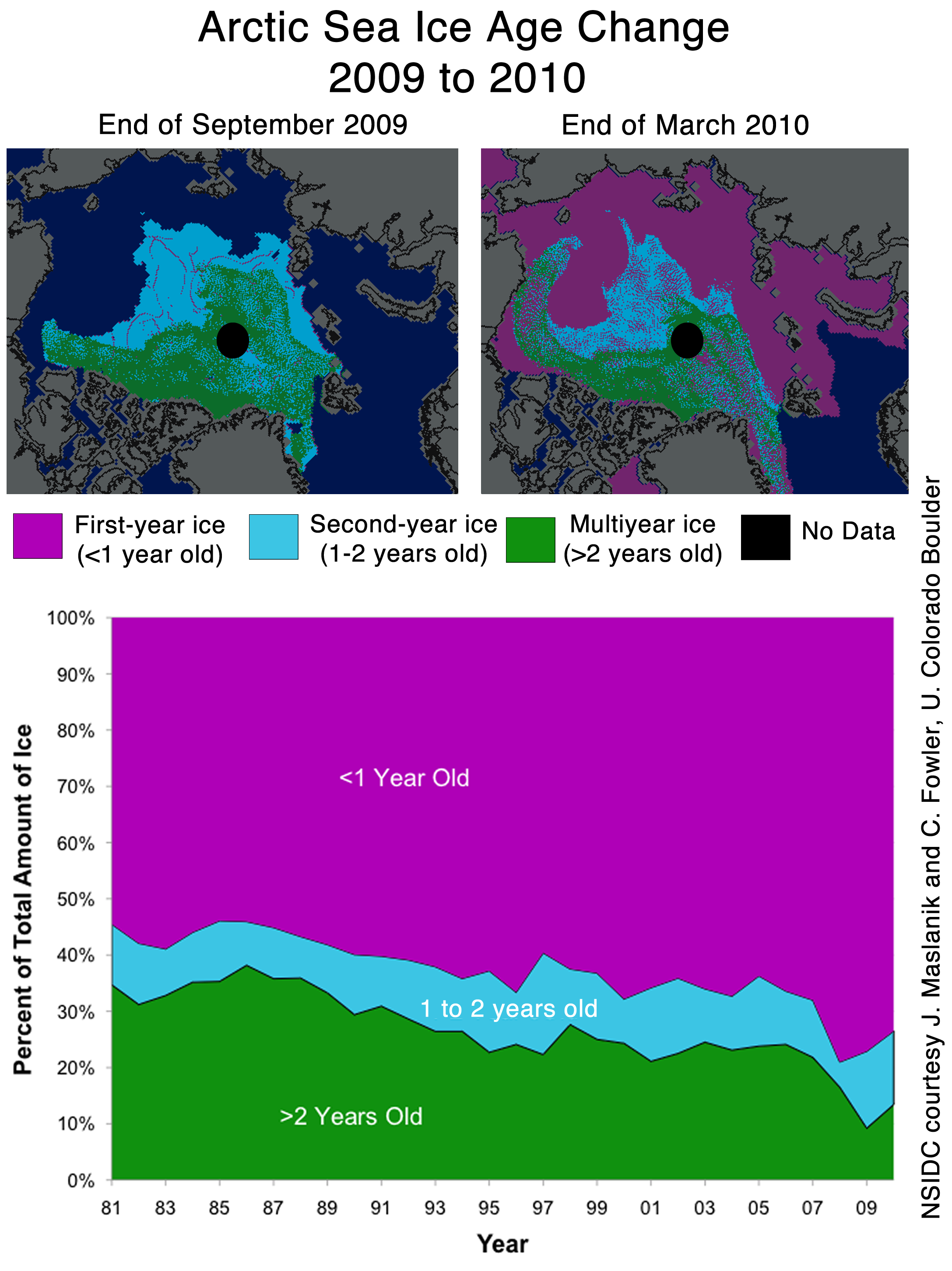
The areas that in recent years have been first-year ice that are now covered by 2nd and 3rd year ice will increase the volume – in those regions. However, compared to the last two years, there is even less of the oldest ice (see images below – I also included 1985 as an example of 1980s ice conditions for comparison). The loss of the oldest, thickest ice may more than offset the gain in volume from the 2nd and 3rd year ice. Also, it’s been a relatively warm winter in the Arctic, so first-year ice is likely a bit thinner than in recent years. Finally, the extent has been less than the last two years for the past couple of months. So the PIOMAS estimate that we are at record low volume anomaly is not implausible.

Early May ice age for: 1985 (top-left), 2008 (top-right), 2009 (bottom-left), and 2010 (bottom-right). OW = open water (no ice); 1 = ice that is 0-1 year old (first-year ice), 2 = ice that is 1-2 years old (2nd year ice), etc. Images courtesy of C. Fowler and J. Maslanik, University of Colorado, Boulder. Updated from Maslanik et al., 2007.
What does this all mean for this year’s minimum? Well, much will depend on the weather for the rest of the summer. As NSIDC states in its most recent post, we’ve expected we may see the rapid decline begin to slow because the melt will soon run into older, thicker ice, which will slow the loss of ice. Steve has said essentially the same thing and indeed we’ve the rate of loss slow over the past few days. Of course, there still a lot of time left in the melt season, and pace of melt continue to be relatively slow or it may speed up again, so we’ll see what happens. Regardless of what happens this summer though, the most important fact is that, despite some areas of the Arctic being a bit thicker this year, the long-term thinning and declining summer ice extent trend continues.
One final note about both PIPS and PIOMAS: Steve has claimed that “everyone agrees that PIPS 2.0 is the best data source of historical ice thickness”. Well, no scientist would even agree that what PIPS 2.0 produces are data! Being a data person myself, this is a bit of a pet peeve, but it’s important to make the distinction that model outputs are not data. Models are tremendously useful for obtaining information where data doesn’t exist (i.e., data sparse regions, historical periods without data), for projecting future changes, and for understanding how physical processes interact with each other (e.g., changes in climate due to changes in forcings).
However, model results are simulations, not observed data. And if there is good data available, I trust data over model estimates. And there is good historical data on ice thickness from submarine and satellite records (Kwok and Rothrock, 2009) and from proxy thickness estimates from ice age data (e.g., Maslanik et al., 2007). These data clearly show a long-term thinning trend. And while 2010 has relatively less of the thinner, first-year ice than the last couple of years, the ice cover is still much thinner than it was in earlier years. And it is clear that the models don’t entirely capture the spatial distribution of thickness correctly. As an example, compare the first-year ice in the ice age figure above with the PIPS 2.0 estimate from the same time period (below). In May, PIPS showed most of the central Arctic covered by ~3+ m ice, all the way to the Siberian coast. This is simply not realistic because the ice age data indicate first-year ice on much of the Siberian side of the Arctic (see images above), which would average at most 2 m. Thus Steve’s comparison of May 2010 and May 2008 with PIPS data is not valid because the model results are capturing observed spatial patterns of thickness.

References
Kwok , R. and D.A. Rothrock, 2009. Decline in Arctic sea ice thickness from submarine and ICESat records: 1958–2008, Geophys. Res. Lett., 36, L15501, doi:10.1029/2009GL039035.
Maslanik, J.A., C. Fowler, J. Stroeve, S. Drobot, J. Zwally, D. Yi, and W. Emery, 2007. A younger, thinner Arctic ice cover: Increased potential for extensive sea-ice loss, Geophys. Res. Lett., 34, L24501, doi:10.1029/2007GL032043.
Key PIPS 2.0 Model references:
Cox, M., 1984. A primitive equation, 3-dimensional model of the ocean, Geophysical Fluid Dynamics Laboratory Ocean Group Technical Report, Princeton, NJ, 1141 pp.
Hibler, W.D. III, 1979. A dynamic thermodynamic sea ice model, J. Phys. Oceanogr., 9(4), 815-846.
Hibler, W.D. III, 1980. Modeling a variable thickness sea ice cover, Mon. Weather Rev., 108(12), 1943-1973.
Thorndike, A.S., D.A. Rothrock, G.A. Maykut, and R. Colony, 1975. The thickness distribution of sea ice, J. Geophys. Res., 80(33), 4501-4513.
Key PIOMAS Model references:
Dukowicz, J.K., and R.D. Smith, 1994. Implicit free-surface method for the Bryan-Cox-Semtner ocean model, J. Geophys. Res., 99, 7791-8014.
Winton, M., 2000. A reformulated three-layer sea ice model, J. Atmos. Oceanic Technol., 17, 525-531.
Zhang J., and W.D. Hibler III, 1997. On an efficient numerical method for modeling sea ice dynamics, J. Geophys. Res., 102, 8691-8702.
Zhang, J., and D.A. Rothrock, 2001. A thickness and enthalpy distribution sea-ice model, J. Phys. Oceanogr., 31, 2986-3001.
Zhang, J., and D.A. Rothrock, 2003. Modeling global sea ice with a thickness and enthalpy distribution model in generalized curvilinear coordinates, Mon. Weather Rev., 131, 845-861.
Discover more from Watts Up With That?
Subscribe to get the latest posts sent to your email.
HR says:
July 14, 2010 at 4:06 am
R. Gates says:
July 13, 2010 at 9:42 pm
“Wow! Thanks for taking the time for such an excellent explanation. More than anything, I think we all can look forward to the time that we start getting the real data from CryoSat 2.”
Contain your excitement.
__________
New information is always exciting to me.
One question that still lingers for me is one of sea ice mass vs. volume. It’s seems the idea of “rotten ice” etc. is something that will be with us, and so you can have thick ice that is less dense. It would be nice to be able to measure both density AND volume, and hense get an idea of how much actual mass we have. This would seem to take a combination of what both GRACE and CryoSat – 2 can deliver. I would hope that IceSat 2 will deliver this. Julienne?
Anu,
You might want to keep your coffee contained for a bit longer. PIPS has been spot on.
http://wattsupwiththat.com/2010/06/02/the-undeath-spiral/
Dr. Meier’s quote was made out of context.
I was referring to “everyone” on WUWT, none of whom were able to produce a single other source of historical thickness data. I also don’t believe that Dr. Meier has mentioned any other source of historical thickness data. So, PIPS is indeed the best source.
From the article:
I agree that data completely trumps model, but I definitely disagree with proxies being considered data. Proxies convert one measurement to a different estimate something else using what?…a model. Clearly some proxies are vastly superior to others, but I think Mann and coworkers pretty much put a black stain on proxies in the area of climate science with the hockey stick debacle.
-Scott
”Had we no satellites, winter 2010 would have gone down as one of the coldest in history. ”
False
Canada’s warmth more than made up for cold across many regions.
Good post, lots of substance.
Clarification sought, though–shouldn’t that last sentence have another “not” in it? As in, “the model results are NOT capturing observed spatial patterns. . .”
The emended version would seem consistent with the preceding sentence, which the existing version does not.
My wife has been going through the books we gave our children and giving them to our grandchildren. She called my attention to this one, which may be on topic:
White Wilderness – Animals of the Arctic (Golden Press 1958)
The Golden Library of Knowledge – Factual Books for Young Readers
“The carefully researched, scholarly texts are nevertheless simple and easy to read.”
The world wears a cap of ice all through the year. Over an area around the North Pole the sun is not warm enough to melt all the ice during the summer….
The Arctic Ocean has many icebergs, but the sea ice itself averages only about seven feet in thickness, and never forms a solid frozen crust. Tides, currents, and winds constantly are breaking it up into huge floes, which are great flat cakes of ice….
In every season, [seals, walrus, and polar bear] always can be found on the southern fringes of the ice pack….
The killer whale also preys on the ringed seal. But it comes to the Arctic only during the summer to hunt in the wide channels of open water at the edge of the ice pack….
[T]he polar bear is a powerful swimmer and has been seen swimming in the open sea miles from ice or land….
We think the book accurate enough for our grandchildren.
I thank folks for the comments, though I apologize that I only have time to scan through them. A couple things that I’ve seen:
1. PIPS actually doesn’t forecast winds, it forecasts ice motion. The ice motion is driven primarily by winds, which are forecast by a weather model (in this case the Navy NOGAPS model). A subtle difference perhaps, but I think important because a lot of the accuracy over a synoptic scale is determined by the accuracy of the weather model, more so than the sea ice model. The sea ice model physics becomes more important over seasonal and interannual scales. That is why PIOMAS, with improved model physics, is more trustworthy over the long-term.
2. “Long-term” is a bit ambiguous of a term. Generally I mean decadal to multi-decadal scale. That is the scale where the CO2 signal becomes clear outside of the short-term climate variations. It is the scale where thinning of the sea ice starts to show up beyond the year-to-year ice extent variations. And it is the scale where glacier/ice sheet melt and SLR becomes clear.
3. I do congratulate Steve on his assessment of the ice conditions this summer. He has been pretty accurate (though I would say in spite of the PIPS model, not because of it). While we only post once per month, so are sometimes behind the trend, the recent slowdown is nothing terribly surprising. In our April post, we noted the increase in multiyear ice and the effect it may have on summer extents.
walt
Tenuc says:
July 14, 2010 at 12:09 am
I suspect that neither of the models used by PIOMAS and PIPS 2.0 give a good estimate of ice volume and we will have to wait for Cryosat 2 data before we start having good estimates.
Well stated. One of the big problems in climate science, and most likely affecting PIOMAS, is bias. They have under-predicted the ice extent the last two years and will most likely miss on the low side again.
This is the factor that most warmists can’t seem to get their brains around (and I’m afraid Dr. Meier falls into this group). There actually is a reason that any medical study that is not double-blind is considered questionable. That means ALL climate studies are questionable. It doesn’t mean the scientists aren’t trying to be objective, the fact is, it is IMPOSSIBLE to be objective.
Sorry, but this article by Dr. Meier will also be be contaminated by personal bias just as Steve’s articles are, R Gates posts are, and every else who has a strong opinion.
I cannot see that any human is under either a moral or even prudential obligation to strive to ensure that all animal species now extant remain so and remain in the same numbers as now exist.
The human race exists, and many other present species, because of previous mass extinctions so not all extinctions are to be regreted. Would any Green dare claim that it was unfortunate that a passing alien did not prevent the extinction of the dinosaurs?
Do people think this is accurate? There’s a lot of blue on it. I can’t find other up to date concentration maps. http://nsidc.org/data/seaice_index/images/daily_images/N_daily_concentration_hires.png
Walt,
Mark Serreze has been often quoted in the press as expecting a record low this summer. This seems to be at odds with what you have been saying.
http://www.allheadlinenews.com/articles/7018784377
As far as PIPS goes, its relative comparisons have done an incredible job of describing relative year over year Arctic conditions, and was the primary basis of my analysis this summer.
http://wattsupwiththat.com/2010/06/02/the-undeath-spiral/
Also, no one so far has provided me with any other links to historical ice thickness, besides PIPS.
Robert (8:20 am):
Canada’s warmth more than made up for cold across many regions.
============
I believe those who live west of Ontario who would dispute that
rbateman says:
July 13, 2010 at 10:04 pm
the Antarctic will cut the Atlantic off from the Pacific at the kneecaps with permanent ice.
Maybe you ought to look at the southern sea ice dynamics before making wacky projections – http://arctic.atmos.uiuc.edu/cryosphere/IMAGES/seaice.area.antarctic.png
stevengoddard says:
July 14, 2010 at 9:47
Mark Serreze has been often quoted in the press as expecting a record low this summer. This seems to be at odds with what you have been saying.
http://www.allheadlinenews.com/articles/7018784377
I don’t see the quote. Maybe you pasted the wrong link?
jakers says:
July 14, 2010 at 9:32 am
Do people think this is accurate? There’s a lot of blue on it. I can’t find other up to date concentration maps.
ftp://ftp-projects.zmaw.de/seaice/NEAR_REAL_TIME/Arc_latest_large.png
http://iup.physik.uni-bremen.de:8084/amsr/arctic_AMSRE_nic.png
(but this site has been having trouble the last few days)
http://climateprogress.org/2010/05/24/arctic-sea-ice-extent-volume-nsidc-record-steve-goddard/
Anu,
Thank you for the above link. My quick perusal of the site found these for 2007 – 2009.
ftp://ftp-projects.zmaw.de/seaice/AMSR-E_ASI_IceConc/SeaIceMinimum2007-contour50.png
ftp://ftp-projects.zmaw.de/seaice/AMSR-E_ASI_IceConc/SeaIceMinimum2008-contour50.png
ftp://ftp-projects.zmaw.de/seaice/AMSR-E_ASI_IceConc/SeaIceMinimum2009-contour50.jpg
Cannot wait to add image for the minimum for 2010 to see how it compares.
Again, Thank you!
Another image to watch, The Prediction.
ftp://ftp-projects.zmaw.de/seaice/prediction/current_estimate.png
Jon P
Very bold of people to make predictions in mid-July ;^)
It’s always good to hear from Dr. Walt Meier here. I hope he’ll be a frequent contributor. His input is very helpful, as he intends. Thanks, Dr. Meier.
Since when is ‘I think it’s quite possible’ the same as ‘I expect’?
Thanks for answering all my questions, Steve! I’ll leave you in peace now.
Dr Walt Meier states:
“Long-term is a bit ambiguous of a term. Generally I mean decadal to multi-decadal scale. That is the scale where the CO2 SIGNAL becomes clear outside of the short-term climate variations. It is the scale where thinning of the sea ice starts to show up beyond the year-to-year ice extent variations. And it is the scale where glacier/ice sheet melt and SLR becomes clear”
I take issue with the statement about a CO2 signal becoming clear simply because there is no proven correlation between tiny increases in multi decadal average temperature and an as yet uproven atmospheric carbon dioxide greenhouse effect. Polar ice levels have been lower in the past and higher with greater and lesser CO2 concentrations and higher and lower GATs. Conventional AGW wisdom dictates that higher GATs are having a direct and lasting effect on the polar ice caps yet the rise is so tiny and uncertain and the polar caps are so massive that any mathematical equation of the timeline a tiny rise in GATs and subsequent melting of the caps will run into the thousands of years.
What the planet has seen over the last thirty years(multi decadal) is a slight increase in GATs and a subsequent slowing on a decadal timescale, going back further than sattelite coverage becomes uncertain at best with the supposed “CO2 signal” being dwarfed by the error margins in measured/value added averages alone. To be perfectly blunt, if a CO2 signal stands out from a supposed net 0.5c rise in average temperatures when the error margin is much greater than that of the supposed multi decadal rise then I am a pink alligator.
The questions that need to be examined are:
a) What would be the estimated rise in global average temperature from natural cyclic warming alone and how much higher over that is the supposed AGW component and what is the margin of error involved?
b) How much of the supposed rise in global average temperatures can be attributed to this “clear CO2 signal” and again what is the margin of error involved?
c) How could such a tiny increase in temperatures cause a polar ice loss over the long(geologic)term let alone a few years to decades as the AGW wisdom dictates?
With respect may I submit that in fact this clear CO2 signal is in fact an artefact of a series of unreliable and inaccurate models fed with a series of educated guesses based on speculation and highly dubious data sources. The error margins alone are simply too high to determine a rise in GATs let alone an anthropogenic carbon dioxide component.
Yours
Cassie K.
So, Walter, Models are not data? If so, why does PIOMAS show error bars in their estimates. I thought error is a statistical probability device only used with data. How did PIOMAS then come up with their error bars? To obfuscate and pretend that PIOMAS is data, is that the intent? So they can point to ice being at “historically low values”, since one or two sigmas have been exceeded?
Not only that, but PIOMAS error bars are fixed, that is, the trend line uses a fixed error of unknown provence based on a composite “error” based on a fortuitous starting point near a known high ice value, then proceeding until it arbitrarily cuts off during a warming period, ignoring recent high ice recovery values after 2000.
“Adjustments” such as these in the trend line surely make a better case for ice loss so that grants can proceed at a prolific and lucrative pace. This is why PIOMAS must be looked at with much less objective confidence. There are good reasons why PIPS is relied upon for accuracy by military and commercial interests, since these need the most accurate and update picture they can get or their dogs won’t hunt.
“Mark Serreze of the center forecast the ice decline this year would even break 2007’s record.”
Read more: http://www.allheadlinenews.com/articles/7018784377#ixzz0tgK32mzL