By Steven Goddard
The Arctic sun has now passed its peak, and is starting its decline towards the horizon over the next 90 days.

All four (JAXA NSIDC DMI NORSEX) ice extent measurements now show 2010 as below 2007. You can see in the modified NSIDC map below that the regions which are below the 30 year mean (marked in red) are all outside of the Arctic Basin and are normally ice free in September, so it is still too early to make any September forecasts based on extent data.

The modified NSIDC map below shows ice loss (in red) during the last nine days. There has been very little change in the Arctic Basin.

The modified NSIDC map below shows ice loss (in red) since early April. According to JAXA, this is about 5 million km².

The modified NSIDC map below shows ice loss (in red) since early April. According to JAXA, this is about 5 million km².
The modified NSIDC map below shows ice loss (in red) since 2007. According to JAXA, this is about 500,000 km². Areas in green have more ice than 2007.

There has been a strong clockwise rotation of wind in the Beaufort Gyre, which is pulling ice away from the land around the edges of the Beaufort, Chukchi and East Siberian and Laptev Seas.

http://www7320.nrlssc.navy.mil/pips2/archive/mag/2010/mag_2010062200.gif

The video below shows changes in PIPS ice thickness and extent during June. You can see the ice rotating clockwise and concentrating in the center of the Arctic Basin.
During the last 10 days, PIPS shows that Arctic Basin ice volume has dropped close to 2007 and 2009 levels. Volume has increased by about 40% since 2008.

Average ice thickness is now the highest for the date during the last five years. This is due to the compression of the ice towards the interior of the Arctic Basin.

Ice offshore of Barrow, Alaska is showing little signs of melt so far.
 ‘
‘
http://seaice.alaska.edu/gi/observatories/barrow_sealevel/brw2010/BRW_MBS10_overview_complete.png
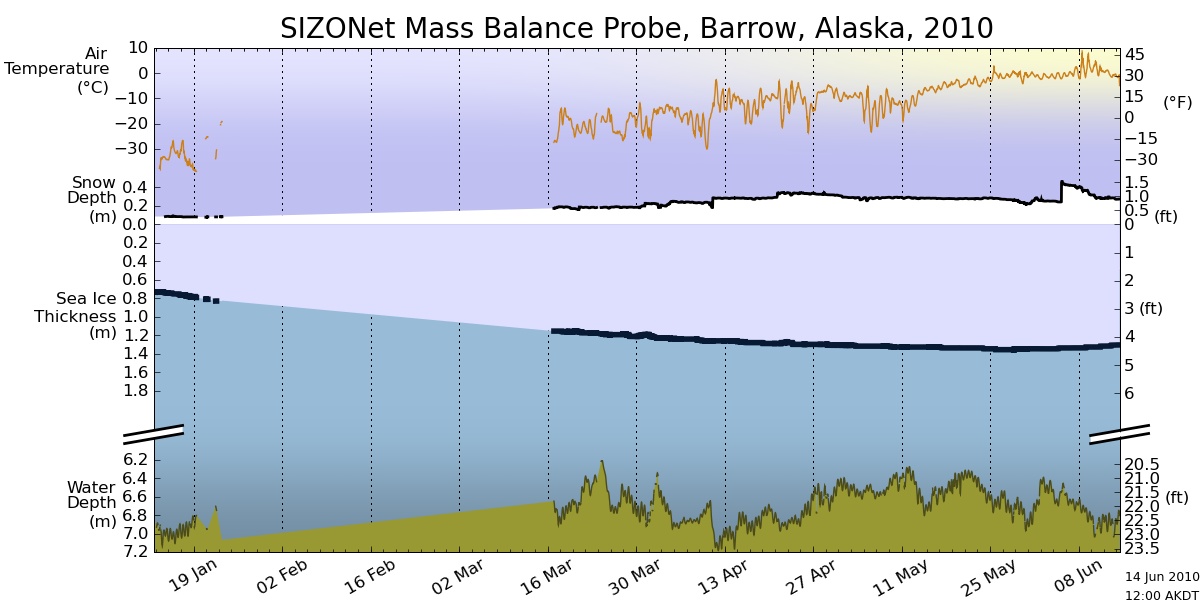
The current break up forecast calls for July 5.

http://seaice.alaska.edu/gi/observatories/barrow_breakup
Temperatures north of 80N have been persistently below normal this summer.

http://ocean.dmi.dk/arctic/plots/meanTarchive/meanT_2010.png
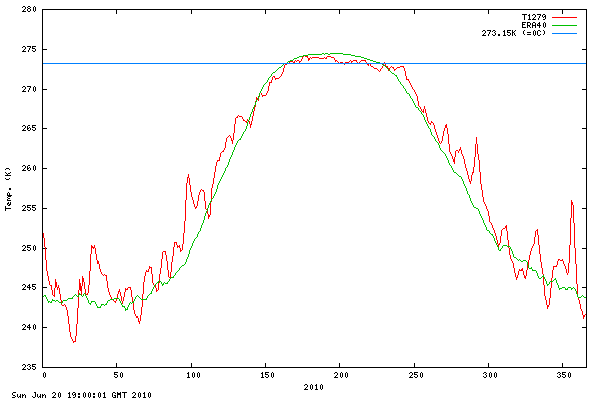
There are still no signs of melt at the North Pole, with temperatures running right at the freezing point – and below normal. Normally there has been surface melting for several weeks already.

http://psc.apl.washington.edu/northpole/webphotos/noaa2-sml.jpg

Arctic Basin ice generally looks healthier than 20 years ago.

I’m forecasting a summer minimum of 5.5 million km², based on JAXA. i.e. higher than 2009, lower than 2006.
Meanwhile down south, Antarctic ice is well above “normal” close to a record maximum for the date.

http://arctic.atmos.uiuc.edu/cryosphere/IMAGES/seaice.recent.antarctic.png

The video below shows the entire NSIDC Antarctic record for the last 30 years.It looks like a heart beating
Discover more from Watts Up With That?
Subscribe to get the latest posts sent to your email.
We are all doomed any way…
And yet we are told that 2010 will beat 2007 in terms of melt. As you say, we will not know until September, and the Arctic basin looks much healthier than 20 years ago
Forgive the OT:
Yahoo News has finally featured an article (from The Washington Post) about the current solar minimum. It is quite a good read and contains almost no AGW nonsense.
Steve–
So you’re issuing a new forecast of 5.5M km/2, superceding your original 5.8M km/2?
My feeling on the matter of issuing multiple predictions for the same melt season is I don’t care to do it. My 6.0-6.2M km/2 (made in late March or early April) may turn out wrong, but I don’t want to be like the Solar guys and forever chasing a series of predictions. I made one for this year, I’ll follow developments until extent minimum, learn whatever lessons are to be learned, and apply them to next year’s prediction.
It is quite amazing the focus on the Arctic sea ice extent. If all the Arctic sea ice melted, sea levels would not rise at all. It is equally amazing the lack of interest, and in some instances false statements, about the ice conditions in the Antarctic. It is Antarctic ice that must melt to cause sea level rise yet the Antarctic had the most sea ice ever recorded in 2008 and the ice extent is currently 1 million square kilometers above average. Antarctica is the highest continent on earth, the average temperature is 55 below zero, it is classified as a desert, the driest place on earth. Even if the man made global warming theory was true, melting Antarctic sea ice would not cause any sea level rise, yet there would be more humidity and thus more snow fall in the interior, Antarctic snow levels would increase, and the land ice would build up.
I am an avid “ice watcher” and appreciate this the comprehensive yet concise data set here, with not too much analysis and prognostication.
I watch because it is clear we are not in a “death spiral” and I can use the info to console those that believe polar bears are indeed going to perish in their lifetime due o arctic ice loss.
It does seem to me though that the continued gradual warming during this interglaciel will lead to gradual ice loss at the poles. So “record ice extent lows” are to be expected. The thing is the record only has to be slightly lower to be a record but its not much and not much to worry about!
5.5 is the only estimate I have made.
If the extent in 2006 this time of year was any kind of predictor of what will happen in September as compared to 2007 then we’re in for a minimum that beats 2003!
But it seems that there’s almost nothing in the data of any year that predicts 3 months later for any time period that I can tell. We just have to wait….
Lucia’s Blackboard gives you three bites at the apple: Long-, medium-, and short-range forecasts, with winners in each category.
I still like the original 5.8 forecast, but would not be surprised if 2010 follows right on 2006.
Does it mean that it endangers our whiskey on the rocks?
Global sea ice area is now plunging well below zero on cryosphere , don’t expect it to go much positive for the rest of the year as the Arctic drop takes the rains and the Antarctic rise peters out against the Southern ocean winds and currents.
Will the Arctic turn upwards like 2006 again? I doubt it, the guesses of 5.5 and 5.7 of WUWT and Steve G. I think will be shattered. Sub 5 is my esitmate.
No recovery, R. Gates is likely to be closer.
Mr. Alex says:
June 23, 2010 at 1:42 pm
It is quite a good read and contains almost no AGW nonsense.
Only mantras from Nasa church…how cool!
It looks to me that sea ice will make another record low this summer. People need to get off the oil addiction. The polution and warming is killing the planet.
Maybe we’ll know by late August. Here’s something interesting I noticed in the IARC/JAXA data…
YEAR MIN_ICE RANK AUG28 RANK
=============================
2003 6032031 1 6353125 1
2004 5784688 2 5971563 2
2006 5781719 3 5966406 3
2002 5646875 4 5957656 4
2005 5315156 5 5771250 5
2009 5249844 6 5554219 6
2008 4707813 7 5163125 7
2007 4254531 8 4724844 8
The August 28th rank is a perfect predictor (so far) of the final rank. You can’t beat 100% correlation.
Thanks for the extensive overview Steve.
geo says:
June 23, 2010 at 1:52 pm
I agree with Geo. Dont modify the forecast now. Stand by your forecast until the date is here. Otherwise, whats the point?
Either do not come with any forecasts that early, or stick with it, and admit it was to high later. Your forecast might be right too. We have the whole month of July in front of us.
I have a question. Who modifies your NSIDC images?
As to the point made about surface melting being visible by now, I looked at the North Pole Webcam website and went back 2009, 2008, 2007, and 2006 for the period covering June 20th thru 24th and in no images during those dates back 4 years is there any visible signs of melting or ponding
Steve, I think it’s a bit misleading to say that the ice is healthier today than 20 years ago by looking at ice concentration from two days from different years. Just yesterday I looked at ice concentrations from this year and 2007 on the 22nd of June and 2010 showed lower ice concentrations (and we all know how 2007 turned out). There is a lot of daily variation sometimes in the ice concentration fields from weather effects. So personally, I wouldn’t make comparisons between a day from two different years and read much into it.
I’m glad you included mention of circulation/winds in this post. The Arctic Dipole has been implicated in the 2007 ice loss, and this pattern is happening now. If it persists the entire summer like it did in 2007, then I think the September ice extent will fall below 5.5 million sq-km. Note just based on survival rates of ice from different ice age classes during the last several years, we also predicted a 5.5 million sq-km value. But a weather pattern like in 2007 (with 2007 ice survival rates) would yield around 4.3 million sq-km. Interestingly, J. Maslanik whose ice age product we use, is predicting more like 4.3 million sq-km based on the southerly location of some of the old ice (making it more prone to melt out).
But like you say, it’s too soon to tell. Would be good though to mention to your readers that June 2010 is a new record low in the satellite data record…
regards, Julienne
I also wanted to mention, right now the 2010 ice extent is nearly 700,000 sq-km below that in 2007 (10.14 vs 10.82 million sq-km)
And while the sun is now past it’s peak, another 5 million sq-km of ice will likely be lost by September.
A couple looks at Antarctic Sea Ice Extent, which, like Area, is trending well above average;
http://nsidc.org/data/seaice_index/images/daily_images/S_stddev_timeseries.png
and:
http://www.iup.uni-bremen.de:8084/amsr/ice_ext_s.png
Also, for those of you who would like to do some of your own digging here are some of the best sources of Sea Ice Data:
The Cryosphere Today – Arctic Climate Research at the University of Illinois:
http://arctic.atmos.uiuc.edu/
http://arctic.atmos.uiuc.edu/cryosphere/
http://arctic.atmos.uiuc.edu/cryosphere/IMAGES/
National Sea and Ice Data Center (NSIDC):
http://nsidc.org/
http://nsidc.org/data/seaice_index/images/
http://nsidc.org/searchlight/
University of Bremenpart
http://www.iup.uni-bremen.de/eng/
http://www.iup.uni-bremen.de/iuppage/psa/2001/amsrop.html
http://www.iup.uni-bremen.de:8084/
International Arctic Research Center/Japan Aerospace Exploration Agency (IARC-JAXA)
http://www.ijis.iarc.uaf.edu/en/
http://www.ijis.iarc.uaf.edu/en/home/
Danish Meteorological Institute (DMI)
http://ocean.dmi.dk/english/index.php
http://ocean.dmi.dk/arctic/index.uk.php
If I missed any, please let me know.
Is there any news from Russian ice breakers on how thick the ice is from their point of view?
Sea ice, schmee mice.
Just to pick a nit: 1990 was 21 years ago.
The ice 20 years ago looked like this
Totally agree with Julienne’s point about comparing with a single day 20 (or 21) years ago. It’s all about the trends.
http://nsidc.org/data/seaice_index/images/n_plot_tmb.png