Earths Missing Energy: Trenberth’s Plot Proves My Point
By Dr. Roy Spencer

The plot that is included in Kevin Trenberth’s most recent post on Roger Pielke, Sr.’s blog actually proves the point I have been making: The trend in the imbalance in the Earth’s radiation budget as measured by the CERES instrument of NASA’s Terra satellite that has been building since about 2000 is primarily in the reflected solar (shortwave, or SW, or RSW) component, not the emitted infrared (longwave, or LW) component.
To demonstrate that, the following is the chart from Trenberth’s most recent post, upon which I have overlaid the 2000-2008 trend lines from MY plots of CERES data, and which we have computed from the official NASA-blessed ES-4 Edition 2 global gridpoint dataset.

The plots I provided in my previous post have greater resolution in the vertical axis.
For those who are following this mini-debate, please see that post, not Roger’s version of my post, which was a draft version of my post and was incomplete.
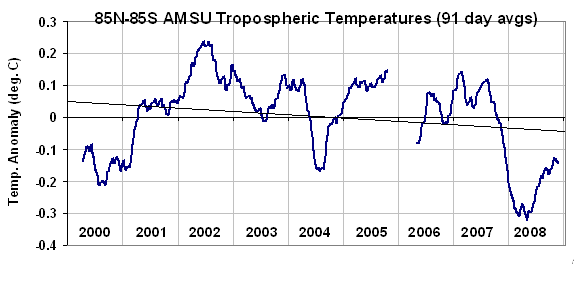
And, again I point out, the most recent dip in the LW curve (above) is consistent with cooling of the global average troposphere seen in our plot of AMSU5 data. UPDATE, 1:45 p.m. CDT: small correction to above figure.

Discover more from Watts Up With That?
Subscribe to get the latest posts sent to your email.
“Anthony Cox says:
May 11, 2010 at 6:41 pm
Pinker’s paper really sums up what Roy is saying;
http://www.sciencemag.org/cgi/content/abstract/sci;308/5723/850
Pinker found from 1983-2001 a TOA decline of SW flux, more coming in, less going out, and a commensurate increase in BOA SW flux, S, which means more sunlight was hiting the deck. Pinker allocates the reason for this as being due to cloud variation which is supported by cloud studies of the relevant period; with less cloud there is less OLR from albedo; the reflected LW from the tops of clouds appears to always exceed the ‘trapped’ LW from the surface by the bottom of the clouds so with less clouds more SW hits the surface then LW leaves. And just think Gore is making a fortune misrepresenting this basic fact.”
That would suit me very nicely.
To fit my New Climate Model all one needs to propose is that the main effect on albedo is the poleward / equatorward shift in the three main cloud bands, namely the ITCZ and the two mid latitude jets.
Throughout the late 20th century warming trend all those bands were further away from the equator letting more solar shortwave in because a poleward positioning of the cloud bands reflects less due to the lower angle of incidence of solar input and leaves more open sky in lower latitudes.
Now that the cloud bands are more equatorward more incoming solar is being reflected from the top of the atmosphere and less energy is getting into the oceans.
I assume that Roy’s RSW is a Bottom Of Atmosphere decline which should be correlated with a Top Of Atmosphere increase which would fit with Pinker’s 1983 to 2001 findings but reversed.
I mentioned long ago that I first noted that the jets were moving back equatorward from around 2000.
Then the final step is to implicate changes in solar activity levels as causing the latitudinal shift of the cloud bands which my New Climate Model does. That then ‘squares the circle’ for a plausible complete hypothesis for global energy budget variability.
Part of that variability being ocean induced and part being solar induced.
Invariant
“Still we may expect up to 8 degrees warmer weather east of Svalbard within 90 years”…
This will come as a bit of a surprise for the Swedes and the Danes who this winter could walk across the ice for exchange visits and whose ships were trapped in ice until recently.
Statistically, are these differences significant? And are the trends statistically significant? How do we know it is all not just noise?
Of course all the regression lines on those graphs are not statistically significant, so basically this analysis is meaningless.
Pamela Gray says:
May 11, 2010 at 12:18 pm
Correct me if I’m wrong, but I believe the missing heat is based on models of AGW heat that SHOULD be building somewhere based on calculations of greenhouse gas capability and the amount of increasing CO2 we are putting into the air outside of natural sources. It is not based on the direct measures of incoming, outgoing, and net heating energy.
============
Actually Pamela, you are wrong on this. From what I have read from Roy Spencer’s and Roger Pielkes articles this “missing heat” arises from observed radiation imbalances in the satellite data. I think though, we have a textbook case of confirmation bias; since the observed imbalance appears to agree with model predictions, scientists like Trenberth have jumped on this as “proof” that heat is being sequestered undetected in the earth’s climate system. The problem with all this is in the uncertaintites and the fact that the radiation imbalance is in the short wave whereas AGW theory says it should be in the longwave.
Gail Combs says:
May 11, 2010 at 7:54
Perhaps.
There was a change in the composition of the TSI according to NASA:
“April 1, 2009: …..A 12-year low in solar “irradiance”: Careful measurements by several NASA spacecraft show that the sun’s brightness has dropped by 0.02% at visible wavelengths and 6% at extreme UV wavelengths since the solar minimum of 1996….” http://science.nasa.gov/science-news/science-at-nasa/2009/01apr_deepsolarminimum/
According to Dr Leif Svalgaard, the TSI did not change more than 0.1% so therefore there must be an increase in longer wavelengths to keep the TSI close to constant. See: http://www.leif.org/research/TSI-LEIF.pdf
Why would there need to be an increase in longer wavelengths to keep TSI “close to constant”. What percentage of the total is extreme UV?
Thanks for another illuminating piece Roy. I thought in light of this article it would be worthwhile to look at solar output vs. absorption. Here is a wiki graph of same:
http://upload.wikimedia.org/wikipedia/commons/4/4c/Solar_Spectrum.png
I was surprised by this graph showing the delta from top-of atmosphere to sea level and what wavelengths are absorbed by what gases. This simple graphic shows the insignificance of CO2 absorption relative to O3, O2 and H2O. Nothing else gets a mention, and even CO2 is a tiny fraction.
I made a feedback model just using 10.7 flux and an inertial mass. After setting the base lines, “waa haa “, the CO2 warming was duplicated. I will add in the Iceland volcano as a flux reducer. Is severe global cooling possible????
This is too easy!!!
Dear Dr. Spencer,
I am very happy for your illuminating resolution regarding the missing energy. However, I would be most pleased to know whether you also can explain the “missing energy” between the ever increasing UAH satellite temperatures and the cold Siberian temperatures we experience in Europe these days. I suspect it must be terribly hot somewhere else to account for this – and I wonder where?
Another question is whether you know for how long the negative North Atlantic Oscillation and negative Arctic oscillation will last?
Best Regards,
Invariant
Dear Dr. Spencer,
“From the early 1940s until the early 1970s, when NAO index exhibited a downward trend, European wintertime temperatures were frequently lower than normal. “
http://www.cgd.ucar.edu/cas/jhurrell/Docs/hurrell0895-science.pdf
Could this possibly mean that European wintertime temperatures from the early 2010s until the early 2040s may frequently become lower than normal?
I am starting to get used to the North Wind here in Norway, but come on, 30 years?
Best Regards,
Invariant
Today I overheard a German TV weatherman stating that average May temperature in Berlin has dropped from 18 to 9 degrees Centigrade in the last 20 years. Now I don’t trust that’s necessarily correct (although it seems plausible, just looking out of the window at passers-by in winter overcoats), but anyway it was like a gust of fresh air to hear a statement like this in the mainstream media of my country. Looks like the recent Euro crisis has knocked some sense into some heads about what’s really and imminently important and problematic….
The other day, upon the stair, I calc’ed some heat that wasn’t there.
It wasn’t there again today; The heat I calc’ed has gone astray.
Or perhaps wasn’t there to begin with.
George E. Smith says:
May 11, 2010 at 5:45 pm
“But we are grateful to havesomebody with Dr Spencer’s stature to carry the colors in this battle; along with John Christy they make a great team.”
Hear! Hear!
A big HURRAY for Spencer, Christy and their teams !
Real scientists, using real data from the real world.
“”” davidmhoffer says:
May 11, 2010 at 9:04 pm
So… we’re seeing less variability in LW this last decade than we are seeing in SW. Of course, CO2 effects are logarithmic, so the higher the CO2 levels are, the less variation as a % we would expect to see of CO2/LW forcing as a whole in comparison to the amount of CO2 we are adding each year. Who knew? Physics works! “””
“”” Of course, CO2 effects are logarithmic “””
People keep saying that David. I wish that somebody who says that would cite a reference to some peer reviewed actual measured data showing a plot of mean global surface TEMPERATURE vs LOG(CO2 IN ATMOSPHERE).
Not a computer model simulation but an actual observed and measured data.
Then since you say that Physics works; what about a simple physics cause and effect relationship that shows why such a plot should be logarithmic.
I’ve been following this subject now for about 30 years in some form or another; and I have yet to see either theory or data to support a logarithmic temperature to CO2 connection; or for that matter any other form of such a connection.
For a start; the supposed driving force behind a physical CO2 to surface Temperature connection is the surface emitted LWIR thermal radiation; a small part of which, the CO2 in the atmosphere intercepts. That much we know is true; and the atmosphere itself is warmed by that intercepted energy. But the problem is that the surface temperature has a huge range on earth; a total of about 150 deg C from the coldest surfaces to the hottest surfaces; and that results in about an 11:1 range in the value of that LWIR emittance; so the driving force behind CO2 absorption and warming is not even a constant over the earth; so the resultant heating of the surface from the CO2 warmed air is also a highly variable effect.
Doubling the atmospheric CO2 raises the surface temperature 3 deg C; the IPCC says so; well +/- 50% so maybe its 1.5 deg C, or maybe it’s three times that at 4.5 deg C; maybe, that is.
Well doubling the CO2 in the air over Vostok Station will not raise the surface temperature by 3 deg C; or even by 1.5 deg C; there simply is not enough total energy emitted from the surface there, even if the CO2 absorbed all of it, which it doesn’t, it still wouldn’t raise the surface by 3 deg C.
There’s no global network monitoring the local value of “climate sensitivity” as Stephen Schneider described it; so there’s no way we could even measure that.
And what about the time lag factor. Photons can proceed from the surface to 300 km in 1 msec, and other photons can return in the same 1 msec. So give it a second for the energy exchange to take place. So what is the thermal time constant of the earth surface, and should we be measuring the CO2 increase, and then waiting 800 years to obseve the temperature rise ? Oops !, I forgot; the temperature rise seems to happen before the CO2 increase that caused it.
So if you plot Surface T vs Log CO2 and vary the time delay from CO2 data to Temperature data; at what delay time do you get the best straight line fit showing that the relationship is logarithmic at that time offset.
Frankly; I’m getting just a little tired of watching the Climatologers keep on fiddling with statistical trends and correlation coefficients, and standard deviations; and all that clap trap of statistical “mathematics”, in the vain hope that somehow somewhere, sometime, somebody is going to trip over the correct set of parameters; and out will pop a true model of the Physics of global warming via the CO2 hypothesis.
Lord Monckton has said several times that the way to “address” the validity of AGW was to do it within the framework of classical theory that the Climatologers themselves all use. That seems to be to just help them search for the magic set of parameters that would show that AGW is wrong.
And Dr Spencer along with Professor Christy, and maybe Dr Richard Lindzen, all seem to be trying to do that; to show that classical climate science does not really support AGW when you get the right set of statistical parameters or observations.
I think it is high time to abandon Stephen Schneider, and his “climate sensitivity”, which is a neo-science “ether”, and stop looking for ways to try and force CO2 to shoulder the blame for normal global climate temperature variations; and simply fess up that we can’t show that CO2 has anything much to do with the earth temperature.
Time to concentrate on the real villain which is that three phased bent molecule; without which there would be no life on this planet; or anywhere else or likely even possible.
HEY ! IT’S THE WATER !
John Karajas
May 11, 2010 10:27pm
The Second Law of Thermodynamics has nothing to do with an open or closed environment. It does however have everything to do with the transport of heat in thermodynamic processes. Heat in a system is always OBSERVED to move towards
a colder region. This movement produces work. The 2nd law is essentially a law of “heat power”. If you think this law is irrelevant or doesn’t hold water then don’t get involved in engineering. Those who design real world equipment absolutely must take the 2nd law into account or the final design will fail in short order. With regards to the atmosphere, the top of the troposphere averages around -55 oC, the top of the mesosphere -100 oC. Since hot air rises any kinetic heat in the atmosphere will make its way to first the tot then on to the mesophere. From here it makes its way to space which is of course the coldest at -273 oC. There is simply no mechanism for moving or redirecting heat flow in the opposite direction. To do so EXTERNAL WORK must be applied! Warmers attempts to invalidate the 2nd law are laughable, pitiful and LAME. For an example of this see the website (pseudo) science of doom’s website. Current climate scientists(and I use that term verrry loosely) are like magicians trying to pull a rabbit out of a hat. Sheer magic.
George E. Smith says:
May 12, 2010 at 10:29 am
Time to concentrate on the real villain which is that three phased bent molecule; without which there would be no life on this planet; or anywhere else or likely even possible.
HEY ! IT’S THE WATER !
George, I like your style!
I agree we need to look first at the classical science behind earth’s climate. Take for instance the geometry of the earth and it’s atmosphere. Look up “dip of the horizon”. You won’t find it in Wikipedia, that is for sure! Know why? It goes directly against AGW and GHG effects. See http://mintaka.sdsu.edu/GF/explain/atmos_refr/dip.html.
Look at the diagram. See the point ‘O’. That is a water molecule or CO2 molecule. If it radiates, how much will go back toward the surface and how much will go to space? At about 1000m high the difference is already 1%. Not 0.1% or 0.01% but a whopping 1%. At about 3000m it’s two percent, 51% to space, 49% toward the ground. You see, the odds are stacked against re-radiation back to earth, like Las Vegas casinos. You can never win and that is using simple geometry, not fancy computer models.
I would like very much to see the spectral intensities of light reflected from the Moon, the brighter asteroids, Mercury, Mars, and Pluto. Have the IR and UV intensities reflected from these bodies changed? I would also like to see mapping of incident Solar radiation versus time on our various Solar observatories (in orbit around Earth and the Sun).
Does the mix of energy depend on sunspots, solar storms, and solar radio flux?
If so, how? I am not one to believe that the variation in solar storms has no effect on the mix of Solar energy, nor do I believe that the sources for the different wavelengths are fully understood.
What is coming FROM the Earth has changed. What kind of change is there for what is coming TO the Earth?
It is all a question of apples and oranges.
“”” wayne says:
May 12, 2010 at 11:29 am
George E. Smith says:
May 12, 2010 at 10:29 am
Time to concentrate on the real villain which is that three phased bent molecule; without which there would be no life on this planet; or anywhere else or likely even possible.
HEY ! IT’S THE WATER !
George, I like your style!
I agree we need to look first at the classical science behind earth’s climate. Take for instance the geometry of the earth and it’s atmosphere. Look up “dip of the horizon”. You won’t find it in Wikipedia, that is for sure! Know why? It goes directly against AGW and GHG effects. See http://mintaka.sdsu.edu/GF/explain/atmos_refr/dip.html.
Look at the diagram. See the point ‘O’. That is a water molecule or CO2 molecule. If it radiates, how much will go back toward the surface and how much will go to space? At about 1000m high the difference is already 1%. Not 0.1% or 0.01% but a whopping 1%. At about 3000m it’s two percent, 51% to space, 49% toward the ground. You see, the odds are stacked against re-radiation back to earth, like Las Vegas casinos. You can never win and that is using simple geometry, not fancy computer models. “””
Wayne, I do not have any kind of broad band radiation measuring equipment with which to make my own radiation measurements. So I have never measured the LWIR emssions from the surface of the earth; anywhere. Nor have I ever measured the spectral composition of that radiation at any frequency, let alone with enough resolution to know what the exact emission spectrum looks like.
Nor have I ever measured the thermal emission spectrum from the atmosphere back down to the surface of the earth. But I assume that Climatologers have and have all that data from all over the earth’s surface; at every possible kind of terrain and surface material. If not, then what the hell is it that they are doing with all those R&D dollars that they are continuously given by the taxpayers.
But I think it is possible to make some plausible arguments; based on 8th grade high school science, as to why the radiation from the atmosphere should favor escape to space, rather than return to the surface.
Just consider some pocket of atmosphere (clear air) with its normal complement of CO2. We could throw in other GHG including H2O; but that just complicates things and the point can be made with just a single component.
So CO2 is known to absorb at a number of closely spaced narrow lines in a band from about 13.5 to 16.5 microns. That is the isolated CO2 molecule at a cold temperature.
In the atmosphere, that CO2 molecule is vastly outnumbered by N2, O2, and Ar molecules, and it is constantly undergoing collisions with those molecules and thereby transmitting some of the absorbed energy from the LWIR spectrum to the ordinary atmospehric gas molecules. The higher the temperature, the greater the mean particle velocity; which actually goes as the square root of the Temperature (K). The result of that velocity, is that a Doppler shift occurs in the frequency of the absorption lines the molecules has, so it can absorb nearby wavelengths as well; so the actual real atmosphere absorption spectrum has those lines broadened by the Doppler shift. The absorption is also influenced by collisions, which alter the time the CO2 molecule spends in its excited state, and causes an uncertainty in the wavelength due to the Heisenberg Principle, resulting in a further line broadening based on collision rates, which depends on the atmospheric pressure.
So we have a CO2 molecule exchanging energies with nearby molecules all at some temperature and pressure somewhere in the atmosphere. The atmospheric molecules containing electrons and having some non zero Temperature can then radiate a thermal continuum spectrum of LKWIR that depends on the atmospheric Temperature in that location. That radiation is emitted isotropically, there being nothing to favor some direction of emission.
So maybe half is directed towards space, and half towards the ground.
Now the air below the sample, is denser because of the higher atmospheric pressure there, and it is also hotter due to the normal atmospheric temperature lapse rate. So we can reasonably state, that a CO2 molecule at a lower altitude than the sample molecule; has both a higher doppler broadening effect, and also a higher pressure broadening effect; and therefore that lower CO2 molecule has a higher probablility of absorbing the thermal energy spectrum from above than the sample specimen does. So the likelihood of the downward radiation being reabsorbed by lower CO2 molecules is increased, the lower we go in the atmosphere. Reabsorption could happen multiple times, but always, the LWIR emission from the atmosphere travelling towards the surface encounters an increasingly stronger absorption by CO2; and every time such a trapping occurs the eventual re-emission of that energy by the lower atmosphere will split again between up and down.
Now the portion of the original emission from our sample atmosphere, that proceeds upwards towards space, will encounter CO2 molecules that are colder and less dense that the sample atmosphere, so the 15 micron band absorption lines will be narrowed, because of the colder molecules with lower Doppler shift, and the lower density giving fewer collisions,a dn a longer time between collitiosn so both Doppler and pressure broadening ar less for the higher atmsphere, so the absorption door slowly narrows as you go up, rather than slightly widening as you go down.
So the probability of reabsorption increasesa syou go down, and decreases as you go up; and every time there is a new capture and eventual re-emission, the energy is split in half again with half heading downwards, and the other half heading upwards.
So one would expect that the escape route to space, is favoured over the return to surface route; and that will tend to reduce any thermal influence that atmospheric LWIR emission has on the earth surface. Regardless of the surface curvature geometry; the simple physics of the GHG mechanism, suggests that more of the CO2 absorbed energy escapes to space, than gets returned to the surface.
Brian W says:
We are not “attempt[ing] to invalidate the 2nd law”. We are attempting to apply it correctly. You are right about what the 2nd Law says in regard to heat flow but this is the NET heat flow. If you put a cold object near a hot object, it doesn’t magically detect the hot object is there and stop radiating. Rather, the Second Law just tells us that the heat from the hotter object that is absorbed by the colder object will be greater than the heat from the colder object that is absorbed by the hotter object.
If you work out any model of the atmospheric greenhouse effect, whether it be a line-by-line radiation code or a toy model like Willis Eschenbach’s “Steel Greenhouse”, you will find that the net heat flow is from the hotter earth to the colder atmosphere, just as the Second Law requires.
Why then, you might ask, does this result in warming? Well, the important point is “warming” compared to what. The comparison case for the greenhouse effect is the case where the atmosphere is transparent to IR radiation and hence all of the radiation that the earth emits is radiated back out into space. The fact that an IR-active atmosphere causes some of that radiation to return to the earth means that the earth ends up warmer, even if the amount returned is only some fraction of the amount that the atmosphere absorbs.
See here for more details: http://www.worldscinet.com/ijmpb/24/2410/S021797921005555X.html
John Finn says:
May 12, 2010 at 3:16 am
“….Why would there need to be an increase in longer wavelengths to keep TSI “close to constant”. What percentage of the total is extreme UV?”
____________________________________________________________________
Assume the TSI has remained constant (according to Dr Svalgaard)
Assume the radiation out put of the sun is a gaussian distribution with the peak at the visible wavelengths.
Then if the radiation
dropped by 0.02% at visible wavelengths and
dropped by 6% at extreme UV wavelengths
one can assume there was a varying drop in radiation between the visible and the extreme wavelengths.
This leaves two options. First the entire output of the sun dropped, that is TSI dropped OR the curve shifted positions towards the longer wavelengths. That means more of the energy comes from wavelengths longer that visible so the total energy remains the same.
Which is actually true depends on what is meant by “no change” in the TSI and extreme UV wavelengths. If my memory serves me correctly I think the change in TSI was actually 0.01% that would mean there was a drop AND a shift. It would be consistent with less sunspots. The flares associated with sunspots are supposed to generate higher energy wavelengths such as Gamma rays.
george
“I’ve been following this subject now for about 30 years in some form or another; and I have yet to see either theory or data to support a logarithmic temperature to CO2 connection; or for that matter any other form of such a connection.
http://www.agu.org/pubs/crossref/1998/98GL01908.shtml
Start there. that will get you part way home.
here. no paywall
http://folk.uio.no/gunnarmy/paper/myhre_grl98.pdf
George E. Smith says:
May 12, 2010 at 10:29 am
George if you want to understand the logC02 stuff as I noted you can start with the paper above.
and if you want to understand the models, just google GENLN2
add ‘remote sensor’ to your search and you’ll see other resources that should be of interest
http://cimss.ssec.wisc.edu/itwg/itsc/itsc14/proceedings/A40_Qi.pdf
Gail Combs says:
May 12, 2010 at 3:34 pm
____________________________________________________________________
Assume the TSI has remained constant (according to Dr Svalgaard)
I don’t think you can assume that. It doesn’t vary much but it’s not constant.
Assume the radiation out put of the sun is a gaussian distribution with the peak at the visible wavelengths.
Then if the radiation
dropped by 0.02% at visible wavelengths and
dropped by 6% at extreme UV wavelengths
one can assume there was a varying drop in radiation between the visible and the extreme wavelengths .
There’s a lot of assumptions in there and a lot depends on how the falls were distributed throughout the spectrum. It seems perfectly possible that solar output remained well within the bounds of natural variability even given the percentage falls you quote.
Which is actually true depends on what is meant by “no change” in the TSI and extreme UV wavelengths. If my memory serves me correctly I think the change in TSI was actually 0.01% that would mean there was a drop AND a shift. It would be consistent with less sunspots. The flares associated with sunspots are supposed to generate higher energy wavelengths such as Gamma rays.
The 0.01% change in TSI is new information, i.e. it was not included in your original post.
wayne says:
Okay, so are you seriously suggesting that Wikipedia doesn’t discuss this (at least under the search term you entered) because it might have some obscure application to AGW and GHG effects? Doesn’t that strike you as just slightly paranoid?
And, you expect this to have a significant impact how exactly? So, you use a computer model where a rise in GHGs results in the additional absorptions and re-emissions sending only 49% back to the ground and I use one that results in them sending 50% back to the ground. Do you honestly expect this to make a big difference? I don’t think we even know the radiative forcing to an accuracy of 1%…and we certainly don’t know the climate sensitivity to anything close to that. I think you are making a big deal about an effect that is effectively in the noise, whether it is currently accounted for in the models or not.