Earths Missing Energy: Trenberth’s Plot Proves My Point
By Dr. Roy Spencer

The plot that is included in Kevin Trenberth’s most recent post on Roger Pielke, Sr.’s blog actually proves the point I have been making: The trend in the imbalance in the Earth’s radiation budget as measured by the CERES instrument of NASA’s Terra satellite that has been building since about 2000 is primarily in the reflected solar (shortwave, or SW, or RSW) component, not the emitted infrared (longwave, or LW) component.
To demonstrate that, the following is the chart from Trenberth’s most recent post, upon which I have overlaid the 2000-2008 trend lines from MY plots of CERES data, and which we have computed from the official NASA-blessed ES-4 Edition 2 global gridpoint dataset.

The plots I provided in my previous post have greater resolution in the vertical axis.
For those who are following this mini-debate, please see that post, not Roger’s version of my post, which was a draft version of my post and was incomplete.
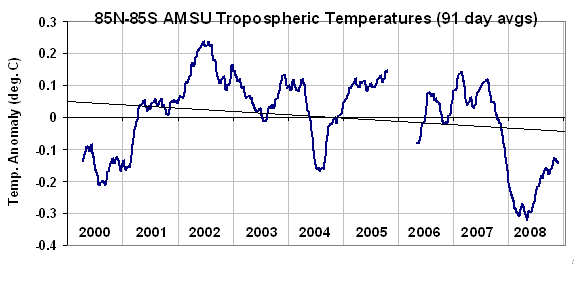
And, again I point out, the most recent dip in the LW curve (above) is consistent with cooling of the global average troposphere seen in our plot of AMSU5 data. UPDATE, 1:45 p.m. CDT: small correction to above figure.

Discover more from Watts Up With That?
Subscribe to get the latest posts sent to your email.
Dr. Spencer,
Partially referencing your article “A Response to Kevin Trenberth” on your site, you properly raise to Trenberth the possibility that the drop in temperatures in 2008 could account for at least part of that drop in the Net LW+SW.
I am curious why you didn’t also raise that it could also be affected by the drop in TSI as indicated between the TSI reported by Dr. Svalgaard and other sites of 2008 and other TSI plots located on NASA’s site for the period of 2002-2003. The TSI seemed to have decreased a few W/m2 over that same period.
I am assuming a portion of the brightness reported by the sounders is the reflected LW and SW never absorbed by the Earth system. Could not this drop in TSI over these years also have a hand in the Net LW+SW decrease reported? That seems just as logical as a drop in temperature over that period and both probably have a hand in what is seen in the satellite data. Is that not correct?
DirkH,
“Wasn’t WG I lead by a certain Kevin Trenberth?
Thanks, Martin, most enlightening!”
It was quite frustrating. They wanted to express even more confidence than the TAR. But the TAR had the confidence that could only come from blissful ignorance. But we now had high quality diagnostic studies available that showed that the models were not skilled enough to be relevant to the task at hand. Of course they should have expressed less confidence than the TAR, and not reported model projections or climate sensitivities at all, except perhaps as a footnote for the intellectually curious.
Since there is little model independent support for the net positive feed backs, this is far more central to the climate controversy than climategate. How do you get the authors to admit that the models are probably two or three generations and a decade to a decade and a half away from being adequate to the task of attributing an energy imbalance of less than 1W/m^2? The working group I authors are getting a pass when perhaps they and the modeling community are the most responsible for covering up the current state of the science.
Excellent point Pamela. Can any of the scientists that visist this site respond to Pamela Gray’s eariler post?
“Correct me if I’m wrong, but I believe the missing heat is based on models of AGW heat that SHOULD be building somewhere based on calculations of greenhouse gas capability and the amount of increasing CO2 we are putting into the air outside of natural sources. It is not based on the direct measures of incoming, outgoing, and net heating energy. If the models say heat should be building but we can’t detect it or find it, I would think a reasonable scientist would question the model as the first step to solving the puzzle.”
From PJB:
“Based on the “curves” provided, looks like that “rise” will become a “fluctuation” shortly as it comes back down a bit. The Catastrophic has been tossed and the Anthropogenic is next in line….can Warming be far behind?”
Oh, there’s probably some up-warming left in the interglacial. Let’s enjoy it before the Earth trends back to its much colder normal state.
I always appreciate seeing Roy Spencer bringing the data. What does any blog about global warming need? More Roy Spencer!
Here’s a video with Roy Spencer from 4/18/10 I came across. He talks about current temperatures:
Pamela Gray says:
May 11, 2010 at 12:18 pm
How interesting, Pam. Seems like all we end up with is computer-modeled kits that don’t fly.
Strange as it may sound, it says “hours of fun & enjoyment” right on the box.
Steve Allen says:
May 11, 2010 at 3:29 pm
Excellent point Pamela. Can any of the scientists that visist this site respond to Pamela Gray’s eariler post?
“Correct me if I’m wrong, but I believe the missing heat is based on models of AGW heat that SHOULD be building somewhere
.
It appears the ‘missing heat’ is Kevin Trenberth’s band-aid over his ‘travesty’.
James
OLR = Outgoing Longwave Radiation
Manfred:
“that means AGW proponents could not prove their theory.”
They don’t have a THEORY. They have a hypiothesis. A theory is an explanation which is consistent with ALL observations and data and which can used to make testbale predictions. Ummmm…. ZIP, ZIP
wayne says:
May 11, 2010 at 2:11 pm
“Dr. Spencer,
Partially referencing your article “A Response to Kevin Trenberth” on your site, you properly raise to Trenberth the possibility that the drop in temperatures in 2008 could account for at least part of that drop in the Net LW+SW.
I am curious why you didn’t also raise that it could also be affected by the drop in TSI as indicated between the TSI reported by Dr. Svalgaard and other sites of 2008….”
__________________________________________________________________________
There was also a change in the composition of the TSI according to NASA:
“April 1, 2009: …..A 12-year low in solar “irradiance”: Careful measurements by several NASA spacecraft show that the sun’s brightness has dropped by 0.02% at visible wavelengths and 6% at extreme UV wavelengths since the solar minimum of 1996….” http://science.nasa.gov/science-news/science-at-nasa/2009/01apr_deepsolarminimum/
Does this not mean there has been a drop of 6% in SW? Isn’t extreme UV wavelengths considered short wave?
Tom G(ologist) says:
May 11, 2010 at 4:39 pm
Manfred:
“that means AGW proponents could not prove their theory.”
They don’t have a THEORY. They have a hypiothesis. A theory is an explanation which is consistent with ALL observations and data and which can used to make testbale predictions. Ummmm…. ZIP, ZIP
Heck do they even have any real data? Let alone something to be consistent with.
Well I liked that video of Dr Spencer; he’s a really hansome dude, and not at all what I had expected. And if I may say so; he clearly doesn’t speak his mind; but is constrained by that tradition that we mustn’t get mad at anybody; and of course his research institute expects a certain modicum of propriety.
What I’m waiting for is somebody like Spencer to get up and yell it from the roof tops.
HEY ! it’s the WATER; STUPID !
Roy keeps ballet dancing around the issue of how small a change in cloud cover it takes to negate any amount of CO2 you want to put up there.
The question of what controls the temperature range on earth should be a fourth grade science question on “Are You Smarter, than a Fifth grader ?”
IT’S THE WATER ; and CO2 has almost nothing to do with it.
But we are grateful to havesomebody with Dr Spencer’s stature to carry the colors in this battle; along with John Christy they make a great team.
One gets the feeling we are starting to close the knowledge gaps. It would help if some of the people who starve without government grants would get the courage or means to report on “the other half of the story.”
Big Bear Solar Observatory has, in my mind, confirmed Svensmark’s theories of cloud-affected albedo by measuring back scatter from the moon. It has seemed to me that they are either afraid of offending their sponsors or perhaps just afraid of their data.
I don’t get it. As I see it, OLR is down in recent years. And RSW is also down to. So less energy is leaving the earth. Assuming the incident solar radiation remains constant that says that earth is gaining energy, presumably heating up. Am I missing something?
Pinker’s paper really sums up what Roy is saying;
http://www.sciencemag.org/cgi/content/abstract/sci;308/5723/850
Pinker found from 1983-2001 a TOA decline of SW flux, more coming in, less going out, and a commensurate increase in BOA SW flux, S, which means more sunlight was hiting the deck. Pinker allocates the reason for this as being due to cloud variation which is supported by cloud studies of the relevant period; with less cloud there is less OLR from albedo; the reflected LW from the tops of clouds appears to always exceed the ‘trapped’ LW from the surface by the bottom of the clouds so with less clouds more SW hits the surface then LW leaves. And just think Gore is making a fortune misrepresenting this basic fact.
Does this mean I can use a motorised lawn mower after all? (http://wattsupwiththat.com/2010/05/10/the-union-of-concerned-scientists-tackles-gardening-to-save-the-planet/)
I would have appreciated seeing the graphs uncluttered by the lines. Obviously the lines are supposed to tell us how to view the graphs. But the conclusions they encourage us to draw don’t seem to have any statistical significance.
Answer to:
Patrik says:
May 11, 2010 at 1:05 pm
I had the same question. It seems to me that OLR is outgoing longwave radiation, RSW is reflected shortwave radiation so the radiation balance is TSI-RSW-OLR where TSI is total solar radiation; that is, rate in-rate out where rate in = TSI-RSW (total-reflected) and rate out = OLR. Since TSI is supposed to be constant, the variable component is -RSW-OLR.
David Segesta says:
May 11, 2010 at 6:19 pm
I don’t get it. As I see it, OLR is down in recent years. And RSW is also down to. So less energy is leaving the earth. Assuming the incident solar radiation remains constant that says that earth is gaining energy, presumably heating up. Am I missing something?
____________________________________________________________________
Perhaps.
There was a change in the composition of the TSI according to NASA:
“April 1, 2009: …..A 12-year low in solar “irradiance”: Careful measurements by several NASA spacecraft show that the sun’s brightness has dropped by 0.02% at visible wavelengths and 6% at extreme UV wavelengths since the solar minimum of 1996….” http://science.nasa.gov/science-news/science-at-nasa/2009/01apr_deepsolarminimum/
According to Dr Leif Svalgaard, the TSI did not change more than 0.1% so therefore there must be an increase in longer wavelengths to keep the TSI close to constant. See: http://www.leif.org/research/TSI-LEIF.pdf
For the incoming radiation from the sun
99% of sun’s radiation fall between 0.2 – 5.6um with 80% at 0.4 – 1.5um
Water vapour causes most absorption in the near infrared from 0.7um to 6 um with C0 2 bands at 2.7 um and 4.3 um. O2 and O3 absorb at the high end above 0.3um
For the outgoing Long Wave Radiation
energy is radiated at infrared wavelengths between 4-25um with the maximum emission occurs at 9.7um
there is strong C02 absorption around 15 um, then intense water vapour absorption takes over right through to about 1 mm wavelength
See: http://www.freerepublic.com/~jim/
I do not know if my reasoning is correct but.
There is a loss of 6% at extreme UV wavelengths. These are the wavelengths that would penetrate deep into the ocean. There is little change – 0.02% – at visible wavelengths , so therefore there is a compensating increase in the infrared (long wavelengths) where the incoming radiation would be absorbed by water and CO2. Also these longer wavelengths would not penetrate more than a short distance (centimeters?) into the ocean.
Looks like the incident solar radiation may not have remained constant after all. The date 2005 (drop in RSW) coincides with the drop in Livingston and Penn’s magnetic filed strength (sunspot strength)in Figure 4. of http://wattsupwiththat.com/2009/06/13/sunspots-today-a-cheshire-cat-new-essay-from-livingston-and-penn/
I am sure Dr lief will say the change is too minor but the change is still there along with the change in solar wind and the related change in cosmic radiation and perhaps cloud cover.
I wonder how volcanoes (like in Iceland) that send out constant streams of ash and gas for extended periods in the lower and middle parts of the atmosphere would effect the SW and OLR scenario for the region its affecting. I remember dust storms from the Sahara Desert over the Atlantic may have an effect. Ash would do the same, I suppose. The effect on cloud formation/precip is another issue. Just wondering out loud.
Another thing would be how this major oil leak in the Gulf and its possible spreading far and wide would affect SW/OLR scenario of the effected waters and sat SST measurements.
So… we’re seeing less variability in LW this last decade than we are seeing in SW. Of course, CO2 effects are logarithmic, so the higher the CO2 levels are, the less variation as a % we would expect to see of CO2/LW forcing as a whole in comparison to the amount of CO2 we are adding each year. Who knew? Physics works!
I was wondering though Dr Spencer, your graphs all show that the satellite data is from 85S to 85N. I know that leaves a fairly small part of the planet out of the numbers, but as we are looking for VERY small amounts of heat (compared to the big picture) and the arctic zones show the MOST temperature variability, and we have the least amount of data from them, does this not leave a rather large gap in the data?
I’d love to see some clear information on albedo effects.
Here in Australia “Our ABC” every now and then interviews kids who are wet behind the ears who invoke “the second law of thermodynamics”. As if the earth’s atmosphere is a closed system and all the energy that enters it stays there!
George E. Smith says:
May 11, 2010 at 2:10 pm
I’m a bit puzzled about how trend lines are computed.
Hi George.
The lines are not computed from the squiggly lines.According to the author,
To demonstrate that, the following is the chart from Trenberth’s most recent post, upon which I have overlaid the 2000-2008 trend lines from MY plots of CERES data, and which we have computed from the official NASA-blessed ES-4 Edition 2 global gridpoint dataset.
bold mine, since just shouting it out did not help.
The lines are for supperimposing Spencer’s analysis on Trenberth’s plots.
Att: Mod
Glossary update?
http://wattsupwiththat.com/glossary/
OLR = Outgoing Longwave Radiation
The acronyms are a fair enough convention but need explaining, add:
TSI = Total Solar Irradiance
ASR = Absorbed Shortwave Radiation
RSW = Reflected Shortwave
OLR = Outgoing Longwave Radiation
NET = Energy accumulating
considering anomalies only: TSI = ASR + RSW = 0 (supposedly)
NET = ASR – OLR
ASR = -RSW
-> NET = – OLR – RWS
Less clouds (brightening) coupled lately with also less outgoing > recent accumulation