By Steve Goddard

The Catlin Expedition is Now only 45 miles away from the North Pole. They have traveled 265 miles (as the crow flies) since March 3, for an average of about four miles per day. They only have a few days left on the ice and are caught in The Beaufort Gyre. They write:
Imagine being chilled to the very bone; where every step brings pain and discomfort; where there is no way of getting respite from a permanently aching back; where hauling a sledge twice your body weight is like dragging a car with the handbrake on; and where, despite trekking for over eight hours in the type of biting winds that feel like being relentlessly pecked at by invisible crows, you are getting nowhere. Literally nowhere. Caught on a polar treadmill that will happily drive you backwards if you stop your herculean efforts to…. Just. Keep. Going. Some 50-odd days into the expedition, and Ann, Charlie and Martin find themselves once again suffering from the powerful negative drift that persecuted them at the start of their mission. Aside from pressure ridges, open leads of water and large patches of thin ice, negative drift is one of the biggest factors affecting Arctic crossings. Psychologically, it is the most damaging of all.

Soon they can return home and report on the rapidly melting, highly acidic Arctic.
Temperatures in the Arctic are close to normal, and will be above freezing in about a month.

http://ocean.dmi.dk/arctic/meant80n.uk.php
Arctic ice extent is also close to normal.

http://arctic-roos.org/observations/satellite-data/sea-ice/observation_images/ssmi1_ice_ext.png

The big story during the last few days is the divergence between the different data sources.

JAXA (green) is nearly half a million km2 lower than NORSEX (red.) DMI (fine dots) and NSIDC (purple) are half way in between. All are within one standard deviation of the mean (i.e. normal.) Unfortunately the NSIDC computer has been naughty and hasn’t updated any of their graphs or maps since Friday.
This time of year shows almost no year over year variation in extent or area. Ice extent has now declined by over one million km2 since the late March peak. The modified NSIDC map below shows in red, the total melt since early April.

The next modified NSIDC map shows where ice has melted during the last week.

The modified NSIDC map below shows where ice is above normal (green) and below normal (red.)

Ice continues to be above normal on the Pacific side where the waters are running very cold, and below normal on the Atlantic side where the waters are running warm.

http://weather.unisys.com/surface/sst_anom.html
The Pacific side of the Arctic is where the anomalies (red) have mainly been the last few summers, so things are shaping up for a nice recovery this summer.

Modified September 3, 2008 map from http://nsidc.org/images/arcticseaicenews/20080904_Figure1.png
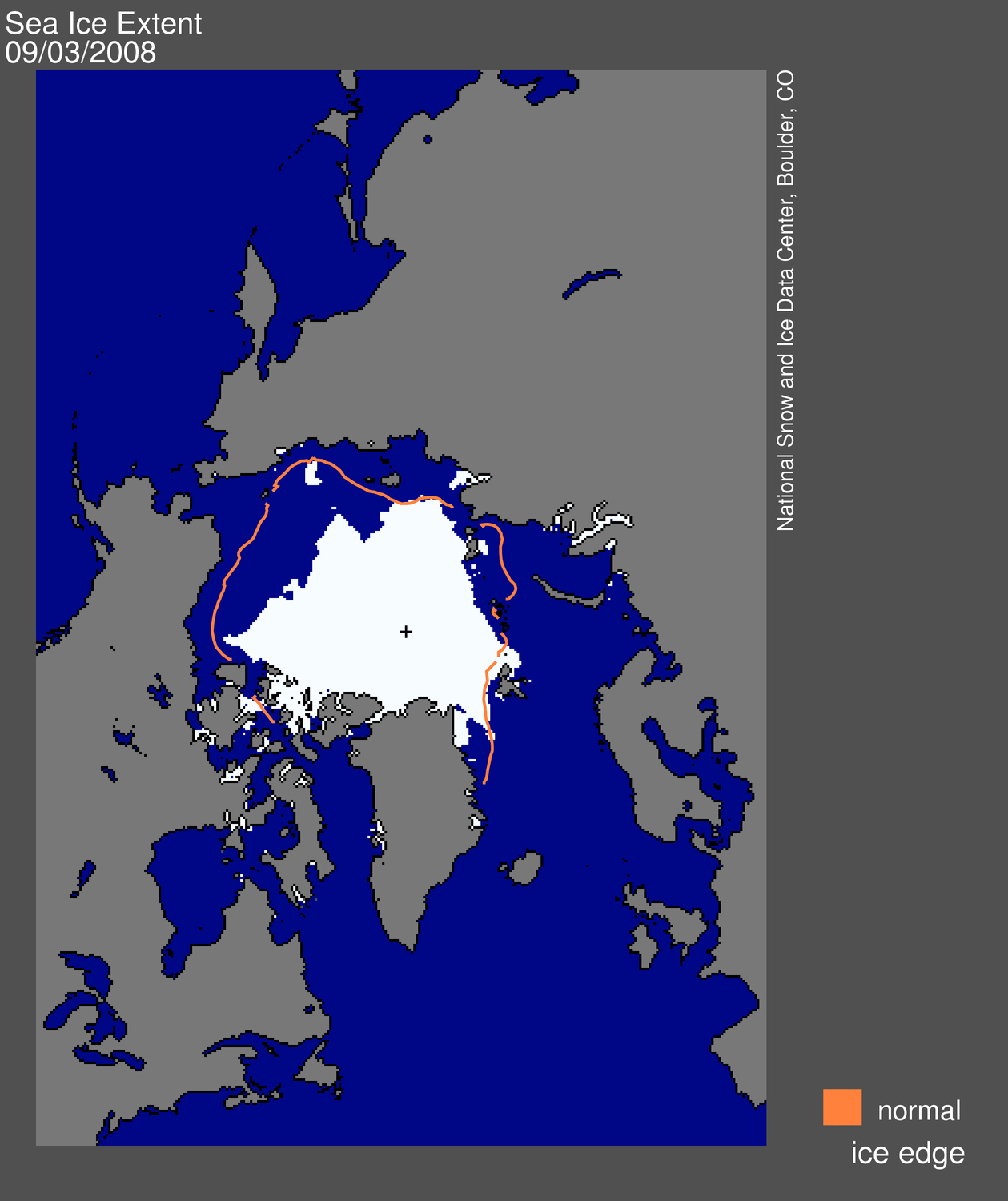
Within a few weeks, ice in the central Arctic will quit thickening and start to melt. Stay tuned. The next few weeks will be slow news.
Warmair says: (May 10, 2010 at 12:09 am) “If anyone is seriously trying to argue that the earth has not warmed up over the last 30 years . . .”
It is not clear that you are understanding the posts. I doubt any serious person questions the direction in the last 30 years. In fact, I would suggest that the trend has been going on for the last 50 or 60 years, and I do not think that you would find disagreement. In fact, if we put the figure at 200 years, you still would not find disagreement; the “evidence is overwhelming.” But that evidence gives little support to CAGW. Moreover, It is not so clear that we are warmer now than 80 years ago; certainly raw data from the Arctic, Antartica, rural United States and other non-urbanized areas suggests that the 1930s had warmer summers than now. I am cautious about taking that last observation too far, but I would be even more cautious about equating the trend of the last 30 years to CAGW.
Sorry not relivant to this post but at Sunday roast this weekend my mum and dad couldn’t stop laughing when i told them that guberments had found a way to tax thin air. They said “Don’t be stupid” and i said “If it was only that easy”.
Barefootgirl,
Yawn,
Nice troll, very little actual scientific content.
Steve used a lot of actual scientific content in his post. If you are going to try to contractict what he is saying and give us your “doomsday scenario” you will have to do A LOT better than that.
Phil.
The NSIDC servers have been available all weekend. The graphs have not been updated and have no disclaimers attached.
http://nsidc.org/data/seaice_index/images/daily_images/N_timeseries.png
Warmair asks: What ever happened to the America that lead the world ?
Exactly. America has fallen prey to the same illness that is pretty much worldwide: the CAGW/CC scare, due to bad science and outright lies driven by politics, greed, the MSM, and various and sundry NGOs, carpetbaggers, swindlers, and useful fools.
But, we haven’t gone down the tubes yet, so there is still hope. That is where sites like this come in. Read and learn – that is exactly what more and more people are doing, which is why the Alarmist ideology is being rejected.
While the Catlin “explorers” are earnestly trying to kill themselves, their leader seems to be enjoying life like never before:
According to the LA Times [ http://articles.latimes.com/2010/may/08/home/la-hm-hotprop-20100508 ]:
“Indisputable: Gore buys Montecito villa
He and Tipper paid $8,875,000 for the home.
May 08, 2010
In a move that critics may cite as his own inconvenient truth, former Vice President Al Gore and his wife, Tipper, have added a house in secluded Montecito to their real estate holdings.
The couple spent $8,875,000 on a gated ocean-view villa on 1 1/2 acres with a swimming pool, spa and fountains, according to real estate sources familiar with the deal. The Italian-style house has high ceilings with beams in the public rooms, a family room, a wine cellar, terraces, six fireplaces, five bedrooms and nine bathrooms in more than 6,500 square feet of living space.”
Bruce Cobb
That is true, however it seems that there is plenty of money financing these fools, because they insist everyday and everywhere, through all media, that, for example, water will run out, will be exausted, etc.etc.
If “they”want to impose on us a global government, why don´t do it without resorting to all this stupidity?; they got the means, the organization (United Nations), etc.,etc.
The whole issue has gone too far and the problem is that if the US falls, all the rest of countries will fall almost inmediately in their hand.
Could you imagine how would it be such a world?. They have already suceeded in implementing a lot of world regulations, from the ILO to WHO, WTO, etc. A real free world should stop all these binding agreements signed without the authorization of the peoples of the world.
Gail Combs said:
“Or more bluntly there is no mathematically significant change period.”
——–
I disagree completely. To suggest that there has been no significant change in the Arctic over the past 30 years is to put blinders on– perhaps politically and philosophically motivated blinders, which are the worst kind and hardest to get rid of.
I could have informed them, that at this time of year, it is rather ‘brass monkeys’ in the Arctic, what is the reason for this daft expedition?
I have a suggestion for a new law;
“If anyone travels over land to reach one of the poles just for propaganda purposes, it is not allowed to rescue them using any kind of transportation using fossile fuels for their propulsion”.
Reason;
We dont want to increase these persons carbon footprints just for marketing purposes for the nuclear industry.
Well if you look at that complete arctic tent village they have laid out there on their web page; it’s no wonder it takes them so long to get anywhere. If you can imagine having to disassemble that whole place every morning; pack it up on the “sledge” (haven’t seen that word in decades), and then trying to drag all that crap to the next spot on the ice, and then re-assemble the whole damn village so you don’t freeze your butt off during the night. Oh I fogot; they don’t have regular day night like we do.
When your car stalls in a puddle of water; you never try to push it out of there; specially in your panty hose. There’s a reason why your car is sitting in a puddle of water; hey it’s at the bottom of a hill you idiot ! Unless you can lift a good fraction of your car’s weight; just call a friend to tow you out of there.
Maybe if you send the camera crew home; you wouldn’t have to be hauling so much crap over the ice bumps.
As for the highly acidic arctic; I thought it was only the oceans that were acidic. The ice would have expelled both the salt, and the CO2 when the sea water froze; so there wouldn’t be much carbonic acid in the ice. Maybe we could guess that the arctic ocean might be colder than the Antarctic, since it is closer to the pole; mostly, and wouldn’t that colder water dissolve even more CO2, that the Antarctic peripheral water do ? Well it’s just a thought; I’m just ruminating here.
Got a long way to go to break through that magic 7.0 barrier to get you to acidity though; good luck on that Catlin. Are they filming this for “Are you smarter than a Fifth grader ?”
I just checked the official Catlin site for the first time this year and noticed some major differences from 2009. The research section focuses predominantly on ocean acidification with less discussion of sea ice loss. Furthermore, there is no link to the data archives.
Last year the expedition’s stated goal was to measure Arctic ice thickness and establish a baseline for future measurements. However, beyond speculative commentary in the press, we never got to see any of the data. Moreover, this year they changed their route, so any baseline measurements from 2009 would be meaningless.
Have they abandoned the quest to proove the Arctic is melting? Is ocean ‘acidification’ the new, trendy ecological threat to the Arctic?
Mike A. says:
May 10, 2010 at 8:02 am
I’m sure there are fluorescent bulbs in the chandeliers, though.
Gary Pearse says:
May 10, 2010 at 6:03 am
“The pallid exploits of the Catlin kids sure enlarges the giants of polar exploration of the past couple of centuries. I hope and trust history won’t list them along with Amundsen, Scott, Nansen, Frobisher…”
The only way the Catlin Survey will be remembered one or two years after their final expedition is if they die. Their only other hope for going down in the history books is as an object of ridicule. It sure won’t be for their “science.”
(C’mon. Admit it! Their exploits are a hoot to follow. Lot’s of purple prose reporting of their exploits, eh?)
Back in the days of Indulgences paid for by the penitent to get out of Purgatory,
the world got the Sistine Chapel. Now for our Carbon Sins Al gets a new house and an
overhaul on the Gulfstream….
“”” anna v says:
May 9, 2010 at 9:30 pm
barefootgirl says:
May 9, 2010 at 7:32 pm
Instead of actually reading observational reports of thin ice and leads forming, of ice being thinner this year than last, of the change in slope during the last week showing the ice getting closer to the 2007 line, you completely ignore these facts and falsely state a relationship between SSTs outside of the Arctic Basin to this summer’s upcoming ice loss.
Sad, very sad.
What, if not sad, declares ignorance of basic physics is that the air temperatures in the arctic basin are still much below the ice melting point. Have a look at what is displayed also in the sidebar : http://ocean.dmi.dk/arctic/meant80n.uk.php
Elementary knowledge of physics tells us that the ice cannot be thinning due to air temperatures, and elementary logic tells us that (ignoring volcanoes) ocean currents are melting the ice during this season, ocean circulation, because if there were no water circulation the water underneath the ice would keep the ice/water temperature point and there would be no thinning.
Therefore SSTs outside the arctic basin have a large role to play . “””
Come now Anna, you’re not going to drag real science into this are you ? Hey if they can melt the snows of Kilimanjaro at sub zero temperatures; surely having sub zero air temperatures is just a minor inconvenience when it comes to melting the floating Arctic ice.
I have a “please try this at home” experiment for barefootgirl to try; should be very illuminating.
You need a thermometer, that can read temperatures around zero deg C, and you need a stop watch. Then you have to find yourself a “laboratory” that meets the following conditions:-
You have to find a lake, that has floating ice on it that is pretty stable, neither melting nor freezing; and out of the wind so there is no chill factor. The experiment has two sections; which should be performed at night so there are no extraneous energy sources present.
Section one; check the air temperature near the lake shoreline to see that it is at zero deg C and no measurable wind. Strip off all of your clothes, and start the stop watch, while you stand on the shore of the lake. Time how long it takes you to freeze to death; or alternatively get to the point where you decide to quit. Stop the stop watch and record the total elapsed time.
Section two calls for you to repeat Section one exactly; except for one slight detail; before you start the stopwatch to time the experiment; why don’t you go and jump in the lake !
Don’t forget to record the elapsed time for the second experiment.
R. Gates says:
May 10, 2010 at 8:41 am
A minor technicality. There has been no net change in global Sea Ice the last 30 years.
As for ship passage in the Arctic, the Russians still have to provide big Icebreaker ships, and they have been doing this a lot longer than 30 years.
What is the big deal: Did we lose another cruise ship to an Iceberg? N.H. ports choked with ice and out of commission?
Nope. 3 stooges went up ‘There” again, trying to find Gilligan’s Island.
South Pole Has Warmest Year on Record
http://news.yahoo.com/s/livescience/20100510/sc_livescience/southpolehaswarmestyearonrecord
Here is an interesting comparison I just found between 2007 and today:
http://arctic.atmos.uiuc.edu/cryosphere/IMAGES/ARCHIVE/20070509.jpg
http://arctic.atmos.uiuc.edu/cryosphere/NEWIMAGES/arctic.seaice.color.000.png
“What, if not sad, declares ignorance of basic physics is that the air temperatures in the arctic basin are still much below the ice melting point. Have a look at what is displayed also in the sidebar : http://ocean.dmi.dk/arctic/meant80n.uk.php”
That is a result of a computer model, for average temperature north of 80 degrees lat., you realize?
Enneagram says:
May 10, 2010 at 9:50 am
“However, this April, the South Pole Station recorded an unseasonably early 22 minute dip below 100 F. “
We’re still in panic mode in Illinois because April was the warmest on record…nothing in the news about the abrupt halt in corn growth due to the FRICKIN COLD WEATHER
Smokey says:
May 10, 2010 at 5:39 am
Smokey, you are the one talking about CO2 here, not me. I’m talking about the state of the ice cover and this post that is not even close to explaining the real situation in the Arctic. The fact that you bring a discussion about ice conditions to CO2 and the null hypothesis proves you have no scientific knowledge of the situation of the ice cover, and you are simply wanting to argue for the sake of arguing rather than staying focused on the discussion at hand.
I think WUWT could do a real service to the sea ice community by spending some time intercomparing the different sea ice algorithms and compare them to observational data, visible satellite data, NIC ice charts, etc. to see which institution is given the best representation of the Arctic ice cover. You can also spend time with inter-sensor calibration to make sure the sea ice record shows no biases during sensor changes. That would be extremely valuable.
And I’m in Hawaii, so no cold feet for me (to whoever said that)
George writes that air temperatures cannot cause the ice to thin? Really? So when temperatures go above freezing and the ice starts to melt, that doesn’t thin the ice? Hmmm…and when melt ponds form on the ice surface and absorb more solar radiation than the surrounding (white) bare ice, they don’t further the melting of ice?
Like I said there are MANY factors that determine the thinning of the ice cover.
But let’s summarize a few things for you:
1) air temperatures show warming in all months/seasons in the Arctic. Your own Steve Goddard even showed a post recently of UAH temperature trends and they were all positive (in case you don’t want to believe what science papers are saying, or surface obs, or reanalysis data sets, etc.).
2) melt onset is starting earlier in the Arctic and freeze-up is starting later, so the total melt season is extending which means more time to thin the ice to less time to grow the ice.
3) buoy observations and ocean temperatures have shown increases in pulses of warm water into the Arctic.
4) circulation patterns have shown predominance of a Beaufort Sea High in recent summers, combined with a low over Siberia which helps to advect ice away from the coasts towards the pole, further warming the SSTs and enhancing lateral and bottom melt.
5) 1990s saw a loss of much old ice from the positive winter AO state, helping to lead to thinner spring ice conditions in the 2000s. Thinner ice is important as it allows for open water areas to develop earlier in the melt season, enhancing the positive ice-albedo feedback. Thinner ice is also more vulnerable to the winds, so in 2007 when you had the Arctic dipole pattern set up, a lot of ice was lost, whereas when it happened in the 1970s you didn’t see such a large ice loss. During a thicker ice regime, you can have an anomalously warm summer and see a large loss of ice volume, but it won’t translate into a large change in extent because the ice is thick enough to survive. In a thin ice regime, the same anomalous summer will result in large changes in extent.
George, I’m sorry but the experiment you suggest is not relevant to the situation occurring in the Arctic…
barefootgirl May 10, 2010 at 11:09 am,
I was simply responding to your not too friendly comment to anna v and me @12:34 am. I understand that you don’t like the fact that natural variability explains the climate better than AGW, but that’s where the evidence leads. The current climate is well within its long term parameters, and Arctic ice cover has always fluctuated cyclically, as shown here.
The entire AGW hypothesis has morphed into the CO2=Catastrophic AGW
hypothesisconjecture. What do you think all the claptrap about “carbon” is about?If you will admit that there is no testable, measurable evidence that a tiny trace gas drives the climate, and that the whole “carbon” bugaboo is in reality a scheme to tax the air, then we’re on the same page.
Otherwise, CO2 is part and parcel of every global warming discussion, whether it is specifically mentioned or not, and any attempt to avoid that fact is just another attempt to move the goal posts.