By Steve Goddard

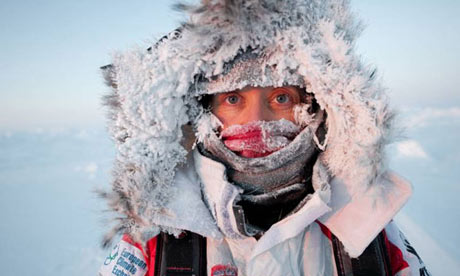
Guardian photo : Ann Daniels Enjoying The Warming Arctic
Yesterday, WUWT reported on a University of Melbourne study claiming that melting ice is behind the warming of the Arctic.
“Findings published in Nature today reveal the rapid melting of sea ice has dramatically increased the levels of warming in the region in the last two decades. The sea ice acts like a shiny lid on the Arctic Ocean. When it is heated, it reflects most of the incoming sunlight back into space. When the sea ice melts, more heat is absorbed by the water. The warmer water then heats the atmosphere above it.”
If this were true, we would expect to see that months with the most ice loss would also show the most warming. In fact, we see the exact opposite. As you can see in the graph below, most Arctic warming from 1979-present has occurred in the winter and spring, with very little warming during the summer.

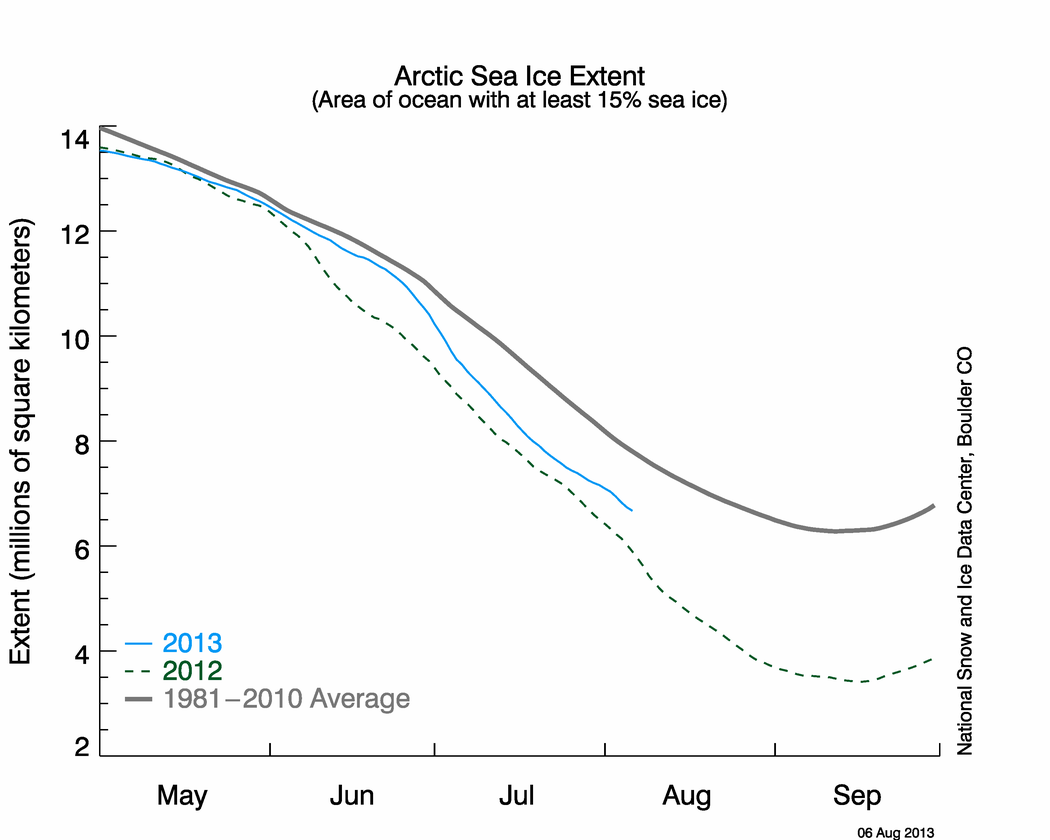
By contrast, ice extent trends over that same time interval show that ice loss has occurred mainly during the summer. It appears that the relationship between warming and ice loss is inconsistent with the claims in the University of Melbourne study. Temperatures have increased the least during times of year when ice loss was the greatest.

April is the month which has warmed the most, a full seven months after September – the month of peak ice loss. There is very little variation in ice extent year over year during April – except for this year which is running well above any other recent years.

http://ocean.dmi.dk/arctic/icecover.uk.php
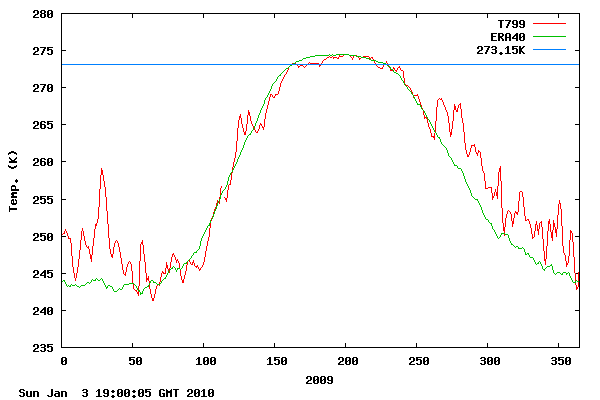
A couple of other familiar graphs showing the same issues can be seen below. Note in the DMI graph below that Arctic temperatures have not warmed at all during the summer in the central Arctic.

In the Cryosphere Today graph below, you can see that most ice loss has been during the summer, when there has been little or no temperature gain.


The scatter plot below shows Arctic temperature trends vs. the absolute value of ice extent trends, for all 12 months. Note that there is no meaningful correlation between temperature trends and ice loss. In fact, the months with the most increase in temperature seem to be the ones with little ice loss.

The article claims
” Strong winter warming is consistent with the atmospheric response to reduced sea ice cover.”
But this is inconsistent with the fact that there has been very little reduction in winter ice cover. The temperature of water under the winter sea ice is fixed by thermodynamics at -2C down to a depth of tens of metres, and does not vary from one year to the next. Furthermore, the rate of heat transfer through 2-5 meter thick 99+% concentration ice, is very low. NSIDC is currently showing ice extent right at the 1979-2000 mean, and above the 1979-2009 mean – yet temperatures in the Arctic have been well above the mean all through the spring. How is the heat escaping through all the thick, high concentration ice?

http://ocean.dmi.dk/arctic/meant80n.uk.php
The article also claims :
“reduced summer sea ice cover allows for greater warming of the upper ocean….The excess heat stored in the upper ocean is subsequently released to the atmosphere during winter.”
There is a major problem with that theory. The summer minimum occurs at the autumnal equinox when the Arctic is receiving almost no SW radiation, and that which is being received is well below the critical angle of water. By September, the shortage of insulating ice cover is actually causing a net loss of heat from the ocean. NSIDC explains it like this:
“In the past five years, the Arctic has shown a pattern of strong low-level atmospheric warming over the Arctic Ocean in autumn because of heat loss from the ocean back to the atmosphere. …. As larger expanses of open water are left at the end of each melt season, the ocean will continue to hand off heat to the atmosphere.”

In other words, loss of summer ice should produce atmospheric warming in the autumn, but not in the winter and spring when ice is cover is normal or near normal.
Two years ago, WUWT published this article after review by Walt Meier at NSIDC, Roger Pielke Sr. at CU, and Ben Herman at the University of Arizona. It explains why changes in ice cover probably are causing a net cooling effect. None of the reviewers had any substantive disagreements with the conclusions.
Conclusion: The University of Melbourne study claims are not supported by the available data. The authors seem to have jumped right into statistical analysis without proposing a physical mechanism that works. Heat flows across differences in temperatures, yet the winter water temperature under the ice is fixed at -2C. Thus elevated winter air temperatures should actually cause a reduction in heat flow out of the ocean. Whatever is driving increases in winter Arctic temperatures is not heat coming out of the Arctic Ocean, which is covered with insulating ice.
A more logical conclusion would be that the decline in ice thickness is associated with warmer winter temperatures.
If scientific reasoning were limited to the logical processes of arithmetic, we should not get very far in our understanding of the physical world. One might as well attempt to grasp the game of poker entirely by the use of the mathematics of probability.
– Vannevar Bush
BTW..here is a nice MODIS image of the Bering Sea
http://www.arcus.org/search/siwo
And here I thought that melting ice took energy input… 330-odd kJ/Kg IIRC
stevengoddard says: April 30, 2010 at 12:20 pm
Have you seen today’s NSIDC graph?
http://nsidc.org/data/seaice_index/images/daily_images/N_timeseries.png
Excellent! Now we are looking forward to a powerful Katla eruption that may possibly follow after Eyjafjallajökull eruption and earthquakes and then trigger the next (little?) ice age…
http://translate.google.co.uk/translate?hl=en&sl=is&tl=en&u=http://www.ruv.is/frett/skjalftavirkni-naerri-siglufirdi
Speaking of the Arctic, I am starting to think that I live there. This winter is about to pass it’s seventh month in Colorado, with no end in sight. I took this picture yesterday while cycling to work.
https://docs.google.com/Doc?docid=0AXKz9p_7fMvBZGR3ODJ3d3NfNjIzZGZxNGZ3aG0&hl=en
R. de Haan
I agree with Icecap about the PDO, and brought it up in a WUWT Q&A with Walt Meier in 2008. He didn’t believe it, but I think the idea is correct.
I want a magic predictamo-thingy like R. Gates has! I hope it works for lottery numbers too. It’s especially cool because it allows predictions based on feelings.
By the way, R. Gates, heat is released FAR more readily from open water than from under ice of any thickness. By that metric it is obvious that watching the Arctic ice cover is like watching a major portion of the global thermostat mechanism in action.
In our post-normal era, it’s the theory that drives the science, not the science that drives the theory. That’s how we’re getting so much objectionable science.
A couple of things to consider here:
1. The sea water is cold, close to 0 °C, so the air temperature near the open water, will stay not much about freezing during the summer anyway. So I think it would be more correct to look for changes in the sea temperature caused by the lower albedo.
2. It’s cloudy over open water in the arctic most of the time during summer anyway. Clouds should give a similar albedo. Even if there are few high clouds, a thin layer of fog just above the water is pretty common due to the cooling effect of the water especially at the very high latitudes.
useful stuff Steve – much appreciated, I agree – I can’t see the sun warming the ocean much after September 15th maximum sea ice loss because of the angle, and as the season turns, the exposed water will cool rapidly – I think the main temperature patterns are determined by winds, and these by whatever determines the shift (oscillation) of the high pressure/low pressure vortices and the strength of those winds, all of which affect currents below and clouds above – Arctic cloud increased by 14% from 1980 to 2000 and I think it then declined – and the strength and direction of the Beaufort Gyre is a crucial factor in the ice-dynamic – we have to look to what is driving the oscillations – and like Ulrich, I think it is likley solar and magnetic.
There is a major problem with that theory. The summer minimum occurs at the autumnal equinox when the Arctic is receiving almost no SW radiation,
Just a note here. They say “reduced summer sea ice cover”, this doesn’t imply that the ice is at it’s minimum. Having said that though, the annual extent bands narrow during the melt and I doubt the difference would add much to the ocean heat content. If it did then it should show up in the North Atlantic and it doesn’t.
North Atlantic
I would like to see the ice loss values for each December, January and February
compared to Sudden Stratospheric Warming events. The 1990`s only had 2 SSW`s.
http://www.appmath.columbia.edu/ssws/index.php
Enneagram April 30, 2010 at 12:41 pm
“And what about these geomagnetic field changes caused by changes in the “solar wind”, forbush decreases,etc.?”
Difficult to say but there appear to be a certain correlation (accidental or causal who knows?).
http://www.vukcevic.talktalk.net/LFC9.htm
R. Gates says:
April 30, 2010 at 12:04 pm
First, do you have a citation showing how much heat is released, and when it is released, from the warmer water? Because in other parts of the planet, the lag is usually on the order of a month or two. For example, the peak insolation in the Northern Hemisphere is in June. The warmest month, on the other hand, is July or August. Here’s the lag by latitude:

Note that further north, the lag is less. And nowhere is the lag three months.
Second, if what you say is true, what is causing the warming in April?
Third, if what you say is true, why is January warming so little?
Fourth, the real mystery is September and October. True, there is generally a lag in the peak of the energy release. But that only pushes the peak a bit later, it doesn’t mean no warming during the peak month. The month of greatest heat gain is not far down on the temperature list, because when the ocean warms it immediately begins to lose more heat. So why is September and October not warming? Is it your claim that the heat is absorbed in September but hardly radiates at all, stays hidden for three months, and then comes out when the area is covered with ice in December? I don’t think so …
Steve, nice post. I started one after seeing the article, because the claim looked bogus on the surface, it didn’t pass the laugh test. But your post is much better than mine was turning out to be.
Willis ,
Thanks. Much appreciated.
Vuk seems closer to the “primum mobile” with his relation to GMF. If this GMF also relates to other variables, then thay way would take us nearer to real causes and not just chatting on how much or little ice…
A rotating charged body will produce a dipolar magnetic field. Scientists discard this simple explanation because it is calculated for the Earth that the moving charge would have to constitute a current of a billion Amps, which implies a tremendously strong electric field at the Earth’s surface. But this simple electrostatic argument fails in a plasma environment. The electric field at the Earth’s surface reflects merely the difference in voltage between the Earth and its plasma sheath at the magnetospheric boundary with the solar wind. Like a bird sitting on a high-voltage transmission line, we are unaware of the electrification beneath our feet
Wallace Thornhill
Where is it the origin of climate?
kadaka,
I keep waiting for that big oil paycheck, but they are busy dumping all their oil into the Gulf of Mexico right now – as a thank you to Obama for opening up some offshore drilling last week.
They are talking as if the ocean under the ice was a closed system. The water circulates around the globe. But even when the water manages to get out and being exposed to open air, most likely that water will still be cooler than the air (assuming that the air is warmer than the ice (thus- the melting), the water would not give its “heat” up to the air. The air would actually be cooled down, else it violates the zeroth law of thermodynamics.
In the case of melting ice, again if ice was to give up its heat during the process it means that I could make hot tea by simply throwing a bunch of ice cubes in a cup… never seen that! It would gain violate the law of entropy.
Then, again… it’s not the first time that we see Miss Science being violated by global warmists.
“Ulric Lyons says:
April 30, 2010 at 1:19 pm”
Correction: major SSW`s.
http://www.geo.fu-berlin.de/en/met/ag/strat/produkte/northpole/index.html
LOL. Seriously. It took a moment for that photo of “Ann Daniels enjoying the warming arctic” to pop up as I was reading the headline and I did laugh out loud. Really appreciate the humor/sarcasm that is part of this site. Thanks Steve or Anthony for adding that perfect icing on this cake.
Now I guess I better read this article and the always informative and interesting comments.
MartinGAtkins says:
April 30, 2010 at 1:02 pm
Martin, you can look at the heating of Arctic SSTs here (http://www.arctic.noaa.gov/report08/ocean.html) from the retreat of the ice cover.
Yes, the Ocean does absorb the heat from the sun everywhere on the planet. What the study is looking at is the “change” in near surface atmospheric temperatures related to a decrease in sea ice (and hence an increase in open water). In the North Atlantic you don’t have this strong trend in more open water do you? But you do in the Beaufort, Chukchi, E. Siberian and Laptev seas.
Also, go to NCEP’s interactive web site and you can for yourself compute anomalies in latent and sensible heat fluxes, atmospheric water vapor, precipitable water content, etc. and see the heat transfer for yourself.
Good post Steven, I appreciate that you and others who post here take the time to stay on top of all this. Here’s what it looked like outside Carbondale, CO 1100hours on 4/29, at 6600 ft, a little higher than you:
http://i44.tinypic.com/vqifm0.jpg
R. Gates says:
April 30, 2010 at 12:04 pm
Nice post Steve, except I think your logic is flawed. Low summer ice means more warming of the water, and that heat is not released until later in the season.
I have no problem with the premise of the paper. The question is, is the heat gained by the ocean significant and is it long lasting. As I understand things the very low 2007 extent was caused primarily by wind dispersal. Certainly it took a long time for the extent to recover so it’s reasonable to assume that sea temperature retarded refreezing.
As more ocean was exposed during early refreezing it’s also reasonable to assume that there was an increased loss of heat gained during the previous summer. Indeed when the refreeze reached November it excelerated and caught up with the extent in previous years.
Willis Eschenbach says:
go to NCEP’s web pages and look at the sensible and latent heat fluxes for yourself. Remember the basic energy balance equation reads:
Net radiation = net solar + net longwave
The available net radiation is used to do work in the Earth-atmosphere system, i.e.
Net Radiation = sensible heat flux + latent heat flux + subsurface ground heat.
A book by Oke 1987 can provide you with the basics.
Willis,
You asked “So why is September and October not warming?”
Because there isn’t much solar energy being received and the radiative energy balance is strongly negative.
Interesting post.
I have a minor question, which I’m sure someone can sort out for me. The main objection against the paper seems to be “If this were true, we would expect to see that months with the most ice loss would also show the most warming. ”
I understand this if we assume that the transfer of energy at all time goes from the sea to the atmosphere, because an ice cover insulates. This assumption seems to be valid during winter, where we do see a strong warming, but how do we know that it is also valid during the summer months? Wouldn’t less ice cool the atmosphere, and warm the water during summer?