By Steven Goddard

Break out the Speedos and Bikinis. Springtime has finally arrived in the Arctic!

Temperatures have risen about 15C, and are now averaging a balmy -15C (5F) north of latitude 80N – with sunshine 24 hours a day. Under those conditions, you can get frostbite and a tan at the same time.

http://ocean.dmi.dk/arctic/meant80n.uk.php
But despite the balmy weather, NORSEX ice area continues to run above the 1979-2006 mean – as it has for the entire month of April.

http://arctic-roos.org/observations/satellite-data/sea-ice/observation_images/ssmi1_ice_area.png

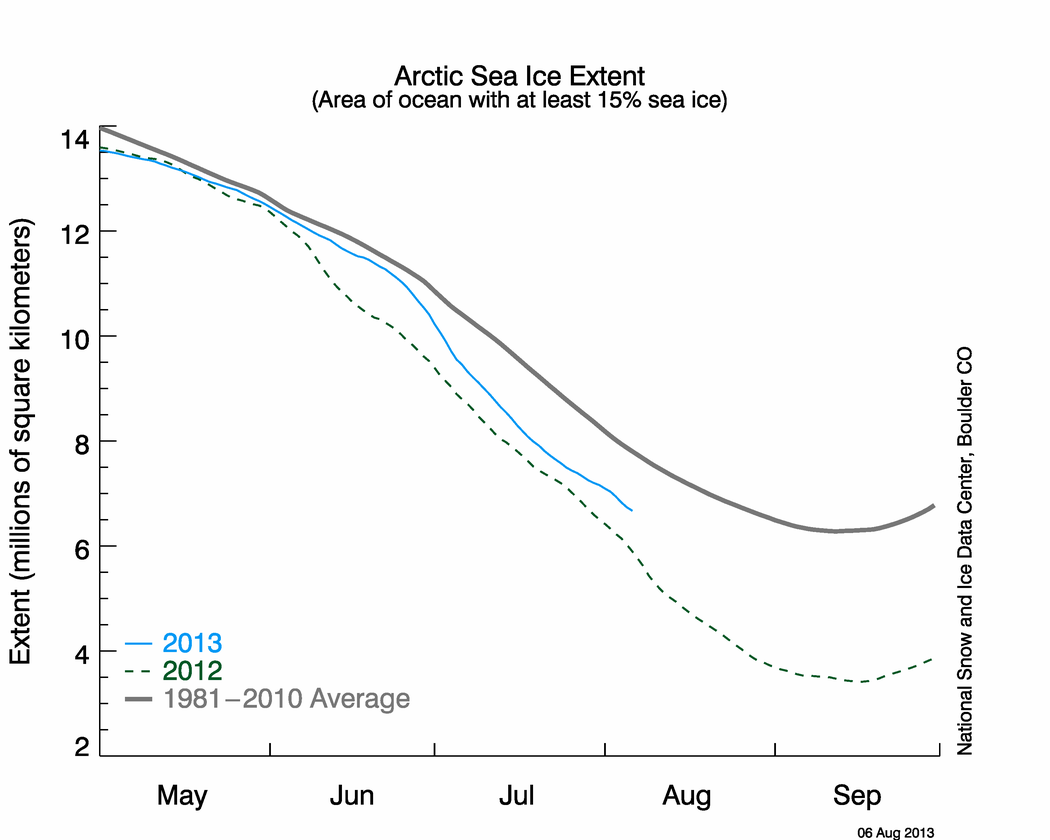
Since the melt season started, the Arctic has lost about one million km2 of sea ice. Below is a composite graph showing all of the popular (NSIDC, JAXA, NORSEX, DMI) extent measurements, superimposed on the NSIDC mean and two standard deviation region. The thin blue line is NSIDC extent from 2009. Note that all measurements have been nudging up against the mean line – for the entire month of April.


Disclaimer: All maps below are taken from NSIDC maps, and modified by the “breathtakingly ignorant” writers at WUWT.
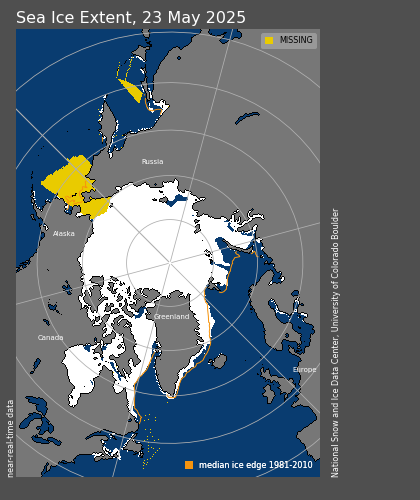
During the last three weeks ice has melted mainly at lower latitudes, as seen below in red. Areas in green have actually increased in extent, due to drift. Ice is probably still getting thicker in much of the Arctic, because temperatures remain well below freezing.

The map below shows changes over the past week.

And the map below shows changes since the same date in 2007. Green indicates ice growth.

The next map shows current areas of deficient ice (relative to the median) in red, and excess ice in green. The total amount of excess minus deficient ice is close to zero. In other words – Arctic ice extent is normal.

The Arctic Oscillation remains negative, so circulation is clockwise – as seen below in the buoy drift map. This pattern is keeping older, thicker ice from the Canadian side inside the Arctic Basin, and bodes well for another summer of increased ice thickness and extent – relative to the record melt of 2007.


http://iabp.apl.washington.edu/maps_daily_track-map.html
People counting on bad news from the Arctic to keep their agenda alive are staring at a long, (rhetorically) cold summer……. The good news is that they can keep raising the red flags about Montana glaciers, if the Arctic refuses to melt.
It has now been over 41 years since the New York Times headlined “Expert Says Arctic Ocean Will Soon Be an Open Sea.” triggering the Arctic Death Spiral. After 41 years of dangerous and increasing melt, ice area is again above normal.
My failure to understand this is surely a sign of “breathtaking ignorance.” But don’t call me Shirley.
jeffbrown:
You never answer my questions. Typical of closed-minded alarmists. Your mind is made up and shut tight.
This is a typical record of GISS “raw” data: click
If you believe that diddling with the raw data like that supports your CAGW, you will believe anything. And it is clear that you believe anything that your guru, Al Gore, says.
Start thinking for yourself. And start providing raw, empirical data to back up your opinions. Everyone’s got a cake hole. But data is what counts.
jeff brown
The Arctic minimum occurs in September when the sun is barely above the horizon. It has minimal effect on the radiative balance. During April-July, when the sun is up high in the sky, there is little year over year variation in ice area.
Leif Svalgaard says:
April 28, 2010 at 11:29 am
David Ball says:
April 28, 2010 at 11:03 am
“Careful, Leif, you have admonished others for using anecdotal evidence. Some have claimed that Canada had a “warmer than normal” winter. If I said it was not “because I come from there” what would your response be to that? Good for the goose and all that, ……”
I’m always careful. so I provided detailed evidence as well: “Leif Svalgaard says:
April 28, 2010 at 11:06 am”, but a report from my daughter-in-law [in Denmark] who is a meteorologist/glaciologist I rate a bit above ‘anecdotal evidence’
Here’s a MODIS shot from a few days ago showing the iceless Danish islands
http://rapidfire.sci.gsfc.nasa.gov/realtime/single.php?A101151225
Pamela Gray says: April 28, 2010 at 9:38 pm
“The trend is nothing more than a statistic, entirely made up of weather noise”
Noise has a zero mean. The probability of a trend being generated randomly from noise becomes smaller and smaller as the trend persists. If this were a purely statistical exercise we could read a few books and calculate probabilities to our heart’s content. What would be missing though is recognition of the fundamental physical driver for the observed behaviour.
Smokey says:
April 28, 2010 at 9:24 pm
“The North Pole has been ice free in the recent past — so what made it freeze up again? CAGW? Really, could you red-faced arm wavers possibly be any more unconvincing? The climate changes, see? Always has, always will. But of course, you don’t see. Cognitive dissonance: the flying saucers didn’t arrive on schedule, so you just reset the date of arrival, never considering the possibility that the flying saucers [CAGW] exist only in your imagination. In reality, all you are seeing is normal climate variability.
Like the King of the Cherrypickers, R. Gates, you also turn a blind eye to the one-half of the planet that doesn’t fit you preconceived notions. The Antarctic isn’t following your cherry-picking globaloney script, so it is completely ignored. You don’t see a problem with ignoring half the planet?
The ice extent in the Antarctic is above its 30 year average, and the Arctic is rapidly recovering from its recent lows. The fact that what we are observing is natural climate variability whizzes right over your heads. You don’t even understand the concept of the null hypothesis, or the fact that your CO2=CAGW hypothesis has been repeatedly falsified, not least by the planet itself.”
Good points Smokey, I think you’ve hit the nail on the head.
CAGW alarmists are like members of some weird religious sect who still believe in their imaginary god even after ‘the end is nigh’ dead-line issued by their prophets has passed. You would have though the SH anomaly would have killed the scam!
CO2 is indeed a strange and remarkable gas which can melt the northern hemisphere ice, while not affecting ice in the southern hemisphere!
I think “our side” ought to request funding for a study to clean up and revise downwards these earlier, flawed satellite ice-estimates. It mightn’t be that hard to do, at least within an error-bound. It would be a good talking point to harp on until it occurs.
Check this out:
http://wattsupwiththat.com/2010/01/11/antarctic-sea-water-shows-no-sign-of-warming/
Also check this out:
http://wattsupwiththat.com/2010/02/16/greenland-glaciers-melt-due-to-sea-current-change-not-air-temperature/
Ammonite, white noise I know about. Used to be an audiologist and did research using white noise clicks as a control stimulus when measuring tone pip auditory brainstem responses. White noise, in its purest sense is a mathematical construct. It can be generated but it does not occur in nature. Weather noise does not, and cannot, cancel itself out. You can do better.
jeff brown says: April 28, 2010 at 8:38 pm
“Bill Illis, I’m not sure you understand that you cannot divide a climatology of ice volume by the actual ice areas for individual years. The ice volume has changed over time and you must include this if you are going to convert to mean thickness for individual years. Thus, your results are in error.”
They gave us their Ice Volume chart over time so I used that data (not the average climatology). April 1988 was 4.0M km3 above the average climatology of 28.5M km3 which equals … April 2009 was 7.0M km3 below the average which equals …. and so on.
Ammonite says:
April 28, 2010 at 11:18 pm
What would be missing though is recognition of the fundamental physical driver for the observed behaviour.
And therein lies the whole problem: the Alarmists have simply “decided” that C02, and specifically man-made C02 is driving climate. For propaganda purposes, melting or vanishing ice, no matter what the actual cause, helps the CAGW/CC “cause”, since it’s visual, and people can relate to it more easily. Thus, we have the Caitlin “expeditions” and their ilk to “prove” the ice is “vanishing” or “thinning”.
In other words, their interest is driven by PNS. They have an agenda.
The mainstream screws up again – sort of:
“Arctic warming fuelled by ice loss: scientists
Rise in temperatures in Far North twice global average”
http://www.ottawacitizen.com/technology/Arctic+warming+fuelled+loss+scientists/2963681/story.html
But read the entire article including the last two paragraphs, which don’t match the headline:
“After a spring cold snap in March, Arctic sea ice reached its maximum extent of 15.25 million square kilometres, well above the record low seen in 2006, according to the U.S. National Snow and Ice Data Center that monitors the waxing and waning of the ice.
Climate change skeptics were heartened to see so much ice form this winter, but scientists say much of the ice is thin and could melt quickly when temperatures rise this summer.”
stevengoddard says:
April 28, 2010 at 10:59 pm
Steve, you don’t seem to understand the point about heat absorption in the expanding open water areas during summer. That is where the heat is coming from in autumn.
Bill Illis says:
April 29, 2010 at 5:35 am
Bill, can you point to the link for that? Or provide the actual numbers you used in your calculations so that I can verify those?
Tenuc says:
April 28, 2010 at 11:50 pm
If you look at the Antarctic sea ice you will see the regions of ice loss and the regions of ice gain. The region of ice gain is the in the Ross Sea and this has been shown in numerous papers to be related to strengthening of winds that push the ice away from the coast, increasing new ice formation in the leads and increasing ice extent. This is related to ozone loss and the strengthening of the polar vortex. Ice in Antarctica is actually decreasing in the western Antarctic as a result of warmer temperatures. It’s important to not cherry pick and actually understand the system.
stevengoddard says:
April 28, 2010 at 8:40 am
Phil,
2007 was typified by unusual summer melt on the western side of the Arctic, and winter drift on the east. There is no evidence of either this year.
Well we haven’t had summer yet so we don’t know about the first and there is plenty of evidence of winter drift on the east. Also 2007 had an open Nares strait which allowed some of the oldest ice to drift south and melt, this year it’s open again and the impact in the Arctic appears to be greater at this date (judging by MODIS).
2007-like does not mean that 2010 will follow an identical path in any case.
stevengoddard says:
April 28, 2010 at 10:59 pm
jeff brown
The Arctic minimum occurs in September when the sun is barely above the horizon. It has minimal effect on the radiative balance. During April-July, when the sun is up high in the sky, there is little year over year variation in ice area.
However the change in ice type alone is expected to lead to a 28% increase in SW absorption.
http://soa.arcus.org/sites/soa.arcus.org/files/sessions/2-1-observations-arctic-change/pdf/2-1-3-tschudi-mark.pdf
jeff brown
The ice extent divergence occurs in the autumn, not the summer.
http://www.ijis.iarc.uaf.edu/seaice/extent/AMSRE_Sea_Ice_Extent.png
A setting sun doesn’t add much heat to the ocean.
Phil,
Hansen and others say that soot is responsible for 40-95% of Arctic warming.
“”” The Ghost Of Big Jim Cooley says:
April 28, 2010 at 11:37 am
Phil, (genuinely) have I got this wrong in my head then? Fresh water has a density of 1.0 but salt water has a density of 1.025. So salt water is definitely heavier than fresh water. So if the fresh water ice melts, how does that raise sea levels? Either I need more coffee, or I’m temporarily away with the fairies… Can someone explain? “””
Well Ghost, none of that has anything to do with it; well almost nothing to do with it. If the sea water freezes and turns into fresh water ice, that is lighter (even lighter than fresh water); well less dense to be more pedantic, the center of mass will remain at the same level (well almost). The water in the ice that is above sea level; plus the water in the ice that is below sea level, can all fit into the volume occupied by the ice that is under the sea surface.
But most of the “heat” required to melt the ice (80 cal per gram) is extracted from the surrounding sea water; not from the atmosphere; nor from the sun, so that will cool a whole lot of ocean water. Salt water of > 2.47% salinity always has a positive temperature coefficient of expansion; so cooling it will shrink a lot of water, so the se level will actually go down if all that floating sea ice melts. A British/Dutch team in mid 2006, reported from ten years of satellite observations of the arctic ocean sea level, that the se level was falling at 2mm per year in the arctic ocean; and of course we know that the arctic sea ice has been melting during that period. those researchers were confident of their data; but said they had no idea why; and they hoped that the theory would soon catch up to their data.
The theory actually stated in mid 2004, that the sea level should fall; and that was published in Jan 2005; a year and a half before they relesed their data; so it had been known for two years before they reported their results. See:- Jan 2005 Physics Today Letters. George E. Smith, commenting on Morrison’s review of Weart’s “The Discovery of Global Warming”.
Also gravity varies with altitude, so I suspect that if you examine it in more detail; you will finde that the gravity gradient changes the sea height with ice melting.
No I don’t have the foggiest idea which way it goes or how much.
Ammonite:
I am enjoying the back and forth as you seem to have a good head for science and are fairly well informed. However some of your information appears outdated. You state “The ocean is rising on the order of 3mm per year, 75% of which is due to thermal expansion.” The rate of sea level rise has now been measured very precisely using GPS CORS (Continuously Operating Reference Stations). We now know that when subsidence and isostatic rebound are corrected for, sea level is rising at a rate of 1.6 to 1.8 mm/year: http://www.agu.org/pubs/crossref/2009/2009GL038720.shtml.
This is very consistent with numerous studies of post glacial sea level rise for the past several thousand years: http://schools-wikipedia.org/images/119/11900.png.htm. Do you have more accurate and/or more recent data (no models please!) that indicates sea level is currently rising any faster than this?
Stay well informed and stick to your guns if you think you’re right.
Roger Knights: April 29, 2010 at 3:40 am
A continent over the south pole makes direct comparisons between the Arctic and Antartic fraught, so one comment from me only. Much of Antarctica is “protected” by a circumpolar current. Areas south of this current remain cold. The West Antarctic peninsula juts north of this current and has been the site of much publicised ice shelf collapses.
Try
Feb 14, 2002: “…the mid-depth Southern Ocean is responding and warming more rapidly than global ocean temperatures. According to Gille, her study appears to suggest that the cold ocean current that moves around Antarctica, called the Antarctic circumpolar current, may have shifted southward around the continent as part of the warming.”
Is Roger’s paper cherry-picked? Is mine? How do you determine truth when earnest people say seemingly incompatible things?
Ammonite initially wrote:
I responded:
He responded:
Therefore, he should have originally referred only to the antarctic peninsula, not Antarctica as a whole. He also wrote:
One factor to consider is the date of publication: 2002 (his) vs. 2009 (mine). Since 2002 the Argo buoys have been deployed and have found a flat global trend in non-surface ocean temperatures. This contradicts his claim about “the steadily warming ocean,” which certainly sounds like a global (unqualified) claim, not a local one.
Louis6439: April 29, 2010 at 11:24 am
“sea level is rising at a rate of 1.6 to 1.8 mm/year”
The figure provided above is an average across the last century. An estimate from more recent yeas is: 3.1 +/-0.7 mm/year.
Bindoff, NL et al.. “Observations: Oceanic Climate Change and Sea Level”. Climate Change 2007: The Physical Science Basis. Contribution of Working Group I to the Fourth Assessment Report of the Intergovernmental Panel on Climate Change. Cambridge University Press. http://ipcc-wg1.ucar.edu/wg1/Report/AR4WG1_Print_Ch05.pdf.
Phil. says:
April 29, 2010 at 8:23 am
However the change in ice type alone is expected to lead to a 28% increase in SW absorption.
http://soa.arcus.org/sites/soa.arcus.org/files/sessions/2-1-observations-arctic-change/pdf/2-1-3-tschudi-mark.pdf
The link is obviously a Powerpoint for a verbal presentation so a lot of information is probably missing, but looking at pg. 10 some questions come to mind. It indicates the reflectances were derived from aerial photos taken by a UAV, which would mean from a vertical azimuth that would be far from anything the ice would see from even the peak solar angles of incidence. UAVs aren’t usually high fliers so one wonders what the scale of the areas depicted in the photos are and how reflective they are of arctic ice in general. In the left photo it is a little hard to tell if the dark areas in the “first year ice” are ice or open water.
Bruce Cobb: April 29, 2010 at 6:26 am
“And therein lies the whole problem: the Alarmists have simply “decided” that C02…”
Hi Bruce. For each person, it is worth asking what level of evidence would be required give credence to the AGW case. Some feel there is plenty already. Others none at all. For me, increasing ocean heat content and net disappearance of ice globally are sure signs the earth is heating. As you rightly point out, that does not mean AGW is automatically the culprit. Perhaps it is due to changes in the sun. Perhaps it is a long term response to the ending of the last ice age, clouds, undersea volcanoes, high climate sensitivity to forcing, low sensitivity to forcing… Various assertions are routinely weighed in the scientific literature. “Alarmists have simply decided that CO2” could be re-phrased as “scientists in disparate fields have gathered evidence that CO2…”
Concerning the Guardian photo reportedly at Longyearbyen Norway, there are a few things to note, in addition to the clouds, quoting George E Smith, April 28, 2010 at 9:58 am :