By Steven Goddard

Break out the Speedos and Bikinis. Springtime has finally arrived in the Arctic!

Temperatures have risen about 15C, and are now averaging a balmy -15C (5F) north of latitude 80N – with sunshine 24 hours a day. Under those conditions, you can get frostbite and a tan at the same time.

http://ocean.dmi.dk/arctic/meant80n.uk.php
But despite the balmy weather, NORSEX ice area continues to run above the 1979-2006 mean – as it has for the entire month of April.

http://arctic-roos.org/observations/satellite-data/sea-ice/observation_images/ssmi1_ice_area.png

Since the melt season started, the Arctic has lost about one million km2 of sea ice. Below is a composite graph showing all of the popular (NSIDC, JAXA, NORSEX, DMI) extent measurements, superimposed on the NSIDC mean and two standard deviation region. The thin blue line is NSIDC extent from 2009. Note that all measurements have been nudging up against the mean line – for the entire month of April.
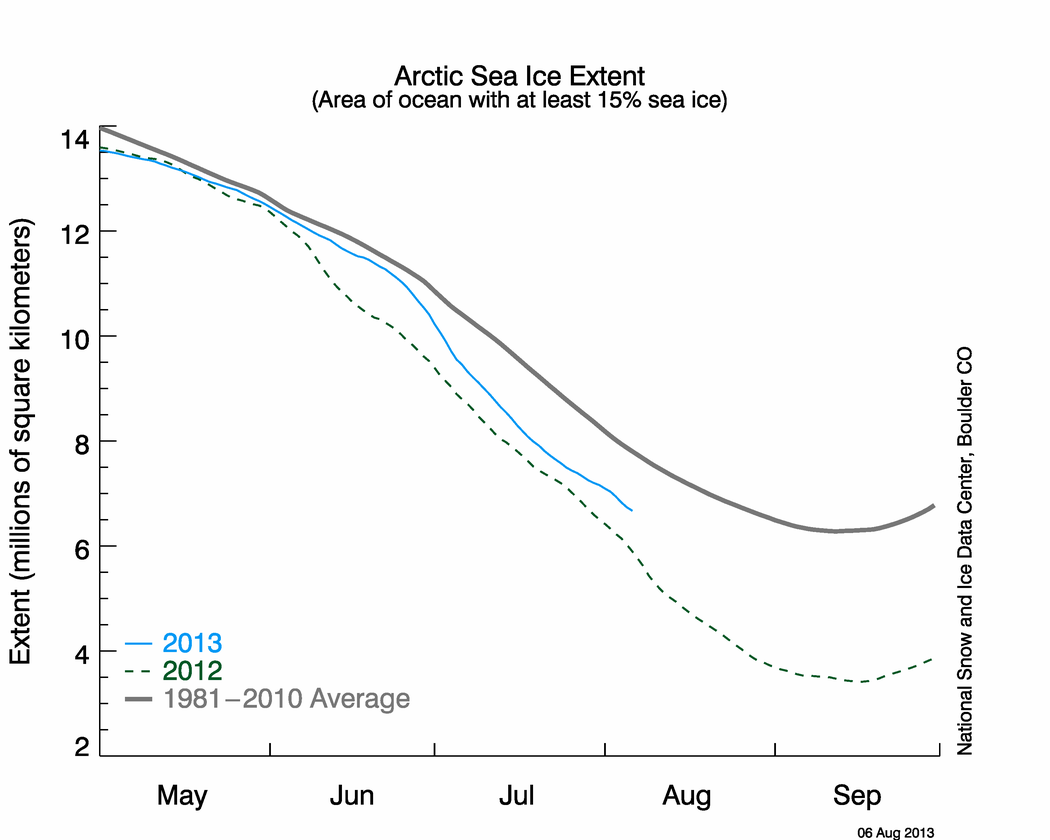


Disclaimer: All maps below are taken from NSIDC maps, and modified by the “breathtakingly ignorant” writers at WUWT.
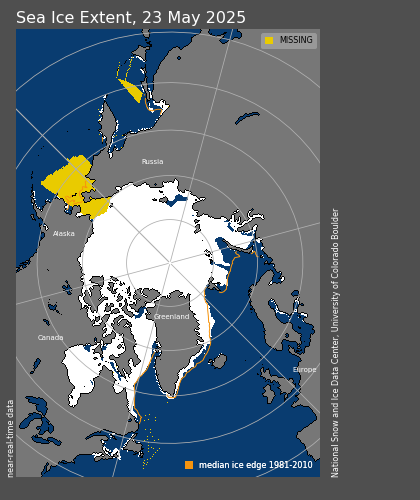
During the last three weeks ice has melted mainly at lower latitudes, as seen below in red. Areas in green have actually increased in extent, due to drift. Ice is probably still getting thicker in much of the Arctic, because temperatures remain well below freezing.

The map below shows changes over the past week.

And the map below shows changes since the same date in 2007. Green indicates ice growth.

The next map shows current areas of deficient ice (relative to the median) in red, and excess ice in green. The total amount of excess minus deficient ice is close to zero. In other words – Arctic ice extent is normal.

The Arctic Oscillation remains negative, so circulation is clockwise – as seen below in the buoy drift map. This pattern is keeping older, thicker ice from the Canadian side inside the Arctic Basin, and bodes well for another summer of increased ice thickness and extent – relative to the record melt of 2007.


http://iabp.apl.washington.edu/maps_daily_track-map.html
People counting on bad news from the Arctic to keep their agenda alive are staring at a long, (rhetorically) cold summer……. The good news is that they can keep raising the red flags about Montana glaciers, if the Arctic refuses to melt.
It has now been over 41 years since the New York Times headlined “Expert Says Arctic Ocean Will Soon Be an Open Sea.” triggering the Arctic Death Spiral. After 41 years of dangerous and increasing melt, ice area is again above normal.
My failure to understand this is surely a sign of “breathtaking ignorance.” But don’t call me Shirley.
This coverage in the Sydney Morning Herald today makes me ashamed to be Australian.
http://www.smh.com.au/environment/climate-change/melting-ice-makes-the-arctic-a-vicious-circle-20100429-tssb.html
Re stevengoddard: April 28, 2010 at 6:01 pm
Is the “steady rise” in ocean temperatures responsible for the return to above average ice area?
Weather vs climate Steven. I am sure that the complexity of Arctic weather re ocean currents, wind, land barriers, salinity, various oscillators and whatnot can generate wide responses in ice extent during any given set of years. The point is that these wide responses are being overlaid on a downward trend. When low ice coverage is favoured the prospects for record summertime lows will become progressively high. When high ice coverage is favoured the prospect of record summertime highs will be non-existent.
tty says:
April 28, 2010 at 7:56 am
It would be nice if someone published a regular map of ice thickness, but I have never seen that.
Here you go (in this case MY is more than 1):
http://saf.met.no/p/ice/nh/type/type.shtml
Bill Illis says:
April 28, 2010 at 6:24 pm
Apr 1988: 2.47M Sep 1988: 3.49M; Apr 2009: 1.71M Sep 2009: 1.75M
Sorry, those numbers cannot be right
Why not?
Anu said:
Yes, and the biosphere is loving it. Great plant food. They run even higher in greenhouses … and it’s not for the greenhouse effect of the CO2.
Bill Illis says:
April 28, 2010 at 6:24 pm
All the Silurian CO2 estimates are in the 4,000 to 5,000 ppm range.
Obviously not all!
Phil. says:
April 28, 2010 at 7:12 pm
Thanks for that link I hadn’t seen that site before.
#
Ammonite says:
April 28, 2010 at 6:45 pm
Re stevengoddard: April 28, 2010 at 6:01 pm
Is the “steady rise” in ocean temperatures responsible for the return to above average ice area?
Weather vs climate Steven. … The point is that these wide responses are being overlaid on a downward trend. When low ice coverage is favoured the prospects for record summertime lows will become progressively high. When high ice coverage is favoured the prospect of record summertime highs will be non-existent.
—…—…—
Nice claim = The old “Arctic Death spiral of higher temp’s => more suummer melting => less reflection => more absorbed sunlight => higher temps the next year => more melting …
But this “death spiral” has been proven completely false in practice over the same length of time that global temperatures are claimed to have risen. The plot at the top of this column shows Arctic temperatures since the early 1950’s.
There has been NO CHANGE in summer temperatures since the first plot. None. Summer Arctic temp’s are exactly the same as they are every other year, regardless of ice extents, CO2 levels, Arctic winds, winter temps, winter sea ice extents, sea ice volume, or the amount of rotten ice in Denmark. (Which does bring into question the accuracy of the rest of the sea data ….)
Nice claim, but false in the real world.
Bill Illis says:
Bill, I’m not sure you understand that you cannot divide a climatology of ice volume by the actual ice areas for individual years. The ice volume has changed over time and you must include this if you are going to convert to mean thickness for individual years. Thus, your results are in error.
RACookPE1978 says:
Changes in summer temperatures are not expected because the energy is used to melt the ice which keeps the near surface air temperatures near 0. Thus your argument above doesn’t work.
But look at the autumn temperature plots and you will see the ice-albedo feedback mechanism in affect. Arctic amplification has emerged in the observational data as predicted by climate models. In the real world we are seeing the positive albedo feedback mechanism working.
Ammonite says:
“The point is that these wide responses are being overlaid on a downward trend…”
———-
Another insightful and brilliant post. I wonder what Steve will be saying when the arctic sea ice extent dips below the level for the same date 2009 in the next few days, and then we see the summer low go below 2008 and 2009? And how are the AGW skeptics explaining this near record warm 2010, when the solar maximum is still years away, and the El Nino of 2009-2010 is not as strong as 1998’s? Where is all this warmth coming from? And what about the ocean heat index…how are the AGW skeptics explaining this:
http://www.nodc.noaa.gov/OC5/3M_HEAT_CONTENT/
and then contrast it to this:
http://psc.apl.washington.edu/ArcticSeaiceVolume/images/BPIOMASIceVolumeAnomalyCurrent.png
and this:
http://arctic.atmos.uiuc.edu/cryosphere/IMAGES/seasonal.extent.1900-2007.jpg
In short, near instrument record global warmth, a high ocean heat content, Arctic sea ice mass is lower than average, and how could anyone think we’ll see the arctic sea ice continue to recover. I would posit that the modest “recovery” we’ve seen in thepast few years (not back to the norm, but at least it stopped falling off a cliff) has been mainly due to the solar minimum, La Nina, and the negative AO index. The cards are just too stacked against a strong and fully recovery of arctic sea ice. The multi-year ice that has built up during 2009-2010 is nothing like the multi-year ice we saw 5 or 10, or 20 years ago. When this years near record heat of June, July, and August hits the arctic, there will be some serious melting. I mean, look at these tropo temps:
http://discover.itsc.uah.edu/amsutemps/execute.csh?amsutemps
Continuing very warm…regardless of how you want to qualify it, those temps represent energy in the troposphere, and they continue at near 20 year record highs.
Steve, I just hope you continue to report on those days when the arctic sea ice is losing 500,000 sq. km. a day during the dog days of summer as it heads toward a summer minimum of around 4.5 million sq. km. (just barely above the 2007 minimum).
The only wild card out there is volcanic activity– which is of course very possible, but the relatively minor eruptions in Iceland so far won’t stop this year’s heat…
I thought the Arctic was supposed to be ice free in 1969, or 2008, or 2012.
http://news.xinhuanet.com/english/2008-03/01/content_7696460.htm
#
jeff brown says:
April 28, 2010 at 8:41 pm
RACookPE1978 says:
Changes in summer temperatures are not expected because the energy is used to melt the ice which keeps the near surface air temperatures near 0. Thus your argument above doesn’t work.
But look at the autumn temperature plots and you will see the ice-albedo feedback mechanism in affect. Arctic amplification has emerged in the observational data as predicted by climate models. In the real world we are seeing the positive albedo feedback mechanism working.
—…—…—…
No. The fall (and spring! and winter!) temperatures oscillate greatly – some of the great changes apparently coming the missing “M” field in the below freezing Metar hourly weather reports falsely reported as “positive” C vice negative C – but there is NO year-to-year Arctic spiral. Over the entire 60 year record, what happens in the fall has NO EFFECT on the temperatures or sea ice extent the following winter, following spring, nor following summer.
Every summer, Arctic temperatures remain constant. Despite changes in CO2, Hansen’s corrections, Metar (lack of errors), winds, previous sea extent, etc.
jeff brown April 28, 2010 at 8:38 pm,
Your post is somewhat incomprehensible. Bill Illis backs up his words with real data, while you simply emanate cake hole rubbish. “Arctic amplification”? I suppose that is a way to claim that global warming …is occurring only in the Arctic.
The Arctic had a temporary, routine low in ice extent early in the year, and it has rapidly recovered since then. This is completely normal variability, which happens repeatedly.
The North Pole has been ice free in the recent past — so what made it freeze up again? CAGW? Really, could you red-faced arm wavers possibly be any more unconvincing? The climate changes, see? Always has, always will. But of course, you don’t see. Cognitive dissonance: the flying saucers didn’t arrive on schedule, so you just reset the date of arrival, never considering the possibility that the flying saucers [CAGW] exist only in your imagination. In reality, all you are seeing is normal climate variability.
Like the King of the Cherrypickers, R. Gates, you also turn a blind eye to the one-half of the planet that doesn’t fit you preconceived notions. The Antarctic isn’t following your cherry-picking globaloney script, so it is completely ignored. You don’t see a problem with ignoring half the planet?
The ice extent in the Antarctic is above its 30 year average, and the Arctic is rapidly recovering from its recent lows. The fact that what we are observing is natural climate variability whizzes right over your heads. You don’t even understand the concept of the null hypothesis, or the fact that your CO2=CAGW hypothesis has been repeatedly falsified, not least by the planet itself.
Since you are no more up to speed on the null hypothesis than R. Gates, I suggest that you simply try to show the rest of us where any climate metric exceeds its long term parameters, if you think you can. Provide testable, empirical raw data. Anything else is alarmist hand-waving, and no more credible than cherry-picking the Arctic simply because it fits the alarmist propaganda meme. As you can see, that doesn’t work here.
I will stand by my prediction of near normal summer ice extent and area as long as the AO stays near neutral or in negative territory. And until we can get real measurements of ice thickness (not calculated), I think based on AO dynamics and topography around the Arctic, ice is thicker relative to 2007, regardless of age, and not easily flushed.
If my prediction comes true for the summer, ice will continue to recover next winter.
Ammonite, the trend is not a separate set of data. There are not two layers of data. The trend is nothing more than a statistic, entirely made up of weather noise. I am amazed at the number of times I see posts that talk of weather noise and trends as if they are two separate sets of data, collected independent of each other, and given separate names.
Smokey says:
April 28, 2010 at 9:24 pm
Ok…I will say it in simple language so that you can understand. You cannot divide a climatological value of April or September ice volume by the actual ice area for April or September of 1988 and 2009 and compare them. That is incorrect. If you want to actually compare the ice thickness for April and September for 2 different years, then you need to actually know the ice volume for those years. Is that simple enough?
Also, so that you understand, Arctic amplification does not mean that warming only happens in the Arctic, but that the warming is amplified in the Arctic because of the snow and ice albedo feedback.
It is unfortunate that you do not understand these basic concepts and principals. No wonder you continue with your null hypothesis as your only defense.
Pamela Gray says:
April 28, 2010 at 9:24 pm
Pam, a paper by Ogi et al., 2004 suggest that a negative AO in winter is followed by a negative AO in summer. This is based on statistics, so of course it’s not perfect. But if that were to happen, then the negative summer AO would actually result in more ice melt (see paper by Rigor and Wallace, 2004).
What is also interesting is that while a negative AO in the past has helped to replenish the ice cover (on interannual time-scales), the last few years have seen ice not surviving their summer trip through the Beaufort Gyre (in the late 1990s the southernmost reaches of the Gyre were melting out, and this has continued more strongly in the last decade). So, it will be very interesting to see what happens this summer.
R. Gates says:
April 28, 2010 at 8:44 pm
And how are the AGW skeptics explaining this near record warm 2010,
M is for METAR fubar.
Nothing to explain except a coding error.
jeff brown says:
April 28, 2010 at 9:40:
“No wonder you continue with your null hypothesis as your only defense.”
First, noob, scientific skeptics have nothing to defend. Sorry you fail to understand that basic fact.
It is the climate alarmist contingent that fails to provide any raw data to support CAGW — and you are failing to provide any data right now. Where is your raw data?
All it takes to falsify the null hypothesis is one verifiable fact showing that the current climate is outside the parameters of natural variability. But you have no facts, only cake hole emanations.
Einstein’s retort to the 100 signers of an open letter saying his theory of relativity was wrong was: ”To defeat relativity one did not need the word of 100 scientists, just one fact.”
So give us one verifiable, testable, empirical fact, showing that the current climate is outside of its normal, natural, historical parameters. Just one fact. If you can.
Smokey there is a lot of raw data out there. NSIDC makes all their data freely available and they even make value added products available so that you don’t have to work with raw satellite imagery and try to convert for yourself the raw DN values into sea ice concentration or extent for example. NCDC makes atmospheric data freely available. NASA satellite data is freely available from different DAACS. All the raw data is there for you to play with. Scientific papers analyze that data and show results in the papers. If you would bother to read them, you would understand many of the concepts folks like myself have tried to discuss with you. You seem very narrow minded. I have read paleoclimate and present day climate papers. Have you? Maybe it’s time you read some. It seems to me that you chose to cherrypick what data you want to believe is accurate and what data you don’t. You don’t want to believe thermometers, but yet you are willing to believe ice-core reconstructions of past temperatures. I find that strange. I wonder, how do you decide what data to believe?
Jeff, the 2007 flush happened most likely because of a strong positive AO (winds are stronger with a positive AO) flushing ice out to warmer currents in the Atlantic through the Fram Strait. When the AO is negative, winds are diminished and less funneled through the Strait, even to the point of occasionally going in the opposite direction TOWARDS the Arctic.
I have been watching the wind patterns over the Arctic for many years, including buoy drift, near surface winds, and the jet stream. With this information obtained first, I have been able to guess what areas of the Arctic are more or less melted before I check the actual graphs. Been right most days.
Bottom line: The variability of the Arctic area and extent follow the dynamics of the wind.
It is claimed many tens of thousand times that “Global warming is proven by the melting of the Arctic ice caps, and – almost as often – that “The melting Arctic icecap proves (catastrophic anthropogenic) global warming is occurring.”
At most, using the artificially corrupted (er, corrected) GISS data, global temperatures rose 1/2 of one degree since 1973. The daily temperature graphs of temperatures at 80 degree north prove this supposed 1/2 of one degree increase did NOT occur in the Arctic summers between 1960 and 2010 – they remained constant at +3 degrees C the entire time despite a 39 percent increase in CO2 levels.
Arctic ice cannot melt in the below zero degrees Arctic fall, winter, and spring. So, show me your calculations showing the AGW themes are true: That a 1/2 of one degree increase in global temperature (a temperature change not actually observed in the Arctic!) was enough to melt that massive volume of ice that supposedly melted (during below freezing conditions.)
Pam, please, read the paper by Rigor and Wallace, 2004. And also, there are several papers about the 2007 minimum. It wasn’t the positive AO, it was the strong Arctic Dipole Anomaly during all summer months that caused the large ice loss that year (that and the fact that the ice cover was thin to begin with). Also be clear that the AO is usually discussed for winter, and in winter yes the positive AO does help to flush ice out of Fram Strait. But analysis of this winter’s ice flux out of Fram Strait actually shows ice was still removed (and the ice older than 5 years still declined as it was exported out of Fram Strait).
But the AO can also take affect in summer. But this is mostly manifested as a strong Beaufort Sea High.
Of course winds do affect the ice cover and the recent paper by Ogi et al. does a statistical analysis to show the effects of the winds. BUT…a statistical analysis of air temperature versus the September ice extent gives an even high correlation (twice as much). It’s more important to understand the actual physical processes behind the correlations that simply use statistics to state the changes in September ice extent are due to winds or air temperature. It was way more complicated than that.
RACookPE1978 says:
April 28, 2010 at 10:03 pm
You can play around with the NCEP data from NCDC’s web site and do some of your own calculations.
I think you are not understanding the concept behind the ice-albedo feedback. In summer the energy is used to melt the ice so summer temperatures stay near 0. When more ice melts, the solar energy is absorbed by the expanding open water areas. Before the ice can once again refreeze in autumn, the ocean must first release the heat it gained during summer. Thus, the ocean transfers the heat back to the atmosphere. This is the Arctic amplification. And when you look at trends or anomalies of tropospheric temperatures, you will find that there is pronounced autumn warming that is a result of the loss of the summer sea ice. In winter you can still see this affect somewhat, but there is also warming aloft suggesting circulation may also be bringing in the warm air.
Arctic amplification is not a feature of summer. Thus, summer temperatures while warmer than normal in recent years, still do not show as much change as the other seasons. What does matter in terms of ice, is that the freeze-up is delayed with more heat being put into the ocean, which impacts on ice thickness during the winter growing season. Also, some of the heat absorbed by the ocean is kept in the ocean, which further impacts on winter ice growth. If you look at buoy data from this winter you will find very slow ice growth for this winter.