By Steven Goddard

Break out the Speedos and Bikinis. Springtime has finally arrived in the Arctic!

Temperatures have risen about 15C, and are now averaging a balmy -15C (5F) north of latitude 80N – with sunshine 24 hours a day. Under those conditions, you can get frostbite and a tan at the same time.

http://ocean.dmi.dk/arctic/meant80n.uk.php
But despite the balmy weather, NORSEX ice area continues to run above the 1979-2006 mean – as it has for the entire month of April.

http://arctic-roos.org/observations/satellite-data/sea-ice/observation_images/ssmi1_ice_area.png

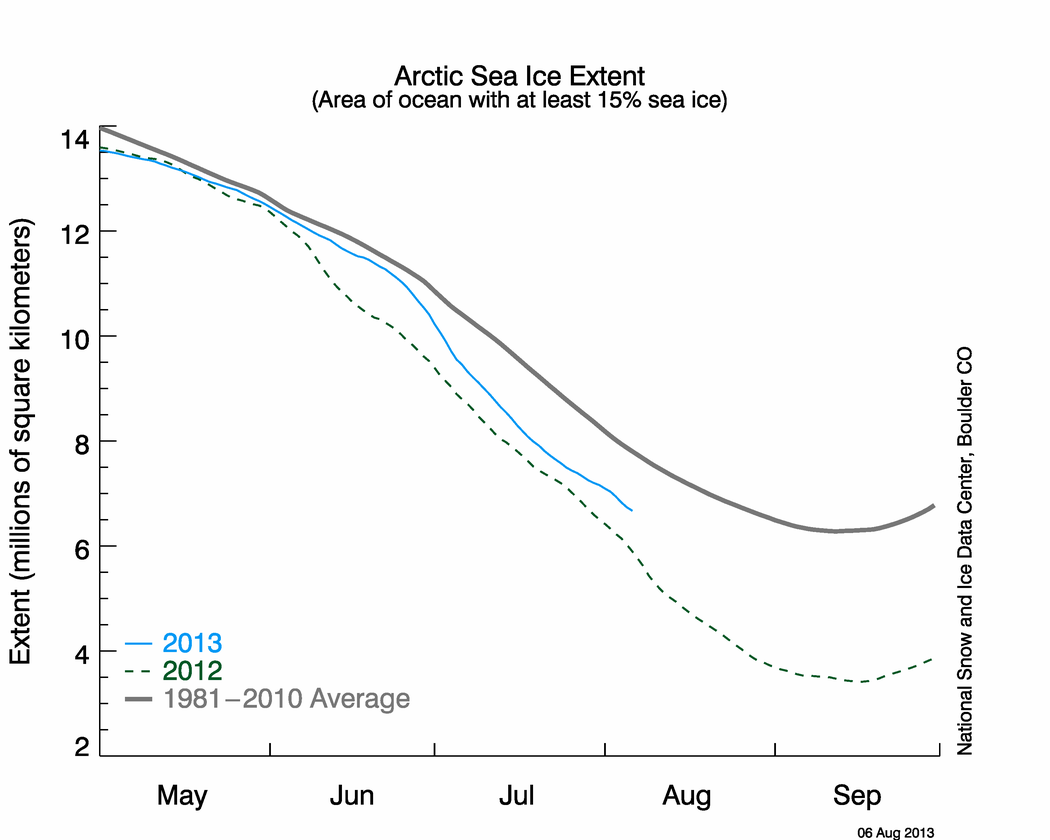
Since the melt season started, the Arctic has lost about one million km2 of sea ice. Below is a composite graph showing all of the popular (NSIDC, JAXA, NORSEX, DMI) extent measurements, superimposed on the NSIDC mean and two standard deviation region. The thin blue line is NSIDC extent from 2009. Note that all measurements have been nudging up against the mean line – for the entire month of April.


Disclaimer: All maps below are taken from NSIDC maps, and modified by the “breathtakingly ignorant” writers at WUWT.
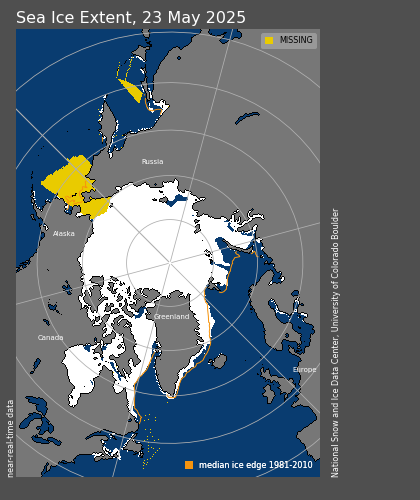
During the last three weeks ice has melted mainly at lower latitudes, as seen below in red. Areas in green have actually increased in extent, due to drift. Ice is probably still getting thicker in much of the Arctic, because temperatures remain well below freezing.

The map below shows changes over the past week.

And the map below shows changes since the same date in 2007. Green indicates ice growth.

The next map shows current areas of deficient ice (relative to the median) in red, and excess ice in green. The total amount of excess minus deficient ice is close to zero. In other words – Arctic ice extent is normal.

The Arctic Oscillation remains negative, so circulation is clockwise – as seen below in the buoy drift map. This pattern is keeping older, thicker ice from the Canadian side inside the Arctic Basin, and bodes well for another summer of increased ice thickness and extent – relative to the record melt of 2007.


http://iabp.apl.washington.edu/maps_daily_track-map.html
People counting on bad news from the Arctic to keep their agenda alive are staring at a long, (rhetorically) cold summer……. The good news is that they can keep raising the red flags about Montana glaciers, if the Arctic refuses to melt.
It has now been over 41 years since the New York Times headlined “Expert Says Arctic Ocean Will Soon Be an Open Sea.” triggering the Arctic Death Spiral. After 41 years of dangerous and increasing melt, ice area is again above normal.
My failure to understand this is surely a sign of “breathtaking ignorance.” But don’t call me Shirley.
Dave Wendt says:
April 28, 2010 at 1:08 pm
Phil. says:
Perhaps you are unfamiliar with Wootton, Pfister,& Forester 2008
http://www.pnas.org/content/105/48/18848.full.pdf+html
……..To me that would suggest, if ocean life forms were really unable to deal with 0.1 – 0.2 changes in PH, they would all have been on the extinction train long ago and the oceans would be as barren as the Attacama or the South Pole.
To them though their results suggested:
“Our results indicate that pH decline is proceeding at
a more rapid rate than previously predicted in some areas, and that
this decline has ecological consequences for near shore benthic
ecosystems.”
It seems an Earthquake just hit Katla, Iceland. The thing might very well blow of really soon…
http://poleshift.ning.com/profiles/blogs/katla-earthquake
rbateman says:
April 28, 2010 at 10:04 am
[Phil. says:
April 28, 2010 at 9:08 am
Ice has predominantly been flowing out of the Fram this year, see all that ice down the Eastern Greenland coast, that’s how it got there.]
“Yes, Phil, see all that sea ice down the Eastern Greenland coast in 1979 and 2010?
http://www.robertb.darkhorizons.org/TempGr/New%20Image.GIF
I don’t see what is so special about sea ice down the Eastern Greenland or Eastern Canadian coast.”
I like your 2007 vv 2010 Cryosphere chart Robert. This years sea ice looks much more solid than 2007 and there is a lot more of the white stuff on the surrounding land. And in the mean-time we still have a quiet sun.
It is going to take an awful lot of heat out of the sea and atmosphere to make a dent in that lot! I’m sure the polar ice caps play a big part in Earth’s air-conditioning system.
Pascvaks says:
April 28, 2010 at 11:45 am
“…Humans are capable of great achievements and, at the sametime, enormous mistakes and misjudgements…”
Precisely!!!!! Your post couldn’t have hit that nail on the head any more solidly. My sentiments exactly!
Phil
Where did you get 900 PPM for the Silurian? That number is low.
Nice link here – live volcano webcams from Iceland: http://www.volcanolive.com/volcanocams.html
Thankyou to the various respondents. My paleontology excursion belongs in a different thread and I am happy to be corrected on any false impressions.
On “global melting = global warming”. The vast majority of ice loss is due to melting, not sublimation etc. As has been noted, there is no “A” in the above statement. My point is that an individual season’s behaviour is interesting but not usually noteworthy regarding climate trends. This cuts both ways – ill-informed warmists have been known to become excitable over a single melt season… Nevertheless, a consistent downtrend necessarily implies new lows at some point. The steady rise in ocean heat content (whatever its cause) is a systemic factor working against summertime ice. Unless something changes new summertime lows are inevitable.
“The sea ice pack thawed to its second smallest size in 2008, followed by the third smallest in 2009.” Maybe 31’th smallest this year?
http://www.guardian.co.uk/environment/2010/apr/28/arctic-sea-ice-loss-warming
§.-)
Rotten ice and rotten data. There’s a nice symmetry there!
Typo. The vast majority of ice loss is due to “melting”, not sublimation etc. “Melting” should read “temperature increase”. (…and yes, phase change does not involve temperature change but rather energy absorption in this case…)
Ammonite said:
“The steady rise in ocean heat content (whatever its cause) is a systemic factor working against summertime ice. Unless something changes new summertime lows are inevitable…”
——–
Bingo. Most pertinent post of the day related to the longer term trend of sea ice…though Steve’s weekly blow-by-blow updates are enjoyable…
Positive feedback mechanism found occuring in the melting of arctic sea ice:
http://www.physorg.com/news191665797.html
But if you’d believe some posters…it’s all “the wind”…
Leif, loved the map.
By the way, your post reminds me of a funny story. I have a concealed weapons permit and own a “Windicator” 357 mag revolver (not easily concealed on a short lightweight elf but that’s another funny story). My American friends always ask about the name and wonder what it has to do with wind. Silly friends. The “w” is pronounced “v”. Puts a whole new meaning on the name of the gun, doesn’t it.
stevengoddard says:
April 28, 2010 at 10:17 am
Anu,
Mann loved tree rings, until 1960 when they stopped giving him the numbers he wanted.
Pre-1960 tree rings are good, but post 1960 tree rings are evil. Makes perfect sense form a scientific point of view, given the proliferation of mind-altering drugs which occurred in the 1960s.
Some higher latitude tree ring density data started to diverge from the thermometer measurements in the 1960’s and 1980’s – growth rates started being affected by more than the usual suspects.
But that’s a good hypothesis, drugs in the water 🙂
I’ve heard there are hundreds of chemicals that show up in trace amounts in typical city water supplies, and even in rainwater due to airborne pollutants. I’m sure scientists somewhere are looking into these mind-altered trees.
I myself prefer thermometers to tell me the temperature numbers I want – I think that’s how my car measures the outside temperature, but it might be using ice cores, lake sediments, or tree rings …
Pamela Gray says:
April 28, 2010 at 4:43 pm
By the way, your post reminds me of a funny story. I have a concealed weapons permit
This whole thing with ‘concealed weapons’ has almost been a complete mystery to me. What difference does concealment make? You need a permit to hide that you are carrying? but not one if you carry it openly, e.g in a very visible holster [ http://www.rustedfables.com/ ]. Makes no sense.
Ocean pH :
I am constantly amazed by discussions of a change in the second decimal place of pH due to warming when data clearly shows that the ocean goes through DAILY changes of 0.24 units or more. The pH at the Monterey Bay (Aquarium data( varies daily and has varied from 7.7 to 8.2 over the last 15 years with many seasonal ups and downs. It makes the “projected” 0.24 GW amount seem rather small.
http://pondside.uchicago.edu/ecol-evol/faculty/Wootton/pH.htm
http://www.seafriends.org.nz/issues/global/acid2.htm#how_acidic
Phil. says:
http://wattsupwiththat.com/2010/04/27/wuwt-sea-ice-news-2/#comment-379021
To them though their results suggested:
“Our results indicate that pH decline is proceeding at
a more rapid rate than previously predicted in some areas, and that
this decline has ecological consequences for near shore benthic
ecosystems.”
Damn, where’s Claude Rains when you need him? In rummaging about in this CC topic for many years now I’ve come to find that, when reviewing the multitude of papers I’ve been referred to, it pays to examine the data collected before wasting a lot of time on the conclusions offered. The number of those papers where the data fully supported the conclusions offered or where other possible conclusions have not been ignored has been incredibly small. You and this paper’s author’s may feel it’s correct to conclude that a couple of tenths of average PH decline will be catastrophically destructive for ocean species when their own measurements demonstrate that those species are subject to similar variability on a daily basis, I do not.
BTW, in my other rummages into ocean PH I came across several other papers which suggest that average ocean PH is not stable over time but, like almost every other natural phenomenon, is subject to cyclical variability, which suggests that the relationship between CO2 and PH is another where correlation does not prove causality.
Stephen Skinner says:
April 28, 2010 at 5:34 am
In the New York Times artcile the 2nd to last paragraph makes an interesting claim.
http://wattsupwiththat.files.wordpress.com/2008/07/nyt_arctic_77442757.pdf
“There is eveidence that the carbon dioxide content of the world’s air has risen from 10 to 15 percent…”
This seems a bit of an exaggeration. What happened to the general understanding of the proportions of the constituent parts of the atmosphere? Unless this is some journalistic transmogrification that happens.
The cited 1969 article said:
There is eveidence that the carbon dioxide content of the world’s air has risen from 10 to 15 percent during the last century.
This means that whatever “constituent part” of the atmosphere that CO2 comprised in 1869, that fraction had increased by 10 to 15 percent by 1969.
In 1969, CO2 was about 325 ppm:
http://commons.wikimedia.org/wiki/File:CO2-Mauna-Loa.png
Before the Industrial Revolution, CO2 comprised about 280 ppm of the atmosphere.
http://cdiac.ornl.gov/pns/current_ghg.html
From pre-1750 to 1969, that is 16% increase in “the carbon dioxide content of the world’s air”. I don’t have a figure for 1869, but if it was 295, then rising to 325 would be a bit more than 10%. If it was 290, that would be a 12% rise.
Data are reported as a dry air mole fraction defined as the number of molecules of carbon dioxide divided by the number of all molecules in air, including CO2 itself, after water vapor has been removed. The mole fraction is expressed as parts per million (ppm).
http://www.esrl.noaa.gov/gmd/ccgg/trends/co2_data_mlo.html
BTW, the CO2 now stands at about 390 ppm: this is a 39.3% increase in “the carbon dioxide content of the world’s air” since the Industrial Revolution. The CO2 has gone up by another 65 ppm since that 1969 article.
Anu
How did tree rings and thermometers correlate during the 14th Century?
Ammonite
Is the “steady rise” in ocean temperatures responsible for the return to above average ice area?
David Ball says:
how on earth do you reach that conclusion from what I wrote? I am talking about circulation patterns, and the fact that even though ice extent is near normal this year (which it also was the last 2 winters), that it not a complete picture. Please, pay attention.
The weapon is for personal protection. In some places, you are not allowed to carry openly, or loaded in your car. I agree with you regarding concealed or open. I wish open carry were the rule everywhere.
It isn’t for status. I take gun safety classes regularly (twice in 5 years with one of those classes at a police officers’ protection/gun safety range) and go to the range (just did so last week) often to keep my shooting and gun safety skills sharp. I shot a high powered rifle, a mauser, a 9 mil, and my revolver. Out of the 3 men I was with, I was the one that shot the clay (it was loaded with plastics so it really went boom and blew up the stump it was attached to) using a rifle with a laser scope. As a single woman, I will not be anyone’s target.
stevengoddard says:
April 28, 2010 at 2:46 pm
Phil
Where did you get 900 PPM for the Silurian? That number is low.
Marine Sciences Group, University of California Berkeley, where do you get your number from, it’s high?
Just one more comment then I will get back to weather and climate. In Oregon, if you have a loaded weapon in the car, it must be out in the open or securely placed in a case, unless you have a concealed weapons permit. Keeping a loaded weapon visible in your car and ready for use, with the car locked or not, is an open invitation to a broken window and having your gun stolen.
http://www.usacarry.com/
All the Silurian CO2 estimates are in the 4,000 to 5,000 ppm range.
—————-
The ice thickness/volume figures linked above many times from the Polar Ice Centre must contain significant mathematical errors.
There is a seasonal pattern in the average volume (which must equal Area times Average Ice Thickness) which they show as:
http://psc.apl.washington.edu/ArcticSeaiceVolume/images/PIOMAS_daily_mean.png
The September Ice Area is here:
ftp://sidads.colorado.edu/DATASETS/NOAA/G02135/Sep/N_09_area.txt
The April Ice Area is here:
ftp://sidads.colorado.edu/DATASETS/NOAA/G02135/Apr/N_04_area.txt
Which results in the following ice thickness calculations for 1988 versus 2009:
Apr 1988: 2.47M
Sep 1988: 3.49M
Apr 2009: 1.71M
Sep 2009: 1.75M
Sorry, those numbers cannot be right and all we have is another computer model gone astray and the scientists don’t bother to double-check their findings because they like what the fake graph shows.