Guest Post by Steven Goddard
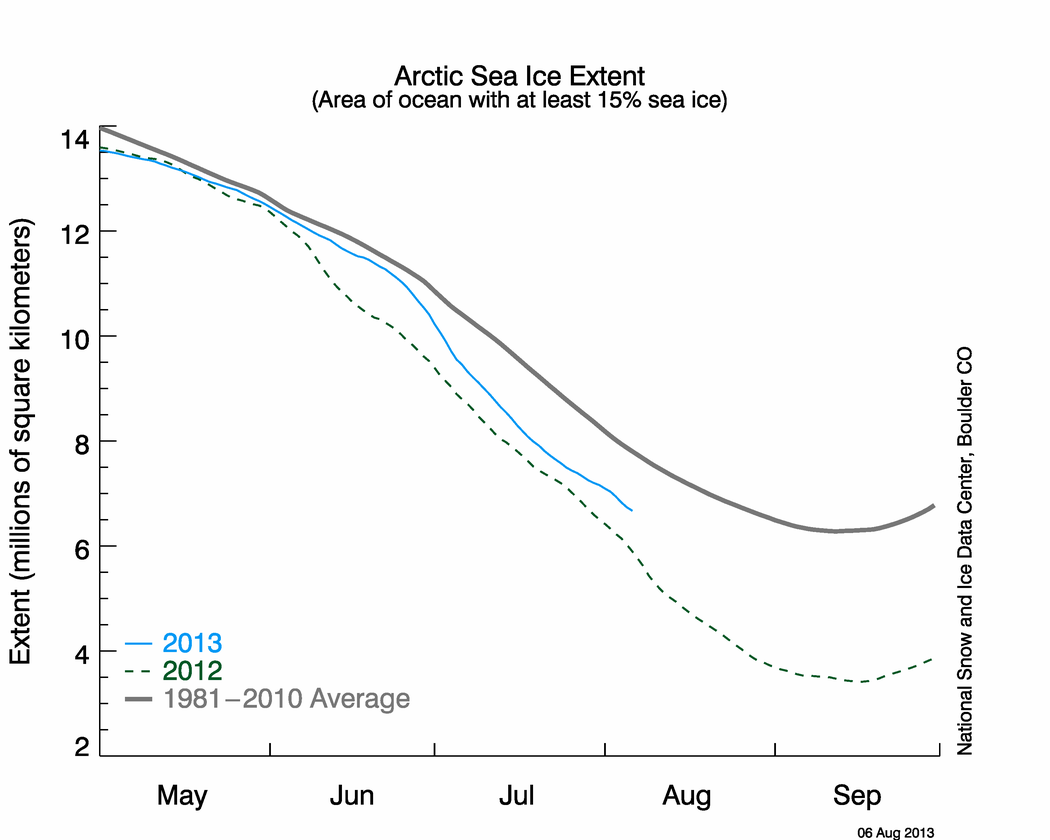
We are all aware that Arctic ice extent has increased over the last two months, and is now about one million km2 larger than it was in 2007. But where has the ice growth occurred? I generated an image which makes this easy to visualize.

http://nsidc.org/data/seaice_index/images/daily_images/N_timeseries.png
In the composite image I prepared below, green colors represent 2010 ice that was not present in 2007, and red colors show where 2007 ice existed on this date but is not currently present.

A couple of interesting items.
- There is excess ice in the Baltic Sea, due to the cold winter there.
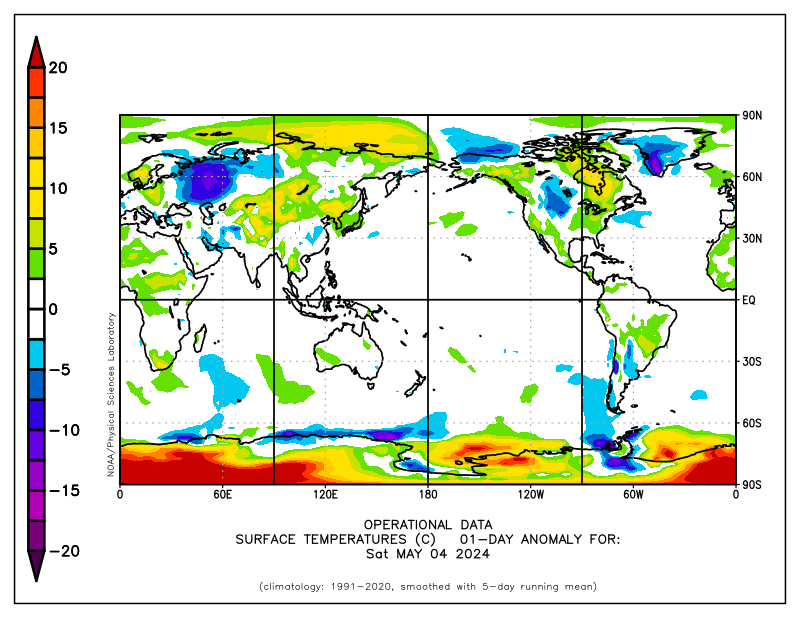
- There has been a lot of cold air over the Bering Sea and Sea of Okhotsk (as seen below) causing excess ice on the Pacific side.

http://www.esrl.noaa.gov/psd/map/ANIM/sfctmpmer_01a.fnl.25.gif
David Alan Evans (18:33:26)
The poles get very little of their energy from the sun. In part this is because of the factor that you mention, the low sun angle. This reduces the maximum sunlight at the poles to Cos(23.45) = 40% of full sun. However, there are other factors at work as well. The sunlight has to go through a much longer atmospheric path due to the low angle. In addition, ocean albedo jumps dramatically at low sun angles, the same factor that lead to the bright reflection from the sea in the late afternoon. This is also true to a lesser degree of the ground. Finally, at low sun angles tall clouds shade much more of the earth than at low sun angles, because their sides cast long shadows.
This is why I have focused on the areas near the equator in my thermostat hypothesis. The majority of the solar energy entering the planetary climate system strikes the tropics and subtropics. Control of the incoming energy there by variable clouds controls the overall energy of the system.
w.
(PS – As an aside, many people think that because of the months when the sun never rises the polar regions get fewer hours of sunlight than the tropics. Not true, all parts of the earth get the same number of hours of sunlight per year. But I digress …)
R. Gates,
“Just for an update: According the IJIS/Jaxa, the Arctic sea ice is now below where it was in 2003 on this date, April 11, and we’ve dropped over 450,000 sq. km since the peak on March 3.”
OMG, it’s worse than we thought!
R. Gates (12:15:20) :
Steve,
What are those “real” issues you’re referring to?
How about Millions of people starving, still without running water, living in slums and off rubbish sites (India in particular) while the world spends billions on Arms, Fighting and Carbon Trading and Space Craft, just for a start.
John from CA (13:05:02) : “How do they know its thin?”
I expect they have been up there measuring with Micrometers. sarcasm off
NicL (13:36:59) : We all know that 3 years is no time in terms of “Climate”, these Threads are in response to warmist statements like “Accelerating Artic Ice Loss”, “Arctic ice in death spiral” etc. Most of which was based on the dramatic Artic Ice reduction in 2007 which was caused by Water Temperatures & Flow and Wind Speed & Direction BUT blamed on AGW.
Pascvaks (16:24:13) : Sorry common sense, real world observations are not allowed in Climate Research, only Computer Models. Sarcasm off.
John of Cloverdale WA (17:31:32) : “Following their narrow escape from the crack in the sea ice that threatened to swallow up them and the tent, they now find themselves effectively marooned on an island of ice, unable to travel in any direction due to surrounding ice that’s too thin to walk across but too thick to swim through.”
I would like to see that team SWIM in those conditions with all their gear even if there was absolutely no ice. Polar Bears & Seals can and maybe one or two very special people, but the average person would be dead in no time.
R. Gates (20:16:33) :
Just for an update: According the IJIS/Jaxa, the Arctic sea ice is now below where it was in 2003 on this date, April 11, and we’ve dropped over 450,000 sq. km since the peak on March 31.
Yep! And by July the sea ice will have dropped another 6 million square kilometers! At this rate…
It seems you are not interested at all in learning something, except spinning your head around and repeating a tiresome ‘The Ice Is Melting!’ mantra.
Simply, here we have some observations – you know, that are actually happening and are measured – that do not seem to fit with the AGW hypothesis. These aren’t statements that directly state AGW or any global warming isn’t occurring, but that the evidence that is used to promote AGW is on thin ice.
*tap*tap*tap*
*whuf*whuf*
Is this thing on?
A couple of questions (because I am troll-like and enouy asking them, even though nobody will ever answer them.
1. Does ice melt (or even sublimate) at minus 34 degrees C? (That’s -29 in real temperature–I guess we can still line-dry clothes here at that temperature–not sure. I’ll have to go read “Little House On The Prairie” again.)
2. Why won’t anybody produce (or show me how to produce the http://climateinsiders.files.wordpress.com/2010/04/n_timeseries_4_10_2010.png
graph with the average for 1979-2009 plotted? What is being hidden?
3. (hmmmm…..bonus?) How much is it going to cost this time to fetch those idiots back off the ice?
4. (I’ve got a counting problem, don’t I?) How much oil and fuel are they going to abandon to the ecosystem this year?
R. Gates (20:16:33) :
“Just for an update: According the IJIS/Jaxa, the Arctic sea ice is now below where it was in 2003 on this date, April 11, and we’ve dropped over 450,000 sq. km since the peak on March 31.”
What? 2007 wasn’t good enough for you?
Oh my God, it changed! We’re all going to die!
(Dave Johnson, that was funny!)
Lewis Pugh swimming in the Arctic
http://www.digitaltrainer.ca/blog/wp-content/uploads/2009/10/Lewis+Pugh+Swimming-300×219.jpg
Larry Sheldon (08:06:14) :
*tap*tap*tap*
*whuf*whuf*
Is this thing on?
A couple of questions (because I am troll-like and enouy asking them, even though nobody will ever answer them.
1. Does ice melt (or even sublimate) at minus 34 degrees C? (That’s -29 in real temperature–I guess we can still line-dry clothes here at that temperature–not sure. I’ll have to go read “Little House On The Prairie” again.)
Yes depending on the humidity it will sublimate.
2. Why won’t anybody produce (or show me how to produce the http://climateinsiders.files.wordpress.com/2010/04/n_timeseries_4_10_2010.png
graph with the average for 1979-2009 plotted? What is being hidden?
Nothing, you could try here:
http://iup.physik.uni-bremen.de:8084/amsr/ice_ext_n.png
3. (hmmmm…..bonus?) How much is it going to cost this time to fetch those idiots back off the ice?
Cost of a helicopter ride I guess, like the young kid. They and their sponsors will presumably pay so it won’t cost you or I anything.
4. (I’ve got a counting problem, don’t I?) How much oil and fuel are they going to abandon to the ecosystem this year?
Hopefully the same as last time, i.e. none.
“”” lazor (12:37:53) :
Maybe you all should go back to basic math classes and learn the difference between surface area and volume.
REPLY: Maybe you should learn not to jump to conclusions. “””
When it comes to tipping points; the arctic ice tipping point we are told, is when an ice surface, that is highly reflective, white, high albedo, gets replaced by a water surface that is black, low albedo, so the positive feedback of that effect melts even more ice; and its tip tip hooray !
Last time I checked the difference between a water surface, and an ice surface, is how much area of each there is. It (the ice) could go all the way to the bottom, and it still would look white on top.
So I would think tipping is more about area than volume, since a large chunk of the area melts every year, and is regrown next fall and winter.
George E. Smith (10:49:12) :
The elevation of the sun in most the Arctic is always less than the critical angle of the air/water interface, so don’t expect a lot of solar energy to enter the ocean. However, the ice cap insulates warmer water underneath and keeps heat from moving out of the ocean.
So what is the net feedback from declining Arctic ice?
“”” Steve Goddard (12:48:47) :
George E. Smith (10:49:12) :
The elevation of the sun in most the Arctic is always less than the critical angle of the air/water interface, so don’t expect a lot of solar energy to enter the ocean. However, the ice cap insulates warmer water underneath and keeps heat from moving out of the ocean.
So what is the net feedback from declining Arctic ice? “””
Steve, when light travels from a low index medium such as air, where the group velocity is almost (c) into a denser medium, such as water, where the group velocity of light is about c/1.333; 1.333 being the refractive index of water, Snells law applies so Na.sine theta (a) = Nw.sine theta(w), and there is a solution for theta (w) for any angle theta(a) up to and including 90 degrees.
So even for grazing incidence (theta (a) = 90) the light can eneter the water, and inside the water, it lies in a cone with a half angle of arcsine (Na/Nw) which is about 48.6 degrees.
The critical angle which leads to Total Internal Reflection, only applies to passage from the higher index medium (water) to teh lower index medium (air.
I’m sure if you have ever gone scuba diving, and sat on the bottom looking up fish style, you will relaize that t you can see the entire space above the water from horizon to horizon, compressed inside that 46 deg cone.
Outside that cone, you get TIR, and you see a reflection of the bottom (if you are in shallow enough water).
The ocean can accept light from any angle up to grazing incidence BUT the reflection coefficient rmains low for incidence anlges (from the normal) up to the Brewster angle which is arctan (Nw/Na) o0r 53.1 deg.
At that angle; 36.9 above the surface, the reflected light is plane polarized perpendicular to the plane of incidence (electric vector), but the reflection coefficient for the surviving polarization has about doubled so the reflection coefficient hasn’t changed much; but once you go beyond the Brewster angle (less than 36.9 deg above the surface, the reflection coefficient climbs rapidly towards one.
I agree with you that close to grazing incidence, the reflectance is high, but some light is still transmitted into the water, even though at low intensity.
George E. Smith (17:15:18) :
“so don’t expect a lot of solar energy to enter the ocean”
So is the answer then, that given the low sun-angle, not much energy is transferred to the water in any case and it therefore it doesn’t much matter if there is any ice there or not?
“How much oil and fuel are they going to abandon to the ecosystem this year?
Hopefully the same as last time, i.e. none.”
OK. When and whare was it that they had to establish several fuel-caches, most (all?) of which were abandoned in the effort to retrieve them and their gear in fixed-wing aircraft?
Steve Goddard (12:48:47) :
George E. Smith (10:49:12) :
The elevation of the sun in most the Arctic is always less than the critical angle of the air/water interface, so don’t expect a lot of solar energy to enter the ocean.
What ‘critical’ angle? Do you mean the Brewster angle?
Larry Sheldon (18:21:08) :
“How much oil and fuel are they going to abandon to the ecosystem this year?
Hopefully the same as last time, i.e. none.”
OK. When and whare was it that they had to establish several fuel-caches, most (all?) of which were abandoned in the effort to retrieve them and their gear in fixed-wing aircraft?
Didn’t happen, their air support, Kenn Borek Air Ltd., was responsible for the fuel caches (they operate permanently in the Arctic) and retrieved them.
Glad to hear that. Interesting that nobody (that I read) mentioned that.
I was sure that some or all of it was said to have been lost.
Also interesting tat there was enough ice to allow that.
“”” Phil. (18:44:32) :
Steve Goddard (12:48:47) :
George E. Smith (10:49:12) :
The elevation of the sun in most the Arctic is always less than the critical angle of the air/water interface, so don’t expect a lot of solar energy to enter the ocean.
What ‘critical’ angle? Do you mean the Brewster angle? “””
In the interest of clarification, Phil; The wording above was Steve’s response to me; it was not his cut and paste of a statement by me.
The critical angle is of no consequence for refraction going from the low index medium, to the high index medium; as far as the TIR phenomenon is concerned, and at really low sun angles, the Brewster angle phenomenon, doesn’t stop reflection; but it does make the two reflected polarisations quite different in amplitude, until grazing incidence.
I just don’t think much of the ice is ever flat enough to get grazing incidence reflection off the ice though.
George E. Smith (10:08:03) :
“”” Phil. (18:44:32) :
Steve Goddard (12:48:47) :
George E. Smith (10:49:12) :
The elevation of the sun in most the Arctic is always less than the critical angle of the air/water interface, so don’t expect a lot of solar energy to enter the ocean.
What ‘critical’ angle? Do you mean the Brewster angle? “””
In the interest of clarification, Phil; The wording above was Steve’s response to me; it was not his cut and paste of a statement by me.
The critical angle is of no consequence for refraction going from the low index medium, to the high index medium; as far as the TIR phenomenon is concerned, and at really low sun angles, the Brewster angle phenomenon, doesn’t stop reflection; but it does make the two reflected polarisations quite different in amplitude, until grazing incidence.
Exactly, which is why I was trying to clarify what was meant because the term made no sense to me in that context.
I just don’t think much of the ice is ever flat enough to get grazing incidence reflection off the ice though.
I doubt whether the open ocean water is either.
Quoting: Dave Springer (12:23:46) :
“There’s thought to be a lot of currently inaccessable, unknown size oil fields under the ice. ”
Commenting:
There are known (and ice-free) oil reserves off California, Alaska and Florida that are being forbidden. What makes unknow, icy oilfields more attractive?…or less likely to be off-limits?
Mike D. (17:56:54) :
$100 billion wasted on global warming alarmism, and the alarmists have the temerity to query, “What are the real issues?”.
Please, let’s be honest and also look at the proportions:
– US deficit 12 000 billion, spent on wars, tax cuts for affluent people
and rescuing large-scale gamblers
– US reseach budget/year, something like 380 billion, with defense
and health research dominating, very little on energy research,
climate reseach? – i don’t know, but if the gobal total over a longer
period is100 billion – it can’t be much per year in USA, in proportion
to figures mentioned above.
Further, given that science must advance, increasing shares of the
reserach budget should go to integrative research at system level –
how can we bypass the earth and climate system in that setting?
Note that the category in statistics is ‘climate reseach’ not ‘AGW
theory supporting research’. I suppose sceptics would argue that in practice the categories are identical. I don’t think so, but I will not
go into that argument here – the main point is that the illusion
sceptics want to propagate of ‘enormous sums being spent’ does
not hold.
Mike, I am prepared to believe that you care for the ‘real issues’
you mention, but taken as a whole: the sceptic side argument against
climate change mitigation policies is mostly, ‘don’t raise our taxes’.
To give an impression that 100 billion is ready and earmarked for
sending, to alleviate the real issues you mention, only the bad AGW
guys now want to knick it, is not honest.